

We charge the debt. We look at the thousands of billions accumulated in the United States, France, Italy, elsewhere in Europe, and we wonder how far this can go.
But debt is not illness. She’s the symptom.
The disease is the budget deficit that has become permanent.
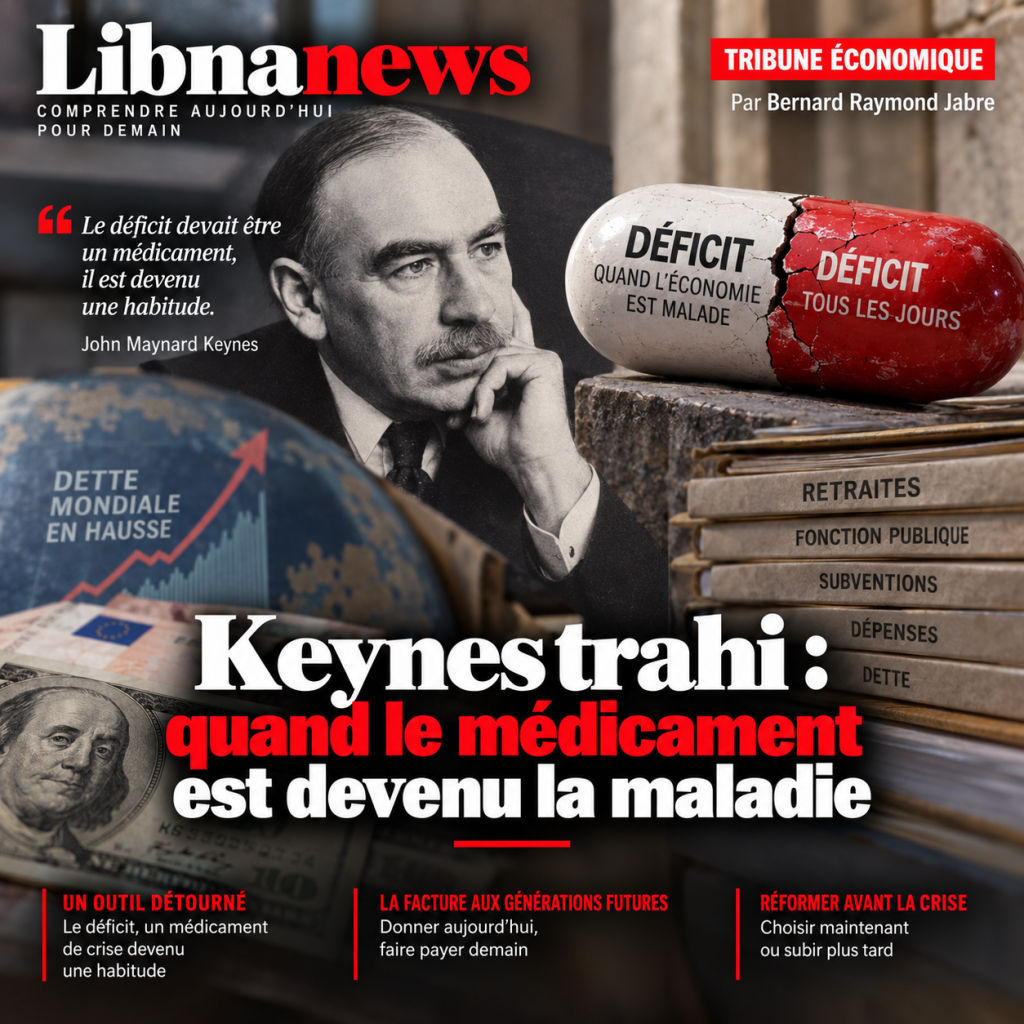
We have to get back to Keynes. John Maynard Keynes never imagined deficit as a normal and eternal way of governing. His reasoning was first that of the cycle. When the economy collapses, private investment disappears, unemployment rises and fear paralyses businesses and households, the state must take over. He spends, invests, temporarily accepts the deficit. Monetary policy can also become accommodative.
It was a medicine.
An economic antibiotic when an organism is ill.
The problem is that we ended up taking the antibiotic every day.
The deficit, which had to respond to the bad years, has settled into the good ones. It no longer finances only wars, recessions, major investments or disasters. It also finances the day-to-day functioning of the State: administrations, pensions, social benefits, defence, subsidies, bureaucracies and sometimes structures whose costs are not really at stake.
And since it is necessary to finance the difference between what the state spends and what it collects, it borrows.
The mechanics are almost childish simplicity:
deficit, debt, interest, new deficit, new debt.
For a long time, it works. It’s even politically wonderful.
Debt makes it possible to give today without immediately levying the corresponding price. It allows the elector present to be satisfied by sending part of the invoice to the future elector.
It is here that Keynes encounters a problem which he was not intended to solve: that of democratic time.
Four years against forty years
The debt is thought of over twenty, thirty or forty years. A government is thinking about the next election.
In the United States, four years separate two presidential elections and, in the middle, the midterms are already reminding the government that he will be tried. In Europe, the mechanics are different but the constraint remains the same: why today bear the political cost of a reform whose benefits may appear under the next government?
Reducing an expense immediately creates a discontent. Removing administration immediately causes resistance. Reforming a pension immediately sends people down the street.
On the other hand, borrowing makes almost no noise.
Perhaps this is the real fault of the public debt: it separates the expenditure politically from its payment.
Gradually, each one defends his state piece. The ministry defends its budget, the administration its staff, the beneficiary its advantage, the political leader its electorate. All this is human. All this is even rational taken separately.
But the addition of all these rational behaviors can become collectively irrational.
Nobody wants to sacrifice themselves. Then we borrow.
When the debt finances the present
Not all debts are worth.
A State that borrows to build productive infrastructure transmits to the next generation a debt, of course, but also an asset.
A state that borrows to go through a depression may avoid the collapse of its economy.
But when a state borrows year after year simply to pay for its lifestyle, the nature of the debt changes.
The next generation receives the invoice without necessarily receiving the corresponding asset.
It is this distinction between investment debt and consumer debt that we have gradually lost.
And U.S. figures are beginning to become worrying. The Congressional Budget Office estimates the U.S. federal deficit at approximately $1,900 billion in 2026, or almost 5.8% of GDP. Public debt stands at around 101% of GDP and, in the current CBO projections, would continue to grow strongly in the following decades.
The most important is not the figure itself. It’s the trajectory.
There is no magic figure — 100%, 120% or 150% of GDP — from which a country would automatically fail. Japan is sufficient to prove otherwise.
The real question is much simpler: is debt growing faster than the economy’s ability to serve it?
If the answer is yes, sooner or later the problem appears.
Lebanon should have taught us something
Unfortunately, we Lebanese know the end of this story.
This obviously does not mean that the United States or France are Lebanon. Economic structures, currencies, institutions and financing capacity are incomparable.
But Lebanon teaches us something more universal.
A debt crisis does not start on the day of default.
It begins long before, when everyone knows that the model needs to be reformed but everyone prefers to win another year.
Then we borrow to avoid sacrifice. Then one borrows again because the first loan precisely avoided sacrifice.
And the success of financing is paradoxically becoming proof that we can continue.
Until the moment when the one who lends begins to doubt.
Then the market doesn’t necessarily say, « I don’t lend you anymore. » He starts by saying, « I lend you, but more expensive. »
And that’s where mechanics become dangerous.
More debt leads to more interest. More interest increases the deficit. The deficit requires more debt.
Debt is starting to make up its own debt.
The sacrifice chosen or the sacrifice suffered
The cost of the Western State must therefore be restructured.
The word « restructuring » does not mean demolishing the social state, abandoning the weakest or abolishing essential public services.
It means choosing.
What is indispensable? What’s not anymore? Which administrations can be merged? What privileges have become unjustifiable? What spending is planning the future and which are only used to maintain the present? Where can technology replace administrative structures that have become too cumbersome?
And above all: would we accept certain public spending if we were to pay them immediately by tax rather than discreetly by debt?
It is time, to use an old French expression, to degrease the mammoth.
Not to have a weak state. On the contrary.
To find a state strong enough to be able to intervene massively when the next real crisis comes.
For if we spend our budget munitions constantly, what will remain when the next 1929, the next 2008, the next pandemic or another crisis that no one has foreseen?
That’s exactly where Keynes was betrayed.
We kept her medication but forgot her diagnosis.
The deficit had to be countercyclical. It has become structural.
The exception has become the rule.
And the tool to save the economy on bad days is now too often used to avoid difficult choices on ordinary days.
So debt is not our real enemy. Debt is a tool.
The danger begins when a society ends up believing that this tool helps to abolish sacrifice.
Because we can postpone an expense. We can refinance a debt. We can lower an interest rate. We can borrow a few more years.
But we cannot abolish arithmetic.
And history almost always presents the same choice to nations:
make the necessary sacrifices when they can still choose them, or suffer them later when they will no longer have the choice.
Bernard Raymond Jabre





Comments