

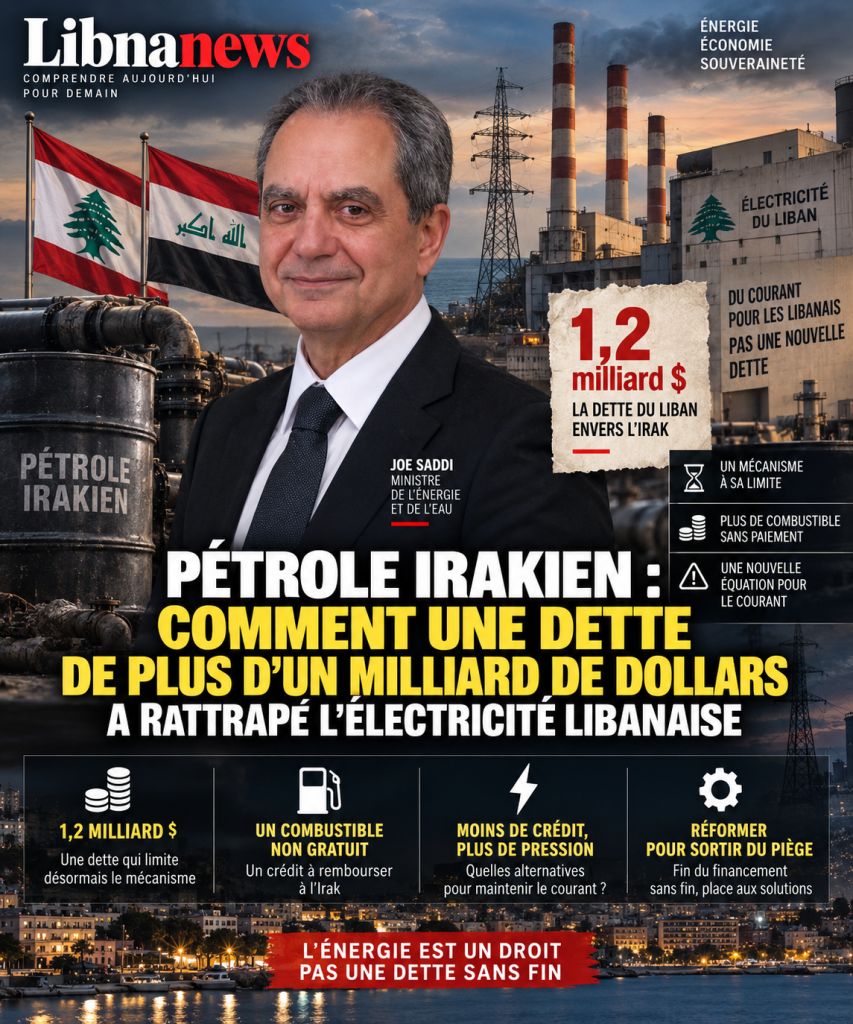
The mechanism to guarantee a minimum of current reached its limit
The Iraqi fuel file alone summarizes much of the contradictions in the Lebanese electricity sector. The mechanism had enabled Electricity in Lebanon to dispose of quantities of fuel oil when the State could no longer finance its imports as before the crisis. It therefore played the role of a safety net: to avoid complete shutdown of power plants and to maintain a minimum level of power supply. But this system was not a gift. Lebanon was required to credit the value of the fuel to the Iraqi State in an account opened at the Bank of Lebanon, while Baghdad could use these amounts to obtain Lebanese goods and services. In other words, the electricity consumed in Lebanon created a financial obligation, even if the payment did not take the classical form of an immediate foreign exchange transfer to Iraq.
It was precisely this obligation that ended up catching up. Joe Saddi reported in September that the debt to Iraq was about $1.2 billion. Other data available around the same file placed the cumulative invoice at approximately $1.25 billion. The difference between the two figures is due to the timing of the calculation and the amounts recorded, but the order of magnitude is clear: more than $1 billion in fuel had been provided without Lebanon actually paying the full amount due under the mechanism. The problem was therefore no longer simply to renew a diplomatic agreement with Baghdad. A much simpler question had to be answered: how can we continue to draw on a credit line when the accumulated backlog becomes itself a political and financial risk?
Iraqi fuel was not free
The confusion surrounding the mechanism has long facilitated its political treatment. In the public debate, the expression « Iraqi oil » sometimes gave the impression of energy aid being offered in Lebanon. The device was more complex. Iraq provided heavy fuel oil. Since this product was not directly adapted to all the needs of Lebanese power plants, it had to be exchanged for products compatible with the electricity facilities in Lebanon. Lebanon, for its part, had to credit an account to the Iraqi state. Baghdad could then use this account to acquire services in Lebanon. The flexibility of the mechanism allowed for the circumvention of some of the shortage of immediate currencies, but it never removed the debt.
This distinction is essential to understand why Joe Saddi eventually decided not to use the credit under the contract. Continuing to withdraw quantities without clearing the arrears was tantamount to increasing a debt that the department could not claim to ignore. Iraq had agreed to give Lebanon time. The information available during the summer even indicated that Baghdad remained willing to wait after the changes in its executive. But the supplier’s patience is not a financing model. As the invoices accumulated, the mechanism that had been used as an emergency solution became an additional public debt whose terms of settlement remained uncertain.
Why Joe Saddi chose to stop shooting at the credit
The decision to suspend the use of the mechanism did not mean that Lebanon no longer needed fuel. On the contrary, it reflected a financial constraint. The information available indicates that the contract had been renewed on several occasions and that an extension had still preserved the quantities necessary for the minimum production. But the minister chose not to withdraw from the appropriation due to the accumulation of invoices. This decision may seem paradoxical in a country where each shipment counts. However, it responds to a management logic: a department cannot present as a sustainable resource a supply that it cannot pay for.
However, the choice immediately transfers the pressure to other sources of supply. If the Iraqi fuel is no longer used under the same conditions, it is necessary to buy elsewhere, obtain new facilities, find donations or reduce production. However, each of these options has a cost. A commercial purchase requires available financing and rapid banking procedures. Foreign aid depends on an external political decision. A reduction in production increases the use of private generators. The suspension of the Iraqi mechanism therefore does not solve the electrical problem; It only prevents a debt-financed solution from continuing to mask the lack of resources.
A billion debt, but also a liquidity problem in Beirut
The Iraqi case reveals another weakness: the difference between Lebanon’s theoretical electricity revenues and the money actually mobilized to buy fuel. The public establishment charges electricity, collects revenue and has claims on governments, public institutions and other consumers. However, the immediate availability of import funds remains a problem. A parliamentary committee has also recently called for the State’s administrations and institutions to settle their arrears in electricity in Lebanon and for the Bank of Lebanon to transfer the amounts due to the bank account of the institution. The issue of fuel is therefore linked to the full cash chain: invoice, collect, transfer, convert and pay.
The political debate has become particularly aggressive on this point. The Free Patriotic Current accuses Joe Saddi of having used about $700 million from the availability of electricity in Lebanon without obtaining a corresponding improvement in food. At the same time, he claims that public institutions owe approximately $300 million to the institution. These figures and readings are the political accusation of the party and cannot be presented as an independent audit. They nevertheless highlight the problem that no one really challenges: Electricity in Lebanon needs effective and regular revenues. An accounting claim on an administration does not allow for the payment of a cargo if the money is not transferred on time.
The return of the old trap: buy fuel oil before repairing the system
For decades, the response to electricity shortages in Lebanon has often begun with the search for fuel. This logic is understandable in the short term: without oil, a power plant does not produce. It becomes dangerous when it replaces system reform. Joe Saddi himself recalls that previous governments borrowed nearly $1 billion a year from the Treasury to finance the sector and that over $20 billion has been absorbed over the years. Its stated objective is precisely to avoid a return to this model in which the state borrows to burn fuel without correcting losses, low collection, production deficits and the absence of modern investments.
The Iraqi contract had rejected this problem without removing it. It allowed fuel to be received without immediate conventional disbursement, but debt accumulated elsewhere. A payment facility can give time for reform; it cannot substitute for it. If production remains insufficient, if technical and non-technical losses persist and if revenues do not follow the actual cost of the service, each new shipment will only delay the time when the deviation will have to be paid. It is this logic that the ministry is now seeking to break, at the risk of causing a short-term supply crisis.
Zahrani and Deir Ammar on one side, Zuk and Jiyeh on the other
The problem is not just financial. It’s also technical. Not all Lebanese power plants operate with the same fuel. The information available around the Iraqi mechanism indicates that the Ministry is working to replace certain quantities of heavy fuel oil with diesel oil, especially for the Zahrani and Deir Ammar power stations, while the heavy fuel oil remains suitable for the Zuk and Jiyeh installations. This diversity complicates supply. The country cannot buy any product and inject into any plant. Each solution must correspond to the technical characteristics of production units and storage possibilities.
This constraint also explains the historical use of Iraqi oil exchange operations. The product provided by Baghdad was to be converted commercially into fuel compatible with Lebanese needs. The system therefore added a step between the supplier and the plant. At each stage there are risks: price, availability of ships, tendering procedures, financing, opening of documentary credits and delivery times. When reserves are low, administrative or banking delays can quickly result in a decrease in the number of hours of current. Energy security then depends less on the nominal capacity of the plants than on the fluidity of the entire purchasing chain.
Bank of Lebanon no longer wants to become the sector’s ATM
The current crisis is taking place in a very different monetary environment than the one that allowed the former electricity deficits in Lebanon. Governor Karim Suaid defends a line based on the independence of the Bank of Lebanon and the refusal of automatic financing of public deficits. He recalled that the central bank should be able to say no to excessive debt, to the monetary financing of the deficit and to advances without a precise framework. This doctrine directly affects the electrical sector. For years, deficits could be transferred to the Consolidated Revenue Fund and, directly or indirectly, to the financial system. After the bank collapse, this path is politically and financially much more difficult to reproduce.
This forces the government to face the real cost of electricity. If electricity in Lebanon does not have enough revenue to buy its fuel, only three options exist: to increase or improve revenues, to obtain an explicit budget resource or to reduce expenditure and thus potentially production. Opaque financing by accumulation of arrears only creates a fourth fictional solution. Iraqi debt shows exactly where this method is going. The fuel was consumed, the current was produced, but the financial obligation remains. It must be settled by the State, compensated by services or renegotiated with Baghdad.
The global energy crisis removed the remaining margin
The problem becomes even more difficult with the rise in energy prices caused by regional tensions and disruptions of supply roads. Lebanon must now replace or supplement an Iraqi facility at a time when oil products are more expensive and logistical risks are increasing. This combination explains the current battle over taxes, tariffs and funding. Joe Saddi argues that the government must make quick decisions in order to avoid the global shock being fully transferred to the consumer. Its withdrawal from the meetings of the Council of Ministers is part of this broader confrontation.
Increased fuel costs have a multiplier effect in Lebanon. A reduction in public production does not reduce the demand for electricity. It shifts this demand to private generators, which are themselves powered by oil products whose prices are rising. The household then pays twice the fragility of the system: less public electricity and more expensive private electricity. Therefore, the only comparison between the cost of a cargo and the resources of Electricity in Lebanon is insufficient. It is also necessary to calculate the cost to the economy of each hour of public power which disappears.
Iraq’s Paradox: An Electric Debt at the Time of Consideration of a New Oil Corridor
The paradox is particularly striking because Lebanon and Iraq are also working on a much more ambitious project. During the summer, the government of Nawaf Salam prepared the conditions for Lebanon to become, in a first phase, a storage and re-export platform for Iraqi crude oil and petroleum products. Discussions focused on the roads necessary for the passage of tankers, the preparation of border crossings, storage facilities, security and customs procedures. Other work suggests the prospect of reactivating the historical axis linking Iraqi oil to the Mediterranean via Syria and Tripoli.
The contrast is striking. On the one hand, Beirut wants to become a Mediterranean gateway to Iraqi energy. On the other hand, it still has to pay more than one billion dollars accumulated in the mechanism that enabled it to supply its own power plants. Both files are not legally identical and should not be confused. But their coexistence raises a question of credibility. To build a long-term energy relationship with Baghdad, Lebanon must demonstrate that it can honour existing mechanisms, secure payments and provide an administration capable of managing much larger flows.
The real choice: less debt today or less current tomorrow
The decision to stop shooting at Iraqi credit can be defended as a measure of financial discipline. It avoids increasing an already considerable debt. But it only becomes a reform if a lasting solution takes over. Without new resources, improved collection and diversification of supplies, financial discipline simply translates into less fuel. Less fuel means less production and more generators. The government therefore finds itself facing a particularly brutal arbitration: not to start over the debt that ruined the sector, while preventing a break with the old model from causing an immediate collapse of food.
The output goes through several folders that must move forward at the same time. Public administrations must pay what they owe to Electricity in Lebanon. Financial transfers must become regular. Losses and illegal connections must be reduced. Pricing must be realistic enough to cover a substantial part of the costs without making the service inaccessible. The regulatory authority shall function. The private investments announced must produce new capacity. Finally, plants must gradually emerge from a model based on expensive fuels and old units. As long as only one of these elements is missing, Lebanon remains vulnerable to the next delayed shipment.
An old bill now a test for the new energy policy
The billion due to Iraq is therefore not an isolated anomaly. It is the logical result of a system that used an external facility to compensate for the lack of sustainable domestic financing. Baghdad provided time and fuel. Lebanon obtained hours of power. But the cost did not disappear. It has accumulated as an obligation to the Iraqi State. The choice of Joe Saddi to no longer increase this obligation marks a break with the previous logic, but he immediately exposes all the weaknesses that this logic allowed to hide.
The real test will therefore not be whether the Iraqi contract is stopped, renewed or renegotiated. It will determine whether the government can finance electricity without recovering the same debt elsewhere. If Lebanon replaces an unpaid Iraqi credit with advances from the Treasury, arrears from another supplier or a new charge on the Bank of Lebanon, nothing will have changed. If, on the contrary, the shock forces the state to finally link production, collection, pricing, investment and financial discipline, the current crisis may mark the beginning of another model. For now, the country is exactly between these two scenarios: the old mechanism has reached its limit, but the new one is not yet able to guarantee the current alone.





Comments