





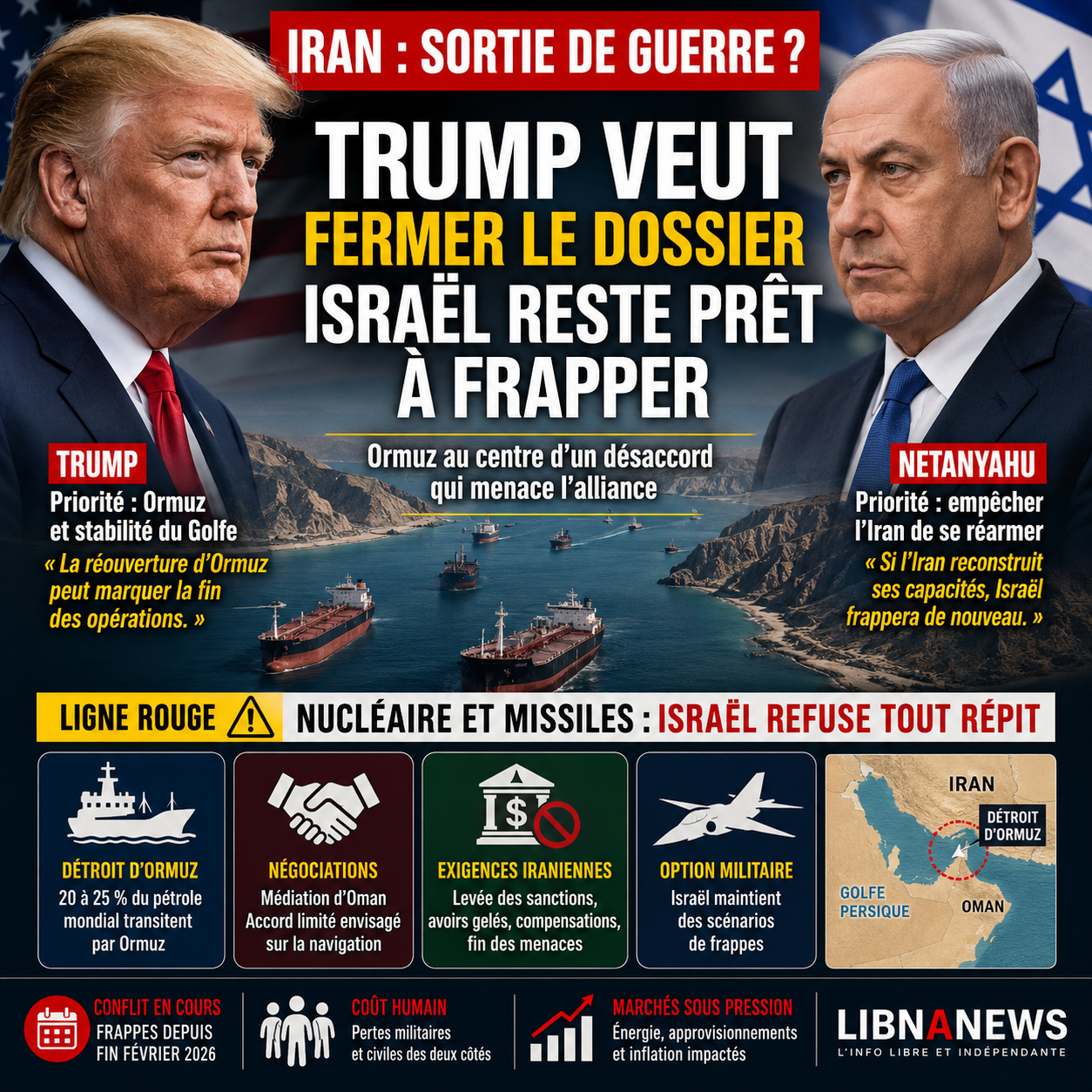
Donald Trump is now seeking to close the war against Iran, at the risk of widening the strategic gap with Israel. On 10 August 2026, the US President focused his efforts on an agreement allowing the reopening of the Strait of Ormuz and the stabilization of the Gulf, after several months of military confrontation. In Washington, officials are even considering that a limited agreement on navigation can be sufficient to declare an end to the conflict without immediate resolution of all nuclear issues. This development is a matter of concern to the government of Benjamin Netanyahu, which believes that the cessation of operations could give Tehran time to rebuild its military capabilities. Israel therefore maintains the option of further strikes if Iran resumes its nuclear or ballistic programmes. The disagreement now threatens to transform a military campaign initially conducted with strong American-Israeli coordination into an arm of arms between two allies on the conditions of exit from war.
Trump wants out of the war with Iran
Donald Trump’s change of priority is becoming increasingly visible. After increasing threats against Tehran and considering further massive strikes in late July, the US President suspended a new operation in early August to give the negotiations a chance. Its immediate objective is no longer only military. Its main aim is to restore traffic in the Strait of Ormuz, whose partial closure has profoundly disrupted the energy markets and complicated United States relations with its Gulf partners.
The White House wants to prevent war from turning into a permanent conflict. The political and economic cost of the confrontation has increased since the launch of the joint US and Israeli strikes against Iran in late February 2026. The goals set at the time were much more ambitious. Washington wanted to prevent Iran from possessing nuclear weapons, reduce its ballistic capabilities and permanently weaken its military apparatus. American statements had also referred to the possibility of political change in Tehran.
More than five months later, logic changed. The United States is seeking a formula for presenting the military sequence as a victory without necessarily achieving all the results proclaimed at the beginning of the conflict. According to information reported by the American press, Donald Trump may consider the complete reopening of the Strait of Ormuz as a sufficient result to announce the end of major war operations. The nuclear issue could then be referred to further negotiation.
This perspective is a major turning point. It means that the immediate US priority becomes maritime security, stable energy prices and reduced US military exposure to the Middle East. For Israel, this hierarchy of objectives is much less acceptable.
Israel fears a limited agreement in Ormuz
The Israeli Government regards Iran’s nuclear programme and Tehran’s missile capabilities as direct threats to its security. Since the beginning of the war, Israeli officials have argued that the military campaign should prevent Iran from rapidly rebuilding these means. An agreement limited to the Strait of Ormuz would therefore only address some of the American concerns, while leaving open the main Israeli concerns.
This discrepancy explains the nervousness observed in Jerusalem for several days. Israeli officials reported that they received little direct information about discussions between Washington, Tehran and regional mediators. Israel would depend in part on indirect channels to monitor the evolution of the negotiations. This is fuelling the fear of a compromise reached before Israeli demands are integrated.
The Israeli authorities have already publicly warned that they reserve the right to act if Iran rebuilds its nuclear or ballistic programmes. This position does not mean that a new attack has been decided. It confirms, however, that the Israeli army still maintains strike scenarios and that the Netanyahu government refuses to consider an American-Iranian arrangement as a sufficient guarantee.
In early August, press reports also indicated that Israel was preparing to participate in an American attack on Iranian energy infrastructure. The operation did not finally take place after Donald Trump’s decision to suspend the strikes and favour negotiations. According to the information, Israel was informed only late of the change in US decision. This episode reinforced the impression of less close coordination than at the beginning of the war.
Donald Trump and Benjamin Netanyahu no longer have the same calendar
The difference is less about Iran’s perception than about the timetable and the goals to be achieved before the fight ends. Donald Trump wants a fast, politically defensible and economically useful result. Benjamin Netanyahu wants to prevent a pause from allowing Iran to turn a ceasefire into a period of military reconstruction.
This difference had already appeared in June. After a new series of strikes between Israel and Iran, Donald Trump had asked the two countries to stop firing immediately. Israel then halted its attacks at the American request. The U.S. President had also put pressure on the Israeli government to avoid operations that could jeopardize discussions with Tehran.
On 19 March, Donald Trump had already asked Israel not to repeat an attack on Iranian energy installations after an Israeli strike against the South Pars gas field. Benjamin Netanyahu had publicly acknowledged that the operation had been conducted by Israel and that Washington had asked not to repeat this type of action.
These precedents today weigh on Israeli calculations. They show that the United States is prepared to limit the military freedom of its ally when Israeli strikes threaten an American diplomatic objective. They also show that Netanyahu cannot presume Trump’s automatic support for all operations decided by his government.
The war with Iran becomes a political problem for Trump
The American will to reduce the intensity of the conflict also responds to internal constraints. Donald Trump had presented the campaign against Iran as an operation that could quickly achieve decisive results. But the war has been prolonged. It has led to American losses, the mobilization of significant military resources and the tension on energy supplies.
Iranian attacks and attacks by Tehran’s allied groups have also expanded the scope of confrontation. American installations and forces in the Gulf were targeted. Commercial shipping was severely disrupted in the Strait of Ormuz. The Yemeni Houthis continued operations against regional interests, while instability affected the Red Sea and energy routes around the Arabian Peninsula.
The conflict therefore weighs on Trump’s central objective: to convince the American opinion that he can impose agreements without maintaining the United States in new wars in the Middle East on a lasting basis. A few months before the mid-term elections, a clear-cut military campaign represents an additional political risk.
The White House is now looking for a measurable result. The reopening of Ormuz offers this possibility. It would restore some of the oil and gas flows, reduce market pressure and present negotiation as a consequence of US military pressure.
Ormuz becomes the real key to compromise
The Strait of Ormuz became the focus of discussions. This sea route between Iran and Oman is one of the most important energy routes in the world. Prior to the war, a considerable proportion of the oil and liquefied natural gas exported from the Gulf was exported daily. The disruptions caused by the conflict have therefore had effects far beyond the region.
Tehran understood the value of this lever. The Iranian authorities now link the complete reopening of the Strait to several American concessions. They called for the lifting of sanctions, the end of military threats, the easing of the maritime blockade, the release of frozen Iranian assets and compensation for the damage caused by the American and Israeli strikes.
Not all of these applications were accepted by Washington. Negotiations continue mainly through Oman and other regional actors. A temporary navigation device is one of the solutions discussed. However, there are still significant differences on the political conditions for a sustainable reopening.
For Trump, the challenge is to convince Iran to reopen the sea lane without giving the impression that the US has paid too high a strategic price. In Tehran’s view, the aim is to demonstrate that his ability to disrupt Ormuz has enabled him to obtain concessions that he would not have acquired through nuclear negotiations alone.
Israel plans to maintain an autonomous strike capability
In the face of this development, Israel is preparing the post-agreement. Statements by Israeli officials indicate that the country does not want to give up an independent capacity for intervention. The advanced principle is simple: if Iran resumes certain activities considered dangerous, Israel could strike without waiting for a new American campaign.
This option should not be confused with an immediate attack decision. There is no evidence confirmed on August 10 that a date has been set for a new Israeli operation against Iran. On the other hand, several signals show that the hypothesis remains actively considered in Israeli security calculations.
Israel may seek to target several categories of facilities if a new campaign is decided: ballistic programme infrastructure, nuclear programme facilities, air defence systems or military capabilities that could directly threaten Israeli territory. However, any such operation would entail a major risk of a resumption of Iranian strikes.
An Israeli attack after an agreement between Washington and Tehran would also create a political crisis with the United States. It could challenge the ceasefire, provoke an Iranian response and force the Trump administration to choose between supporting its ally or protecting the compromise that it would have negotiated.
The June precedent feeds Israeli mistrust
The agreement reached in June had already revealed the limits of the agreement between Washington and Jerusalem. The United States and Iran had entered into an arrangement that did not fully correspond to Israel’s military objectives. The Netanyahu government then indicated that it did not necessarily consider itself bound by all the provisions that might restrict its regional operations.
The problem included Lebanon. Tehran warned that a resumption of Israeli attacks against Hezbollah could jeopardize the de-escalation between Iran and Israel. Washington was therefore seeking to prevent a peripheral front from failing a wider understanding.
This issue remains sensitive. Israel views Hezbollah as a military threat independent of the American-Iranian negotiations. Iran, for its part, continues to see the Lebanese movement as part of its regional machinery, even though the balance of forces has changed significantly after the Israeli strikes and political changes in Syria.
A new deal with Tehran could produce the same problem: Washington would seek to stabilize the Gulf, while Israel would like to maintain freedom of action against Iran’s networks and capabilities in several countries.
The American bet does not solve the nuclear issue
The main Israeli concern remains nuclear. If Washington agrees to temporarily dissociate the Ormuz file from that of uranium enrichment, the White House may get a quick exit from the conflict, but will defer the issue that had helped justify the military campaign.
The United States claims that the strikes have severely degraded Iranian capabilities. Israel also claims that the targeted facilities and infrastructure have delayed Tehran programmes. However, it remains difficult to establish publicly the exact extent of the capacity still available and the time required for their reconstruction.
This uncertainty is at the very heart of the debate. Washington may consider that international surveillance, targeted strike threats and subsequent negotiations are sufficient to contain the risk. On the contrary, Israel may consider that even partial reconstruction justifies preventive action.
The disagreement therefore does not imply a break in the alliance. The United States remains Israel’s main military and diplomatic support. But it shows that the interests of both governments do not automatically coincide when the time comes to determine the conditions for ending a war.
Netanyahu must also cope with its internal constraints
Benjamin Netanyahu approaches this sequence in a difficult Israeli political context. His Government faced tensions on several fronts and had to defend before its opinion the results achieved after months of military operations. Accepting an end to conflict essentially defined by Washington could be presented by its opponents as abandoning strategic objectives announced at the beginning of the campaign against Iran.
The Israeli Prime Minister must also take into account the toughest members of his coalition. They defend a line that military pressure must continue until Iranian threats are permanently eliminated. A prolonged suspension of unsecured nuclear and missile strikes could therefore become an internal policy problem.
Conversely, openly challenging Donald Trump involves a cost. Israel depends on US military support, access to certain munitions and strategic cooperation with the United States. An operation against Washington’s explicit will could cause a tension rarely observed between the two governments during this war.
Netanyahu must thus preserve two contradictory positions: to convince the Israelis that he retains complete military freedom, while avoiding giving Trump the feeling that Israel is sabotaging its exit strategy.
Tehran tries to exploit the differences between allies
Iran closely observes this disagreement. For Iranian leaders, any divergence between Washington and Jerusalem reduces the likelihood of a new coordinated campaign of great magnitude. It can also improve Tehran’s position at the negotiating table.
However, the Iranian authorities have a narrow margin. A visible resumption of the most sensitive nuclear activities or a new series of attacks against US forces could convince Trump to return to the military option. The US President continues to threaten Iran with severe strikes if negotiations fail.
Tehran must therefore maintain sufficient pressure to obtain concessions without crossing the threshold that would trigger a new offensive. Control of navigation in Ormuz remains its main instrument. It offers a means of exerting international economic pressure without immediately initiating direct air confrontation with the United States.
This strategy also poses a risk. The longer the strait disruption continues, the more Iran’s trading partners and the Gulf States can turn against Tehran. The Iranian economy is also affected by war, sanctions and restrictions on exports.
A new Israeli attack could fail the exit from war
The most dangerous scenario for Washington would be an agreement quickly followed by an Israeli strike. Tehran could then consider that the United States does not have the capacity or willingness to guarantee de-escalation. A response against Israel could lead to a new series of missile exchanges and then put US forces under pressure in the Gulf.
Donald Trump has already shown that he wants to prevent this kind of chain. In previous episodes, he called on Israel to suspend or limit certain operations when they might jeopardize its negotiations with Iran. This line could become even more firm if the White House gets an agreement on Ormuz which it wants to present as the end of the war.
For Israel, the question will then be how far it can accept American constraints. The Netanyahu government can choose to wait and monitor Iranian activities. It can also prepare limited strikes that can be carried out quickly if there is evidence of rebuilding of critical capabilities.
This ambiguity is probably the main means of Israeli pressure. By maintaining the credible military option without announcing an operation, Israel seeks to influence both Tehran and Washington.
Trump wants a political victory, Israel a military guarantee
The difference between the two approaches is now clear. Donald Trump is looking for a result that he can present as proof that the American force has forced Iran to negotiate and allowed to reopen an essential artery of the world economy. Israel seeks a more lasting guarantee against the reconstruction of Iranian military power.
These objectives are not necessarily incompatible. An agreement on Ormuz could be a first step before a broader nuclear and missile negotiation. But their calendar is different. Trump wants to stop the war before he settles all the files. Netanyahu fears that the cessation of the war will make the remaining cases more difficult to resolve.
The next test will therefore be the precise content of a possible arrangement negotiated by the United States, Iran and Oman. If the text only concerns navigation in the Strait and the suspension of hostilities, Israel could seek additional American guarantees. If these guarantees are deemed insufficient, the Israeli army is likely to maintain its operational preparations.
As of August 10, no new Israeli attacks against Iran have been officially announced. But the question is no longer whether Washington and Jerusalem share the same general objective of containing Tehran. It is to determine who will decide when the war can be considered to be over, as negotiations on Ormuz progress and Israel continues to affirm that it will again strike if Iran’s nuclear or ballistic capabilities are reconstituted.