

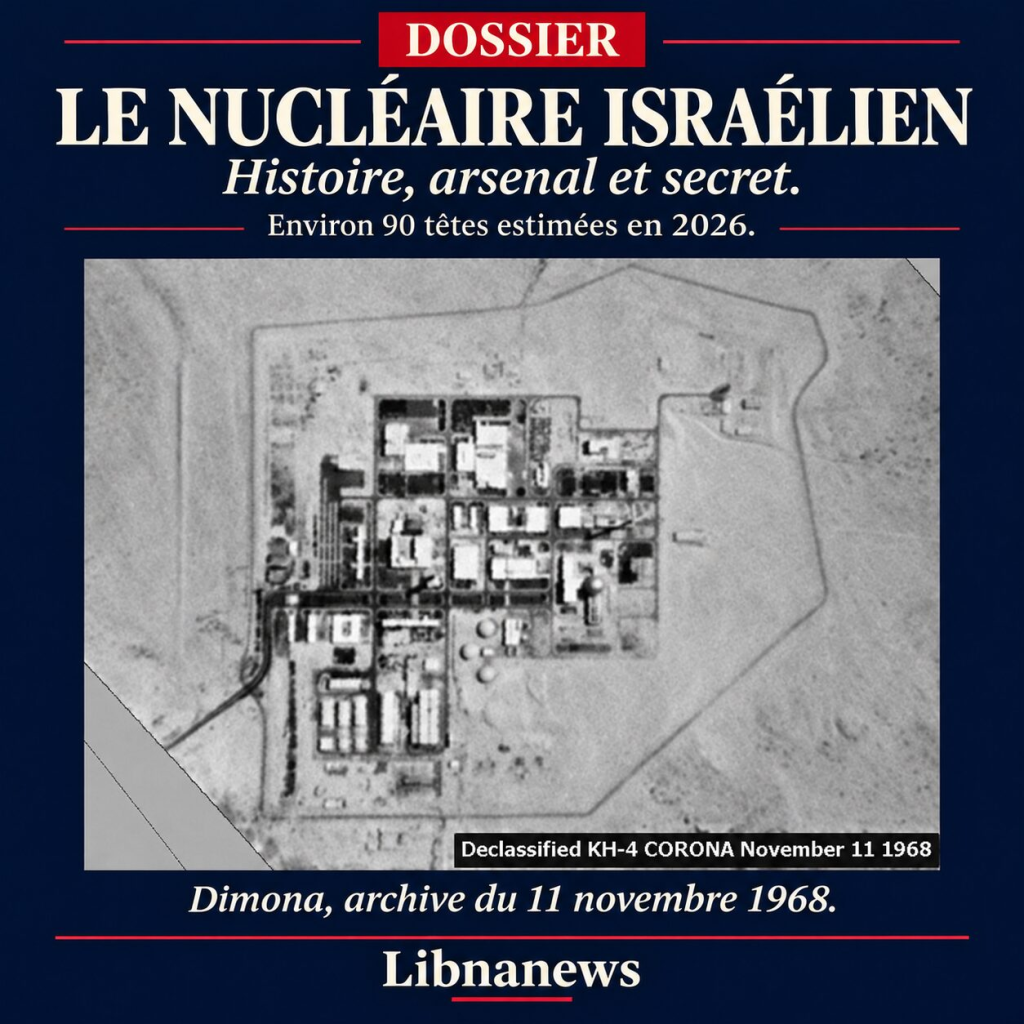
The Israeli nuclear programme remains one of the most secret arsenals in the world. Public estimates hold about 90 heads at the beginning of 2026, with no official inventory or verifiable target list. From the French cooperation of the 1950s to the submarines delivered by Germany, its history sheds light on a strategy based on deterrence, opacity and the refusal to see the emergence of a rival nuclear power in the Middle East.
Infrastructure is evolving, but declaratory policy remains. In June 2026, the international record of nuclear forces reported new work in the Negev complex. On 1 September, the German manufacturer and the Israeli Defense Ministry announced the departure of the INS Drakon submarine to Israel. None of these developments is accompanied by public recognition of a nuclear arsenal.
This apparent contradiction crosses the entire file. Reactors exist, old agreements have been declassified, missiles have been tested. But the exact number, distribution, conditions of use and targeting decisions remain secret. Reconstitute the program therefore requires a distinction between documents prepared, converging estimates and assumptions that have been circulating for decades.
Israel’s six-point nuclear programme
The status:Israel does not formally recognize nuclear weapons. The major international inventories, however, rank it among the nine States that own it. It is the only State in the Middle East to which they attribute a nuclear arsenal.
Volume:about 90 heads at the beginning of 2026. This number represents an estimate of the military stock, not an Israeli declaration. It does not mean that 90 weapons are continuously placed on missiles or embedded in submarines.
The historic centre:the nuclear complex of the Negev, near Dimona, built with French help. Soreq, a result of American civil cooperation, is another important centre, subject to a different safeguards framework.
The vectors:aircraft, ballistic missiles from the Jericho family and an alleged naval component. The existence of platforms is much better documented than their actual nuclear equipment.
Doctrine:Israel claims not to be the first to « introduce » nuclear weapons in the Middle East. This formula does not amount to a commitment to never possess the weapon, nor to a public promise of non-employment first.
Targets:no authenticated public document provides a comprehensive and current Israeli nuclear targeting plan. A city within reach of a missile does not, for this reason alone, become an officially designated target.
Ben-Gourion seeks insurance against existential defeat
The project takes shape in the early years of the State of Israel. David Ben-Gourion considers that conventional superiority can vary over time. The country has a limited population, narrow territory and low strategic depth. Its leaders are seeking a capacity to discourage a war that threatens the very existence of the state.
The memory of the Shoah occupies an essential place in this reflection. It combines with the experience of the 1948 war and tensions with the Arab States. This story explains the motivations of the programme promoters. It alone does not allow them to deduce their subsequent military choices or to attribute a nuclear intent to each crisis.
The Israeli Atomic Energy Commission was established in 1952. Ernst David Bergmann plays a central scientific role. Shimon Peres, at the Ministry of Defence, became one of the main political organizers of the project. The programme thus brings together governmental will, scientific networks and foreign industrial cooperation.
The ambition is also to reduce dependence on external guarantees that are considered uncertain. American or French protection always depends on the decisions of another government. A national capacity promises a margin of autonomy, at the cost of considerable investment and sustainable institutional secrecy.
France provides decisive support in the 1950s
The relationship with Paris precedes the Suez crisis. It is strengthened in a context of military cooperation and confrontation with Egypt by Gamal Abdel Nasser. The Algerian war also weighs on the French perception of Arab nationalism. The leaders of both countries see common strategic interests.
In the autumn of 1957, Franco-Israeli agreements opened the way for the Dimona complex. Archives and historical works establish the decisive role of this cooperation. They also show that decisions are made in a small circle, with arrangements whose details become accessible only gradually.
Summarizing the case with a « bomb offered after Suez » erases this story. France provides major industrial and scientific assistance. Israel organizes a national programme, mobilizes its own staff and continues its efforts after the cooling of bilateral relations. Cooperation is therefore neither a mere gift of weapons completed nor a relationship that has remained unchanged for several decades.
General de Gaulle’s return to power changed the context. Paris seeks to frame and then reduce the sensitive aspects of its commitment. However, the Israeli programme continues. This continuity explains why the French question remains central to its origins, not enough to describe its further development.
Soreq and Dimona, two paths to separate
Israel also benefits from the American program « Atoms for Peace ». The cooperation agreement concluded in 1955 led to the development of the Soreq centre. Its research reactor began operation in 1960. This component has a publicly documented civil and scientific dimension.
Dimona is a different logic. The Negev reactor started operating in the 1960s. The U.S. diplomatic archives soon revealed suspicions about its military purpose. The centre then becomes, in international assessments, the historic heart of the production of materials for the arsenal.
Both sites do not fall under the same verification regime. Soreq is covered by guarantees for designated facilities and materials. Dimona is not subject to comprehensive international safeguards. Confounding the two leads to two opposite mistakes: to say that there is no international control in Israel, or to claim that the entire programme is inspected.
Nuclear research is no more confused with electricity production. A research reactor can be used for science, training or industrial applications. The existence of such equipment does not in itself prove the manufacture of a weapon. In the case of Dimona, military assessment is based on a much broader historical set.
In 1960, the United States understood the nature of the project
Washington does not instantly discover a fully constituted program. Information goes back through several channels: observations, scientific contacts and diplomatic exchanges. The first descriptions of constructions are not always sufficient to establish their function. Interpretations evolved in 1960.
An American estimate of 8 December 1960 identifies a nuclear complex in the Negev and considers military production as one of its major objectives. American officials are asking for explanations. The Israeli authorities then presented the project as peaceful.
The difficulty of this sequence lies in the difference between seeing a site and demonstrating its use. The archives show hesitation, contradictory assessments and incomplete information. They do not describe an informed US government since the first day.
The discovery places the United States above all before a conflict of objectives. They want to support Israel, avoid a regional nuclear race and preserve their relations with Arab countries. This tension crosses successive administrations. Later accommodation was not yet acquired.
Kennedy tries to impose regular checks
John Kennedy treats the issue as a major non-proliferation issue. Two American specialists visited Dimona on 20 May 1961. The president met Ben-Gourion a few days later. Israeli assurances do not dispel Washington’s concerns.
In 1963 the exchange became firmer. Kennedy calls for regular visits, at a semi-annual rate. He wants reliable information on the operation of the complex. In his correspondence with Ben-Gourion and Levi Eshkol, he explicitly links bilateral confidence to this transparency.
The letter to Eshkol on 5 July 1963 warned that US support could be seriously affected in the absence of reliable information. This pressure appears in declassified documents. It recalls that American-Israeli relations have also experienced direct confrontation over nuclear.
Eshkol accepts the principle of visits, while negotiating their terms. Its reply of 19 August leaves the subsequent periodicity to be discussed. The documents also reveal an Israeli concern: not completely reassure Nasser about the lack of military capacity. Uncertainty is already beginning to serve as a political instrument.
U.S. visits continued under Lyndon Johnson, usually once a year, until 1969. They do not offer the permanent and binding mechanism sought by Kennedy. Nor are they comprehensive international IAEA inspections.
1967: the alleged transition to the military threshold
Historical work generally finds the appearance of the first military capabilities in the late 1960s. The testimonies gathered around the Six-Day War gave particular importance to May and June 1967. They describe the assembly of first rudimentary devices in a climate of great concern.
It is a reconstruction based on partial testimonies and archives. Israel did not publish an official calendar attesting to the day when its first weapon became usable. The apparent accuracy of certain chronologies therefore exceeds what the documents guarantee.
Some officials reportedly considered a nuclear demonstration in an extreme scenario. The evidence available does not prove a final political decision on employment or an explosion carried out. The rapid conventional victory of June 1967 did not allow all questions on these preparations to be resolved retrospectively.
This distinction remains essential: studying an option, preparing a capacity and ordering it to be used are three different steps. Historical narratives sometimes misrepresent them in the same spectacular formula.
Nixon and Meir install 1969 accommodation
In the late 1960s, the United States was still seeking to curb the program. The provision of Phantom aircraft becomes a point of discussion. In particular, Washington is trying to clarify the Israeli promise not to « introduce » nuclear weapons into the region.
The negotiators do not all give the same meaning to this verb. For Americans, possession of a weapon can be the dreaded introduction. Israeli interlocutors place greater emphasis on the lack of testing and public recognition. The choice of words therefore has a real political disagreement.
Richard Nixon received Golda Meir on 26 September 1969. Their private maintenance is generally seen as the turning point that stabilizes American accommodation. However, no one-to-one public record of their own can be used to cite a signed nuclear treaty or a complete list of clauses.
The peripheral documents and subsequent practice shed light on the compromise. Israel maintains its programme without official proclamation. Washington stopped pressing Israel to accept visits to Dimona and to accede to the NPT. A memorandum of 8 October 1969 relates, inter alia, to the Israeli interpretation of non-introduction to the absence of testing and publicity.
That framework did not mean that the United States had transferred bombs to Israel. It describes a political tolerance towards an undeclared national capacity. The grade distinguishes the strategic alliance, conventional assistance and the special status of the nuclear issue.
« Amicut », a secret maintained rather than a lack of information
The Hebrew word « amimut » refers to this deliberate opacity. The government avoids official declaration, while foreign governments and specialists reason about the existence of an arsenal. The secret thus relates less to total ignorance than to the absence of institutional recognition.
This posture retains some diplomatic freedom. It avoids a ceremony of entry into the nuclear club, a claimed trial or a detailed doctrine that could provoke immediate reactions. It also allows Israel’s partners to separate their bilateral cooperation from international requests for transparency.
However, there is an analytical cost. It prevents checking ads on stock size. It complicates the evaluation of modernisation. It allows opponents to interpret signals whose exact meaning remains unknown.
An isolated statement by a minister is not enough to abolish this policy. A political formula, an allusion, a verbal threat and a formal change in doctrine must be distinguished. None of these elements replaces a public inventory or a government document on terms and conditions of employment.
1973: a major crisis, disputed nuclear stories
The war of October 1973 fed one of the most sensitive historical debates. The Egyptian and Syrian attack puts Israel in trouble during the first days. Subsequent accounts describe nuclear preparations, sometimes presented as an ultimatum for the United States.
The documentary record is more nuanced. Retrospective evidence indicates that Golda Meir rejected Moshe Dayan’s proposal for demonstration preparations on 7 October. It clarifies a discussion at the summit, but does not constitute a full record of decisions.
A comprehensive historical study published in 2013 considers precautionary or defensive preparedness measures plausible. It does not confirm the scenario of a nuclear signal organized to force Washington to launch its air bridge. The intentions, visibility and American interpretation of the measures remain under discussion.
Presenting a 1973 « nuclear blackmail » as a definitive fact would therefore be excessive. The episode shows above all how a serious conventional war can bring the nuclear issue into the deliberations, without the possibility of re-establishing with certainty the entire decision-making chain.
Vela, the double flash that never closed the debate
On 22 September 1979, an American satellite Vela recorded a double flash in a vast maritime area of the southern hemisphere. The signal evokes, for several specialists, an atmospheric nuclear explosion. It causes an American investigation and different assessments.
Some work links the event to a possible Israeli trial, with possible South African cooperation. Other analyses, including those of a scientific group convened by the White House, challenge the strength of this conclusion. Technical and political interpretations continue to oppose.
The file does not allow an identified author to be presented with certainty. Nor does it justify transforming the hypothesis of an instrumental anomaly into a definitely proven explanation. The available indices have not produced a public consensus equivalent to that which accompanies the tests claimed by other powers.
Recent international inventories therefore continue to note the lack of conclusive public evidence of an Israeli trial. This reserve does not erase Vela. She sets the level of certainty at which her story can be told.
Vanunu broke public secrecy in 1986
Mordechai Vanunu, former technician of Dimona, provides information and photographs on the activities of the complex. Their publication in the British press on 5 October 1986 gives the general public an unprecedented overview of the programme. Foreign governments already had evaluations, but the scope of revelation is changing.
The information provides more ambitious estimates of accumulated capabilities. However, they do not constitute a certified inventory of completed weapons. A testimony about industrial activities and a workshop photograph do not allow direct counting of all available heads.
Israeli services capture Vanunu abroad and bring him back to Israel. He was sentenced and spent 18 years in prison. His case becomes a symbol of the conflict between State secrecy, public alert and freedom of information.
For the history of the programme, 1986 marks a turning point in public knowledge, not its birth. The revelations expand the available evidence without removing the official policy of non-recognition.
Why the 90-head estimate is not a count
The estimate of about 90 weapons, taken at the beginning of 2026, is based on a beam of indices. Researchers cross the history of the program, the materials likely to have been produced, the available platforms and the old intelligence assessments. They do not have an Israeli register accessible to the public.
The figure must always be accompanied by its date and nature. An estimated stock is not an officially declared quantity. It can remain unchanged in a directory while weapons are maintained, replaced or removed. The stability of a total therefore does not prove the absence of industrial activity.
There are also three categories: usable materials, assembled weapons and deployed weapons. Material assessments may suggest a potential greater than the number selected for the arsenal. They do not demonstrate that this potential has been entirely transformed into weapons.
The figures of 100, 200 or more, often cited without context, do not always measure the same thing. Some come from old assumptions. Others correspond to a theoretical production capacity. Adding or choosing the highest systematically creates misleading accuracy.
The 2026 inventories do not include Israeli warheads as publicly identified in operational deployment. This does not mean that no weapon can be prepared. The distinction describes the categories and limitations of the estimate, not a certificate of military inactivity.
Plutonium, types of weapons and powers: the limits of public knowledge
International inventories mainly associate the Israeli arsenal with a plutonium-based industry. This appreciation is part of the history of the Dimona complex. It does not give access to the internal characteristics of weapons, their dimensions or their real power.
Publications sometimes distinguish between fission weapons and supposed thermonuclear capabilities. The former liberate energy by dividing atomic nuclei; The latter also involve fusion reactions. These categories describe general physical principles. They do not allow for an verified catalogue of Israeli models.
The yield attributed to these weapons varies greatly among the authors. There is no official series of tests and declarations to confirm them. It would therefore be misleading to announce a precise power for each head or missile.
The same problem affects the terms « tactical weapon », « strategic weapon » or « neutron bomb ». They appear in some accounts, but their repetition does not constitute equipment. In this case, the estimated number of heads is better substantiated than the detailed technical composition of the stock.
Known sites: what exists and what remains presumed
Dimona:the Negev nuclear centre in southern Israel is the main site associated with the military program in historical studies. Its existence and French origin are established. The precise function of each current installation is not publicly available.
Soreq:this research centre is located in the central coastal region. His American history and scientific activities are documented. Presenting it indiscriminately as a basis for nuclear weapons would erase the difference between research, international safeguards and the alleged military programme.
Dot Micha:this installation, in the center of the country, returns in open studies on Jericho missiles. The association is based on external analyses, not on a nuclear inventory published by Israel. It does not specify the current presence or readiness of heads.
Air and naval bases:in particular, studies involve Tel Nof in a possible aerial nuclear mission. Haifa hosts the submarine fleet. These general functions do not prove that a nuclear weapon is on a given platform at any given time.
This general geography helps to understand the diversity of the program. It does not provide a stock plan or deployment map. Very detailed online lists often mix known installations, image interpretations and statements that cannot be verified.
Jericho I: a documented French ballistic origin
French cooperation also concerns vectors. In 1962 Dassault began studying MD 620 Jericho for Israel. The manufacturer indicates a range target of 500 kilometres. The first shot of a single-storey device occurred in February 1965, and a two-storey trial succeeded in March 1966.
The French programme ended in January 1969 in the context of the arms embargo on Israel. Israeli development continues. Specialized syntheses generally place the Jericho I in service in the 1970s and its withdrawal in the 1990s.
This first generation is covered by short-range ballistic missiles. Public assessments attribute it strong propulsion and nuclear capacity. Its performance remains much more modest than that of subsequent generations.
The historical interest of Jericho I lies in this industrial continuity. It links a documented Franco-Israeli contract with a national missile family that has become one of the presumed pillars of deterrence. It should not be presented as a weapon still representative of the current arsenal.
Jericho II and III: published coverage, uncertain performance
Jericho II appeared in the late 1980s. The public descriptions describe it as a two-storey ballistic missile using a solid propellant. The published ranges vary significantly, usually from 1,500 to 3,500 kilometres. These differences reflect separate assumptions and incomplete information.
The Jericho III is the next generation. Trials are reported from 2008. Some synthesises place its entry into service around 2011. The most frequently taken ranges range from about 4,800 to 6,500 kilometres, but they do not come from an official Israeli fact sheet.
These values are sufficient to understand the scale change: the capacity attributed to recent generations far exceeds Israel’s immediate vicinity. They do not guarantee a precise scope for each configuration. The comparison must be based on orders of magnitude.
The transition between Jericho II and III remains poorly documented. Ancient publications announced a withdrawal of Jericho II around 2026. A forecast does not constitute confirmation of actual withdrawal. The number of missiles of each type cannot be established with confidence.
The same caution applies to statements on multiple heads or precision performance. They appear in some compilations without sufficient public validation. Resuming them as acquired characteristics would make a technical hypothesis a military fact.
Aircraft: an old component, an unknown certification
Aviation is a common component of the arsenal. The open studies refer mainly to certain versions of the F-16. They rely on the history of the air forces and the possibility of adapting aircraft to this mission. Israel does not publish the list of aircraft, units or equipment concerned.
A distinction must be made between an air force aircraft and an aircraft actually assigned to a nuclear mission. The entire fleet cannot be counted as a nuclear force. Nor does the existence of an adapted version in another country prove an identical configuration in Israel.
This reserve applies particularly to the F-35I. Its modern character and presence in conventional operations do not constitute confirmation of an Israeli nuclear mission. The nuclear capabilities announced for certain foreign variants of the F-35 are not automatically transferable to all aircraft in the family.
Nor is a radius of action sufficient to describe a real mission. It varies with flight conditions and configuration. To understand deterrence, the solid point remains the presumed diversification of means, rather than a catalogue of missions whose parameters remain secret.
The Dolphin and the Drakon: the second strike remains an award
The naval component attracts special attention. Dolphin family submarines, built in Germany, are regularly described as capable of carrying nuclear cruise missiles. This assignment remains external: Israel does not confirm this armament or its modalities.
The names of missiles sometimes associated with this mission, including Popeye Turbo, have been circulating in studies for many years. Public information does not allow all their characteristics to be treated as established. A submarine may perform conventional, intelligence or surveillance missions without its existence proving a nuclear load.
September 1, 2026 brings a stronger fact. The builder and the Ministry of Defence announce the departure of Drakon INS from Kiel. The building is presented as the sixth Israeli submarine and the third in the Dolphin series equipped with independent air propulsion.
This technology does not correspond to nuclear propulsion. It improves the diving autonomy of a conventional submarine. The confusion between « nuclear submarine » and « submarine capable of carrying a nuclear weapon » therefore leads to an erroneous description of the fleet.
At the same time, the manufacturer confirms the continuation of the Dakar programme, comprising three future buildings. These announcements demonstrate naval modernization. They alone do not prove an increase in the number of nuclear warheads.
What does a second strike really mean
The second strike is the possibility of retaliating after a major attack. In the theory of deterrence, it aims to convince an opponent that an offensive could not suppress any ability to retaliate. It differs from a mere accumulation of weapons.
Analysts interpret the diversification of Israeli vectors through this logic. Land, air and possibly naval capabilities can provide several forms of response capability. But speaking of a fully verified Israeli « triad » would go beyond public information.
A declared triad is based on officially identified missions and equipment. In the Israeli case, a significant part of this architecture remains assumed. The term therefore often describes an analytical model rather than a confirmed organizational chart.
The nuclear command is another unknown. Israel does not make public detailed licensing mechanisms, transmission procedures or availability conditions. No serious narrative can turn this silence into evidence of an automatic system, a particular delegation or an already scheduled decision.
Capitals and cities targeted: no reliable list is public
The question often arises: what capitals are Israeli missiles targeting? The documentary response is limited. There is no authenticated public list of current nuclear targets. Available range maps show a theoretical geographic capacity, not a strike decision.
Tehran frequently appears in the debates because of the confrontation between Israel and Iran. Damascus and Cairo are recorded in historical accounts of the Arab-Israeli wars. This presence in an analysis does not prove that these cities are now designated as nuclear targets.
The political situation has also changed over time. Egypt signed peace with Israel in 1979 and Jordan in 1994. A map inspired by the opponents of 1967 cannot be presented as a contemporary plan. The scope of a missile often survives the diplomatic configuration that has accompanied its development.
The concepts of strike against military forces and strike against urban centres belong to the vocabulary of strategic studies. They do not allow a particular plan to be assigned to Israel without proof. List cities in Europe, Africa or Asia because they fall within a theoretical radius would produce an intention from a distance.
The dossier can therefore describe the opponents mentioned in the strategic reflection and the general extension of the staves. It must leave the issue of actual targets clearly open, rather than replacing a military secret with an invented list.
The Begin doctrine concerns the opposing capabilities
Israel’s policy also includes another aspect: preventing a regional opponent from acquiring military nuclear capability. This orientation is generally associated with Menachem Begin. The attack on the Iraqi Osirak reactor on 7 June 1981 was particularly evident.
On 19 June, the Security Council unanimously condemned the attack in its resolution 487. It recalls the right to the peaceful use of nuclear energy and calls on Israel to place its facilities under international safeguards. The Israeli justification therefore does not constitute universal legal authorization.
The strike of 6 September 2007 against a Syrian site is part of this counter-proliferation story. In 2011, IAEA considered that the destroyed building was most likely a reactor that should have been declared. This assessment does not mean that a completed Syrian bomb was discovered.
The Syrian case underwent a significant development in September 2026. New declarations and verifications allow the placement of previously undeclared material under guarantees. The Governing Council then withdrew the item on the former non-conformity of its agenda. This development does not rewrite the obligations breached under the previous regime.
The Begin doctrine remains distinct from a public Israeli nuclear doctrine. It first concerns actions aimed at opposing capabilities, often with conventional means. Consolidating these two dimensions blurs the role assigned to the national arsenal.
Iran puts nuclear asymmetry at the centre of the debate
The Israeli-Iranian confrontations and attacks on Iranian installations have revived the issue of differential treatment of regional programmes. Israel presents the prevention of an Iranian weapon as a security imperative. His opponents stress that he himself keeps an undeclared arsenal.
The legal regimes are different. Iran has acceded to the Treaty on the Non-Proliferation of Nuclear Weapons and concluded a comprehensive safeguards agreement. Israel has never acceded to this treaty. This distinction explains some of the differences in control, without removing political controversy.
The argument of double standards therefore goes beyond a simple technical comparison. It questions the credibility of non-proliferation when certain programmes are under intense pressure, while an existing arsenal remains outside a full reporting system.
Conversely, the defenders of the Israeli position invoke regional threats, lack of confidence and the precedents of hidden programmes. The two readings are opposed on the order of priorities: first reduce weapons, or first establish a security environment allowing this reduction.
The debate does not confuse enrichment, industrial capability, assembled weapon and operational force. These steps are different for all countries. The same precision requirements must apply to the evaluation of the Israeli programme and the evaluation of the programmes it intends to prevent.
NPT does not recognize Israel as a nuclear power
The NPT distinguishes between the nuclear-weapon States that manufactured and detonated a nuclear device before 1 January 1967 and the other parties. The five states recognized in this category are the United States, Russia, the United Kingdom, France and China. Israel is not part of it.
To possess a weapon in practice and to enjoy the status of a State under the Treaty are therefore two different things. The recognition of an arsenal by researchers does not automatically confer legal recognition under the NPT.
The absence of Israeli accession limits the scope of obligations arising directly from this treaty. It does not mean that the State is outside international law. The UN Charter, the rules on the use of force and international humanitarian law remain relevant.
Israel has been a member of the IAEA since 1957 and participates in various cooperation. However, its limited safeguards agreements do not give the Agency a general mandate to inspect the entire national programme. The Agency acts within a legal framework: its lack of full access cannot be equated with a validation of the peaceful nature of the entire programme.
Tests, humanitarian law and the prohibition of nuclear weapons
Israel signed the Comprehensive Nuclear-Test-Ban Treaty on 25 September 1996 without ratifying it. Its status remains important for the entry into force of this Treaty. The signature does not amount to a declaration of arsenal or recognition of a past trial.
The right to use arms is not limited to the status of accession to a particular instrument. In its 1996 opinion, the International Court of Justice referred to the requirements of the Charter and humanitarian law. In particular, it highlights the rules applicable to the protection of civilians.
The Court does not definitively determine the legality of employment in an extreme circumstance of self-defence in which the survival of a State would be at issue. This reservation is not a general authorization. It does not remove the distinction between civilians and combatants or other humanitarian obligations.
The consequences of a nuclear explosion would go beyond the claimed military objective of immediate effects, lasting health damage and possible transboundary damage. The discussions on « target cities » cannot therefore be separated from their human and legal dimension.
An area without weapons of mass destruction remains negotiated
The proposal for a regional nuclear-weapon-free zone has a long diplomatic history. It has expanded to include other weapons of mass destruction. The objective is to treat together the safeguards, verification and security of the States of the region.
A United Nations conference has been meeting on this subject since 2019. The sixth session was held from 17 to 21 November 2025 under the Moroccan Presidency. Israel did not participate. The United States was also absent from the observer powers.
The disagreement concerns in particular the method. The promoters of the conference want to move towards a legally binding framework. Israel favours an approach linked to direct regional agreements, mutual recognition and security that it considers sufficient.
This divergence is not just about a timetable. It determines what should precede what: regional political transformation, reduction of arsenals or verification commitments. Technical discussions can progress without resolving this strategic blockage.
For Lebanon and other non-nuclear States in the region, the stakes go beyond the possession of a national weapon. It concerns the prevention of escalation and the consequences of an accident or employment whose effects would not respect borders.
The limits of deterrence in contemporary wars
An alleged nuclear capability did not suppress Israel’s wars, attacks on its territory or conflicts with armed groups. This observation is not sufficient to demonstrate the failure of any deterrence. It shows that the objectives attributed to nuclear power are not confused with the prevention of each hostile act.
Theories of deterrence distinguish an existential threat and a more limited confrontation. In fact, the border may become uncertain under the pressure of a crisis. Risk then depends on perceptions, misinterpretation and the ability of managers to maintain reliable exchanges.
Confidentiality can increase the uncertainty sought in the opponent. It can also prevent the understanding of the thresholds that everyone considers decisive. These two effects coexist: opacity is neither an automatic guarantee of stability nor proof that employment is imminent.
Modernising conventional means further complicates analysis. A missile, aircraft or submarine may have several missions. Observing a movement or test is not sufficient to conclude that a nuclear preparation is in progress. Spectacular alerts based on a single index should be examined with caution.
« Samson option » does not replace official doctrine
The term « Samson option » refers, in part of the literature, to the hypothesis of an ultimate response to an existential threat. The biblical reference evokes a destruction whose consequences the author himself would suffer. The term was imposed in the public debate about Israeli nuclear power.
This is not the title of a published government document setting out thresholds, targets and procedures. Using a certain plan as a synonym leads to the authorities being given a doctrine whose details are not accessible.
This distinction is particularly relevant when comments describe a threat of destruction of foreign capitals. Without authenticated documents, these accounts remain interpretations or speculations. They cannot serve as a basis for a list of targets or a forecast of employment.
What the developments of 2026 make it possible to affirm
The available balance sheet retains three solid points. The order of magnitude chosen for the arsenal remains about 90 heads. Work continues in the Negev nuclear complex. The submarine fleet continues to renew with the Drakon and the Dakar programme.
None of these facts makes it possible to set a quantitative increase in the stock. Visible constructions can meet several industrial needs. A naval delivery does not reveal its possible nuclear weapons. Maintenance of an old capacity can also produce a significant activity without changing the estimated total workforce.
The next decisive information will not necessarily be additional images. They could come from declassified archives, declaratory change, evolution of international safeguards or sufficiently robust data to revise estimates. Meanwhile, the Israeli nuclear programme remains a power widely recognized by analysis, but still exempts from a comprehensive public inventory.





Comments