

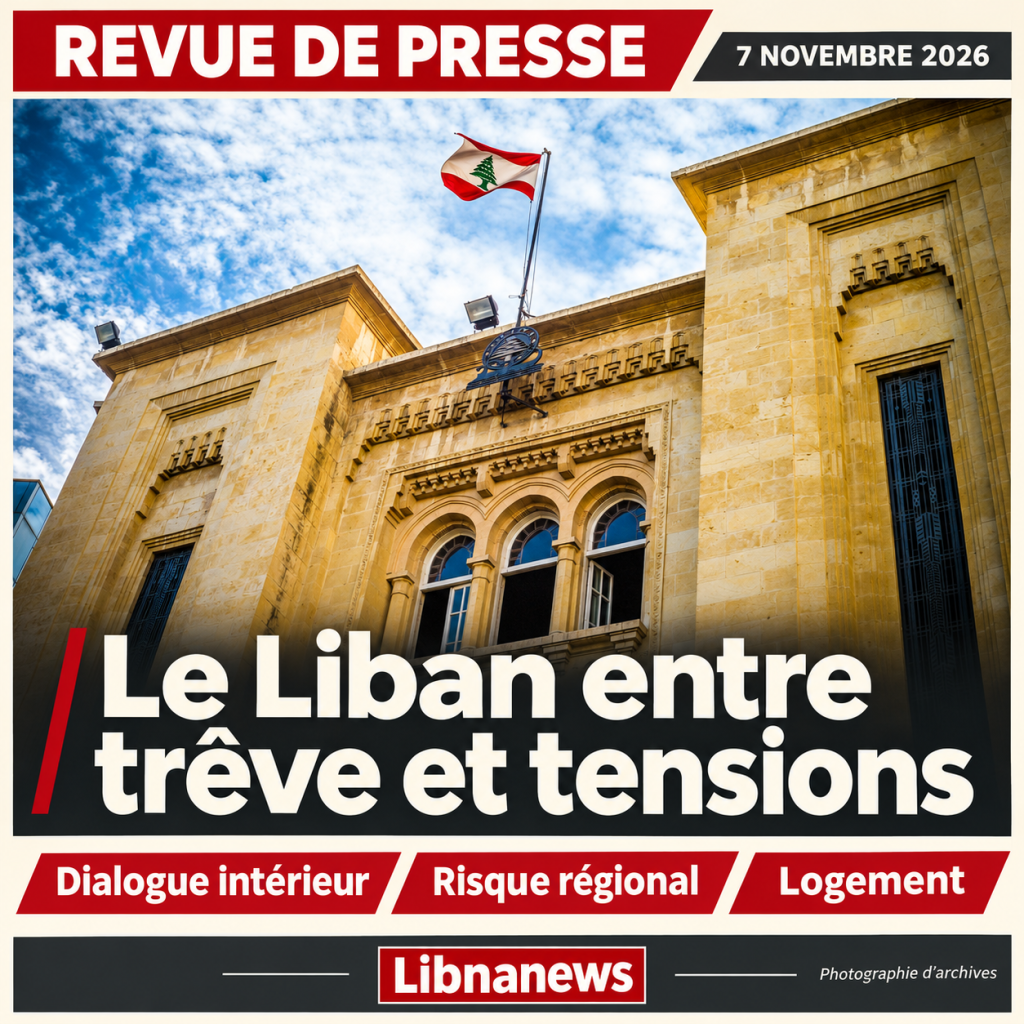
On the front page: an internal truce sought in a region under tension
The Lebanese press review of 7 November 2026 places internal dialogue at the forefront. The newspapers describe an attempt to appease Baabda and Hezbollah. They don’t see an agreement on weapons. In Ad Diyar, Sonia Rizk reports the resumption of indirect contacts. Intermediaries seek to contain tensions between Joseph Aoun, Nawaf Salam and the party. Nabih Berri occupies a central place in this story. The sources close to the Presidency defend a peaceful solution to the disagreement. However, they maintain the aim of the state monopoly on arms. Hezbollah’s sources are calling for this file to be linked to the Israeli withdrawal. They also wish to review decisions regarding its military and security activities. The two positions therefore remain distant. The political exchanges and the tone of interventions are discussed first.
On 7 November, Al Liwa The daily reports on the efforts made to Berri, then mentions circles that dispute its scope. Dialogue is therefore not presented as a meeting already held. Al Joumhouriyat insists on the absence of external guarantees. An anonymous senior official claims that he has neither a precise warning nor a relaxation insurance. The newspaper favours sustainable internal stabilization. He stressed that regional discussions could take time. The control of Lebanese tensions cannot depend on a quick outcome in Washington, Tehran or Israel.
Different readings of military risk
Al Akhbar of 7 November asked another question. Its opening asks what the authorities would expect from Hezbollah if Israel initiates a war. The daily criticises a discussion centered, according to him, on the sole intentions of the party. This reading is part of its editorial line. It is not an offensive announcement. Ad Diyar also presents two scenarios. The first assumes that US and Israeli political constraints favour negotiation. The second envisages a military operation to modify the balance of power. Journalist Paula Mourad attributes these assumptions to an official source. Neither is given as certain.
Al Arabi Al Jadid and Al Quds Al Arabi of 7 November followed the Qatari mediation with Iran. Their stories describe proposals and conditions that are still being discussed. They do not report a final agreement confirmed by all parties. Al Bina is focusing its analysis on the order of concessions. The return of nuclear inspectors, frozen assets and navigation remain linked in the reported formulae. This succession of steps explains the expectation described in the Lebanese pages. However, it does not resolve access to villages in the South or internal disagreement over weapons.
Local policy: contacts to be renewed, decisions still awaited
In Ad Diyar of 7 November 2026, the Dahr al-Baydar explosives case remains one of the points of tension. Sonia Rizk links the appeasement reported to the maintenance of the file in the military judicial circuit. His sources close to Baabda claim that this orientation reduces political confrontation. However, they maintain the requirement of responsibility. On the Hezbollah side, the newspaper’s interlocutors distinguish between improved reporting and resolution of the dispute. They refuse to treat armaments as a separate issue from the Israeli occupation. The text therefore does not describe a common concession on the substance.
Al Joumhouriyat of 7 November reports calls for the gradual restoration of exchanges between officials. The newspaper’s anonymous interlocutors want to prevent disagreements from crippling the institutions. Al Binah also publishes the positions of Wadih al-Khazen and Ahmad Kabalan. Both call for a national agreement, with different arguments. The first supports mediation provided to Berri. The second calls for a discussion table under the auspices of Joseph Aoun. These interventions express political positions. They are not equivalent to the formal convening of a conference.
Parliamentary Calendar and Vacancy in Western Bekaa
On 7 November, Al Bina The daily quotes two separate files. The first concerns the regularization of certain construction offences. The second concerns the Ministry of Technology and Artificial Intelligence project. The planned meeting should continue its consideration of the texts. It does not mean their adoption. Ad Diyar also mentions this convocation, while Al Liwa is detailing Berri’s institutional exchanges. The work of the committees is therefore continuing in an uncertain political climate.
Al Akhbar of 7 November discusses another institutional issue: the siege left vacant by Ghassan Skaff in the West Bekaa. Rula Ibrahim evokes the names of Eli Ferzli, Maysam Skaff and other personalities. These are proposed applications or political discussions reported. The newspaper does not announce any elections fixed by the government. His analysis compares the perspective of a partial and the security arguments put forward for the national calendar. She also questioned the preparation of the vote abroad. The case remains suspended from a formal decision. A declaration of interest cannot be confused with a registered application.
Quotes and speeches: the state, the army and trust at the heart of interventions
Ad Diyar, Al Joumhouriyat and Al Liwa The President received Georges Fayyad, head of Uniterminals, with Kuwaiti partners. He says he wants to create the conditions for a return of trust. His remarks combine human skills, geographical position and productive sectors. He asked to go beyond traditional trade. The aim is to develop joint projects between Lebanese and Kuwaiti companies. No amount of signed investment is given in these accounts. Guarantees and conditions of implementation remain at the centre of the discourse.
On 7 November, Rodolphe Haykal recalled that the army was implementing the decisions of the political authority. In front of the military leaders gathered in Yarzé, he insisted on internal security and borders. It presents the continued Israeli occupation as the main danger facing the country. He also refused the criticisms which he considered far removed from the real work of the institution. The general asks to prepare all scenarios without relying solely on international developments. The newspaper distinguishes this meeting from its meeting with UN coordinator Jean Arnault.
Sovereignty in the words of those responsible
Al Liwa The MP defends state support as a sustainable choice. In the translation of his comments published by Ad Diyar, he calls for supporting the state « as a choice, not as a bet ». He also stated that the proposed budget did not include new taxes. He referred to the suspension of certain fee adjustments proposed by departments. This statement concerns the budget work described by the Member. It does not replace the text that will eventually be adopted.
The same issue of « Al Liwa » reports the Ahmad Hajjar Security Conference. The Minister of the Interior contests the image of a country that is completely turned into crime. However, it recognizes the concerns of the inhabitants and the need to strengthen services. Its position is based on data presented by the security forces. Flight categories and periods must remain distinct. Ad Diyar also reiterates his request for a factual debate. The recognition of limited means is not presented as an excuse for inaction.
Diplomacy: Resolution 1701 and weapons divide readings
Al Quds Al Arabi, Al Bina Before the ambassador of the European Union, the President of Parliament defended Resolution 1701. It presents it as the legal guarantee of the recovery of the territory up to the recognized borders. It describes UNIFIL as the practical framework for its implementation. The newspapers also follow discussions about the period that might follow the mission. They do not report a permanently stopped replacement device. Announcements, political wishes and international decisions are therefore not interchangeable.
Al Liwas and Al Quds Al Arabi on 7 November followed the Canadian visit of Youssef Raggi. The Minister for Foreign Affairs defends the state monopoly on arms and the decision to war. He called for Israeli withdrawal and support for the Lebanese army. He also said that the framework agreement with Israel was organizing future negotiations. It does not present it as a definitive treaty. Before his interlocutors, he refused to allow Lebanon to serve as a front for another country. These positions are those of the Minister, reported in the context of his meetings in Ottawa.
The communiqué of the five embassies arouses opposing reactions
In Ad Diyar, November 7, Michel Nasr analyses the communiqué of the American, British, Australian, Canadian and Japanese embassies. He sees it as a request for public engagement by political forces in favour of state authority. Its text highlights the link with the independence of justice in the Dahr al-Baydar case. However, the communication does not set a time limit. Nor is there any announced sanction. The idea of an international warning is the interpretation of the journalist and his diplomatic sources.
Al Arabi Al Jadid of 7 November reports the criticisms of Ali Ammar. Al-Binah and Al-Quds Al-Arabi are also similar to Ali al-Khatib. These officials denounce interference in national choices and in justice. The difference in treatment is clear. Some articles stress the commitments requested from the Lebanese authorities. Others highlight the challenge of foreign pressure. This opposition concerns the political meaning of the communiqué. It does not lead to the conclusion that a new international measure has already been taken.
International policy: negotiations move forward by proposals, not by agreements
Al Arabi Al Jadid of 7 November 2026 places Iranian conditions at the centre of his cover. Sabir Gol-Anbari reported on Ali Bagheri Kani, who called for concrete measures before a diplomatic resumption. The daily reports separately from Reuters on a proposal sent by Qatar. It also exhibits a sequence reported by Axios. It would involve lifting the blockade, unlocked funds, returning inspectors and navigation in the Strait of Ormuz. These elements remain reported proposals. Their publication does not prove their acceptance by all parties.
Al Quds Al Arabi of 7 November also underlines the lack of joint confirmation of the agreement referred to in certain information. Al Bina In its analysis, Nasser Kandil distinguishes between commitments in principle and the conditions for the opening of final negotiations. The treatment of enriched stocks and access to facilities are not the same. Al Akhbar instead highlights Tehran’s distrust of Donald Trump. Its researchers interviewed consider both escalation and rapid agreement. Their assessments are not military decisions.
Israel: Recommendations not yet a coalition
Al-Akhbar, Al-Liwa- and Al-Quds Al-Arabi of 7 November follow consultations around Gadi Eisenkot. They represent an advantage in the recommendations addressed to President Isaac Herzog. However, they also describe the obstacles to forming a government. The role of the Arab parties, that of the ultraorthodox formations and the conditions laid down by Avigdor Lieberman remain discussed. Support for a designation is not confused with a coalition agreement. Daily newspapers await a new institutional stage on Sunday.
The possible consequences for Lebanon divide commentators. In Al Jumhouriyat of 7 November, Tony Issa believes that Israeli doctrine in the South does not depend on a single leader. He does not anticipate an automatic breakup with Benjamin Netanyahu. Maârouf Daouk reports in Al Liwa It makes it conditional on future actions. Al Bina also presents two readings. Hassan Hardan expects more American constraints, while Rami Chahrour insists on continuity of interests. The press therefore does not propose a unanimous diagnosis.
Conflicts also remain service and income crises
Al Quds Al Arabi of 7 November monitors UNRWA’s financial difficulties. The newspaper quotes the agency’s response on a cash deficit of $80 million. This reply states that no final decision on termination was taken. It distinguishes between the options studied and the choices actually made. It also recalls that the mandate falls under the purview of the UN General Assembly. The figures for deletions of posts mentioned by the newspaper should therefore not be transformed into an executed decision.
In the same issue, Hiba Mohammad’s report in the Yarmouk basin links security and livelihoods. Controls describe controls, difficult access to crops, and uncertainty about returns. One resident explains that his son, who came from Turkey, renounces buying locally. His testimony is not a general real estate index. However, it shows how the restrictions described affect a family decision. Al Akhbar approaches a close mechanism in Gaza: the absence of inputs reduces productive activity and develops life skills. Both reports start from local situations, without confusing them.
Economy: housing finance and trust remain linked
Ad Diyar of November 7, 2026 publishes an interview with Antoine Habib by Joseph Farah. The President of the Habitat Bank announces approximately 1,300 loans for nearly $90 million. The maintenance body places these data in early October. He also mentioned some 45,000 visits to the platform. These visits are not accepted files. The manager distinguishes between acquisition or construction credits, capped at $100,000, and renovation credits, capped at $50,000. Finally, he mentioned the forthcoming launch of financing for prefabricated units. The latter product is advertised, not described as already distributed.
The same interview details the trade in Kuwait. Antoine Habib evokes a sixth tranche of $25 million from the Arab Fund. Its transfer would bring the amounts received to approximately 114 million, out of a total envelope close to 165 million. The wording of the title and the maintenance differ on the status of the transfer. It is therefore appropriate to retain the announced financial increase, without stating a date of disbursement absent from the text. The Habitat Bank says it is pursuing the search for other resources. She also stressed that loans should remain compatible with household incomes.
Vacant housing and proposals still to be decided
On November 7th, Al Liwa He points to the figure of 7,000 empty apartments in Beirut. It advocates a tax study and better public coordination of housing. Ad Diyar explains the same reasoning: encouraging the use of unoccupied units and supporting funding programmes. The responsible person states that such a measure requires a legislative decision. Neither newspaper describes a tax already voted. Possible revenues are not quantified.
Both editions also use loan balance sheets on different dates. Al Liwa Ad Diyar presents the October data. These figures are not contradictory in nature. They do not cover the same deadline. The debate goes beyond bank credit alone. The newspapers refer to rental-access, housing availability and the needs of modest households. They do not provide a comprehensive public program already funded.
Electricity, diaspora and productive projects
The editorial of Ad Diyar of 7 November states that Lebanon’s electricity claims on the State and its agencies exceed $250 million. He commented on the decision to cut power to administrations that did not pay their dues. The newspaper opposes these unpaid payments to the foreign currency expenses for fuel and maintenance. It does not publish a audited statement of each debtor. Its focus is on the coherence of public recovery and the financing of the service.
Al Bina and Al Quds Al Arabi of 7 November follow the meeting of Nawaf Salam with the Lebanese World Cultural Union. Diaspora representatives ask for guarantees for investors and depositors. They emphasize independent justice and the fight against corruption. Their stated availability is not a quantified investment promise. Al Liwa The objectives mentioned concern productive projects, approaches and skills. The conditions for implementation remain decisive in these various reports.
Justice: procedures, amnesty and human rights remain separate
Ad Diyar of 7 November 2026 devotes his last page to a decision of Zahlé’s criminal judge, Alaa Bachir. Nader Kaspar explains the reasons in a legal column. The file concerns a false certificate under article 466 of the Criminal Code. According to the judgment reproduced, the public action is extinguished by the effect of amnesty. However, the court continues to examine the civil action. A hearing is scheduled for 17 December 2026. The termination of public proceedings is therefore neither an acquittal on the merits nor the disappearance of any personal request.
The reasoning presented also concerns the interpretative reservations of the Constitutional Council. The chronicle discusses the scope of its October 12, 2026 decision. It distinguishes between monetary counterfeiting and other counterfeit offences. The judge examines how to apply the exceptions to amnesty in the case before him. This technical debate does not suggest that all fake files would receive the same treatment. The scope of each decision depends on the text, the facts and the procedure.
False documents and death in custody
Al Liwas of 7 November reports an investigation into an alleged falsification network. The daily describes a banking complaint, followed by judicial investigations in Beirut. According to the evidence, 12 banks were involved. The text mentions certificates of capital and other administrative documents. It refers to prosecutions for criminal association, forgery and the use of forgery. These procedural acts do not constitute a conviction. The volumes cited remain those of the survey described by the newspaper. They alone do not measure a financial loss.
In the same edition, Al Liwa The newspaper reports the Family Committee’s request for investigation. He claims that a release should occur and denounces administrative delays. These accusations must remain attributed. The record does not provide a medical and judicial conclusion establishing the cause of death. It also does not prove a causal link between the reported delay and that death. Health, judicial calendar and accountability issues remain separate.
Company: moving settles, services must follow
Al Akhbar of 7 November 2026 publishes a report by Firas Khalifeh on the Zahrani coast. The daily newspaper describes about 10,000 displaced persons in 18 localities. Family networks, rents and the proximity of the motorway explain this. In Sarafand, the municipality referred to 800 families, or about 3,600 people. In Khraieb, the report mentions some 1,200 displaced persons. These figures belong to the same set. They should not be added to the regional total. The text shows above all how an emergency reception becomes an extended installation.
Needs change with this duration. The municipalities seek to contain rents and maintain aid. Families make houses available. Displaced traders reopen an activity by keeping the name of their home town. The report follows in particular a shoe shop from Bint Jbeil. He also refers to the links maintained with villages where return remains impossible. The testimonies not only describe a loss of housing. They cover work, libraries, memories and burial places.
Study, cultivate and prepare for winter
In the same report, Al Akhbar of 7 November describes the provisional transfer of branch V from the Faculty of Science of the Lebanese University from Nabatiyah to Tefahta. Director Wassim Abdallah announces 900 administrative registrations. The building, planned for a high school, was loaned by the municipality. The South Council rehabilitated and equipped, according to the text. A biology student describes a smaller but considered safer place. The number of registrants does not measure attendance or results. It captures the extent of the service to be maintained despite displacement.
Al Liwas, Al Binas and Al Quds Al Arabi of 7 November recaptured the olive growers of Deir Mimas. They report shooting, access restrictions and the arrest of a resident. They do not report victims for these specific facts. Agricultural income here depends on physical access to the fields. In addition, Al Liwa This clarification avoids bringing together events of a different nature in a single military narrative.
Environmental risks and public responsibilities
The results of the review presented by Tamara el-Zein are taken from Al Liwas and Al Binas of 7 November. The Minister of the Environment refers to more than 16,000 hectares of agricultural and forestry burned between October 2023 and September 2026. It also describes damage to reserves and soils. It announces the preparation of an international file and calls for remedies. The figures are those of the ministerial review reported. The magnitude equivalencies mentioned concern explosion signals. They do not prove the onset of natural earthquakes. The Minister specifically requests specialized studies before concluding.
At last, Al Liwa on 7 November, the engineer Mohammad al-Hajj Chehadé approached the floods. Its maintenance distinguishes between public works roads, municipal networks and watercourses. Cleaning does not resolve capacity defects or encroachments. The case of Nahr al-Ghadir illustrates this limitation. The responsible person describes points that require new infrastructure and land assets. It does not announce the disappearance of the winter risk. Useful information covers both the competencies of each organization and maintenance operations.
Culture: Lebanese memory, books and public spaces
The cultural supplement of Al Akhbar of 7 November 2026 presents Christo El-Murr’s novel, whose title can be translated as « Between the Hungers ». Mohammad Nassereddine describes a family history over four generations. The story crosses Mount Lebanon, Beirut, Africa and Chile. The famine of 1916, migration and civil war feed its fabric. Criticism distinguishes material hunger, desire and the search for justice. It also refers to documentary passages that sometimes slow down the narrative. The characters and their actions belong to the novel. They must not be transformed into contemporary facts.
Al Bina on 7 November announces a work by Zeina Henri Khalil on monasteries and churches in Achqout. The notice insists on historical and architectural documentation. It links monuments to the memory of the village and Kesrouan. It does not specify a launch programme or a complete list of sites studied. In Al Akhbar, other pages follow the poetry of Fatma Khodr and the work of Abdel-Wahab al-Bayati. The city has a central place in the city’s exile and its daily objects. These cultural readings offer another access to the effects of breaks and departures.
The cornice and financing of creation
On 7 November, Al Liwa, published a reflection by Ziad Sami Itani on the blue chair of Ain el-Mreisse. The author puts the work in the memory of the seafront. It evokes fishermen, walkers and popular uses. His questions concern funding, authorization and maintenance. It does not establish misappropriation of funds. Al Akhbar treats the same object in a much more controversial gallery of Salim Muawad. Both texts do not defend the same tone. However, they make it possible to identify a debate on the place of art in public space.
Ad Diyar of November 7 questions director Elijah Walid Ramouz about the decline of Lebanese social series. It calls into question funding difficulties and the relationship between producers and chains. It also refers to competition from co-productions and regional platforms. According to him, family subjects did not lose their audience in principle. It calls for stories close to society and economically sustainable production. His comments are not based on a new public hearing. They describe the professional constraints of a cultural sector.
Some appointments announced in the editions
Al Liwa The daily also mentions the sixty-seventh anniversary of the Arab University of Beirut. The ceremony is scheduled for 13 November at 6 p.m. on Debbieh campus. The announcement places the appointment in the Omar Houri room. These are published programmes, not reports of events already held. The same newspaper evokes a future edition of Beirut Art Days in June 2027. This date belongs to a more distant calendar.
Al Arabi Al Jadid of November 7 follows the links between Palestinian creation and European scenes. His program in Utrecht includes sound archives and Lebanese musicians, including Sary Moussa and Abed Kobeissy. The daily also presents the Edward Said National Conservatory Forum. Monthly distance meetings link research, teaching and memory. The next appointment follows an announced pace, the last Tuesday of the month. The newspaper insists on the continuity of cultural work, beyond an isolated solidarity concert.
Sport: Lebanese Olympism in the face of an institutional deadline
Al Akhbar of 7 November 2026 reports a letter from the International Olympic Committee and the Asian Olympic Council. The text, addressed to Minister Nora Bayrakdarian, concerns Lebanese Olympic governance. The daily describes two rival directions and the positions of international organizations. He cited a request for cooperation with the recognized management, chaired by Boutros Jalkh. A response is expected no later than 15 November. The newspaper refers to protective measures or possible sanctions. It does not announce a suspension already pronounced.
The scope of the case exceeds the competition. The article links institutional recognition and representation of Lebanese sport. He mentioned the Olympic Charter and an arbitral decision. These references should be distinguished from the positions taken by local leaders. The timeliness is a response deadline. The report does not make it possible to announce an exclusion of athletes from a competition. Such a consequence would require an explicit decision by the competent authorities.
The Lebanese Rendez-vous of November
Al Liwa The newspaper reports the meeting of May el-Khalil with General Security Director Hassan Choucair. It places preparations in the sports and organisational register. The appointment announced does not yet constitute a balance sheet of participation. The same page follows the preparation of the young selections and the matches of the football championship. The results already played must remain separate from the forthcoming posters.
Al Liwa的 and Al Akhbar of 7 November also announce the welcome of swimmer Tia Obeid after Dakar. Their published schedules are not identical. This magazine keeps the welcome announcement without assigning it a certain hour. At the end of the day, Al Liwa! presents Waël Arakji’s entrepreneurial partnership with Antoine Abu Antoun. The player defends the investment in Lebanon. The report relates to a professional project. It does not provide an amount committed or a commercial result.
Technology: Digital services judge their implementation
Ad Diyar of 7 November 2026 presents the « Masak » platform of the General Security. The newspaper resumed an investigation of the journal of the institution and the explanations of General Fadi Harb. The device combines a mobile application with a portal. It is intended to enable applications to be filed, attachments to be attached, and follow up. The services mentioned concern passports, visas, stays and various certificates. Their launch must be gradual, after verification of their operation. The presentation does not therefore mean that all approaches are already available online.
The registration conditions described include a Lebanese biometric passport, even expired, a telephone and accessible means of contact. Control combines chip reading, face comparison and temporary code. According to the said official, the data are hosted in the General Security Centre in Lebanon. The journal mentions encryption, access rights and traceability. These are the guarantees announced by the institution. They are not worth independent technical audit. Reduced displacement and clear monitoring remain the benefits sought.
Learning and industry: distinguishing projects from results
Al Liwa Student teams are working on the retention of generation Z. Five finalist groups are due to present their proposals on November 13. The newspaper cites mentorship and opportunities for professional discovery. It does not yet publish the results of the competition. Al Arabi Al Jadid presents Algerian teacher Naïma Boualtout. Its tools combine digital stories, games and sensory media. The report describes a pedagogical approach. It does not establish a school gain measured by a controlled study.
Al Joumhouriyat of 7 November examines autonomous driving announcements around Nvidia and several industrial partners. The daily differs between tests, data collection and the fleets envisaged. It recalls that a level four autonomy remains limited to a defined field of use. Authorizations, insurance and proof of safety remain necessary. The volumes of vehicles envisaged are not vehicles already in use. This is in line with that observed in digital utilities: an advertisement must be followed by access conditions and verifiable results.
People: career paths rather than rumors
Al Arabi Al Jadid of 7 November 2026 follows the shooting in Istanbul of the series « Rahma ». The daily quotes Saba Mubarak, Bassem Yakhour and Qais Sheikh Najib. Georges Trad and Ranim Matar are also included in the distribution. The paper is mainly interested in the economics of adaptations and outdoor shooting. It describes the trade-offs between costs, advertising and broadcasting. He mentions rumours about future changes in production, without official confirmation. They cannot therefore be presented as decisions.
Ad Diyar of November 7 adds additional light to Elijah Walid Ramouz. The director defends the place of social fiction in Lebanese cultural identity. He does not ask to remove difficult subjects. He wishes to deal with them with a clear narrative and social intent. According to him, issues of violence or dependence are not enough to condemn a work. The problem concerns their treatment and production conditions. The choice of channels and producers remains at the centre of this discussion.





Comments