

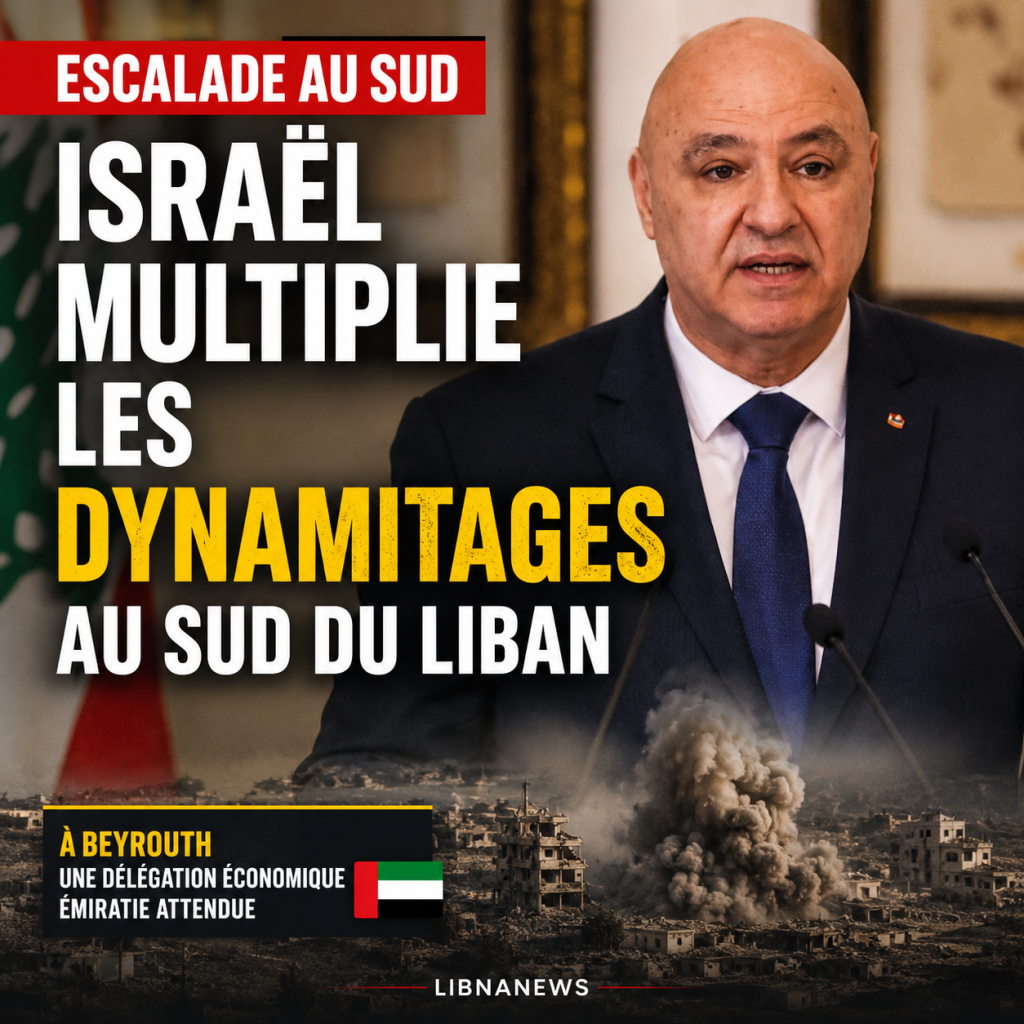
On Tuesday, 25 August, Israeli forces intensified their destruction and firing operations in several areas of southern Lebanon. Dynamiting, house demolitions, armoured movements, artillery fire and fire were reported from Bint Jbeil to Tyre, including Nabatiyah and Marjayoun. This new sequence comes as a major economic delegation from the United Arab Emirates arrives on Wednesday 26 August in Beirut for a two-day visit, in a context where Lebanon is simultaneously trying to contain military pressure in the South and revive its Arab economic relations.
Dynamiting in several southern districts
The day of 25 August was marked by a succession of Israeli operations on a large arc of border territory. From Monday night to Tuesday, explosions were reported in Hadatha and on the outskirts of Haris, in Bint Jbeil District.
Operations continued in the morning. Significant blasting has been reported in Zawtar al-Sharqiya, Nabatiyah District. In Ainata, Bint Jbeil District, heavy artillery fire targeted the western sector of the town. Other explosions were reported in Sarbine and Mais al-Jabal.
In Doubeih, on the western outskirts of Mais al-Jabal, Israeli forces demolished several constructions. This area of Marjayoun District is one of the areas where military movements and destruction operations are regularly reported.
The increase indynamiting in southern Lebanonis one of the most visible elements of pressure on communities close to the border. It directly affects buildings and infrastructure and complicates the stabilization of the villages concerned.
Guns, artillery and fire in southern Lebanon
Operations were not limited to demolitions. Israeli military vehicles were observed in Houla, Markaba and Mansouri. Other movements have been reported from Taybeh to Qantara in the Marjayoun area.
In Markaba, these movements coincided with artillery fire. Bombardments also affected several other sectors. These include the Zibqine wadi, the heights of Ali al-Taher, Dohat Kfar Rummane and the Slouqi wadi.
The fire also involved Bani Hayyan, where several heavy shells were reported during the day. Bombardments hit the vicinity of Khiam, Qantara, Mansouri, Beit Lif, Sarbine and Baraachit. Gunfire was also reported in several locations.
At the same time, fires hit agricultural land. Olive groves burned between Hadatha and Haris. Fires were also reported in the area of Ainata and in the heights of Jabal al-Warda near Markaba.
These fires add an agricultural dimension to the damage caused by military operations. In border villages, cultivated land is an important source of income. Their destruction or inaccessibility therefore affects opportunities for return and economic recovery.
Mansouri and several communities hit during the day
Military activity continued over the hours. In Mansouri, in Tyre District, demolitions and air strikes were reported. A Merkava tank was also observed in the area of the locality.
In Yater, an Israeli drone dropped deafening grenades. In Dohat Kfar Rummane, a drone targeted a van-type vehicle. The projectile hit the ground and shrapnel reached the vehicle, without causing any casualties according to available information.
The previous night had already been marked by shootings at several sectors. An air strike targeted the course of Litani at about 4 a.m. under the monastery of Deir Mar Mima in Deir Mimas.
Land embankments have also been erected in the area of Deir Mimas, Burj al-Muluk and Kfar Killa. One of them was about 150 metres away from Burj al-Muluk, according to reports on Tuesday.
Taken together, these events show activity spread across several cazas rather than a single-point incident. Operations involve destruction of buildings, land movements, bombardments, overflights and drone operations.
Persistent pressure despite negotiated framework
This sequence occurs in a security environment that is always unstable. Following the resumption of hostilities in March 2026, diplomatic efforts, including by the United States, culminated in a framework agreement between Lebanon and Israel in June.
This arrangement provides for a gradual Israeli withdrawal from the occupied Lebanese territories, along with the deployment of the Lebanese army and the handling of the issue of the weapons of armed groups. However, its implementation remains incomplete.
The operations of 25 August show that the situation on the ground remains far from normalization. Material destruction is an immediate challenge for the inhabitants of the affected areas. They complicate reconstruction and maintain uncertainty about the conditions for a sustainable return to several villages.
The issue also remains linked to the political and security discussions between Beirut and Israel, conducted with American mediation. Several rounds of discussions have already taken place in Rome. No final timetable for a new round of negotiations had yet been announced on Tuesday.
France and Saudi Arabia, for their part, reaffirmed on 24 August their support for a solution including Israel’s complete withdrawal from Lebanese territory and the disarmament of armed groups. This position comes at a time when the question of effective control of the territory remains at the centre of discussions on the future of the South.
Emirati delegation expected in Beirut
It is in this context that Beirut hosts, on Wednesday, 26 August, an important economic delegation from the United Arab Emirates. The mission is scheduled to remain in Lebanon until Thursday, 27 August.
It is led by Thani bin Ahmed Al Zeyoudi, Emirati Minister of Foreign Trade. The Lebanese economic authorities and officials had initially announced a delegation comprising 67 leaders and businessmen. Other information published in the approach to the visit refers to about 80 participants. This difference is likely to reflect the enlargement of the composition of the mission, without a complete final list being made public in the available elements.
As early as 24 August, President Joseph Aoun had discussed preparations for the visit with the Lebanese Ambassador to the United Arab Emirates, Tarek Mneimneh. The Lebanese economic circles present displacement as a stage in the resumption of economic relations between Beirut and Abu Dhabi.
Prime Minister Nawaf Salam also welcomed the delegation’s visit in a telephone interview with the Emirati Minister for Foreign Affairs, Abdallah bin Zayed. He felt that the visit could help to strengthen cooperation and partnerships between the two countries.
Beirut seeks to restore economic confidence
The Emirati visit should address opportunities for cooperation and investment in several sectors. Its composition, dominated by economic leaders, investors and business leaders, gives it a different scope from conventional diplomatic missions.
It is part of the rapprochement between Beirut and Abu Dhabi. In particular, President Joseph Aoun and President Emirati Mohammed bin Zayed Al Nahyane had discussed the strengthening of bilateral relations in their previous discussions.
For the Lebanese authorities, the presence of such a large group of Emirati economic actors is a signal sought after years of financial crisis and difficult relations with part of the Gulf countries. However, it alone does not mean that specific investments will be made. The concrete announcements will have to be evaluated at the end of the meetings on 26 and 27 August.
The security situation remains an essential element of this equation. The recovery of investment, the reconstruction of the South and the sustainable return of foreign capital depend in part on the capacity of the State to stabilize the territory and reduce the risk of a new confrontation.
The simultaneity of the two sequences is particularly clear Wednesday morning: in the south, the consequences of the Israeli blastings and bombings of 25 August remain visible in several villages; In Beirut, Lebanese officials and Emirati opened two days of economic discussions. The results of the Emirati mission and the evolution of military operations in border localities must now be monitored in parallel.




