

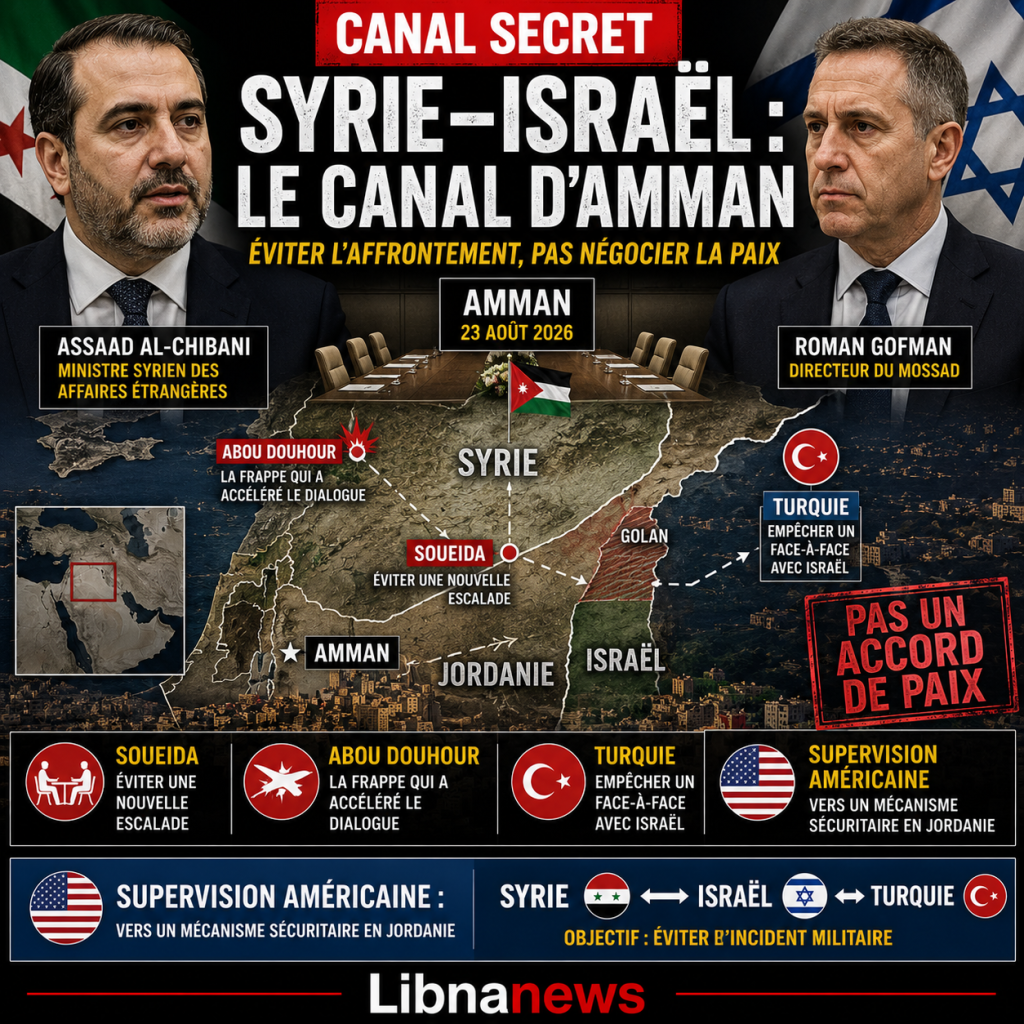
The secret meeting held on 23 August 2026 in Jordan between the Syrian Foreign Minister, Assaad al-Chibani, and the director of Mossad, Roman Gofman, does not constitute a peace agreement or normalization between Damascus and Israel. However, it reveals the existence of a direct military risk management channel, reopened in the emergency after an Israeli strike against the Abu Douhour air base in north-western Syria. Discussions focused on Sueida, military tensions in the south of the country and the establishment of a security mechanism under American supervision to avoid confrontation between Syria and Israel, but also between Israel and Turkey.
A meeting after the strike of Abu Douhour
The military context is crucial to understanding the scope of the Amman meeting. A few days before the interview, Israel had struck the Abu Douhour air base in the Idlib area. The operation had suddenly raised the tension between the new Syrian authorities and Israel, at a time when several channels were trying to maintain a minimum security dialogue between the two sides.
The strike also rekindled concerns about the Turkish presence in Syria. Information had been circulated on the possibility of Turkish military movements or deployments around the base. Damascus had denied any plans to permanently install a Turkish base in Abu Douhour. Israel, for its part, made known its red lines in the face of any Turkish military strengthening that could alter Syria’s strategic balance.
In this climate, the meeting of 23 August was conceived as an instrument of de-escalation. It came after several contacts between Syrian, American and Israeli officials. Assaad al-Chibani had met American envoy Tom Barrack in Istanbul on 17 August. According to information reported by the Arab press, this sequence helped prepare the meeting held a few days later in Jordan.
Assaad al-Chibani facing Roman Gofman
The Syrian delegation was led by Assaad al-Chibani, Minister of Foreign Affairs of the new Syrian power. On the Israeli side, the main interlocutor was Roman Gofman, director of Mossad. The choice of participants gives an initial indication of the nature of the dialogue. It was not a traditional diplomatic exchange between two States preparing for normalization, but a discussion focusing on security, military incidents and preventing escalation.
Jordan provided the framework for this meeting. The Hashemite kingdom maintains close relations with Washington and has channels with Damascus as with Israel. Its geographical and diplomatic position also allows it to quietly welcome discussions on the security of southern Syria.
According to Al Quds Al Arabi, who reports the details of the meeting in its 25 August edition, the discussions were difficult but serious. A diplomatic source describes a process that is still complicated, but does not question the willingness of the two sides to continue their contacts. This assessment is one of the main lessons of the meeting: differences remain deep, but they no longer prevent direct dialogue when military risk becomes too high.
Soueida, one of the sensitive cases
Among the issues discussed are the situation in Sueida, in southern Syria. This Druze-majority province has become one of the most delicate points of the new Syrian configuration. Internal tensions, local security issues and Israeli interventions justified by Israel in the name of the protection of the Druze have gradually transformed Sueida into a direct friction between Damascus and Tel Aviv.
For the Syrian authorities, the control of the south is a matter of national sovereignty and the restoration of state authority after the fall of the Bashar al-Assad regime. For Israel, the security development of the area affects its border interests and its position towards Syrian Druze communities. The superimposition of these two logics increases the risk that a local operation may cause a wider military reaction.
The Amman meeting therefore sought to identify mechanisms capable of containing incidents. This includes preventing a movement of Syrian forces, an Israeli operation or a local crisis in Sueida from being interpreted as the beginning of a larger offensive.
Damascus also placed the issue of Israeli operations on the table. The new Syrian authorities are calling for the cessation of strikes and incursions into their territory. They contest the positions taken by the Israeli army beyond the previous lines and regard these movements as an infringement of Syrian sovereignty. The Amman Canal does not resolve this disagreement. It aims, at this stage, to prevent it from leading to direct confrontation.
Syria-Israel: A Security Mechanism in Jordan
The most concrete element of the meeting concerns the project of a security mechanism established in Jordan and under American supervision. According to information reported by several media, the mechanism could take the form of a coordination structure or an operating room to deal with incidents quickly and exchange information between the parties concerned.
His first function would be to prevent a direct confrontation between Syria and Israel. The risk is real. The Israeli army continues to intervene in Syrian territory while the Damascus power seeks to restore its control over different parts of the country. In this context, a displacement of forces, a local operation or a strike can be interpreted as a broader threat.
The proposed mechanism would not eliminate political and territorial disagreements. In particular, it would provide for a system of notification and verification. This would allow the parties to quickly obtain information about a military movement or operation before deciding on a response that could lead to escalation.
American oversight is a central component of this project. Washington maintains a strategic relationship with Israel while developing its contacts with the new Syrian authorities. The United States thus has an intermediation capacity that neither Damascus nor Tel Aviv has alone. Their role would include transmitting messages, verifying certain information and keeping communications open during times of tension.
The Turkish factor at the heart of the equation
The Amman meeting, however, is not just about the relationship between Syria and Israel. Turkey is the third player in the equation. Ankara is one of the main partners of the new Syrian power. Its military and political influence in Syria has been strengthened, while Damascus considers cooperation with Turkey as an important element in rebuilding its state capabilities.
This development concerns Israel when it concerns military infrastructure that can accommodate Turkish forces or equipment. The case of Abu Douhour directly illustrates this difficulty. Israel had expressed its concern about the possible use of the base by Turkey, while Damascus was ensuring that no permanent Turkish base project was planned.
The mechanism discussed in Jordan would therefore have a second mission: to avoid a Turkish deployment to Syria causing a confrontation between Ankara and Israel. A coordination structure could clarify the nature of certain military movements and reduce the risk of their being immediately interpreted as a threat.
This dimension gives the project a regional scope. An incident between Israel and Syria could already lead to a significant escalation. A confrontation directly involving Israel and Turkey would have far wider consequences, Ankara being a member of NATO and one of the major military actors on the Syrian issue.
Washington is thus in a particular position. The United States is Israel’s main external ally and remains bound to Turkey by the Atlantic Alliance. They also have a growing canal with Damascus. The Jordanian mechanism could therefore function as a preventive architecture designed to keep these three actors away from unintentional confrontation.
An important step for the new Syria
The political significance of the meeting lies less with an immediate result, if any, than with the fact that it took place. Direct contacts at this level between Syrian and Israeli officials remain exceptional. Seeing the Syrian Foreign Minister meeting with the director of Mossad shows that the new authorities in Damascus accept a pragmatic dialogue when they consider that he can protect their security interests.
According to information reported by Al Quds Al Arabi, preparations for the meeting included the meeting between al-Chibani and Tom Barrack in Istanbul on 17 August. The newspaper also considers that the Israeli acceptance of a direct interview is an evolution after previous reluctance to organize such a meeting.
This openness does not mean that Syria abandons its territorial positions. Damascus continues to regard the Golan as occupied Syrian territory and calls for Israeli withdrawal from areas where Israeli forces have advanced. The Syrian authorities also continue to call for a halt to the strikes and refer to the arrangements resulting from the 1974 disengagement agreement.
Israel, for its part, retains strong reservations about the new Syrian power and intends to preserve its freedom of action in the face of developments that it considers threatening. Both sides therefore do not address these discussions with the same priorities. That is precisely why the description of difficult but serious negotiations makes sense.
A military channel, not a peace agreement
The secret meeting of Amman cannot therefore be equated with a peace agreement. There is no evidence of negotiations on diplomatic recognition, complete normalization or a timetable comparable to Israeli agreements with several Arab States.
The known objectives are more limited. Damascus and Israel first seek to prevent their forces, or those of their partners, from being drawn into an uncontrolled confrontation. Sueida, the Israeli incursions, the Abu Douhour base and the Turkish military presence are all homes where a misinterpretation could quickly cause a regional crisis.
The real novelty therefore lies in the method. Both sides are testing a more structured channel in which Jordan provides space for dialogue and the United States can provide oversight. This does not automatically bring Syria and Israel closer to their fundamental differences, but it creates a tool to manage the military consequences of these disputes.
Future discussions will have to show whether this architecture is beyond the project stage. The resumption of contacts, the evolution of Israeli operations in Syria and the modalities for a possible Turkish deployment will mainly determine whether the Amman Canal can really prevent the next military incident from turning into a confrontation.




