

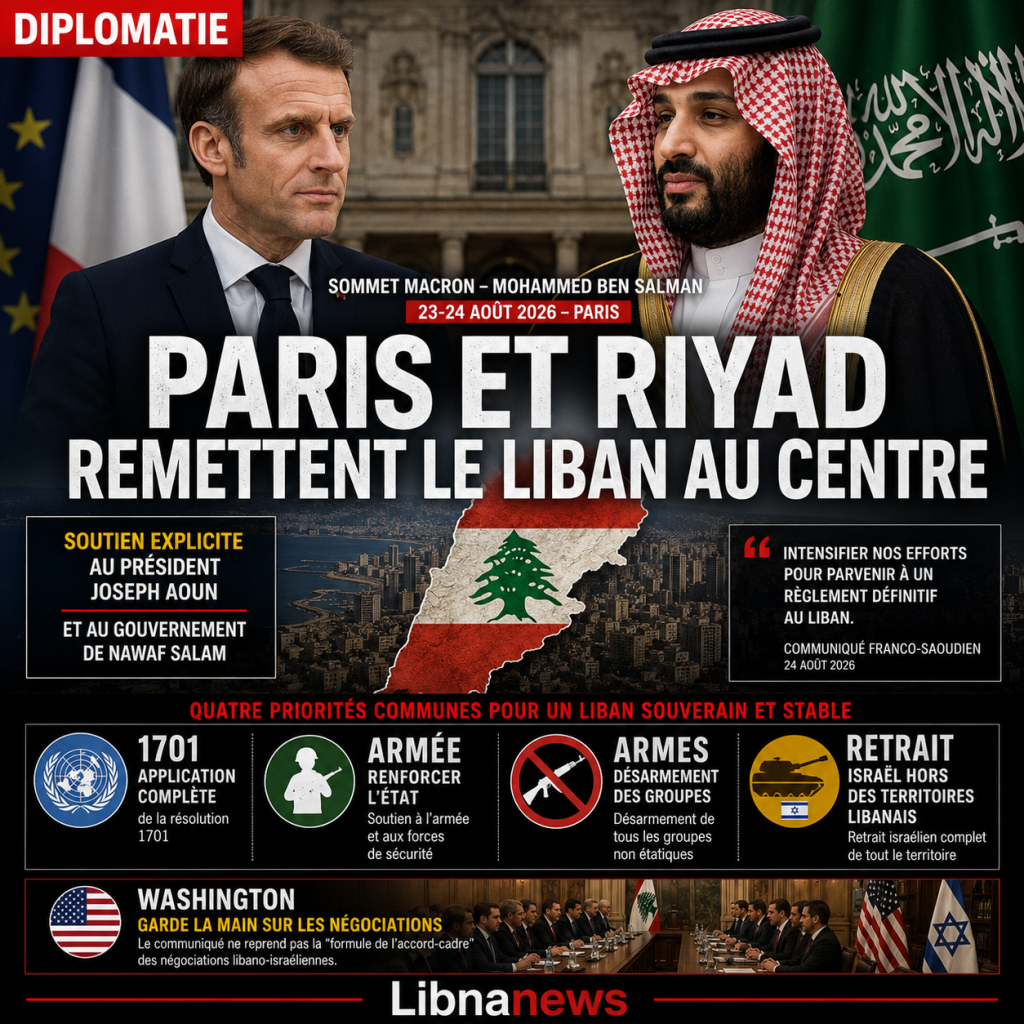
Paris and Riyadh place Lebanon at the centre of their regional coordination. Following Mohammed bin Salman’s State visit to France on 23 and 24 August 2026, Emmanuel Macron and the Saudi Crown Prince set out a road map that combines four objectives: the full implementation of resolution 1701, the strengthening of the Lebanese army, the disarmament of non-State armed groups and the Israeli withdrawal from all Lebanese territories. The communiqué also explicitly supports President Joseph Aoun and the government of Nawaf Salam. However, it does not take up the « framework agreement formula » which currently structures the Lebanese-Israeli negotiations under American leadership. This difference makes it possible to measure both the convergence between Paris, Riyadh and Beirut on the strengthening of the state and the limits of their alignment with the Washington-led mechanism.
Macron and Mohammed bin Salmane display a common line
Mohammed bin Salman’s visit to Paris far exceeded the Lebanese case. Saudi Crown Prince and Prime Minister met with Emmanuel Macron during a two-day state visit. The two leaders also chaired the first meeting of the Franco-Saudi Strategic Partnership Council. Discussions focused on bilateral relations, defence and investment, but also on the main crises in the Middle East.
The final communiqué reflects a desire for broader political coordination between France and Saudi Arabia. Both countries emphasize the sovereignty of States, respect for international law and the search for political solutions to regional crises. Lebanon appears in this architecture as a specific case, for which Paris and Riyadh are not content to call for stability. They define the elements they consider necessary for a lasting settlement.
This formulation marks an important development. France and Saudi Arabia claim to want to « intensify their efforts » in order to reach a final settlement in Lebanon. They place at the heart of this process the strengthening of the Lebanese State and its institutions, as well as the preservation of the sovereignty and territorial integrity of the country.
The logic is therefore institutional before being only safe. Paris and Riyadh consider that a lasting settlement requires the State to regain its capacity to exercise its full authority. The press release then declines this general direction into much more specific requests.
Lebanon: Resolution 1701 returns to central framework
First element of the Franco-Saudi roadmap: full implementation of UN Security Council Resolution 1701. Adopted in August 2006 after the war between Israel and Hezbollah, this resolution has been one of the main international frameworks applicable to southern Lebanon for twenty years.
The choice of words is important. Paris and Riyadh do not require partial or limited application of border provisions. They insist on its full implementation. This means that their approach cannot be reduced to the mere cessation of military operations between Israel and Lebanon.
The resolution also concerns the authority of the State, the deployment of regular forces and the absence of weapons or authority other than those recognized by the Lebanese Government. The Franco-Saudi communiqué therefore directly links the question of the south with that of the more general monopoly of legitimate force by the State.
This approach corresponds to the line defended since Joseph Aoun’s arrival in the presidency. The Head of State has made the restoration of institutional authority and State control over weapons a central element of his mandate. The government of Nawaf Salam is also part of this logic.
Paris and Riyadh want to strengthen the Lebanese army
The second axis directly concerns the Lebanese armed forces. France and Saudi Arabia reaffirm their commitment to support the army and the security forces so that they can fully exercise their national responsibilities.
This provision is not secondary. It provides the operational component of the State Strengthening Strategy. To ask Beirut to extend its authority presupposes that the security institutions have the necessary means to do so.
Paris has long maintained military cooperation with Lebanon. Riyadh, for its part, has gradually put the State and its institutions at the centre of its Lebanese policy. Franco-Saudi convergence now consists in presenting support to the army as one of the indispensable instruments for a political settlement.
The issue could quickly be translated into concrete terms. Paris has been working for several months on an international mobilization for the Lebanese armed forces. A military meeting was announced for 17 September, following the postponement of initiatives previously envisaged due to the deterioration of the regional situation.
Support for the army is therefore not presented as an isolated measure. It must accompany the extension of State authority and make possible the fulfilment of the security commitments requested in Lebanon.
The disarmament of non-State groups explicitly requested
The third element is the most politically sensitive in Lebanon. France and Saudi Arabia are calling for the completion of the disarmament of all non-State armed groups.
The formulation goes beyond the case of Hezbollah alone, although the Shiite movement is obviously the main actor involved in this issue. The general principle is that no organization outside the State institutions should maintain an independent military capacity for a long time.
This demand is directly in line with the strategy of restoring the state monopoly on arms. It also provides special political support to Joseph Aoun and Nawaf Salam. Paris and Riyadh are not limited to welcoming the institutional stability found. They endorse the measures taken to rebuild institutions and extend State authority.
However, the Franco-Saudi communiqué associates this requirement with another obligation, addressed this time to Israel. It is this articulation that constitutes one of the most significant elements of the text.
Israeli withdrawal in the same equation
Paris and Riyadh call for a complete Israeli withdrawal from all Lebanese territories. The disarmament of non-State groups therefore does not appear alone in the road map. It is placed next to the end of the Israeli presence on Lebanese territory.
This construction allows the two capitals to present their approach as based on parallel obligations. The Lebanese State must regain the arms monopoly and exercise its full authority. Israel, for its part, must withdraw entirely from Lebanese territory.
The communiqué does not thus define sovereignty as an obligation applicable only to Beirut. It uses it in both directions: the State must be the sole holder of legitimate force within Lebanon and its territory must be freed from any Israeli military presence.
This articulation is politically important to the Lebanese authorities. An exclusively disarmament-oriented strategy would expose Beirut to the accusation of accepting internal demands without obtaining a counterpart on the issue of the Israeli occupation. On the contrary, Paris and Riyadh have both files in the same diplomatic set.
Joseph Aoun and Nawaf Salam get explicit support
The communiqué also includes a message addressed directly to the Lebanese authorities. Emmanuel Macron and Mohammed bin Salmane welcome the steps taken by President Joseph Aoun and the government led by Nawaf Salam to rebuild institutions and extend state authority.
This support is significant because it focuses on a specific policy direction. Paris and Riyadh confirm the principle of a strengthened State, with operational institutions and capable of exercising its security authority in its territory.
For Joseph Aoun, this position provides external support for a strategy that remains politically sensitive within the country. For Nawaf Salam, it confirms that the French and Saudi partners associate Lebanon’s recovery not only with economic and institutional reforms, but also with the restoration of state sovereignty.
This convergence does not mean that Paris and Riyadh already have a mechanism to achieve all these objectives. The press release focuses on principles and the desired outcome. It is precisely on the method that comparison with the American process becomes important.
What the French-Saudi communiqué does not say
In its August 25 edition, Al Joumhouria noted a significant difference in wording. The Franco-Saudi communiqué explicitly cites Resolution 1701, but does not take up the « framework agreement formula » used in the Lebanese-Israeli negotiations currently conducted with the involvement of the United States.
This absence does not mean that Paris or Riyadh reject the negotiations. Rather, it shows that their joint statement is on another level. France and Saudi Arabia define the political objectives of a settlement: Lebanese sovereignty, institution-building, state monopoly of arms, implementation of resolution 1701 and Israeli withdrawal.
Washington is more involved in the process of transforming these principles into concrete arrangements between Lebanon and Israel. Discussions include territorial and security arrangements, as well as steps to continue negotiations.
According to Al Joumhouria, no further progress had been made on this front on 24 August. Lebanese officials were waiting for a US initiative to continue discussions and set up an eighth negotiating session.
The distinction is therefore essential. The Franco-Saudi text does not replace American mediation and does not announce a new competing channel. Rather, it provides a common political framework for Paris and Riyadh, while Washington remains directly engaged in the mechanics of the Lebanese-Israeli discussions.
Convergence on objectives, not a parallel mechanism
The Paris roadmap thus shows an implicit division of roles. France and Saudi Arabia support the reconstruction of the Lebanese state and define the principles they want to see incorporated into a settlement. For the time being, the United States continues to play a key role in direct or indirect negotiations between Beirut and Israel.
It would therefore be excessive to present the communiqué as the announcement of a diplomatic initiative competing with the Washington initiative. Nothing in the public text establishes the creation of a new negotiating format. On the other hand, Paris and Riyadh reaffirm their willingness to influence the definition of the final result.
This nuance also includes the term « final settlement » used in the press release. The two countries no longer only want to deal with the immediate consequences of the confrontation in the south. They seek to place the case in a broader perspective, based on the strengthening of the State and the simultaneous resolution of the main issues of sovereignty.
The content published after the Macron-Mohammed bin Salmane meeting is therefore more accurate than a simple message of support in Lebanon, but less operational than a negotiating plan. It sets out four requirements and provides political support to the Lebanese authorities. It does not define a timetable for their implementation, a detailed sequence between disarmament and Israeli withdrawal, or a new mechanism to replace the one led by Washington.
At this stage, the next concrete indication will therefore come less from the principles set out in Paris than from their translation. The continuation of the Lebanese-Israeli negotiations, the international mobilization for the army and the decisions taken in Beirut on the arms monopoly will determine whether Franco-Saudi convergence becomes an operational lever or remains a common political framework.




