

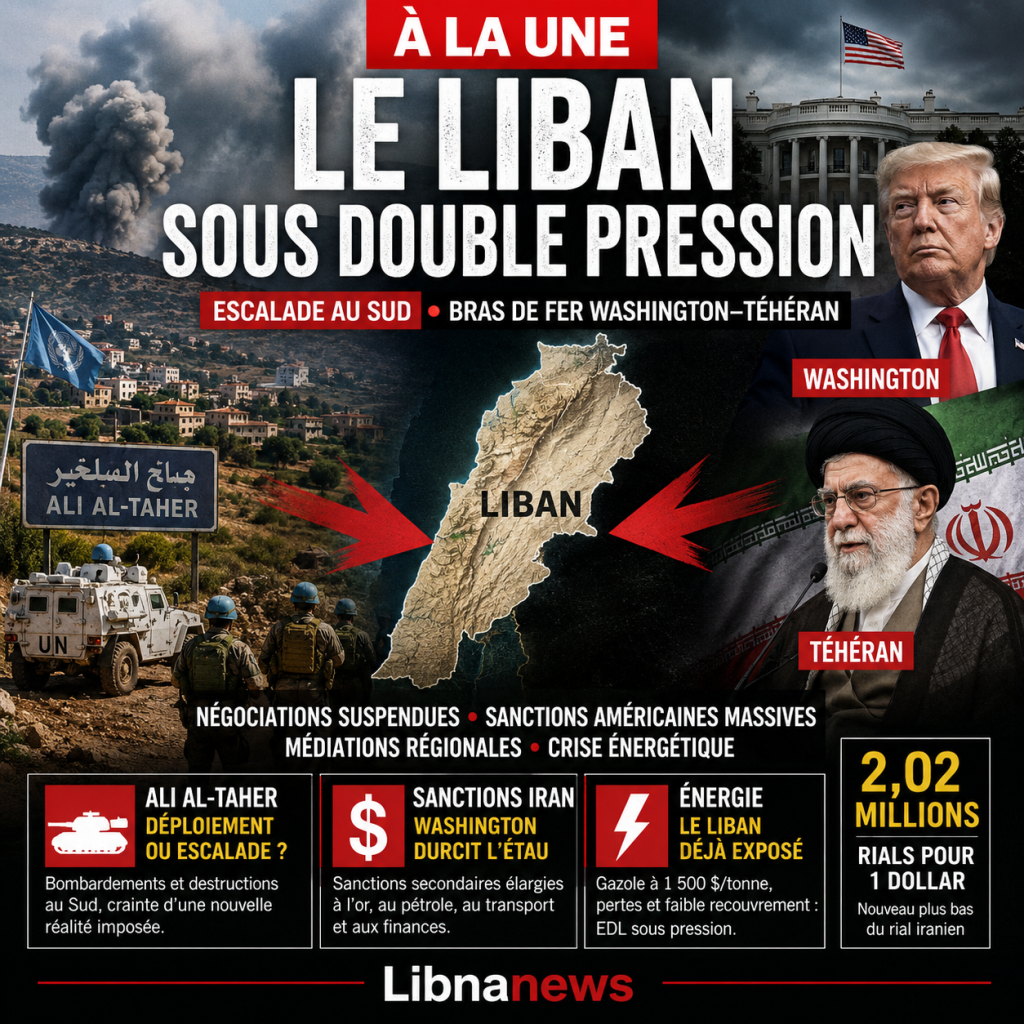
The South at the centre of concerns and Ali al-Taher as the crystallization point
The press of 25 August 2026 puts Lebanon in front of two movements that intersect. The first is military and directly concerns the South, with the continuation of Israeli operations and the tension around the heights of Ali al-Taher. The second is regional. It follows from the dramatic tightening of US economic pressure against Iran. Between the two is the Lebanese State, which tries to preserve the path of negotiations while seeking international guarantees. Several newspapers describe a phase in which the diplomatic calendar remains suspended from military developments. Al Jumhouria of 25 August 2026 reports that no date has yet been set for the eighth direct negotiation session between Lebanon and Israel in Rome. According to the diplomatic sources cited by the daily newspaper, Beirut did not receive any new information from the American mediator. They believe, however, that Washington prefers to limit operations around Ali al-Taher rather than allow confrontation to spread. The same publication mentions a different fear: Israel might have chosen a military option to impose a new reality in the South before a political compromise was reached. This assumption is based, inter alia, on the continuation of bombings and destruction operations in several sectors. Al Jumhouria also stresses that the evolution of Ali al-Taher can directly affect the resumption of negotiations.
Al Arabi Al Jadid of 25 August 2026 also presents Ali al-Taher as one of the main points of tension. According to information gathered by the newspaper, the Lebanese army would not oppose taking a position on these heights. However, it would request American guarantees. These should include the cessation of Israeli operations in the area and a full Israeli withdrawal prior to the deployment of Lebanese troops. The daily says that the issue is an important part of the discussions between Beirut and Washington. He also reports that President Joseph Aoun exchanged with the Americans on a formula that allowed the army to deploy after the withdrawal of Hezbollah elements. The Speaker also reportedly informed the Speaker of the House, Nabih Berri, of this process. The newspaper adds, however, that Hezbollah is wary of American or Israeli guarantees. This divergence therefore complicates a solution which, on paper, would transfer control of the area to the army without a major battle. Al Arabi Al Jadid also reports the continuation of Israeli strikes and recalls that the United Nations considers the blue line as the relevant reference in the South. The United Nations Interim Force in Lebanon claims that any Israeli military presence north of this line constitutes a violation of Resolution 1701.
Annahar of 25 August 2026 describes two scenarios concerning the heights of Ali al-Taher. According to a security source quoted by the daily newspaper, either Hezbollah surrenders the area to the Lebanese army or Israel launches a military operation to take control of it. This alternative illustrates the reduction of the Lebanese margin of manoeuvre. The newspaper also points out that the question of the future method of verifying agreements remains in the hands of the American mediator. An official source claims that Joseph Aoun did not negotiate with the Italian officials the choice of the country or agency responsible for this mission. According to this version, Washington retains responsibility for defining the appropriate formula. At the same time, Annahar notes that Israeli shelling, destruction and earth-moving operations continue in several southern localities. The combination of this military pressure and the lack of a precise timetable for the new meeting in Rome is therefore uncertain.
Paris and Riyadh want to strengthen the state while Washington retains the decisive role
Diplomatic activity around Lebanon is the other major component of the front page. Asharq Al-Awsat of 25 August 2026 gives a central place to the visit of Saudi Crown Prince Mohammed bin Salmane to Paris and his discussions with French President Emmanuel Macron. The joint Franco-Saudi communiqué affirms the will of both countries to intensify their efforts to reach a final settlement of the conflict in Lebanon. This approach must, according to the daily report, strengthen the Lebanese State and its institutions, preserve its sovereignty and territorial integrity. Paris and Riyadh also reaffirm their support for the Lebanese armed forces. They call for full implementation of resolution 1701, disarmament of non-State armed groups and Israeli withdrawal from all Lebanese territory. The communiqué also supports the efforts of Joseph Aoun and the government led by Nawaf Salam. The Franco-Saudi rapprochement thus gives the Lebanese dossier a dimension that goes beyond negotiations with Israel alone. It places the reconstruction of institutions and the strengthening of the army at the heart of the diplomatic strategy.
Ad Diyar of 25 August 2026 asks precisely about the French objectives. According to diplomatic sources cited by the daily newspaper, Paris would seek a significant Saudi commitment in the preparation of a conference in support of the Lebanese army and security forces. France would like a financial and political participation capable of giving this initiative a stronger Arab foundation. The newspaper also refers to the debate on the possible successor force to the United Nations Interim Force in Lebanon. Paris would like to retain a place in this future architecture. However, the press also describes Italy’s growing influence, particularly after Lebanese political and military contacts with Rome. Ad Diyar considers that Washington nevertheless remains the external actor with the decisive weight. According to its analysis published on 25 August 2026, the other powers must deal with American choices, whether it be the French, Italian, Saudi or Iranian role.
The same context explains the importance of the announced visit by an important economic delegation of the United Arab Emirates. Several newspapers of 25 August 2026 report that Joseph Aoun discussed the preparations for this visit with the Lebanese ambassador to the United Arab Emirates, Tarek Mnaymneh. The delegation, led by Emirati Minister of Foreign Trade Thani ben Ahmed Al Zeyoudi, is to include 67 economic and business leaders and travel to Lebanon on 26 and 27 August. Beyond its commercial dimension, this visit comes as the authorities seek to place Lebanon in Arab investment channels. It thus complements the Franco-Saudi political aspect with a Gulf economic perspective. Ad Diyar of 25 August 2026 makes it even one of the main titles of its one, evoking the reopening of the doors of the Gulf investment.
Washington turns confrontation with Tehran into a financial war
The second major news common to all is Iran. Several publications of 25 August 2026 give a major place to the new sanctions mechanism announced by Washington. Asharq Al-Awsat presents this offensive as an « economic landing » designed to further isolate Tehran. According to the newspaper, the US Treasury Department has expanded the scope of secondary sanctions to include digital assets, technology, gold, aviation and shipping. About 60 people, entities and ships linked to Iran are affected by the measures reported in daily life. US Treasury Minister Scott Bessent explains that the goal is to cut the economic channels that still allow Iran’s system to function. He also warns countries and companies that continue their relationship with Tehran that they may be excluded from the dollar-based financial system. President Donald Trump says Iran is collapsing.
Al Arabi Al Jadid of 25 August 2026 further details the mechanics sought by Washington. The daily reports that the new sanctions should include Iranian oil buyers and carriers, shipping companies, foreign exchange offices, free zones, financial operations and other intermediaries that allow the Iranian economy to remain connected to international trade. At the same time the Iranian rial reached a new low, around 2.02 million rials for a dollar according to the data reported by the newspaper. Washington wants to put Iran’s trading partners before an alternative: maintain their relationship with Tehran or maintain their access to the US-dominated financial system. However, Iranian officials challenged the American presentation. Iranian Deputy Foreign Minister Kazem Gharibabadi underlines the contradiction he sees between the American claim to have largely destroyed Iranian capabilities and the declared need to conduct a financial offensive of exceptional magnitude.
Al Akhbar of 25 August 2026 also devotes great attention to what he describes as a « carnival » of sanctions. The newspaper notes that China is one of the main tests of the efficiency of the American device, since it would buy more than 80% of Iranian oil exported from sources it resumes. The real issue therefore becomes the application of secondary sanctions to actors outside Iran. If Washington succeeds in convincing or forcing buyers, carriers and financial intermediaries to withdraw, the impact could be considerable. Otherwise, Tehran would retain trade routes that would allow it to amortize part of the shock. This question goes through several newspapers: the American announcement is massive, but its effectiveness will depend on the behaviour of Iran’s economic partners.
Mediation remains active despite economic escalation
But American hardening does not mean stopping diplomacy. Al Quds Al Arabi of 25 August 2026 reports that the leader of the Pakistani army, Asim Munir, visited Tehran in an attempt to revive mediation efforts with Washington. According to Pakistani sources reported by several newspapers, Munir had exchanged with Donald Trump prior to his travel. The visit is aimed in particular at reducing the crisis of confidence between the United States and Iran. She also intervened before a visit to Tehran by Omani Foreign Minister Badr Al Busaidi. Oman is to discuss navigation in the Strait of Ormuz. The coexistence between maximum sanctions and mediations shows that the two logics do not exclude. Washington increases the economic cost of Iran’s refusal, while allowing channels to be maintained to bring the parties back to negotiation.
Ad Diyar of 25 August 2026 also describes the exchanges involving Iranian Foreign Minister Abbas Araghchi, Oman and Pakistan as an attempt to recirculate messages between Washington and Tehran. The question of Ormuz Strait remains essential. Disruptions in maritime traffic have effects that far exceed Iran. Al Arabi Al Jadid of 25 August 2026 notes that oil is evolving at around $90 and that fuel prices are suffering the consequences of stopping or reducing the passage of certain ships carrying petroleum products. Economic confrontation thus becomes a global supply and price problem. It also affects Lebanon, whose energy vulnerability remains high.
This fragility already appears in the Lebanese electricity sector. Al Arabi Al Jadid of 25 August 2026 reports that the exceptional increase in oil prices directly affects electricity in Lebanon. The international price of diesel oil would have approached $1,500 per tonne, whereas the institution’s 2026 budget had been constructed on an assumption of about $680. The daily newspaper adds the consequences of the war, non-technical losses and the decrease in the collection of invoices in several regions. The arm between Washington and Tehran is therefore not only an international political subject for Beirut. Its energy consequences can directly exacerbate Lebanese financial and social difficulties.
Shibani case reveals internal tensions around the relationship with Iran
The Iranian question finally has a direct Lebanese extension with the fate of Mohammad Reza Shibani. Several newspapers on 25 August 2026 report that the former Iranian ambassador obtained a six-month residence in Lebanon without regaining the status of accredited ambassador. Al Akhbar claims that General Security Director Hassan Choucair played a role in the search for a formula to avoid further confrontation with Tehran. According to the daily, the solution now distinguishes two questions: Shibani’s right to stay in Lebanon and his diplomatic status. His presence becomes legal for six months, but his mission as ambassador remains complete. Al Akhbar presents this evolution as a failure for those who called for his departure.
Annahar of 25 August 2026 adopts a different reading and insists on the institutional contradictions caused by this solution. The newspaper reports that the General Security Directorate granted Shibani a courtesy residence, whereas the Ministry of Foreign Affairs would not have been involved in this decision. He recalls that Foreign Minister Youssef Raggi had defended a much stricter position after Shibani’s ranking among undesirable people. For Annahar, the case goes beyond the personal situation of the former ambassador. It raises the question of the State’s ability to consistently implement its own decisions on sovereignty and diplomatic relations. Asharq Al-Awsat of 25 August 2026 confirms the granting of a six-month residence in a civilian capacity and reports that the Ministry of Foreign Affairs had not been informed of the decision at the time its sources were interviewed.
The treatment of the one of 25 August thus shows a single line of tension in several forms. In the South, Lebanon is trying to avoid a battle around Ali al-Taher derailing the diplomatic path. In Paris, France and Saudi Arabia are seeking to place the state and army at the centre of the settlement. In Washington, the Trump administration launches an economic offensive of exceptional magnitude against Tehran. Finally, in Beirut, the Shibani case shows that the relationship with Iran continues to cause differences within the institutions themselves. The common thread is therefore not an isolated event, but a question of balance of power: who can impose the rules of the next phase, while negotiations continue without having yet produced a settlement and the military, financial and diplomatic pressure is increasing simultaneously?
Local politics: the Lebanese state faced with the South test, the negotiating divisions and the relationship with Iran
Joseph Aoun defends the state while the crisis in the South imposes its timetable
Lebanon’s domestic policy remains dominated by the war in the South and by the State’s ability to take up the initiative in a cross-cutting issue between Hezbollah, Israel and the United States. On 25 August 2026, several publications described a presidency that sought to maintain the diplomatic path while avoiding a further extension of the conflict. This strategy is reflected in the activities of President Joseph Aoun, but also in the debates around the heights of Ali al-Taher and direct negotiations with Israel. Ad Diyar of 25 August 2026 reports that Joseph Aoun received Defence Minister Michel Menassa to examine the security situation and the needs of the army. He also met with several politicians. Together with MP Ahmad al-Khair, he discussed the results of his visit to Rome and the discussions on the framework agreement. The issue is central, as the authorities still hope to secure arrangements to stabilize the South without further general confrontation. At the same time, Aoun took advantage of the commemoration of the birth of the prophet to call the Lebanese to patience, unity and the reconstruction of a strong and just State. He presented national unity as the main bulwark in the face of challenges. This declaration takes on a particular political meaning in a country where the choice of negotiations with Israel is now directly challenged by Hezbollah.
The situation of Ali al-Taher concentrates much of these contradictions. Al Arabi Al Jadid of 25 August 2026 reports that the Lebanese army would be willing to take control of the heights, provided that American guarantees were obtained on the cessation of Israeli operations and the prior withdrawal of Israeli forces. According to news from the newspaper, Joseph Aoun approached this possibility with the Americans and informed the Speaker of the Chamber, Nabih Berri. The objective would be to prevent the dispute from culminating in a battle that could lead to a further extension of the war. However, Hezbollah would not trust American or Israeli safeguards. The question is no longer only military. It directly affects the division of responsibilities between the Presidency, the army and Hezbollah. It also raises the question of whether the State can become the sole interlocutor in the arrangements concerning Lebanese territory.
Annahar of 25 August 2026 sums up this situation with two scenarios: a handover of Ali al-Taher’s heights to the Lebanese army or an Israeli operation to take them by force. The daily believes that the file is now integrated into regional power relations. This reading gives Hezbollah’s decision a major political importance. A transfer to the army would strengthen the state’s position and could avoid a battle. A prolonged refusal would instead increase the risk of an Israeli operation. The question of sovereignty, regularly invoked by the various political forces, is thus confronted with a very concrete situation: to determine who controls a strategic military position and under what conditions such control can be transferred to the army.
Hezbollah attacks the choice of negotiations and simultaneously opens the question of a dialogue with Washington
The most clear political disagreement concerns direct negotiations between the State and Israel. Al Arabi Al Jadid of 25 August 2026 reported the statements of deputy Hassan Ezzeddine, member of the Hezbollah parliamentary bloc. It believes that the framework agreement has led the political power to move away from its own commitments. He accuses the authorities of losing their national orientation and even calls for the prosecution of those responsible for coordinating with Israel. For Hezbollah, the problem includes the existence of a security and military coordination provided for in the negotiating mechanism. These statements show the extent of the political conflict around the method chosen by the State. The government sees the negotiations as a way to achieve Israeli withdrawal and stabilization. On the contrary, Hezbollah sees it as a mechanism that could impose Israeli conditions on Lebanon.
Al Sharq of 25 August 2026 reports a comparable critique of Hassan Ezzeddine. The honourable Member asks what direct negotiations have really brought since they were launched and accuses the power of having chosen this path despite the divisions it causes. He opposed direct negotiations to an indirect formula which, in his view, could have benefited from broader national support. He goes so far as to consider that political power has lost its ability to govern when it moves away from the concerns of the population while pursuing a strategy that has not yet obtained Israeli withdrawal. The virulence of this position shows that the question of the South is no longer limited to tactical disagreement. It becomes part of the debate on the legitimacy of executive decisions and on the way in which major national security decisions must be made.
Yet the same Hezbollah sends a different signal to Washington. Annahar of 25 August 2026 goes back to Mahmoud Qomati, who said that the party did not permanently close the door to direct contact with the Americans and that a decision would depend on the circumstances and political interest. The daily notes that such a statement is not presented as an improvisation. It would have been preceded by internal discussions on the possible usefulness of a canal with Washington. The paradox is important: Hezbollah criticizes the direct negotiations led by the State with Israel, but itself envisages the possibility of direct contact with the United States. Annahar notes, however, that the party does not regard Washington as a neutral mediator and does not necessarily foresee the immediate opening of a dialogue.
Al Akhbar of 25 August 2026 places this issue in the internal debates of the American administration. The daily reports that some of the American officials would consider that the Lebanese authorities are facing serious difficulties in implementing their commitments and that Arab or regional intermediaries have mentioned the usefulness of contacts with Hezbollah. The newspaper also mentions an approach attributed to US Vice-President JD Vance, according to which the Lebanese case could be integrated into a broader settlement with Iran. He insists on the statements of Tom Barrack, who had considered it difficult to reach a serious agreement in the absence of Hezbollah and Iran, before making it clear that Washington was negotiating with the Lebanese State and considering Hezbollah as a foreign terrorist organization. These successive positions feed in Lebanon conflicting interpretations of the possible existence of a new path of dialogue.
Nawaf Salam favours the return of displaced persons and maintains the objective of the Israeli withdrawal
Prime Minister Nawaf Salam, for his part, seeks to link negotiating policy with the concrete consequences of the war. Ad Diyar of 25 August 2026 reports that he received a delegation from the southern town of Dhayra. The Head of Government stated that the State would not allow the inhabitants of this and other populations of the South to bear the consequences of displacement alone. Several housing solutions are being studied, including the payment of rent allowances. In particular, Salam stated that such measures should be taken in parallel with efforts to achieve a full Israeli withdrawal and create conditions for a safe return of the inhabitants to their villages and lands.
Al Sharq of 25 August 2026 also reports that Nawaf Salam refuses to govern by leaks or by statements attributed to anonymous sources. His office stressed that its positions should be considered official when published directly by him or by his services. This clarification occurs in a political climate where information on negotiations, relations with Washington and institutional differences often circulate through anonymous sources. It reflects a desire to further control government words. At the same time, the Prime Minister maintains his line in favour of a single, strong and just state. On the occasion of the religious commemoration on 25 August, he hoped that the Lebanese could find themselves under the roof of the same State capable of protecting their dignity and security.
This line receives explicit support from the Mufti of the Republic, Abdellatif Deriane. Al Jumhouria of 25 August 2026 reports that the mufti has declared its support for the President, the government and its Prime Minister in their efforts to stop Israeli attacks, free the territory and impose state authority over Lebanon as a whole. It also defended government efforts to resolve the economic and social crisis. Deriane stressed above all the need to have the courage of peace, believing that a truce decision to put an end to destruction can be more difficult and courageous than a decision to war. He finally affirmed that any political attack on the Presidency of the Council of Ministers constituted an attack on the country and defended cooperation between the three Presidencies.
The Shibani case exposes an institutional divergence on the relationship with Tehran
The situation of Mohammad Reza Shibani is another internal political issue where differences are visible. The former Iranian ambassador was not accredited as a new ambassador, but his stay in Lebanon was eventually extended. Al Akhbar of 25 August 2026 reports that the Director General of General Security, Hassan Choucair, has contributed to a solution allowing Shibani to remain in the territory for six months. The newspaper states that the formula is based on the administrative powers of the General Security and separates its right of residence from its former diplomatic status. He claims that this solution was politically coordinated with Joseph Aoun and Nabih Berri. According to Al Akhbar, it prevents the case from becoming a direct confrontation with Tehran.
Annahar of 25 August 2026 insists more on the institutional problems posed by this decision. The newspaper reports that the Ministry of Foreign Affairs would not have been consulted before the granting of the comity residence. Minister Youssef Raggi maintained, however, that the continued existence of Shibani in Lebanon after his classification as an undesirable person posed a legal and diplomatic problem. The newspaper recalls that the question now exceeds Shibani’s person. It concerns the State’s ability to enforce a sovereign decision uniformly. For Annahar, the administrative solution certainly avoids an immediate crisis with Iran, but it also reveals the existence of different readings within the state apparatus.
Asharq Al-Awsat of 25 August 2026 confirms the existence of this divergence. The daily reports that Shibani obtained a six-month legal residence as an Iranian citizen and not as a diplomat. A security source explains that Hassan Choucair proposed this solution on the basis of his legal competence and informed the relevant politicians. On the other hand, sources from the Department of Foreign Affairs stated that the department had not been informed of the decision at the time they were interviewed. The coexistence of these two versions shows that the problem also concerns the decision-making channels between the Presidency, the Government, General Security and Lebanese diplomacy.
Army becomes the point of convergence of competing strategies
In this fragmented landscape, the Lebanese army appears to be one of the few institutions around which several actors, however opposed to the rest, converge. Joseph Aoun insists on his role in the South. Nawaf Salam seeks to strengthen state authority. France and Saudi Arabia announce their support for the armed forces. Even the scenarios concerning Ali al-Taher envisage the army as the force likely to take control of the position if a political solution is found. Ad Diyar of 25 August 2026 reports that Paris wishes to obtain from Riyadh an important commitment at the preparatory conference to support the army and the security forces. In particular, France would seek Saudi financial participation that would give the project a stronger Arab dimension.
The role of the army is also linked to the future of the international machinery in the South. Al Joumhouria of 25 August 2026 points out that the visit of the army commander Rodolphe Haykal to Rome was planned independently of the direct negotiations with Israel and concerned the mechanisms of support for the military institution. At the same time, discussions on the United Nations Interim Force in Lebanon remain open. The lack of agreement on the force or mechanism to carry out certain missions after the end of the current mandate makes the military’s ability to deploy and exercise its authority even more important.
The Lebanese internal policy of 25 August 2026 is thus structured around a persistent contradiction. The main State institutions defend a strategy of negotiation, strengthening the army and seeking international guarantees. Hezbollah challenges an essential part of this strategy, in particular the direct negotiations with Israel, while allowing for a possible opening to Washington. The Shibani case shows that the relationship with Iran continues to cause differences within the institutions themselves. Between these fracture lines, Ali al-Taher becomes much more than a military position. Its fate can determine the credibility of the army, the continuity of negotiations and the political balance between the state and Hezbollah in the next phase.
Quotes and speeches by political figures: State, peace and sovereignty at the heart of speeches
Joseph Aoun places national unity above political divisions
The statements of Lebanese officials reported by the press on 25 August 2026 are largely dominated by three notions: the State, sovereignty and the search for an exit from war. President Joseph Aoun uses the commemoration of the birth of the prophet to place these issues in a broader call for national unity. Ad Diyar of 25 August 2026 reports that he refers to a Lebanon faced with serious challenges, between repeated Israeli attacks on the territory and an economic and social crisis that continues to affect citizens. The President calls on the Lebanese to draw on the values of patience, consistency and unity in order to deal with these difficulties and to continue the reconstruction of a « strong and just » state. It stresses above all the capacity of that State to protect all its citizens without discrimination. His message ends with a clear political statement: national unity must be the country’s main bulwark in the face of challenges. The declaration takes on a particular dimension at a time when negotiations with Israel, the disarmament issue and the control of military positions in the South cause strong internal divisions.
Al Binaa of 25 August 2026 reports the same statement by stressing Joseph Aoun’s call to rebuild a public authority capable of protecting all Lebanese. The President explicitly associates the values of coexistence and tolerance with the Lebanese national pact. The discourse therefore seeks to present the strengthening of the State not as the victory of one side over another, but as a condition for the maintenance of the system of coexistence. This idea is also reflected in his political activity. Several newspapers on 25 August reported that he had received Defence Minister Michel Menassa to examine the security situation and the needs of the military institution. He also met with Members with whom he discussed the results of his visit to Rome and the framework agreement. The presidential message on unity is thus accompanied by action focusing on the army, negotiation and search for international support.
MP Ghassan Hasbani, received by Joseph Aoun, gives this question a more direct political formulation. Al Sharq of 25 August 2026 reports that he insists on the existence of a legitimate Lebanese State representing the population in national and international forums. It considers it essential, in this phase, to preserve this role and not recognize any parallel legitimacy capable of speaking on behalf of Lebanon. This statement refers directly to the debate on Hezbollah’s place and the identity of the interlocutor authorized to negotiate war and peace issues. It thus complements the presidential discourse: where Joseph Aoun insists on the unity and reconstruction of the state, Hasbani emphasizes the exclusivity of his political representation.
Nawaf Salam associates peace with the return of the people of the South
Prime Minister Nawaf Salam takes a close line, but his speech focuses more on the human consequences of the war. Ad Diyar of 25 August 2026 reports that on the occasion of the religious commemoration, Salam calls to retain from the prophetic tradition justice, compassion, tolerance, rejection of divisions and the priority given to peace. He hopes that the next few days will bring security and stability to Lebanon, allow the inhabitants to return to their homes and lead all Lebanese to find themselves under the authority of one « strong and just » state. The expression directly joins the vocabulary used by Joseph Aoun. It shows the existence of a common axis between the Presidency of the Republic and the Presidency of the Council on the centrality of the State.
Nawaf Salam then turned this principle into a concrete commitment when he received a delegation from Dhayra. According to Ad Diyar of 25 August 2026, the Prime Minister states that the state will not abandon the inhabitants of this locality or other southern populations facing the burden of displacement. He announced the study of several housing solutions, including rent allocations. Above all, it links this social response to diplomatic action in favour of complete Israeli withdrawal. The stated objective is to create conditions for the inhabitants of the South to return safely to their villages and land. The formula shows that the government seeks to portray negotiation not as an abstract choice, but as a way to get the displaced back.
Al Sharq of 25 August 2026 also reports on the development of the Nawaf Salam office regarding its communication. The Prime Minister claims not to use leaks or statements attributed to anonymous sources. His positions, his office says, are announced directly and officially. This intervention may seem secondary, but it intervenes in a context where negotiations and relations between Lebanese officials are fueled by numerous anonymous information. Salam thus seeks to distinguish his official speech from the flow of political scenarios circulating around negotiations, Hezbollah and relations with Washington.
Nabih Berri favours a discourse of cohesion and leaves political paths open
President Nabih Berri also uses religious commemoration to deliver a political message centered on justice and dignity. Ad Diyar of 25 August 2026 reports that he wants spiritual opportunities to become daily moments of action based on the values of justice and the protection of human dignity. It insists on the moral dimension of public life without entering into the immediate controversies concerning negotiations in this declaration.
This restraint is notable while Berri is at the centre of several sensitive cases. The information reported by Al Arabi Al Jadid on 25 August 2026 indicates that Joseph Aoun had informed him of his actions concerning Ali al-Taher and the possibility of an army deployment following the withdrawal of Hezbollah elements. Berri thus remains an indispensable interlocutor between the Presidency and the Shiite movement. His role also appears in the Mohammad Reza Shibani case. Al Akhbar of 25 August 2026 claims that the formula that allowed the former Iranian ambassador to obtain a six-month residence was coordinated with the Speaker of the Chamber. Berri’s position is therefore less to multiply public statements than to maintain channels of compromise in cases where institutional positions are very distant.
Al Akhbar of 25 August 2026 further reports that Berri is optimistic about the future development of relations between Lebanon and Syria. The newspaper credits him with a positive assessment of his meeting with Syrian Foreign Minister Assaad al-Chibani. According to this reading, the new Syria would seek to stabilize its environment and reduce tensions with the various Lebanese components. This position is important because the relationship with Damascus is gradually returning to the Lebanese political debate after the upheavals in Syria. It also shows that Berri intends to preserve a regional mediation function beyond the South.
Hezbollah hardens its discourse against negotiations but relaxes the one on Washington
The most marked contrast in political statements comes from Hezbollah. Hassan Ezzeddine takes a very tough position on power. Al Arabi Al Jadid of 25 August 2026 reports that he accuses the framework agreement of having led the political authority to turn against the priorities it had itself set. He considers that the power has lost its national compass and broken part of internal unity. More importantly, he calls for the prosecution of those responsible for what he calls communication and coordination with the Israeli enemy. It builds on Lebanese laws prohibiting relations with Israel and criticizes the presence of security and military coordination mechanisms in the framework agreement.
Al Sharq of 25 August 2026 reports another part of his argument. Hassan Ezzeddine asked what the authorities had obtained by choosing direct negotiations. He recalls that an indirect formula would, in his view, have enabled the State to negotiate with broader domestic support. Conversely, the choice of direct discussions was made in a context of deep division. He also accuses the power of wanting to satisfy American and Israeli conditions. The MP goes so far as to believe that the authorities lose their ability to govern when they move away from the problems of the citizens and pursue a policy that has not produced the announced results. The speech thus constitutes a direct attack on the strategy of Joseph Aoun and Nawaf Salam.
However, Mahmoud Qomati simultaneously introduces a major nuance into Hezbollah’s discourse. Annahar of 25 August 2026 reports that he does not permanently close the door to direct communication with the United States. In his view, such a decision would be made in the light of political interests and circumstances. The daily believes that this statement has been reflected and that it is not a mere media improvisation. Hezbollah thus seems to distinguish two cases: it rejects the principle or form of direct negotiations with Israel, but no longer considers contact with Washington as absolutely impossible. This development is all the more remarkable as the United States maintains a very hostile position towards it.
Nevertheless, the shade is quickly framed by the party. Ad Diyar of 25 August 2026 reports that, after the interpretations of Qomati’s words, Hezbollah has specified that the « political process » to which it granted a chance designated the American-Iranian channel linked to Islamabad and not the Lebanese-Israeli framework agreement. Accuracy prevents Qomati’s statements from being interpreted as adherence to the strategy followed by the State. Hezbollah therefore affirms its willingness to wait and give a chance to politics, but continues to favour a regional settlement in which Iran plays a central role.
Abdellatif Deriane makes peace a courageous political choice
The most developed discourse on peace is that of the Mufti of Abdellatif Deriane Republic. Al Jumhouria of 25 August 2026 reported its explicit support to Joseph Aoun, Nawaf Salam and the Government in their efforts to end Israeli attacks, liberate the territory and extend State authority over all Lebanese lands. It also supports efforts to resolve the economic and social crisis and the renewal of relations with Syria and the rapprochement with Saudi Arabia.
Deriane, above all, formulates a political defence of the choice of peace. He considers it necessary to possess the » courage of hope » and the » courage of peace ». According to him, peace can be more difficult than war. He presented the decision of a truce to stop attacks and destruction as a courageous decision. Conversely, it considers that war is not necessarily the right choice for the protection of life, dignity and the future. His intervention thus provides religious and political legitimacy to the negotiating strategy defended by the executive.
The mufti is also involved in the debate on institutional balance. He said that any attack on the Council Presidency was aimed at the country as a whole. He also refused the attacks on the other two Presidencies and considered cooperation between the three as a guarantee of national unity. In a context where the government is directly challenged by Hezbollah and where institutional disagreements appear in the Shibani case, this statement is clearly intended to prevent political disputes from turning into conflict between institutions or communities.
Saad Hariri puts moderation at the centre of his political message
Former Prime Minister Saad Hariri also spoke in the debate. Al Sharq of 25 August 2026 reports that he takes advantage of the religious commemoration to recall the values of compassion, moderation and justice. It believes that Lebanon particularly needs these principles in the current period. His political message is based on three ideas: moderation capable of protecting national unity, a State capable of protecting citizens and a dialogue capable of preserving the future. Even if he no longer holds the presidency of the government, his intervention joins the line defended by Nawaf Salam and Abdellatif Deriane on the priority given to institutions and dialogue.
The political speeches of 25 August 2026 thus reveal two competing visions of the exit from the crisis. Joseph Aoun, Nawaf Salam, Abdellatif Deriane and several officials close to the institutional line present the state, the army, negotiation and peace as the tools for recovering the territory and protecting the citizens. Hezbollah, through Hassan Ezzeddine’s voice, strongly challenges direct negotiations with Israel and accuses the power of having crossed political and legal boundaries. But Mahmoud Qomati also introduces the possibility of contact with Washington, a sign that the refusal to negotiate is not absolute and depends on the interlocutor and the chosen framework. Between these positions, Nabih Berri maintains a public discourse of cohesion while remaining committed to political compromises. Today’s quotations thus show less consensus than a battle over the very definition of the path to sovereignty: state-led negotiation, broader regional settlement or combination of the two.
Diplomacy: Paris and Riyadh push a Lebanese settlement while Washington retains its hand
Paris and Riyadh place Lebanon at the heart of their coordination
Lebanese diplomacy of 25 August 2026 is marked by an increase in external initiatives around the future of the South, the army and the place of the State. The most important sequence comes from Paris. Saudi Crown Prince Mohammed bin Salman’s visit to France led to a common position with President Emmanuel Macron on Lebanon. Asharq Al-Awsat of 25 August 2026 reports that the two leaders agreed to intensify their efforts to reach a final settlement of the conflict in Lebanon. Their approach is based on strengthening the State and its institutions, as well as preserving the sovereignty and territorial integrity of the country. The Franco-Saudi communiqué also supports the efforts of President Joseph Aoun and the government led by Nawaf Salam. It calls for the full implementation of resolution 1701, the continued disarmament of non-State armed groups and the withdrawal of Israel from all Lebanese territory. Finally, Paris and Riyadh affirm their commitment to the Lebanese armed forces. The message therefore goes beyond the cessation of hostilities alone. It draws up a regulation based on a rise in the strength of Lebanese institutions and the army.
Al Joumhouria of 25 August 2026 also insists on this statement. However, the daily newspaper notes a significant diplomatic element: the Franco-Saudi text focuses on resolution 1701 without explicitly incorporating the formula of the framework agreement which currently structures direct negotiations between Lebanon and Israel. This difference is noted while no date has yet been set for the eighth meeting of the negotiations in Rome. According to diplomatic sources cited by Al Joumhouria, Beirut did not receive any new information from the American mediator to set up this meeting. Franco-Saudi diplomacy and the Washington-led process therefore pursue the same general objective of stabilization, but are not described in newspapers as perfectly identical mechanisms.
Ad Diyar of 25 August 2026 goes further in his interpretation of French objectives. According to diplomatic sources cited by the newspaper, Paris is seeking two commitments from Riyadh. The first concerns the conference to support the Lebanese army and security forces. France would like Saudi participation that is not just political. It would also like a financial contribution capable of giving the conference superior Arab and international weight. In this regard, the newspaper recalls the former three billion-dollar Saudi aid to the Lebanese army, a large part of which was to be provided with French equipment before the suspension of the scheme. Paris would therefore seek to restore triangular cooperation between France, Saudi Arabia and the Lebanese military institution.
The second objective assigned to Paris concerns the future of the international presence in the South. Ad Diyar of 25 August 2026 affirms that France would like Saudi support to reduce US reserves of its participation in the future successor force to the United Nations Interim Force in Lebanon. Paris would also like Riyadh to use its influence to encourage the Lebanese authorities to take the necessary steps with the United Nations. France would thus seek to preserve an operational role in the security arrangements of the South, not just a general diplomatic influence. This reading also reflects a French concern: to see other Western powers occupy the space it traditionally held in Lebanon.
Rome settles in diplomatic and military arrangements
Italy appears to be one of the actors whose role is growing. The recent displacements of Joseph Aoun and the army commander Rodolphe Haykal to Rome have reinforced this perception. Ad Diyar of 25 August 2026 describes a new map of international influence in which Washington remains dominant, but where Rome acquires increasing importance. The daily links this evolution to the American desire to diversify the European partners involved in Lebanon. Italy has several advantages: its experience in the United Nations Interim Force in Lebanon, the political weight of its government and the Vatican presence. The newspaper believes that Rome could play a role in the Lebanese-Israeli negotiations, in the future verification mechanism or in the mechanism to replace the current international force.
Al Joumhouria of 25 August 2026, however, provides an important clarification. According to his diplomatic sources, Rodolphe Haykal’s visit to Rome had previously been scheduled and should not be interpreted as a stage in direct negotiations with Israel. It concerns efforts and mechanisms to support the Lebanese army. This distinction is essential. It shows that the rapprochement with Rome is developing on several levels which must not be confused: political negotiation on the one hand, and military and institutional support on the other.
Annahar of 25 August 2026 reports that a Lebanese official source denied that Joseph Aoun had negotiated in Italy the choice of the actor responsible for the future verification mechanism. According to this source, the case remains in the hands of the American mediator, who knows the precise characteristics of the mission. She also claims that the information on a list of countries returned to Lebanon is not accurate. This development confirms a diplomatic hierarchy: Italy is gaining in importance and can become a major partner, but Washington retains central responsibility in defining the mechanism.
The Rome issue also remains linked to direct negotiations with Israel. Al Arabi Al Jadid of 25 August 2026 reports that the Lebanese presidency has not yet received a final date for a further meeting. An agreement in principle would exist for a meeting in early September, but several questions remain open. These include the definition of a second experimental zone, the country responsible for monitoring its implementation and the coordination that will replace certain functions of the United Nations Interim Force in Lebanon after the end of its mandate. Lebanese diplomacy is thus in a phase where the place of discussion is identified, but where operational content remains incomplete.
Washington remains the central arbiter of the Lebanese case
The American place is the driving force behind almost all initiatives. Ad Diyar of 25 August 2026 considers that the United States dominates the new map of international influence in Lebanon. According to the newspaper’s analysis, no other actor can fully perform his role without considering Washington’s choices. This situation concerns both France and Italy, but also Saudi Arabia. The American weight comes from its ability to influence Israel, to organize regional balances and to determine the modalities of security mechanisms.
This centrality is particularly evident in Ali al-Taher’s case. Al-Arabi Al-Jadid of 25 August 2026 reports that the Lebanese army could agree to take control of the heights, but that it requested American guarantees concerning the cessation of Israeli operations and the prior withdrawal of Israeli forces. According to the newspaper, Joseph Aoun discussed this possibility with the Americans. Lebanese diplomacy is therefore seeking less mediation than a guarantee to prevent a transfer to the army from being followed by further strikes.
However, the American position does not appear perfectly uniform in the newspapers. Tom Barrack’s statements generated an important debate. Ad Diyar of 25 August 2026 reports that he considered it difficult to reach a serious settlement until Hezbollah and Iran were represented in the process. The US official then stated that Washington was negotiating with the Lebanese state and not with Hezbollah. Al Akhbar of 25 August 2026 interprets these statements as a reflection of a debate within the US administration. According to the daily newspaper, some officials would consider that a lasting solution might require a treatment of the Lebanese case in a regional context involving Iran. This reading remains that of the sources cited by the newspaper and is not an established official American position. However, it shows that the issue of the relevant interlocutor remains at the centre of diplomatic speculation.
The Shibani affair tests relations between Beirut and Tehran
Lebanese diplomacy must also manage a crisis with Iran around Mohammad Reza Shibani. The dossier reveals the limits between domestic policy and international relations. Asharq Al-Awsat of 25 August 2026 reports that the Lebanese authorities granted him a residence for six months as an Iranian citizen and not as a diplomat. The solution allows it to remain in the territory without returning its status as ambassador. According to a security source quoted by the daily newspaper, the Director General of General Security Hassan Choucair proposed this formula based on his legal competence and informed the political leaders concerned.
However, the situation remains institutionally sensitive. Asharq Al-Awsat reports that sources from the Lebanese Ministry of Foreign Affairs claimed that they had not been informed of the granting of this residence at the time they were interviewed. Minister Youssef Raggi had previously defended a stricter line concerning the application of the decision made with respect to Shibani. The administrative compromise thus avoids a break with Tehran, but it does not eliminate differences within the Lebanese state.
Al Akhbar of 25 August 2026 gives the decision a much more political reading. The daily believes that the formula is a setback for those who wish to turn the Shibani case into a confrontation with Iran. According to his information, Hassan Choucair had conducted a mediation which had led to Joseph Aoun’s agreement, with coordination with Nabih Berri. The newspaper also states that Tehran could use the former ambassador in a political function concerning Lebanon and Syria. This last information remains attributed to the daily and is not confirmed by other publications of the corpus. However, it shows that Shibani’s question is perceived to go far beyond a mere formality of residence.
Damascus gradually returns to the Lebanese equation
The relationship with Syria is another diplomatic project. Al Akhbar of 25 August 2026 reports that Nabih Berri is optimistic about the evolution of relations between Beirut and Damascus. The President of the Chamber reportedly described his meeting with Syrian Foreign Minister Assaad al-Chibani as frank and productive. According to the newspaper, Berri believes that the new Syrian authorities seek stability and want to reduce tensions with their environment. This assessment suggests a willingness to normalize after the political upheavals in Damascus.
However, the Syrian issue remains closely linked to the relations between Syria, Israel, Turkey and the United States. Al Quds Al Arabi of 25 August 2026 reports that Assaad al-Chibani met in Jordan with the head of the Israeli foreign intelligence service, Roman Gofman. According to sources cited by the daily newspaper, discussions focused on security issues, including the possibility of a coordination mechanism to avoid confrontation between Syria and Israel or between Israel and Turkey on Syrian territory. Discussions are taking place as Israeli forces continue to raid areas of southern Syria.
This development concerns Lebanon directly. A stabilization of the relationship between Damascus and its neighbours would change Beirut’s strategic environment. Conversely, an Israeli-Turkish or Israeli-Syrian confrontation would add a new source of tension on the eastern border and throughout the region. Lebanese diplomacy must therefore rebuild its relations with the new Syria while following a regional process that it does not control.
The Emirates prepares a major economic return
Finally, the economic dimension of diplomacy appears with the preparation of an important emirati visit. Several publications of 25 August 2026 report that Joseph Aoun received the Ambassador of Lebanon to the United Arab Emirates, Tarek Mnaymneh, to discuss the preparations for the delegation expected on 26 and 27 August. It must be led by the Emirati Minister of Foreign Trade Thani ben Ahmed Al Zeyoudi and include 67 economic leaders and businessmen. Ad Diyar presents this visit as a possible reopening of the Gulf Investment Gates in Lebanon.
The economic relationship with the Emirates is already based on significant exchanges. The data published by Al Sharq on 25 August 2026 indicate that the United Arab Emirates ranks second among the destinations of Lebanese exports in the daily statistics, at $167 million, or 11 per cent of the total exports. A delegation of this magnitude can therefore be interpreted as an attempt to transform an existing trade relationship into new investments.
This visit complements the diplomatic arrangements observed in other capitals. Paris and Riyadh are working on political settlement and institutional support. Rome is developing its military and diplomatic role. Washington retains control over guarantees and negotiating mechanisms. Tehran remains a key player through Hezbollah and bilateral relations. Damascus is gradually returning to political exchanges. Abu Dhabi, finally, brings an economic dimension that can become essential if the security situation allows a resumption of investment.
Lebanese diplomacy of 25 August 2026 thus appears to be a diplomacy of multiplication of support rather than alignment with one partner. But this diversification has a clear limit: the various initiatives remain dependent on the evolution of the conflict in the South and the ability of the United States to obtain Israeli concessions or not. Franco-Saudi support strengthens the institutions politically. Italy offers a new platform. The Emirates opens up an economic perspective. However, as long as the issues of Ali al-Taher, the Israeli withdrawal and the future international arrangement are not resolved, Lebanese diplomacy remains essentially engaged in a race aimed at preventing the military dynamic from definitively taking over the negotiations.
International Policy: Washington strangles Iran while regional crises seek new balance
US financial offensive opens new phase against Tehran
The confrontation between the United States and Iran largely dominates international politics in the press of 25 August 2026. After several months of conflict and military tensions, Washington moves an essential part of its offensive to the economic terrain. Asharq Al-Awsat of 25 August 2026 reports that the administration of President Donald Trump presents this new phase as an « economic landing ». The U.S. Treasury Department is extending secondary sanctions to digital assets, technology, gold, aviation and shipping. Approximately 60 persons, entities and ships related to Iran are targeted. US Treasury Secretary Scott Bessent explains that the goal is to cut the last economic path for Iran’s system to remain connected to global markets. Tehran’s trading partners are therefore under direct pressure. Washington threatens companies and institutions that facilitate Iranian transactions with an exclusion from the dollar-based financial system. Donald Trump sums up his reading of the situation by saying that Iran « scrambles completely. ».
Al Quds Al Arabi of 25 August 2026 describes an economic and financial operation designed to isolate the Iranian regime worldwide. According to the daily newspaper, the American authorities want to impose on each country a timetable for reducing or stopping certain activities with Tehran. The scheme should include Iranian banking branches abroad and networks used to market oil. Five sectors are particularly mentioned: digital assets, technology, gold, aviation and shipping. The American message is a deliberate deterrent. Any entity that continues to finance or facilitate Iranian economic activities could be subject to secondary sanctions.
Al Arabi Al Jadid of 25 August 2026 points out that this offensive occurs as the Iranian rial reaches a new low. The daily accounts for about 2.02 million rials per dollar at the time of market opening. The US Secretary of Treasury presents sanctions as the decisive phase of a strategy to cut off Iran’s economic « arteries ». He also warned that a possible Tehran military reaction against US forces or against Gulf countries would result in a rapid response from Washington. The strategy therefore combines two instruments. Financial pressure must weaken the Iranian economy, while the military threat aims to deter Tehran from widening the conflict.
Al Akhbar of 25 August 2026 focuses on the possible limits of this device. The newspaper considers that the real test is no longer in Iran, but in countries that buy its oil, transport its goods or facilitate its transactions. China is central to this equation. According to daily data, Beijing would buy more than 80% of Iranian oil exported. The effectiveness of the US strategy therefore depends on Washington’s ability to compel outside actors to break or reduce their relations with Tehran. If secondary sanctions reach these intermediaries, the Iranian economy could lose essential resources. Otherwise, commercial networks allowing Tehran to circumvent some of the sanctions would continue to operate.
Tehran contests American story and maintains threat to Ormuz
Iranian officials respond to the pressure by contesting first the story of an American victory. Al Arabi Al Jadid of 25 August 2026 reports that Iranian Deputy Foreign Minister Kazem Gharibabadi is questioning the consistency of Washington’s statements. He noted that the United States claimed that it had largely dismantled Iranian military capabilities and severely weakened the nuclear programme, while considering it necessary to launch what it presented as the largest financial offensive ever organized against an opponent. The Iranian official thus transforms the American argument into a sign of Tehran’s resistance. The Speaker of Parliament, Mohammad Bagher Ghalibaf, also responds to Donald Trump in a challenging tone.
At the same time, the Strait of Ormuz remains a major lever. According to Al Arabi Al Jadid of 25 August 2026, the secretary of the Iranian Supreme Security Council Mohsen Rezaei claims that the strait remains closed despite American statements. It is conditional upon a change in Washington’s behaviour and the fulfilment of previous commitments. The Iranian official also insists on the length of the Iranian coasts in the Gulf to justify Tehran’s role in the security management of the passage. He referred to an arrangement with Oman concerning a waterway, but said that its implementation remained linked to American behaviour.
This confrontation goes beyond the two protagonists. The disruption of the passage through Ormuz directly affects energy exporters, importers and shipping carriers. Al Binaa of 25 August 2026 reported much lower maritime traffic than usual at the beginning of the week. The data cited by the newspaper indicate that fewer than 20 vessels crossed the strait over a period when traffic was previously significantly higher. The issue therefore becomes an issue of international economic security. It also explains why several regional powers are trying to reopen diplomatic channels with Tehran.
Islamabad and Muscat try to prevent the definitive breakup
The main mediation initiative is the displacement of Pakistani army leader Asim Munir to Tehran. Al Quds Al Arabi of 25 August 2026 reports that this visit aims to revive efforts between Iran and the United States. Three Pakistani sources cited by the press indicate that Munir exchanged with Donald Trump prior to his displacement. According to one of these sources, Washington wanted Pakistan to use its influence to bring Iran back to negotiation. The head of the army is accompanied by the Pakistani Interior Minister Mohsin Naqvi. Islamabad officially presents the visit as a contribution to regional peace and stability.
Al Arabi Al Jadid of 25 August 2026 states that the discussions do not only concern relations between Washington and Tehran. His delegation should also address the Houthis attacks on Saudi Arabia and the new cooperation architecture between Pakistan, Turkey and Saudi Arabia. A Pakistani source describes a crisis of confidence between Americans and Iranians and presents Munir’s mission as an attempt to reduce this mistrust. Iran, for its part, welcomes this visit in the context of a bilateral relationship which its Ministry of Foreign Affairs describes as particularly good.
Oman acts in parallel. Omani Foreign Minister Badr Al Busaidi is to travel to Tehran to discuss, among other things, navigation in the Strait of Ormuz. This sequence shows that mediators do not necessarily seek to resolve the entire conflict immediately. Their first objective is to prevent economic war and the maritime crisis from causing a new military confrontation. So US sanctions and mediation work simultaneously: Washington increases the economic cost while its regional partners maintain channels for discussion.
Syria and Israel resume security dialogue under US surveillance
Syria is the second largest regional issue. Al Quds Al Arabi of 25 August 2026 reports a meeting in Jordan between the Syrian Foreign Minister Assaad al-Chibani and the head of the Israeli foreign intelligence service Roman Gofman. It intervened a few days after an Israeli strike against the Abu Douhour air base in the north-west of Syria. Israel had presented the operation as a means of preventing a Turkish deployment, while Ankara had denied a Turkish military visit to the site.
According to diplomatic and governmental sources cited by Al Quds Al Arabi on 25 August 2026, discussions focused on several security issues, including the possibility of establishing a joint United States-supervised mechanism in Jordan. The aim would be to avoid a confrontation between Syria and Israel, but also a confrontation between Israel and Turkey on Syrian territory. One source cited by the newspaper described the meeting as difficult but serious. Soueida’s case was also said to have been one of the issues under discussion. The immediate issue is not yet a comprehensive political treaty. The first is to reduce the risk of military incidents and create coordination channels.
Ad Diyar of 25 August 2026 also refers to an attempt to relaunch the Syrian-Israeli negotiating process. However, the newspaper highlights Turkey’s weight. Ankara wants to consolidate its influence in Syria, while Israel opposes certain Turkish military deployments. Syria thus finds itself among several imperatives: rebuilding its authority, negotiating a reduction in Israeli attacks and preserving its strategic relationship with Turkey. The resumption of a canal with Israel appears to be an attempt to deal with these contradictions without entering into a new open war.
Gaza remains under attack despite ceasefire
The Palestinian situation remains another major home. Al Quds Al Arabi of 25 August 2026 reports the continuation of Israeli strikes against Gaza, including an attack on a desalination station north-west of Gaza City. The bombing took place after an evacuation order concerning an area comprising inhabitants and displaced persons. The newspaper reports at least eight deaths in various attacks and refers to the continuing violations of the ceasefire identified by the Gaza authorities.
At the same time, the issue of kites launched from Gaza is becoming a new source of tension. The Israeli authorities present them as a potential threat and warn that they could increase operations if such launches continue. Palestinian organizations claim that these are mainly games used by children in camps for internally displaced persons. The debate illustrates the extreme fragility of the situation: a limited incident can be transformed into justification for a new series of military operations.
Al Arabi Al Jadid of 25 August 2026 also devotes its front page to this issue and considers that Israel is building a threat around kites to justify further displacement and destruction. The publication also reports on the continuation of deaths and injuries in Gaza. The two newspapers thus converge on the persistence of a situation of violence despite the mechanisms supposed to govern the ceasefire.
At the Palestinian internal level, Al Quds Al Arabi of 25 August 2026 reports Egyptian efforts to bring Fatah and Mohammed Dahlan’s current closer together before the next elections. A meeting was held in Egypt with a delegation led by Hussein al-Sheikh and representatives of the Dahlan Current. Further discussions were held with Palestinian leftist groups. In this way, Cairo seeks to reduce pre-election divisions and prevent further fragmentation of Palestinian forces from weakening their political representation.
Yemen reopens maritime front against Saudi Arabia
Yemen is also experiencing a new escalation. Al Quds Al Arabi of 25 August 2026 reports that the Houthis announced that they had targeted Saudi oil tanker Amzan north of the Red Sea off Yanbu, using a ballistic missile. The Saudi shipping company confirmed that one of its ships had been attacked. The Houthis also announce operations against Saudi military concentrations in several areas and claim to maintain their maritime pressure.
Al Akhbar of 25 August 2026 places this escalation in the balance of power between Sana’a and Riyadh. The daily reports warnings that Saudi refusal to respond to certain requests would push the Sana’a authorities to increase their demands and intensify their military operations. This reading is that of the sources cited by Al Akhbar and reflects the editorial positioning of the newspaper. However, it confirms a broader fact: the Yemeni front is once again becoming part of regional security as Pakistan tries to mediate between Iran and the United States.
This simultaneousity complicates diplomatic efforts. Pakistan has good relations with Iran, but Saudi Arabia is also a major strategic partner. The Islamabad mediation must therefore take into account the American-Iranian confrontation, the security of the Gulf and the resumption of attacks linked to Yemen. The regional system increasingly functions as a set of intertwined crises rather than as a series of independent conflicts.
Ukraine, Africa and the Mediterranean extend an international day dominated by crises
Outside the Middle East, the war in Ukraine remains present in the 25 August editions. Al Arabi Al Jadid highlights the refusal of Ukrainian President Volodymyr Zelensky to abandon the Donbass on the occasion of the commemoration of Ukrainian independence. Asharq Al-Awsat, for its part, emphasises new European support in Kiev on the same date. These elements show that, despite the domination of Iran and the Middle East in the Arab one, the Russian-Ukrainian war remains an active diplomatic issue.
In Africa, Al Arabi Al Jadid of 25 August 2026 reports the resumption of dialogue between Mali and Algeria after three years of crisis. Malian Prime Minister Abdoulaye Maiga met with Algerian President Abdelmadjid Tebboune. Discussions should include border security and the possibility of relaunching a dialogue process on northern Mali. The daily also reports the beginning of a mission in the eastern part of the Democratic Republic of the Congo to monitor the ceasefire between government forces and the 23 March movement, as part of a mechanism resulting from a negotiated agreement with Qatar.
The international policy of 25 August 2026, however, remains structured by the confrontation between Washington and Tehran. US sanctions seek to transform the financial superiority of the United States into a global instrument of restraint. Iran responds using its regional capacities, trade with Asia and the strategic lever of the Ormuz Strait. Between the two, Pakistan and Oman were trying to preserve a diplomatic path. Other negotiations are developing around this arm: Syria is seeking a security mechanism with Israel, Egypt is trying to reduce Palestinian divisions and several actors are seeking to contain Yemeni and African homes. The international balance described by the newspapers is therefore not that of relaxation. It is based on a multiplication of mediations aimed at preventing several crises that are already active simultaneously from turning into a new military phase.
Economy: Lebanon suffers regional energy shock while seeking to reopen the doors of Arab investment
Energy surge further weakens Electricity in Lebanon
The press on 25 August 2026 describes a Lebanese economy that remains vulnerable to the consequences of the war and is now facing the regional energy crisis. The confrontation between the United States and Iran, disruptions in the Strait of Ormuz and rising oil prices pose an immediate risk to a country that is highly dependent on energy imports. This exhibition appears in particular in the electricity situation of Lebanon. Al Arabi Al Jadid of 25 August 2026 reports that the public establishment is facing a sharp increase in the cost of fuel. The international price of diesel would have reached nearly $1,500 per tonne, while its budget for 2026 was based on an assumption of close to $680. The difference therefore far exceeds the financial forecasts on which it was based. The question is not just about the purchase price. The company also has to deal with the effects of the war, the difficulty of recovery in some areas and the losses that continue to affect its financial balance.
The regional situation makes any projection even more difficult. Al Arabi Al Jadid of 25 August 2026 notes that the disturbances related to the Strait of Ormuz have pushed oil prices around $90 per barrel and caused a much greater rise in some refined products. For Lebanon, this trend is rapidly shifting to production costs, transport and private electricity. The country does not have a significant margin to absorb an external energy shock in a sustainable manner. A prolonged increase in hydrocarbons can therefore spread to a large part of domestic prices, even if today’s PDFs do not yet provide a complete measure of its effect on Lebanese inflation.
Lebanon’s electricity problem also illustrates the limits of budgetary improvement that would not be accompanied by regional stabilisation. Financial assumptions made a few months earlier can be rendered obsolete by a sharp increase in oil. The additional cost must then be absorbed by the establishment, passed on to consumers or compensated by public intervention. Each of these possibilities has a cost. An increase in tariffs would affect households and businesses. State ownership would increase public finances. Finally, a reduction in supply could increase the use of private generators and hence the energy expenditure of households.
War turns expected recovery into economic contraction
Al Akhbar of 25 August 2026 presents a more general picture of the consequences of the war on the Lebanese economy. The daily paper highlights the shift from initially expected growth to a 6.4% contraction. This reversal reflects the magnitude of the impact of the activity. The conflict not only destroys infrastructure. It simultaneously affects consumption, tourism, trade, income and the ability of enterprises to function normally.
One of the mechanisms of this contraction is population displacement. When a family leaves their home, the economic effects are not limited to the cost of temporary accommodation. Employment can be interrupted, local businesses lose their customers and households reduce their non-essential expenses. The affected territories are losing part of their productive activity. Return is not automatic when fighting decreases, since housing, roads or businesses may have been destroyed. Al Akhbar of 25 August 2026 reports that 90,747 dwellings were completely or partially destroyed between 2 March and 12 June. The daily reports that approximately 70 per cent of these destructions would be concentrated in areas particularly affected by military operations.
This figure gives an economic dimension to the political debate on the return of the people of the South. The reconstruction of housing requires materials, labour, financing and functional infrastructure. It also implies that owners or occupants have sufficient resources. When several tens of thousands of units are involved, the issue exceeds individual capacities and becomes a public policy problem. The authorities must therefore arbitrate between direct support to households, reconstruction of infrastructure, support to municipalities and longer-term financing mechanisms.
The war also affected sectors that had played a role in previous recovery phases. Tourism and consumption are particularly vulnerable to insecurity. A country facing regular bombardments, internal displacement and uncertainty about a possible extension of the war cannot rely on a normal tourist season. At the same time, companies delay their investments when political and security visibility is reduced. Thus, even a cessation of operations would not necessarily be sufficient to cause an immediate recovery. Restoring confidence becomes an economic variable as important as physical reconstruction.
Displacement of the people of the South becomes a budgetary and social problem
The government is beginning to respond to this situation through aid mechanisms. Ad Diyar of 25 August 2026 reports that Prime Minister Nawaf Salam, receiving a delegation from Dhayra, claimed that the State would not allow displaced populations to bear the consequences of the war alone. Among the solutions studied are the payment of rent allowances to families forced to leave their homes. At the same time, the Government seeks to speed up procedures while continuing its efforts to secure an Israeli withdrawal and allow the return of the inhabitants.
This response, however, shows the double constraint imposed on public finances. The state must finance the emergency while it must also prepare for reconstruction. Housing aid is needed until people can return. But their extension increases current spending without solving the problem of destroyed heritage. Conversely, launching a massive reconstruction while some areas remain exposed to military operations would entail the risk of financing infrastructure that could be damaged again.
The difficulties are not limited to housing. Al Akhbar of 25 August 2026 reports that the Ministries of Health and Social Affairs find it difficult to finance prostheses intended for the war wounded who have lost a member. The cost of a prosthesis starts at around $1,280 according to the newspaper’s information. Lack of funding would have placed dozens of people on waiting lists. This expense is expected to be repeated since certain prosthetics must be replaced periodically. The war thus produces lasting financial obligations that will continue long after military operations cease.
Another source of future costs is the education system. Al Akhbar of 25 August 2026 reports that more than half of first-year students do not master certain basic mathematics skills and that more than eight out of ten sixth-year students encounter difficulties with the division. The daily adds that the war has deprived more than 250,000 students of education and transformed half of the public schools into shelters during part of the crisis. These data are not limited to social policy. A long-term loss of school skills reduces productivity, increases the risk of dropping out and may affect the future incomes of the generations concerned.
External trade offers some support points
Despite this, trade data published on 25 August show that Lebanon retains external opportunities. Al Sharq of 25 August 2026 presents statistics on the main destinations of Lebanese exports. The United Arab Emirates is ranked second in the data cited, at approximately $167 million, or 11 per cent of the total. This place confirms the economic weight of the Gulf markets for Lebanese companies.
These figures are of particular importance with the announced arrival of an important Emirati economic delegation. Ad Diyar of 25 August 2026 reports that Joseph Aoun discussed the preparations for this visit with the Lebanese Ambassador to the United Arab Emirates, Tarek Mnaymneh. The delegation should be headed by the Emirati Minister of Foreign Trade Thani ben Ahmed Al Zeyoudi and include 67 economic leaders and businessmen. It is expected in Lebanon on 26 and 27 August. The daily presents the event as a possible reopening of the Gulf investment doors.
Ad Diyar-25 08 2026.pdf
The issue is different from that of mere exports. Lebanon needs capital to finance businesses, infrastructure and possibly some of the reconstruction. A delegation of this size may identify projects, but the sources of 25 August do not yet indicate that specific investments have been made. The political scope of the visit should therefore be distinguished from its actual economic results. At this stage, it is above all a signal of interest and an opportunity to restore stronger economic ties.
The return of Gulf investors will also depend on factors not fully controlled by the Lebanese authorities. Security is the first. Legal and institutional stability is the second. The ability of the banking sector to regain normal functions is a third element. The Emirati visit therefore takes place in a period when Beirut seeks to demonstrate that the State can once again become a reliable interlocutor despite the continuation of the conflict.
Reconstruction becomes one of the main challenges of economic diplomacy
At the same time, Saudi Arabia and France play an important role in post-war reflection. Asharq Al-Awsat of 25 August 2026 reports that Mohammed bin Salmane and Emmanuel Macron reaffirmed their support for Lebanese institutions and the armed forces. Their release is mainly political and security, but it necessarily has an economic dimension. No sustainable reconstruction programme can be separated from the restoration of state authority and a more stable security environment.
Ad Diyar of 25 August 2026 recalls that Paris wishes in particular to obtain a significant Saudi participation in the conference in support of the army and the security forces. The daily refers to the former precedent of three billion dollars in Saudi aid to the Lebanese army. Although the current scheme is not presented as a reproduction of this aid, the memory of this initiative shows the potential importance of external financing when national budgetary capacity is limited.
The reconstruction economy will therefore largely depend on Lebanon’s ability to transform diplomatic support into financial commitments. Needs include housing, infrastructure, public services, military equipment, health and education. But the August 25 newspapers do not yet provide a consolidated estimate of the total cost of reconstruction. Any precise assessment beyond the published data would therefore be premature.
The new pipeline project could put Lebanon back on a regional energy road
Al Akhbar of 25 August 2026 also reports on a project which, if implemented, could change Lebanon’s position in regional energy networks. According to the daily newspaper, General Security Director Hassan Choucair reportedly informed several Lebanese officials of an Iraqi project to build a new pipeline through Turkey and Syria before reaching Lebanon and the Mediterranean. The project would be associated with the American company Chevron and would aim to facilitate the export of approximately two million barrels of Iraqi oil per day.
The context explains the interest of such an infrastructure. Troubles in the Strait of Ormuz have reminded Gulf exporters of their vulnerability when their maritime access is reduced. A land road to the Mediterranean would offer Iraq an additional outlet. For Lebanon, it could create a transit activity and strengthen the role of its coastal facilities. However, Al Akhbar states that this is a project reported by sources rather than an infrastructure whose funding and timing would already be decided. The daily newspaper adds that the proposed construction would involve a new pipe rather than simply refurbishing the old network, which lacks the technical capacity to transport the volumes mentioned.
Such a project would also require stable cooperation between Iraq, Turkey, Syria and Lebanon. It would therefore depend as much on geopolitics as on economic profitability. In a region where there are several conflicts, the pipeline is for the moment more a strategic possibility than a certain source of future income for Beirut.
Households and civil servants continue to bear part of the cost of the crisis
Economic tensions are finally reflected in wage demands. Annahar of 25 August 2026 reports gatherings of retired military and civil servants in Baalbeck and Tripoli. In particular, the demonstrators refused to accept the split payment of certain sums owed to them and requested a correction of remuneration and benefits. Pensioners’ organizations argue that retroactive amounts must be paid in full in accordance with the provisions they invoke.
These mobilizations recall that Lebanese economic adjustment remains incomplete. Public incomes have been deeply affected by successive crises, while daily spending remains sensitive to energy prices and fluctuations in the cost of living. The State must respond simultaneously to the demands of pensioners, the needs of displaced persons, the health consequences of war, the financing of education and reconstruction needs.
The economic picture provided by the newspapers of 25 August 2026 is therefore contrasted. War-related indicators are of concern: contraction of activity, destruction of property, displacement, difficulties in the electricity sector and new social costs. The Ormuz crisis adds a major energy risk. In parallel, there are several possibilities. The visit of 67 Emirati economic and business leaders can reopen investment channels. Relations with Saudi Arabia and France can facilitate institutional support and reconstruction. The regional pipeline project offers a longer-term perspective for energy repositioning. But none of these possibilities can yet compensate for the losses already suffered. Their realization depends on a condition that the economic pages finally join the political pages to emphasize: without lasting stabilisation of the South and restoration of confidence in the institutions, the transition from one-off aid to a real recovery of investment will remain difficult.
Society: displacement, health and school, the human cost of war aggravates Lebanese fragility
Displaced people in the South in the face of a housing crisis
The social consequences of the war occupy an important place in the Lebanese press of 25 August 2026. Behind the negotiations, the military operations and the debates on the heights of Ali al-Taher appear a population facing displacement, the destruction of housing and uncertainty about the possibilities of return. The case has become a direct issue for the state. Al Sharq, on 25 August 2026, reports that Prime Minister Nawaf Salam received a delegation from the southern town of Dhayra who came to explain the difficulties of its inhabitants. The Head of Government assured that the State would not allow the inhabitants of this locality, or the people of the South more broadly, to bear the consequences of their displacement alone. Several solutions are being explored. These include the payment of allowances to cover the rents of families forced to live away from home. Nawaf Salam promised to speed up procedures. However, he linked this social response to the government’s political and security objective of securing full Israeli withdrawal and creating the conditions for a safe return of the inhabitants to their villages and lands.
The problem now goes beyond a temporary emergency. Al Akhbar, on 25 August 2026, reports that 90,747 housing units were completely or partially destroyed between 2 March and 12 June. The daily highlights the extent of destruction in areas most directly affected by military operations. Such a situation profoundly alters the nature of displacement. For many families, a ceasefire would not automatically mean a return home. Some homes need to be repaired. Others must be completely rebuilt. To this are added the damage suffered by the infrastructures and services necessary for daily life. Families need accessible roads, water, electricity, schools, shops and health facilities. Thus, displacement may change from a temporary situation to a long-term reality. This would also have consequences for the host communities, which must absorb an additional population while their own infrastructure remains fragile.
Al Akhbar, on 25 August 2026, also described the difficulties encountered in certain areas of the South, where population movements remained under severe constraints. According to the newspaper, international forces themselves face obstacles in their movements in Israeli-controlled areas and require authorization for certain missions. Contacts with the Israeli military authorities would be necessary in order to facilitate the passage of vehicles belonging to humanitarian agencies and to allow the movement of people or basic necessities. The newspaper also reports the concerns of some residents who wish to leave the occupied areas but fear that they will no longer be able to return. This situation transforms a basic choice of security into a heavy decision of consequences. Leaving can mean permanently losing access to its village, housing or land.
War-wounded people facing the lasting cost of disability
The war also left physical consequences, the cost of which would continue to weigh on families and public services long after the end of operations. Al Akhbar, on 25 August 2026, devoted an article to people who had lost a member and the difficulties encountered in financing prosthetics. According to the daily newspaper, the Ministries of Health and Social Affairs no longer have sufficient resources to cover all needs while the number of injured has increased. The price of a prosthesis starts around $1,280. This amount represents only part of the actual expenditure, as the equipment requires maintenance and sometimes needs to be replaced. Rehabilitation also requires medical follow-up and specialized sessions.
Lack of funding leads to delays. The Executive Director of the Singer Centre, quoted by Al Akhbar on 25 August 2026, reports that dozens of wounded are on waiting lists. The pressure concerns the recent victims of the war, but it also affects people who already lived with a disability and needed to renew their equipment. The rapid increase in demand therefore occurs in a system that was already experiencing difficulties before the last phase of the conflict.
The issue goes far beyond the medical field. A prosthesis can determine the possibility of walking, working, pursuing studies or regaining daily autonomy. The absence of equipment increases dependence on relatives. It may require a family member to reduce his/her professional activity in order to support the injured person. The loss of a member can therefore lead to lower household incomes while increasing expenses. In addition, rehabilitation, transport and sometimes housing planning are needed. The social cost of a serious injury is thus much higher than the initial cost of the prosthesis.
The dossier shows above all the need for long-term care. A limited response to the hospital emergency is not enough. The injured must be able to return to work, school and social life. The war thus produces a new category of needs which adds to those accumulated since the economic crisis. Associations and specialised centres play a key role, but their action depends on the funding available. The public system therefore faces a new obligation at a time when its resources remain limited.
Lebanese school threatened by lasting loss of learning
The situation of education is one of the most worrying social issues identified in the 25 August sources. Al Akhbar, 25 August 2026, builds on an evaluation published on 21 August by the Arab Centre for Political Research and Studies in Beirut. The report focuses on the cost of war and successive crises for the education of children in Lebanon. The data cited provide a serious picture. More than half of first-year students would lack the basic skills expected in mathematics. More than eight out of ten sixth-grade students would not properly master the division. These difficulties were not born with the last war. They are the result of an accumulation of crises that have gradually weakened the school system and learning capacities.
However, the war has considerably worsened the situation. Al Akhbar, on 25 August 2026, reports that more than 250,000 students were deprived of education and that half of the public schools were transformed into shelters during the crisis. The school was therefore affected in two ways. The courses were interrupted or disorganized, while the school buildings had to perform a humanitarian function for which they had not been designed. This transformation was made necessary by the urgency of displacement, but it further reduced educational continuity.
The consequences go beyond immediate school outcomes. Basic literacy and mathematics skills determine students’ ability to progress in all other subjects. When they are not acquired at the right time, difficulties accumulate over the years. The risk is then that a delay cannot be filled by a mere normal resumption of prices. The children concerned would need catch-up programmes, appropriate support and additional resources.
Another danger is stalling. Families affected by displacement or declining incomes may be tempted to remove teenagers from school to contribute to the household resources. A prolonged interruption increases this risk. The educational deficit then becomes a long-term economic and social issue. A young person who leaves school prematurely usually has fewer job opportunities and remains more vulnerable to insecurity.
The school also has a protective function. Al Akhbar points out that children have not only lost teaching hours. They have also been deprived of an area of stability, social relations and psychological support. For a child faced with bombardment or displacement, the class may represent an element of normality. Its disappearance reinforces the feeling of insecurity. Returning to school will therefore have to respond to both the educational and psychological consequences of the war.
The grouping of schools raises the question of access to education
Annahar, on 25 August 2026, put the question of regrouping schools among its important subjects and wondered about its real nature: solution to the difficulties of the sector or disguised closure of establishments. The issue comes at a time when public education must already manage the consequences of displacement and loss of learning. A reorganization of the network may be justified by financial, demographic or administrative constraints. However, it can create new difficulties for families if it keeps students away from their place of residence.
The issue is particularly important outside the major urban centres. In some areas, the closure or merger of a school requires students to travel longer distances. Transportation becomes an additional expense. For low-income households, this cost can become an obstacle to schooling. The problem is even more complex when public transport is insufficient.
A school also plays a role in the life of a locality. Its disappearance can speed up the departure of young families and further reduce the supply of public services in peripheral regions. The reorganization of the school network cannot therefore be assessed solely on the basis of the number of pupils per school or the expected budget savings. It must also take into account territorial access to education.
The war makes planning even more difficult. Part of the displacement may be temporary, while another may become sustainable due to the destruction of housing. The authorities must therefore decide where to maintain, merge or strengthen institutions, while the future distribution of the population remains uncertain. The 25 August sources do not yet make it possible to measure all the consequences of these groupings. However, they show that the school system is now facing a simultaneously educational, financial and territorial crisis.
Military and civilian retirees challenge split payment of entitlements
The question of purchasing power is still present in social mobilizations. Annahar, on 25 August 2026, reports rallies of retired military and civil servants in Baalbeck and Tripoli. In particular, the protesters contest the split payment of several sums due to them. In Baalbeck, mobilization began in the Douris sector before continuing to appear before a department of the Ministry of Finance. In Tripoli, retired soldiers also participated in protest actions.
The organisations concerned demand full payment of retroactive amounts and challenge their spread. Claims also relate to school allowances for Internal Security Forces pensioners. Protesters threaten to intensify their actions if their demands are not taken into account. This mobilisation recalls that the consequences of the collapse of purchasing power continue to affect public and former military officials several years after the crisis began.
Retirees are particularly exposed to rising prices. Their ability to find new sources of income is more limited than that of the labour force. They therefore depend directly on their pensions and public benefits. Increasing energy, housing and health costs can quickly absorb a significant portion of their resources.
The problem again puts the state before several simultaneous applications. Public finances must respond to the consequences of the war, the needs of internally displaced persons and reconstruction, while at the same time assuming commitments to civil servants and retirees. The social crisis is therefore not a single emergency. It results from the addition of expenses and fees to be financed at the same time.
Road safety reveals an emergency independent of war
Al Sharq, on 25 August 2026, also reported on an extraordinary meeting of the National Road Safety Committee chaired by Interior Minister Ahmad Hajjar. The figures of the Directorate-General of the Internal Security Forces cited by the daily indicate that 33 per cent of accidents recorded in the second half of August are related to excessive speed, while 40 per cent are associated with a lack of attention during driving.
The Minister called for continued implementation of the Highway Traffic Code and stressed the need to move from recommendations to effective implementation. The meeting also addressed areas where accidents are particularly high, awareness-raising campaigns, compliance with speed limits and road maintenance.
Road safety illustrates the persistence of daily problems that do not disappear during the war. It depends on the behaviour of drivers, but also on the state of infrastructure, signalling, lighting and police control. The budgetary difficulties of administrations can therefore indirectly affect the level of road safety.
Waste places the environment in social concerns
Annahar, on 25 August 2026, also devoted a dossier to environmental collection and whether a real waste treatment strategy was beginning to take shape. The topic recalls that, beyond security crises, waste management remains a daily problem for residents. It directly affects public health, municipalities, the environment and local finances.
Funding is one of the main challenges. An environmental contribution may provide additional resources for collection and processing. However, it represents a new burden for households. Its acceptance therefore depends on the ability of the authorities to demonstrate that the sums collected actually improve the service.
War further complicates this issue. Destruction produces additional rubble and waste. At the same time, population displacement increases the pressure on the services of the municipalities that accommodate displaced families. The geography of needs therefore changes rapidly, while municipal capacities remain uneven.
An accumulation of crises that test the social function of the state
Sources of August 25, 2026 describe primarily an accumulation of vulnerabilities. The war did not replace the previous problems. She made them worse. Displaced families seek housing while purchasing power remains weak. The injured need prostheses in a health system with limited resources. Children are experiencing school delays while the public network is considering school clusters. Retirees claim their rights. Road accidents and waste also continue to require public intervention.
The cessation of the bombardments, if it intervenes, will therefore not suffice to immediately restore a normal situation. The return of the people of the South will depend on the reconstruction of housing and services. Returning students to school will not eliminate the backlog. The hospitalization of an injured person does not regulate his future rehabilitation. The payment of one-off assistance to an displaced family does not replace the possibility of returning to home and work.
The social issue thus becomes a concrete indicator of the capacity of institutions to resume their role. The political debate is largely about sovereignty and territorial control. But sovereignty also has a daily dimension. It measures the ability to house a displaced family, finance the equipment of an injured person, maintain a child in school, pay the fees of a retired person, make roads safer and ensure the collection of waste. The 25 August newspapers show that all these functions are now under pressure, while the continuation of military operations continues to increase the cost.
Culture: Baalbeck revives its memory while heritage remains at the heart of creation
Baalbeck finds his great nights through memory
Lebanese culture was less prominent than politics in the publications of 25 August 2026, but a number of topics led to a common line. Memory, transmission and preservation of heritage dominate widely. In Lebanon, this dynamic crystallizes around Baalbeck, whose artistic history is revived away from temples. She also appeared in the participation of young Lebanese artists in an international demonstration in Moscow and in the tribute paid to Fouad Hijazi, an artist born in Lebanon, many of whom had been built in Jordan.
Annahar, August 25, 2026, devotes an important place to an evening organized in Ajaltoun around the memory of the Baalbeck Festivals. The show « Wina Nay? » combines music, theatre and singing. It revives part of the artistic history of the City of the Sun through a work on memory, absence and memory. The representation therefore seeks not only to reproduce an ancient repertoire. She uses the references to the great years of Baalbeck to question how a cultural experience continues to exist when her place of origin is no longer directly accessible to the public under the same conditions.
The image of Baalbeck occupies an essential place in this construction. Annahar, August 25, 2026, highlights visual references to temples and their role in festival history. For decades, monuments were not simply a decoration. They participated in the identity of the representations. Music, architecture and staging were gathered to produce a cultural experience immediately associated with Lebanon. The evening of Ajaltoun tries to restore part of this relationship through projection, music and theatre.
Fairouz is naturally present in this memory. His relationship with Baalbeck goes beyond the succession of concerts and works presented there. It embodies a period when festivals contributed to the dissemination of a certain cultural image of Lebanon in the Arab world and beyond. His evocation thus makes it possible to bring back an entire epoch. In the evening described by Annahar, the memory of Fairouz and that of the temples meet to remind that Baalbeck has become over time an element of the collective Lebanese imagination.
This is also of particular significance in the current context. War and economic difficulties have profoundly altered the conditions for organizing cultural activities. To symbolically revive Baalbeck in Ajaltoun means that cultural memory can be moved without disappearing. The physical place remains irreplaceable, but its history can continue to circulate. This logic turns the show into an act of transmission as much as entertainment.
Fouad Hijazi, from Baalbeck to Jordanian musical memory
Al Arabi Al Jadid, 25 August 2026, returns at length to Fouad Hijazi’s route on the occasion of his disappearance. The singer was born in the environment of Baalbeck before building a significant part of his career in Jordan. His journey offers another example of the circulation of Lebanese heritage. In his case, this circulation does not involve the reproduction of a specific tradition. It takes the form of an artistic adaptation to another cultural environment.
The daily describes an interpreter who can integrate deeply into the Jordanian song. Fouad Hijazi addressed popular, sentimental and national repertoires. His work has gradually enabled him to be identified by a part of the public with the Jordanian music scene itself. This integration is all the more remarkable as its Lebanese origin remains known. His itinerary thus shows that an artist can belong to several cultural memories without necessarily erasing one another.
Al Arabi Al Jadid, 25 August 2026, insists on Fouad Hijazi’s care in interpreting the words. The text should remain understandable. Voice power was therefore not sought for itself. She was supposed to serve the meaning of the song. The singer also knew how to modify his interpretation according to the register. National songs called for stronger expression, while sentimental songs required more restraint.
This capacity partly explains the longevity of its journey. It allowed him to enter different directories without giving the impression of a simple imitation. The popular song is linked to specific expressions, accents and cultural references. In order for an interpreter from another country to take ownership, he must understand these codes and not just reproduce a melody.
The course of Fouad Hijazi indirectly joins the memory of Baalbeck highlighted by Annahar. In one case, Baalbeck becomes a cultural history transported to Ajaltoun. In the other, it is the starting point for an artist who has developed a new musical identity in Jordan. Both subjects show that Lebanese heritage can circulate and transform without losing its origin entirely.
Young Lebanese artists represent the country in Moscow
Cultural transmission also requires a new generation. Annahar, on 25 August 2026, reports on the participation of a Lebanese delegation in the International Children’s Cultural Forum in Moscow. The group represents the Ministry of Culture following an official Russian invitation. Prior to his departure, the Minister of Culture Ghassan Salamé received the young participants and encouraged them to preserve their cultural identity while taking advantage of this international experience.
The delegation participated in several disciplines. Music, theatre, singing and visual arts are among the areas mentioned by Annahar. Lebanese youth thus present different expressions of the country’s culture to an international audience. The event brings together participants from many Russian regions as well as several countries.
The Ministry of Culture presents this participation as a means of creating new relationships between young Lebanese artists and their foreign counterparts. This dimension is important. An international cultural event is not only about presenting works. It also allows participants to discover other practices and build networks that can be useful for their future journey.
Ghassan Salamé insists, however, on the need not to oppose international openness and cultural identity. Its message to the participants is precisely to maintain a link with Lebanese heritage while developing their skills through exchanges and training. This approach makes culture an instrument of international representation of the country, but also a means of transmitting an identity to younger generations.
This participation has another meaning in the Lebanese context. For several years, successive crises have led many young professionals to leave the country. The cultural sector does not escape this dynamic. Giving young artists international visibility while maintaining their relationship with Lebanese institutions can therefore help limit the opposition between departure and membership. International traffic does not necessarily imply a break with the country of origin.
Waciny Laredj and Sheikha Rimitti revive a debate on Algerian memory
The issue of cultural memory also appeared in Al Arabi Al Jadid on 25 August 2026. The daily reviews the controversy caused in Algeria by a work by the writer Waciny Laredj dedicated to Sheikha Rimitti, a major figure in the history of the rai. The debate is quickly beyond the literary framework. It focuses on the place that a company agrees to give to an artist whose work has profoundly marked its time while challenging several social norms.
Sheikha Rimitti occupied a singular place in the Algerian song. His repertoire directly addressed the desire, sentimental relationships, body, alcohol and status of women. These themes enabled him to gain considerable influence, but they also fed critics from conservative backgrounds. Several decades later, this tension did not completely disappear.
Waciny Laredj’s choice of placing this personality at the centre of a literary work, therefore, is a fundamental question: who deserves to enter the national heritage? Should a cultural figure be consensual in order to be recognized as important? Can artistic influence be distinguished from moral controversies generated by a work?
Al Arabi Al Jadid, August 25, 2026, shows that the reactions generated by the literary project concern both the personality of Sheikha Rimitti and the writing itself. The controversy thus reveals the persistence of a battle around memory. An artist can be recognized as a pioneer by some and continue to be rejected by others.
The rapprochement with Baalbeck makes it possible to measure two different ways of dealing with heritage. The memory of the Baalbeck and Fairouz Festivals in Lebanon enjoys a largely unifying status. On the contrary, Sheikha Rimitti represents a conflicting heritage. However, both situations show that the cultural past is never completely frozen. Each generation chooses the works it wishes to transmit and how it interprets them.
Yemen tries to preserve its musical heritage by creating
Al Quds Al Arabi, August 25, 2026, is interested in the work of Yemeni musician Mahmoud Al Hindi and his project to preserve the musical heritage. The initiative, developed with the Hadramout Foundation for Culture, is based on several dimensions. It is about documenting works, preserving archives, training young musicians and proposing new interpretations capable of reaching a contemporary audience.
The approach refuses to reduce the heritage to passive conservation. Ancient works must remain accessible and alive. This sometimes involves changing their presentation or orchestration without removing their identity. Mahmoud Al Hindi’s work thus seeks a balance between loyalty and modernization.
Al Quds Al Arabi, 25 August 2026, also highlights the role played by the events dedicated to the ancient Yemeni melodies. Two editions of a festival helped to bring some works back into circulation and bring this heritage closer to new generations. Digital broadcasting completes the concerts and makes it possible to reach an audience that cannot physically attend the events.
The situation in Yemen gives this approach additional importance. War threatens institutions, archives and normal conditions of cultural transmission. To preserve a musical repertoire is therefore also to protect part of the collective memory from the effects of the conflict. Culture here becomes a form of continuity within a deeply disturbed society.
The parallel with Lebanon is obvious. Both countries are experiencing crises that disrupt the normal organisation of cultural events. In both cases, the answer is the ability to move, archive and reinterpret heritage. The Baalbeck evening in Ajaltoun and the musical preservation work in Yemen are based on the same idea: a tradition survives only if it continues to be practiced.
Saint Levant keeps Palestine at the heart of a contemporary creation
Al Quds Al Arabi, August 25, 2026, also highlights the release of the album « Effendi » by the Palestinian artist Saint Levant and the song « Maskara ». The newspaper highlights the presence of Palestinian identity in its work. This reference is one of the central elements of a production intended for an audience far beyond the Palestinian territory.
The route of Saint Levant illustrates another form of transmission. It is no longer just about preserving ancient works. Cultural identity is integrated into contemporary forms of music and circulates through international dissemination networks. Palestine thus becomes a matter of current creation rather than an exclusively heritage reference.
The political context naturally reinforces the scope of this approach. The war in Gaza and displacements give Palestinian references meaning that goes beyond the musical realm. An artist can hardly be separated from this context when his identity is one of the components of his work. However, music is not limited to a commentary on current affairs. It also allows to build an image of Palestine through language, references and individual experiences.
This logic joins other cultural subjects of the day. Fouad Hijazi had a Lebanese background in a Jordanian career. Mahmoud Al Hindi seeks to transmit Yemeni heritage with contemporary tools. Saint Levant enshrines Palestine in a production destined for international circulation. These examples show that cultural identity is not necessarily confined in a territory.
A Lebanese cultural agenda focused on memory and exchanges
Sources of 25 August 2026 provide a more limited Lebanese cultural agenda than political or social headings. The most developed event is the evening dedicated to the memory of the Baalbeck Festivals in Ajaltoun. Annahar, on August 25, 2026, made it an important cultural event because of the combination of music, theatre and singing, but above all because of his work on Lebanese cultural history.
Another clearly documented event is the participation of Lebanese youth in the International Children’s Cultural Forum in Moscow. Even if the event takes place outside Lebanon, it belongs directly to the national cultural news as it involves the Ministry of Culture and Lebanese artists engaged in several disciplines.
On the other hand, the publications available on 25 August 2026 do not provide sufficient reliable information to establish a comprehensive calendar of all exhibitions, concerts and performances currently offered in Lebanon. It would therefore be artificial to complete this part with manifestations that are not documented by the corpus. The events mentioned remain those that the newspapers allow to establish accurately.
The culture of August 25 thus appears dominated by the same question: how to transmit a memory when places, societies and conditions of creation change? Baalbeck relives in Ajaltoun through music and image. Fouad Hijazi recalls the ability of an artist born in Lebanon to participate in the musical memory of another country. Young creators represent Lebanon in Moscow. In Algeria, Sheikha Rimitti continues to provoke a debate on the borders of heritage. In Yemen, Mahmoud Al Hindi tries to preserve a directory threatened by crises. Saint Levant, finally, circulates the Palestinian identity in a contemporary creation. The heritage therefore does not appear as an immobile ensemble of ancient works. He remains alive precisely because he is transmitted, moved, discussed and transformed.




