

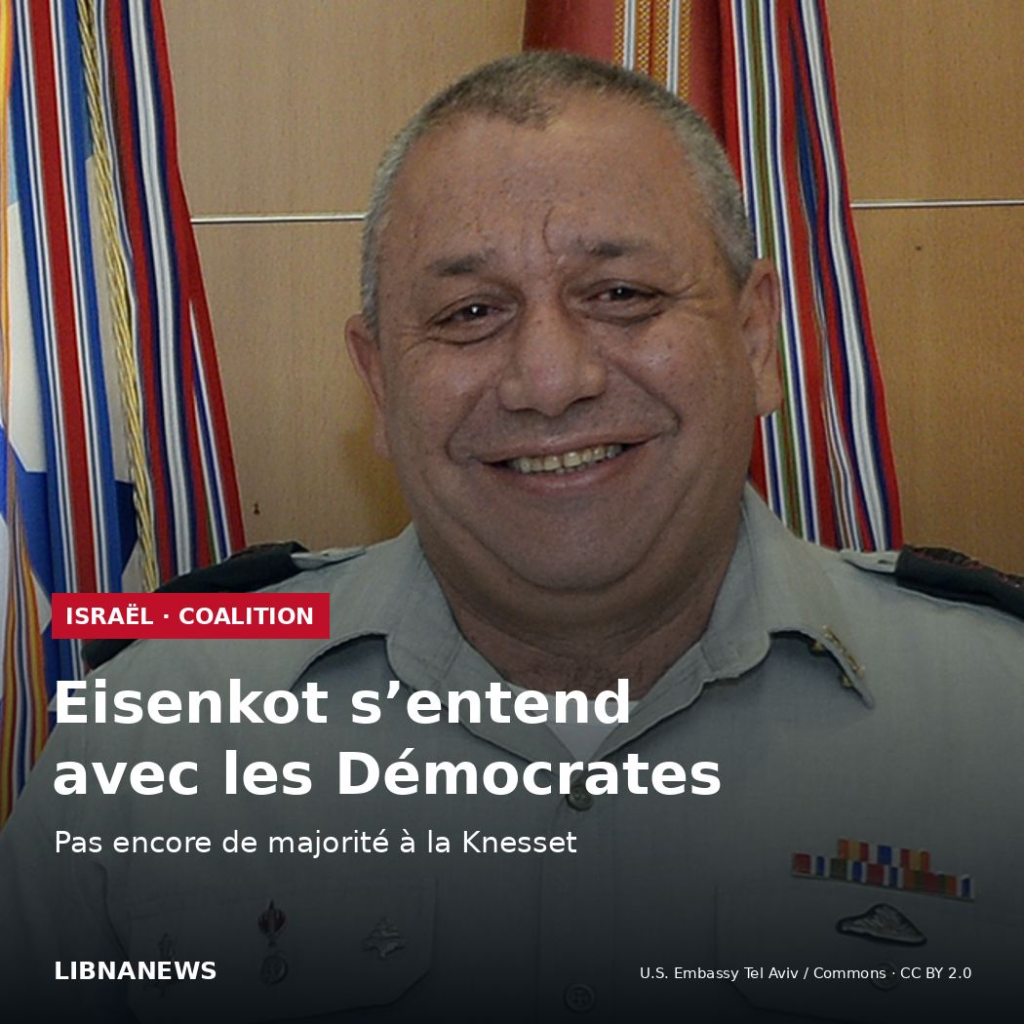
Gadi Eisenkot took a new step on Thursday 26 November in the negotiations to form the next Israeli government. His party, Yashar, and the Yair Golan Democrats announced that they had been heard to sign a coalition agreement. This announcement ends two days of suspension of the discussions, but it does not yet give Eisenkot a majority in the Knesset.
From suspension of talks to agreement in principle
The Democrats had interrupted negotiations on Tuesday, while Yashar was also discussing with Benjamin Netanyahu’s Likud. On Thursday, both parties announced the resumption of discussions and then an agreement in principle. Their joint communiqué does not publish the text of the agreement. The Democrats indicated separately that they saw four ministerial portfolios promised; These functions will only be provided if a government is effectively formed.
The previous agreement announced by Yashar dates back to Tuesday and concerns Yisrael Beituten, the party of Avigdor Liberman. Both bilateral agreements now give Eisenkot partners on both sides of the political centre. However, they do not constitute a complete draft government that is put to the vote.
Thirty-six seats for the three parties that agreed
According to the final results of the 27 October elections, Yashar has 21 seats, the Eight Democrats and Yisrael Beitué seven. Together, these three formations have 36 of the 120 Knesset seats. Together with the twelve elected representatives of the Naftali Bennett formation, there would be 48, 13 fewer than the absolute majority. Support for the nomination remains distinct from participation in the future cabinet.
Reservations on the composition of the coalition have already affected the talks. The two Arab lists together have 19 elected representatives. The two ultra-Orthodox formations, Unified Judaism of Torah and Shas, total thirteen seats. Their place and the conditions for possible support are not laid down in the agreement announced Thursday with Yair Golan.
Netanyahu remains head of the outgoing government
President Isaac Herzog instructed Eisenkot on 8 November to form a government. The initial deadline is until 6 December and may be extended by 14 days. The presidential mandate opens the negotiation; He’s not worth the nomination. A future firm still needs to present its composition and program to the Knesset and gain its confidence. Benjamin Netanyahu remains head of the outgoing government.
Cover: Gadi Eisenkot in Tel Aviv, 16 August 2016, then Chief of Staff (archived). UNITED STATES. Embassy Tel Aviv / Wikimedia Commons, CC BY 2.0. Boxing and dressing Libnanews.






Comments