

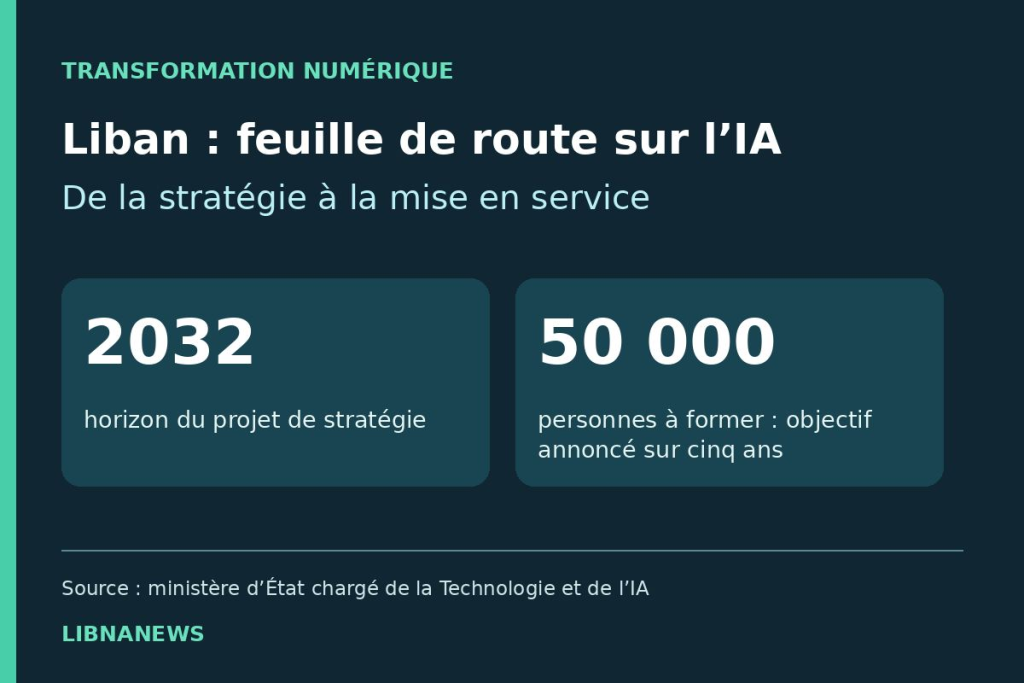
In Lebanon, the draft national strategy for artificial intelligence by 2032 distinguishes between governance, infrastructure and training projects. The searchable version was submitted for comment until 31 October. Its publication does not mean that each project already has a budget or an implementing decision.
On 25 November, during a workshop of the Beirut Chamber of Commerce and Mount Lebanon, Kamal Shehadi again presented ways to finance the adoption of AI by companies: investment funds, credit lines, co-financing for SMEs and access to cloud computing credits. He described them as developing projects, without announcing an open window or disbursement.
A roadmap, several projects to distinguish
The Ministry of State for Technology and Artificial Intelligence, in particular, presents work on digital identity, interoperability of services and data protection. These bricks are not all artificial intelligence applications. Reliable registers and sharing rules can improve a public service without automating its decision. Conversely, a service that processes sensitive data must provide guarantees from the outset of its design, whether or not it uses a d的IA model.
The Ministry gives an example of work already undertaken: the conversion of the paper files of the Ministry of Displaced Persons into digital archives and the development of an application portal. Digital record keeping and portal development are distinct milestones in large-scale implementation: the submission does not provide information on the number of applications processed through this channel.
The roadmap and digital transformation projects alone do not allow us to establish which services are already open. In order to know this, it is necessary to be able to verify, on a project-by-project basis, the responsible administration, the legal basis for data processing, the financing and the timetable for commissioning. Users should also know who can correct an error or reconsider a decision.
Training is a separate component
The Ministry of Kamal Shehadi reported on a protocol with Oracle to train 50,000 people in Lebanon over five years in cloud computing, AI and machine learning. This number is an objective announced by the partners. It does not measure individuals who are actually registered or who have completed training.
Monitoring of the strategy should therefore make it possible to distinguish between three verifiable results: the public services actually accessible, the completed training and the protection rules applicable to the projects deployed. The document submitted for consultation alone does not provide an assessment of these achievements.





Comments