

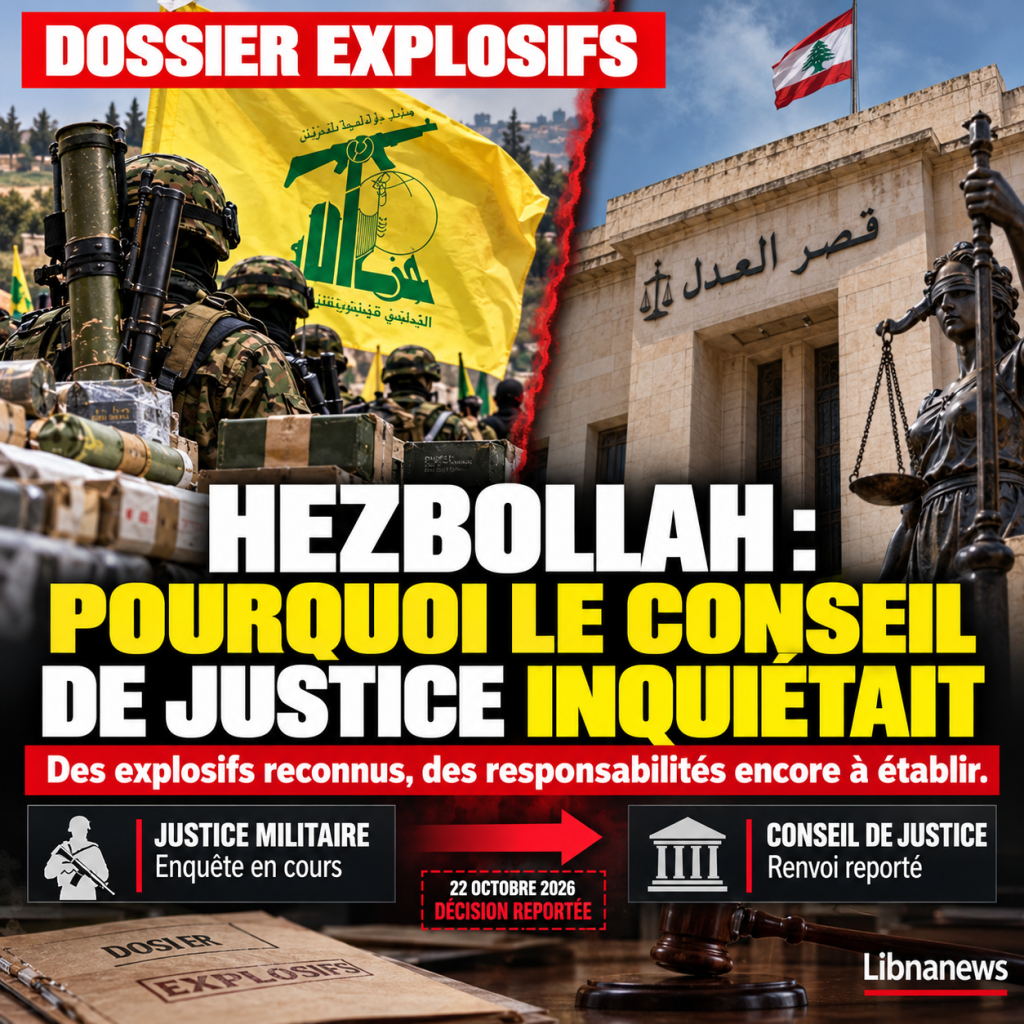
A cargo recognized by Hezbollah, but an investigation far from complete
The explosives seized on 5 and 9 October 2026 in Dahr al-Baidar and in the al-Qasr region placed Hezbollah in a major judicial difficulty. For the first time in this case, the debate no longer concerned only the discovery of explosive materials or their transport on Lebanese territory. It dealt with the possibility of entrusting their consideration to the Council of Justice, which is responsible for certain particularly serious cases affecting the security of the State. This led to a confrontation between political leaders, leading to the postponement of the Government’s decision on 22 October.
MP Hassan Fadllallah acknowledged that the explosives belonged to Hezbollah. He also stated that they were intended for the resistance activities of the party. This statement was an important part of the file. It enabled the organization claiming ownership of seized materials to be identified without establishing individual criminal responsibility. Investigators were still to determine the circumstances of the transport, the persons involved, the source of the explosives and their specific destination. Political recognition of their membership therefore did not replace judicial investigations.
For Hezbollah’s opponents, this statement reinforced arguments for referral to the Justice Council. They considered the transport of explosive materials by an armed organization outside military institutions to be a matter of national security. Hezbollah defended a different interpretation. He presented explosives as means of confrontation with Israel and challenged a process that could place his military activities under a criminal classification linked to State security. The disagreement thus concerned the legal scope of the facts, but also the place that the Lebanese institutions still recognized in the party’s military activities.
Why the choice of jurisdiction had become decisive
The case was initially referred to military justice. This court has jurisdiction over certain offences relating to arms, ammunition and military matters. The Minister of Justice, Adel Nassar, however, wanted the case to be considered by the Justice Council. His request was based on the seriousness of the facts and the risks that the transport of explosive materials could pose to national security. In particular, the Justice Council intervenes in certain cases affecting the internal or external security of the State. Its intervention requires a decision by the Council of Ministers, taken in accordance with the procedures laid down in the legislation.
The difference between the two courts therefore exceeded a simple administrative question. Referral to the Justice Council would have given the case particular institutional scope. It would have meant that the government considered the facts serious enough to justify this exceptional procedure. However, such a decision would not have constituted either a conviction of Hezbollah or evidence of guilt of the persons concerned. The responsibilities should always have been established by the investigation and assessed in accordance with the applicable judicial rules.
Supporters of the referral felt that the circumstances of the seizures warranted such an approach. They highlighted the risks associated with the transport, storage and possible use of explosives. They also called for investigations to determine all those involved in the operations. At the same time, judicial sources expressed concern about the ability of military justice to conduct the investigation without political influence. These charges remained assessments attributed to the authors. There is no evidence of any manipulation of the investigations.
Opponents of the immediate referral made another argument. They considered that the discovery and detention of explosives was not necessarily sufficient to characterize offences warranting referral to the Justice Council. According to this interpretation, investigations had to first clarify the facts and responsibilities. The discussion therefore opposed two readings of the procedure: one favoured a speedy decision because of the alleged seriousness of the case, while the other requested that the investigation be allowed to proceed before changing its legal framework.
The 2 March precedent and the question of Hezbollah’s military activities
The judicial debate was taking on additional importance because of previous government decisions regarding Hezbollah weapons. On 2 March 2026, the government adopted a decision prohibiting the party’s military and security activities. This measure was a central element in the arguments of those in favour of referring the case to the Council of Justice. They considered that the October seizures should be considered in the light of that decision and the State’s commitments regarding the arms monopoly.
The difficulty lay in the confrontation between two principles defended by different actors. Hezbollah continued to present its military capabilities as necessary for resistance against Israel. The Government of Nawaf Salam, for its part, claimed that the carrying of arms and decisions on war and peace were exclusively the responsibility of public institutions. The Prime Minister supported, inter alia, the Taif Agreement, Security Council resolution 1701 and the declaration of cessation of hostilities in November 2024. It considered that these laws, as well as government decisions, defined the responsibilities of the State.
The referral of explosives to the Judicial Council could therefore have provided a judicial translation of the political conflict. It reportedly placed the activities concerned in the context of a state security proceeding, while Hizbullah claimed their military purpose against Israel. This perspective explains part of the sensitivity of the file. However, it does not make it possible to state that the party feared a specific conviction or a judicial decision already prepared. The available documents establish its opposition to the referral, but do not reveal all its internal reasons.
Warnings issued before the Council of Ministers
Tensions intensified when Adel Nassar’s request was placed on the seventh item on the agenda of the Council of Ministers on 22 October. The text covered explosives seized in Dahr al-Baydar and in the al-Qasr region. It also concerned persons whose investigations could establish a direct or indirect link with the seized materials. This wording gave the file a potentially extended scope. It did not prejudge the guilt of the persons concerned, but allowed for the consideration of investigations beyond the individuals present at the seizure.
According to reports attributed to political sources, Hizbullah had issued warnings concerning the consequences of an immediate dismissal. The party considered that such a decision could lead to an internal confrontation. The messages also referred to the danger of a political escalation that could jeopardize the stability of the country. These warnings have helped to strengthen consultations among key institutional leaders. Their existence is reported in several political narratives, but the documents examined do not permit the full reconstitution of private exchanges or the determination of the exact instructions given by the party leadership.
The Speaker of Parliament, Nabih Berri, played a central role in the discussions. His contacts with Joseph Aoun and Nawaf Salam were aimed at finding a solution to continue the investigations without causing an immediate vote on the dismissal. The discussions also involved other politicians, including the president of the Kataëb, Sami Gemayel, received by Joseph Aoun before the meeting. The search for a compromise was based on the possibility of separating the continuation of the investigation from the Government’s decision concerning the competent court.
This distinction ultimately formed the basis of the agreement. Investigations were to continue, while the Council of Ministers would defer its decision on the referral. Hezbollah thus avoided an immediate referral he challenged. The authorities officially retained the possibility of returning to the issue. The compromise therefore did not resolve legal disagreement. It only helped to prevent an immediate government crisis.
Nawaf Salam maintains position on arms monopoly
The 22 October meeting showed that the judicial postponement did not mean a change in the Prime Minister’s position. Nawaf Salam made a particularly firm intervention on the prerogatives of the State. He recalled that only legally authorized institutions could carry weapons. He cited the Lebanese Army, the Internal Security Forces, General Security, State Security, customs and municipal police. He also reiterated that the decision on war and peace could not belong to an organization outside the constitutional institutions.
The Prime Minister stressed the consequences of the transportation and storage of weapons by unauthorized agencies. According to him, such activities constitute a violation of the applicable rules and may threaten public safety. He called on Hezbollah to respect the principles previously declared by the party. This intervention confirmed the Government’s intention to maintain its doctrine of arms monopoly, regardless of the compromise on explosives.
Joseph Aoun’s position was based on a complementary logic. The President of the Republic welcomed the efforts of the security services and stressed the importance of preserving the army. He also paid tribute to Nabih Berri for his positions on civil peace and dialogue. These statements took place in a particularly tense regional context, marked by the risks of a new confrontation involving Israel and Iran. The President thus sought to preserve institutional stability without publicly questioning the principles upheld by the government.
This coexistence between political firmness and procedural compromise is one of the essential characteristics of the meeting. Nawaf Salam maintained his statements on arms, while the government postponed a judicial decision that could increase tensions. Hezbollah received a delay, but not a new recognition of the legality of its military activities. The fundamental differences therefore remained complete.
Lebanese Forces denounce postponement
The compromise provoked an immediate reaction from the Lebanese Forces Ministers. They called for referral of the case to the Justice Council without waiting for the completion of the investigations. In particular, Minister Joe Issa el-Khoury recalled that certain cases had been transmitted to that court promptly after their occurrence. He considered that the information available was sufficient to make a decision. The recognition of Hezbollah’s membership of explosives was, according to this reading, an additional element justifying the referral.
The ministers finally left the meeting to express their opposition to the postponement. Their withdrawal reflected disagreement with the government’s decision, but also with how the political consultations had influenced the handling of the case. For the Lebanese Forces, the issue was beyond judicial process. It concerned the capacity of the State to implement its own decisions on arms and to subject the activities of armed organizations to institutional control.
However, Justice Minister Adel Nassar did not follow their withdrawal. Although he was the author of the removal request, he remained at the meeting. This difference in behaviour kept the discussion within the government framework. It has also shown that political formations favouring referral to the Justice Council do not necessarily share the same strategy. The Minister retained the opportunity to renew his application at a subsequent meeting.
Nawaf Salam criticized the withdrawal of Lebanese Forces ministers, which he associated with a form of political auction. This reaction added additional tension to the relations between the Prime Minister and his government partners. It also highlighted the difficulties of an executive facing conflicting positions on a matter directly related to sovereignty and national security.
What the deferral really changes for Hezbollah
The final decision of the Council of Ministers was to continue consideration of the request for referral on the basis of progress in investigations. It did not constitute a classification of the case. Nor did it prevent the Minister of Justice from making a new application. Hezbollah therefore avoided an immediate decision, without obtaining the disappearance of the judicial file.
The main effect of the compromise was political. It allowed the government to continue its work without causing a break with ministers close to Hezbollah. He also avoided immediately turning the question of jurisdiction into an institutional confrontation. For Nabih Berri and Joseph Aoun, this solution helped preserve internal stability in a period of regional tensions.
A number of judicial issues remained open. Investigators were asked to determine the origin of the explosives, the conditions of their transport, the persons involved in the operations and their destination. They also had to establish which offences could be retained. The recognition of Hezbollah’s membership did not dispense justice with this work. Nor was it possible to assume the criminal responsibility of any person involved.
The dossier revealed above all a persistent institutional difficulty. The government maintained its monopoly on weapons and military decisions, while Hezbollah continued to defend its own armed capabilities. The debate on the Justice Council was a concrete expression of this contradiction. The decision of 22 October postponed its regulation without changing the fundamental positions of the players.
For Hezbollah, the immediate challenge was to avoid a government procedure that he considered hostile to his military activities. For its opponents, the postponement was a step backwards in the implementation of the State’s decisions. Between these two positions, the government chose to let the investigations progress before deciding on the referral. As of 23 October 2026, no final decision had been taken on the referral of the case to the Council of Justice.





Comments