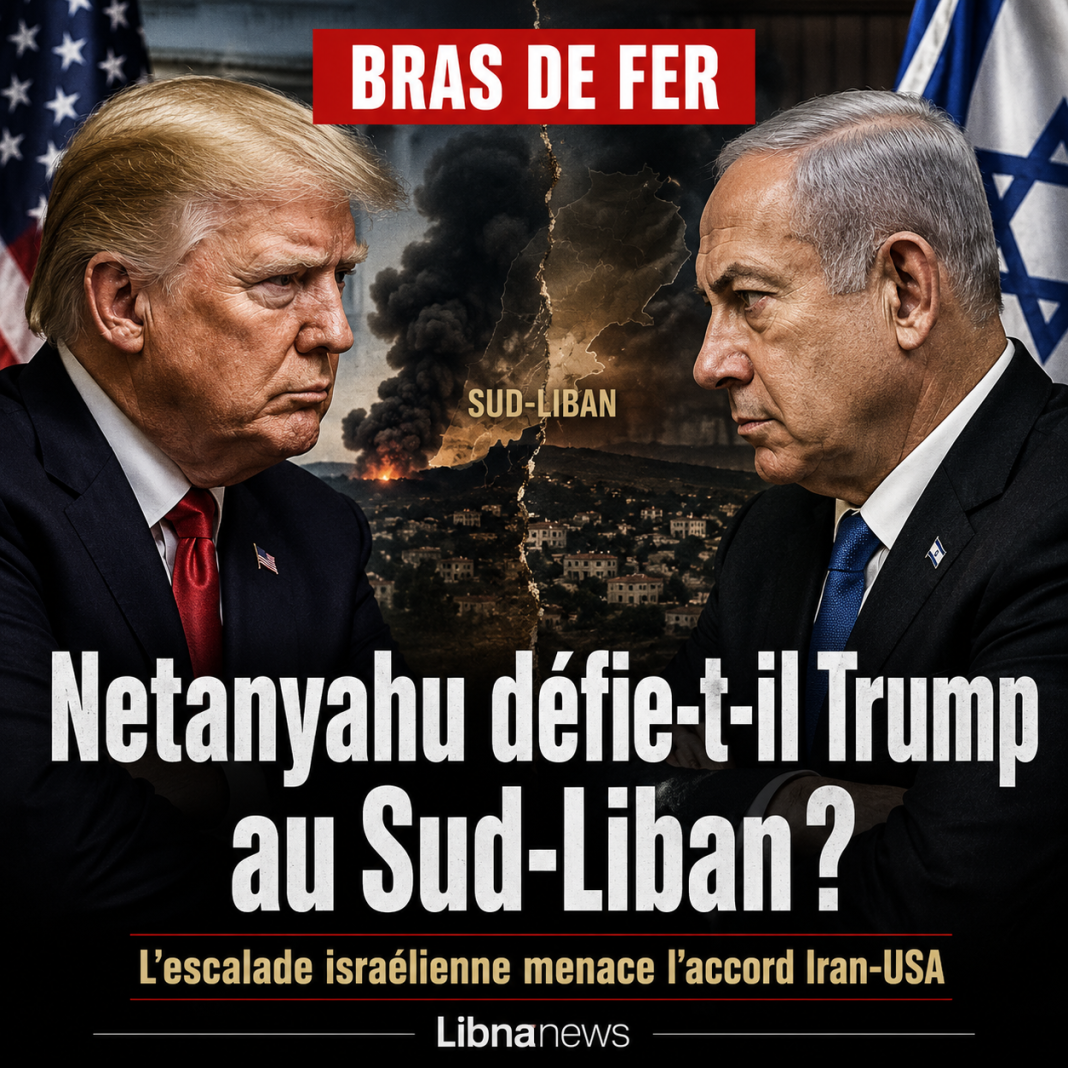






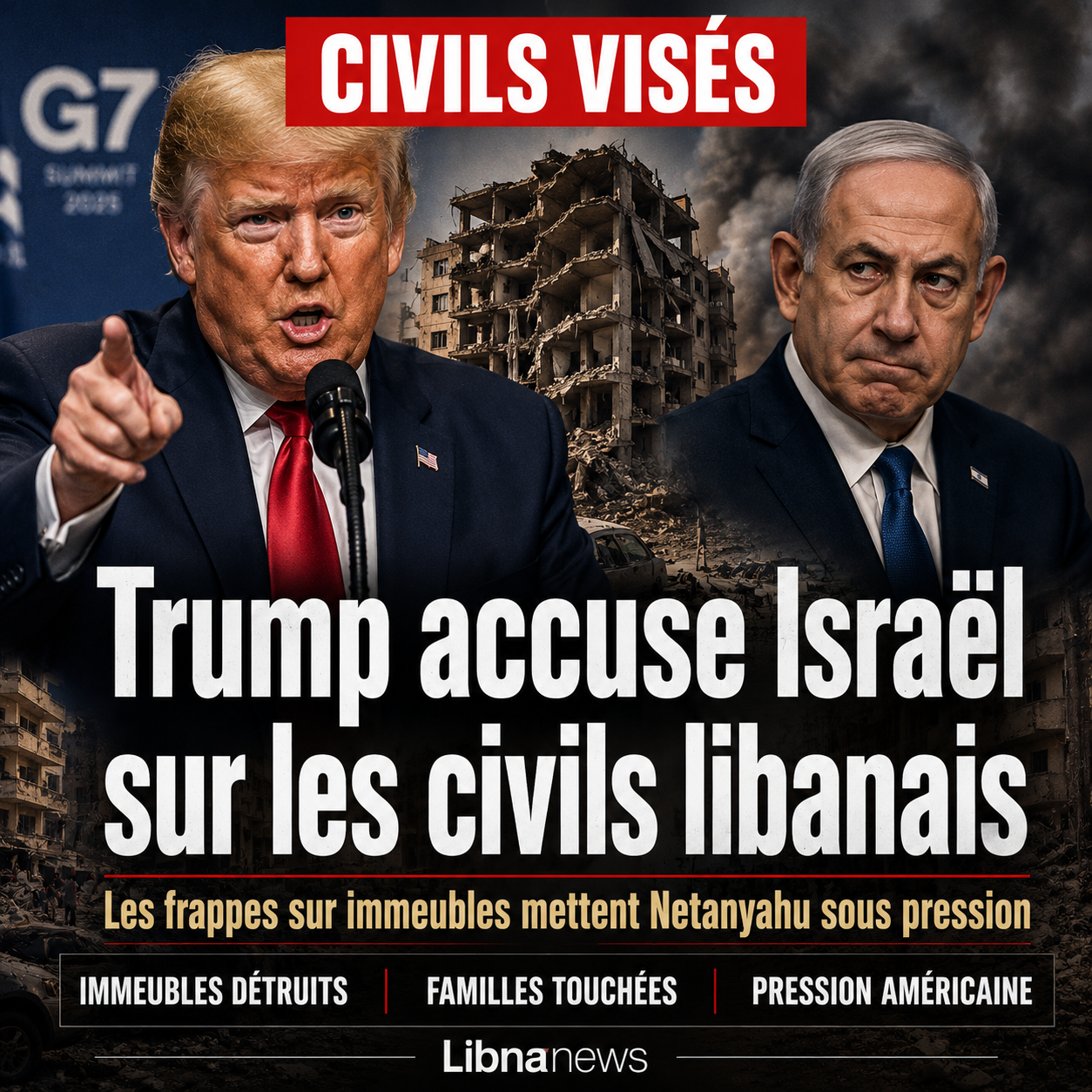
Donald Trump publicly criticized Israeli military methods in Lebanon, accusing Israel of destroying residential buildings and killing civilians to target Hezbollah members. For Lebanon, this rare statement by Israel’s main ally confirms a reality that has lived for months: the war in southern Lebanon affects not only military targets, but neighbourhoods, families and entire villages.
In Lebanon, the sentence was received as a late confession, but with far-reaching consequences. Donald Trump publicly criticized Israeli military methods in Lebanon, believing that Israel did not have to destroy entire residential buildings to target a Hezbollah member. The US President added that too many people had been killed before calling Benjamin Netanyahu to act more responsibly. For Beirut, these words do not repair anything. However, they are changing the political scene. Finally, they place the issue of Lebanese civilians at the heart of a debate previously dominated by Israeli security vocabulary.
This criticism comes at a time when the United States is seeking to preserve the agreement in preparation with Iran. It is therefore not only emotional. It expresses a strategic impatience. Washington wants to close a regional military sequence and prevent a new uncontrollable front. Israel, on the other hand, continues to strike in Lebanon, including in inhabited areas, claiming to target Hezbollah’s capabilities. Between these two priorities, South Lebanon becomes the place where the reality of American authority over its closest ally is measured.
From Lebanon, Trump’s statement confirms what the people of the South, Nabatiyah, the southern suburbs of Beirut and several border villages have been saying for months. War is not limited to abstract military targets. It destroys buildings, emptys neighbourhoods, cuts roads and kills civilians. The terms used by the US President give international visibility to this reality. They also expose the fragility of the Israeli argument that mass destruction would always be proportionate to the military objective pursued.
A rare criticism, coming from Israel’s main ally
The scope of the declaration lies first with the author. Donald Trump is not an enemy of Israel. On the contrary, he claims his role in the political, diplomatic and military support given to the Hebrew State. He recalled that he had an excellent relationship with Benjamin Netanyahu. He also claimed that without the United States, Israel would not exist under the same conditions. This brutal sentence has a political function. It recalls Israel’s strategic dependence on Washington.
This dependence is also rarely said in front of a current US president. United States officials sometimes criticize Israeli operations, but often do so in prudent ways. This time Trump named the method. He said about destroyed residential buildings and civilians killed. He pointed out the gap between the claimed objective, looking for a fighter, and the cost to the inhabitants of an entire building.
For the Lebanese, this precision counts. It breaks with a discursive habit that reduces every building bombed to a Hezbollah site. However, the strikes in dense areas affect families, businesses, workers, the elderly, children and displaced persons. They turn military suspicion into collective punishment. When the U.S. president says that all the inhabitants of these buildings are not Hezbollah, he repeats a often ignored evidence in chanceries.
This criticism, however, remains limited. Trump did not announce an immediate sanction against Israel. He did not mention a suspension of military aid. He did not state that the strikes were illegal. But, politically, the signal is real. He told Netanyahu that American patience has limits, especially when Israeli operations threaten an agreement that Washington wants to present as a major diplomatic success.
Lebanon hears recognition of its suffering
In Lebanon, Trump’s words are perceived in a context of very concrete destruction. Since the spread of the conflict, entire southern localities have been emptied. Nebatiyé neighbourhoods, villages close to the border and secondary roads were hit several times. Buildings were sprayed in inhabited areas. People often tell the same story: an explosion, a cloud of dust, sirens, and then waiting for a balance sheet that the authorities review over the hours.
American criticism does not dispel anger. She confirms it. Many Lebanese see it as less of a gesture of compassion than a late calculation. Civilians have been dying for weeks. Ambulances take risks. The schools are closing. Displaced families live with relatives or in temporary centres. If Washington speaks today, it is also because the pursuit of strikes complicates its own goals with Iran.
This Lebanese reading is not cynical. It is forged by experience. Lebanon knows that the great Powers rarely denounce destruction when they do not disrupt their interests. The novelty here is that American interests are changing. The United States now needs the Lebanese front to calm down. They want from Tehran regional stabilization. They must therefore recognize that Israeli methods can become a political problem.
This recognition remains important, even if it comes late. It offers the Lebanese government a diplomatic argument. It also reinforces calls for Israeli withdrawal from the occupied sectors of the South. Finally, it makes it clear that the protection of civilians is not a secondary issue. It is at the heart of any credible de-escalation.
South Lebanon, a fracture line between Washington and Tel Aviv
South Lebanon now concentrates on the contradictions of the relationship between Washington and Tel Aviv. The United States wants an agreement with Iran. Israel wants to prevent Hezbollah from claiming strategic success. These two objectives are not necessarily incompatible. They become so if Israel pursues strikes that give Iran and Hezbollah a motive to denounce the agreement.
For several days now, American signals have been getting tougher. The announced withdrawal of part of the American refuelling aircraft stationed in Ben Gurion indicates a desire to reduce the US military exposure. Information on a easing of the embargo against Iranian ports is similar. Washington is trying to show Tehran that negotiations are having an impact. In this context, Israeli bombings in Lebanon appear to be a source of disruption.
Trump is therefore not only critical of an excess tactical. He is calling into question a strategy that risks failing his schedule. The agreement with Iran must open a 60-day sequence of more technical discussions, including on nuclear and security assurances. If the Lebanese front remains active, each meeting will be parasitized by the shots of strikes, civilian reports and warnings of Hezbollah.
For Netanyahu, the problem is the opposite. An American-Iranian agreement that does not neutralize Hezbollah can be presented in Israel as a weakness. The Israeli Prime Minister must convince his opinion that he did not let Iran save its allies. He must also respond to the people of northern Israel who ask for guarantees before returning home. This internal constraint pushes to maintain pressure in Lebanon, even if this pressure irritates Washington.
Netanyahu’s political calendar
Israeli policy weighs heavily in this sequence. Benjamin Netanyahu governs with partners who defend a hard line. Itamar Ben Gvir and other radical right figures refuse the idea that an American agreement with Iran can limit Israeli action. They want a visible victory, or at least the certainty that Hezbollah cannot redeploy near the border.
This pressure met with an Israeli public opinion that was affected by the war. Part of this view is that operations should continue until northern security is guaranteed. Displaced families on the Israeli side do not want to return under threat of rockets or drones. This demand is real. But it also serves as a justification for a broader strategy, which keeps Lebanon in a situation of permanent insecurity.
Netanyahu knows that any concession will be used against him. A withdrawal from southern Lebanon can be described by its opponents as a Hezbollah victory. A passive acceptance of the Trump-Iran agreement can be presented as a surrender to Washington. A reduction in strikes can give the image of a leader forced by the Americans. As the electoral deadline approaches, these perceptions become decisive.
That’s why Trump’s statement is so sensitive to Israel. It does not come from a democratic president hostile to Netanyahu. It comes from a political ally that has long been presented as Israel’s best friend in Washington. If Trump believes Netanyahu goes too far in Lebanon, the Israeli Prime Minister loses a valuable rhetorical shield. He can no longer say that all criticism is anti-Israeli bias.
An American pressure that remains reversible
The central question remains the passage of words to deeds. Trump criticized Israeli methods. He said responsibility. He recalled Israel’s dependence on the United States. But Washington has not yet imposed a public and binding mechanism to stop strikes on residential areas in Lebanon. Pressure exists. It remains reversible.
Israel knows that margin. For years, Israeli governments have been able to distinguish American critics from American decisions. A strong sentence can cause media tension without changing military aid, intelligence or diplomatic coverage. So Netanyahu can bet on Trump’s limited anger, especially if the deal with Iran is signed despite the violence in Lebanon.
But this bet is risky. Trump strongly customizes foreign policy. He can’t stand an ally compromising a sequence he wants to present as his victory. If the Israeli strikes lead to a postponement or failure of the agreement with Iran, the US response could become more harsh. It could take the form of a slowdown in some support, a stronger language in the Security Council or an explicit requirement for withdrawal.
Lebanon therefore observed the next few days with caution. Trump’s statements are not enough to protect civilians. However, they may open a breach. If Washington finally agrees to link its relationship with Israel to respect for limits in Lebanon, the momentum will change. If these words remain unanswered, they will become a mere parenthesis in a war where Lebanese civilians continue to pay the main price.
Hezbollah takes advantage of US criticism
American criticism also offers a political advantage to Hezbollah. The movement can now affirm that even Israel’s main ally recognizes the excessive nature of destruction in Lebanon. It can present its own operations as a response to an Israeli violence denounced by Washington. This recovery is predictable. It must not mask a broader reality: Trump’s statement weakens Israel’s account of the accuracy and necessity of all his strikes.
Hezbollah will seek to use this sequence to reinforce its demand for Israeli withdrawal. He said that the problem was not just the presence of his weapons, but the occupation, bombing and vulnerability of civilians. This argument speaks to a part of the Lebanese population, even beyond its political environment. As the strikes continue, the internal debate on Hezbollah’s arsenal remains marginalized by the national emergency.
For the Lebanese State, this situation is delicate. He may welcome an American critique of Israeli methods, but he does not control Hezbollah. He may request Israeli withdrawal, but he depends on external mediation. He may invoke international law, but he lacks military and economic leverage. The risk is that Lebanon will remain an object of negotiation rather than an actor full of de-escalation.
This institutional weakness feeds Lebanese frustration. Villages are bombed, displaced inhabitants, drone-controlled roads, but major decisions are taken in Washington, Tel Aviv and Tehran. Trump’s sentence indirectly recalls this reality. It recognizes Lebanese civilians, but also confirms that their security still depends on foreign calculations.
A sentence that changes the political cost of strikes
Trump’s statement does not end the bombing. However, it changes their political cost. From now on, every building destroyed in Lebanon can be confronted with the American President’s own words. Every strike in a inhabited area can feed into the issue of Israeli responsibility. Every civilian balance sheet can weaken Netanyahu’s position with an ally he needs.
This change is important for Lebanese diplomacy. Beirut can rely on this criticism to demand more stringent guarantees. The Lebanese authorities may also stress the need for a withdrawal schedule and a monitoring mechanism. It is not just about stopping a series of raids. The aim is to prevent South Lebanon from remaining an area open to repeated strikes on the pretext of fighting Hezbollah.
For Washington, the challenge is coherence. The United States cannot promote an agreement with Iran while allowing Israel to conduct operations in Lebanon that undermine that agreement. They cannot talk about regional stabilization while at the same time tolerating the destruction of residential buildings. They cannot ask Tehran to retain its allies without asking Israel to retain its army.
The episode thus reveals a fracture. It’s not a breakup yet. She opposes two temporalities. Trump wants a signature, a de-escalation and a fast diplomatic victory. Netanyahu wants to survive politically, reassure his camp and keep the military initiative. Lebanon, on the other hand, calls for the security of civilians to no longer be treated as secondary damage. In the villages of the South, people are now waiting to see if the words spoken at the top of the G7 will really change the noise of drones above the roofs.