

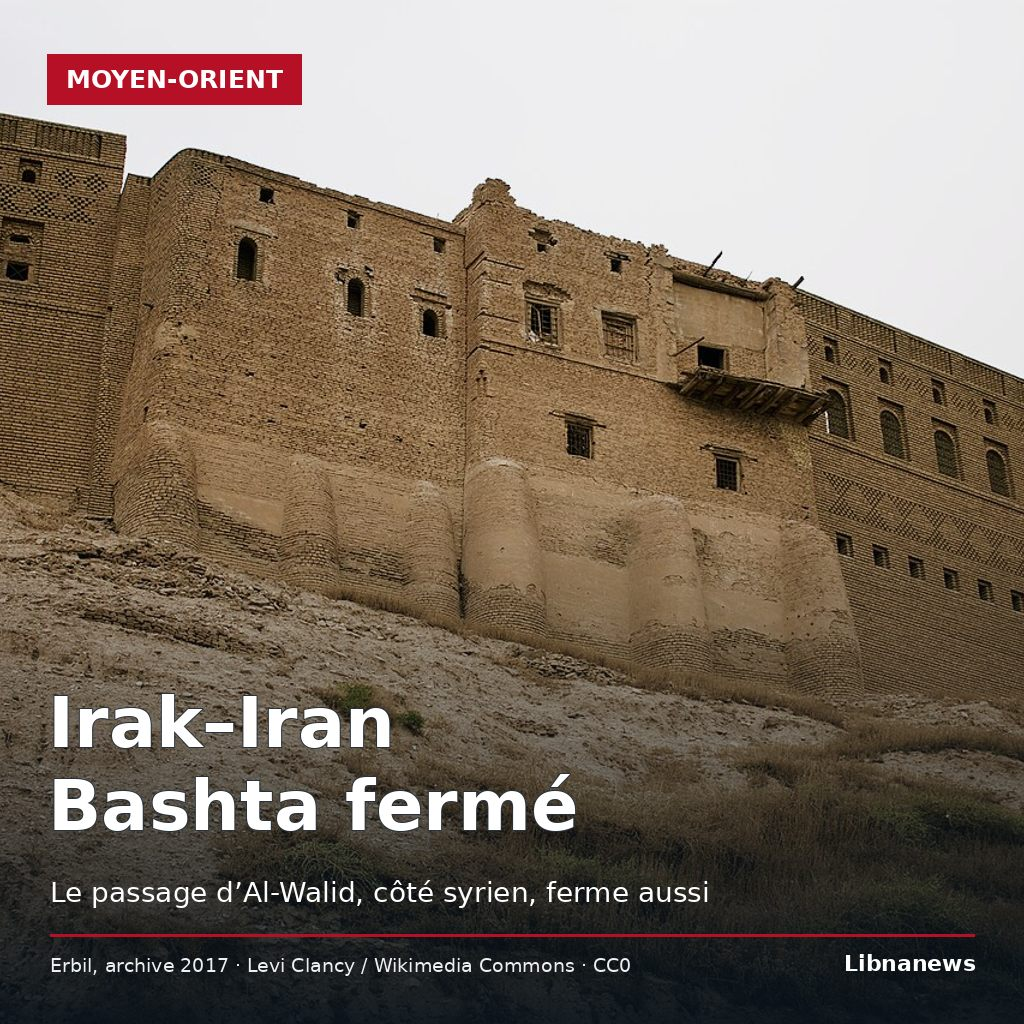
The Iraqi border guards closed the passage from Bashta, in the Kurdish province of Halabja, and from Al-Walid, on the Syrian side. Iraqi Foreign Minister Fouad Hussein had revealed on 7 November an American demand to limit ground trade with Iran to two crossing points. Baghdad did not announce that it would implement this request.
The commander of the Iraqi border guards, Mohammed al-Saidi, announced on Thursday, 26 November, the closure of two passages previously administered by the Iraqi Kurdistan authorities. Bashta is located in Halabja province, on the Iranian border. The Al-Walid crossing targeted by this operation is north of Rabia, on the Syrian border. Neither was recognized by the federal authorities as an official border crossing.
An American application released on November 7
Fouad Hussein stated on 7 November that the US Treasury had formally asked Iraq to close all but two of its crossings with Iran. According to the minister, one was to be in Iraqi Kurdistan, the other in the rest of the country. He did not identify the two positions to be kept open. On 13 November, it found it impossible to implement such a measure, citing the economic ties between the two countries and the cost of closure for the Iraqi population.
The decisions taken in November did not follow a uniform closure movement. On the 10th, the Iraqi Border Post Authority reopened Al-Sheeb, in Maysan province, to passengers and goods after work. It separately announced the temporary closure of Mandali in Diyala Province, beginning on 13 November. On 23 November, the President of the Authority denied the closure of Shalamcheh to travellers. On the Iranian side, the Ministry of the Interior reported that a computer problem had disrupted the clearance of goods.
Baghdad takes hold of Kurdistan passages
The Government of Ali al-Zaïdi ordered the closure of unofficial crossing points and the strengthening of federal control over customs revenues and oil. Referred to by the Prime Minister, the Federal Supreme Court confirmed on 25 November that Baghdad was competent to secure international borders, including in areas administered by Kurdistan. She recalled, however, that customs management should be coordinated with regional authorities. The Kurdish government challenged federal measures and thousands of people protested in Erbil on 26 November.
The closure of Bashta is the change seen on the Iranian side in the announcement of the Iraqi command on 26 November. On Tuesday, the government invoked the fight against smuggling to justify its intervention. No public order in Baghdad identifies the two posts that would remain open if the United States application were implemented.





Comments