

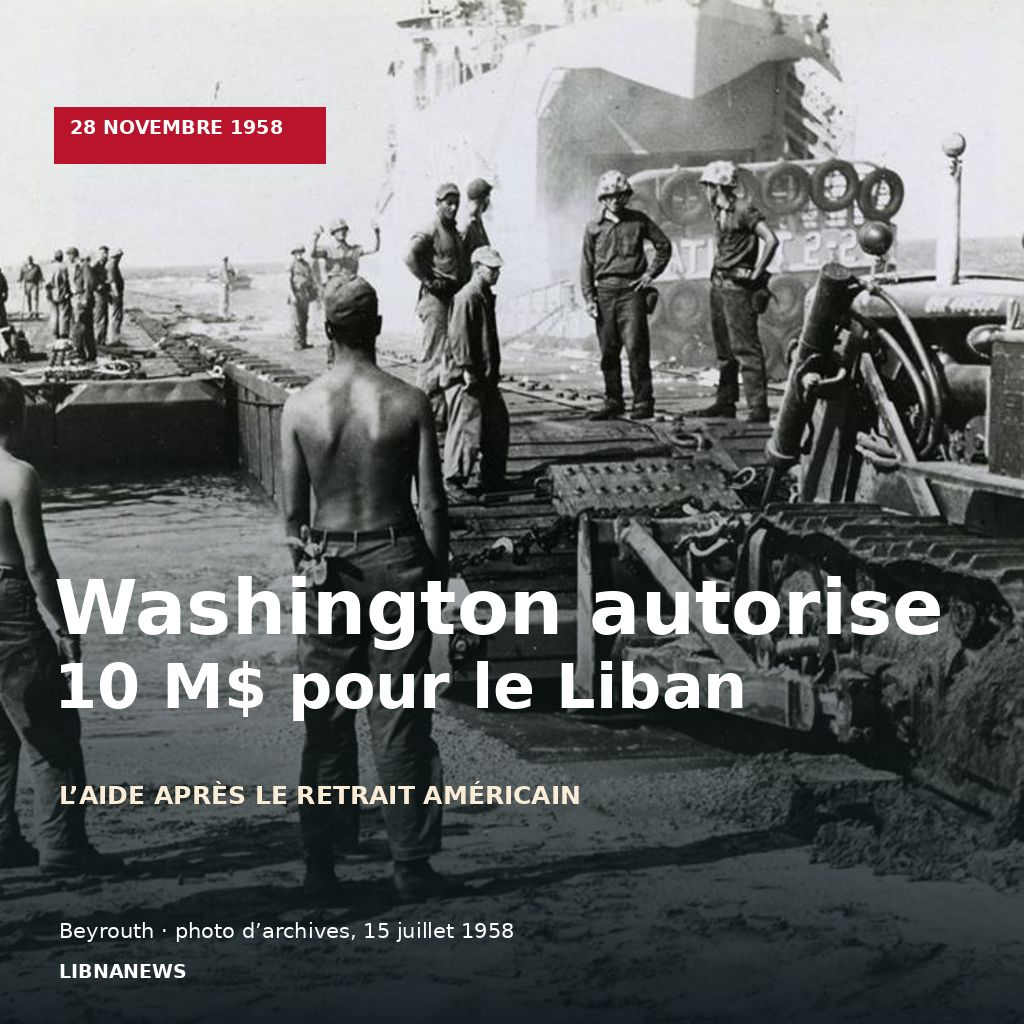
On November 28, 1958, Washington gave its embassy in Beirut the green light to offer ten million dollars to Lebanon. The decision is contained in telegram No. 1990, which is summarized in the United States diplomatic archives. This is an exceptional gift to the Lebanese government, not a loan. The cheque will only be presented to Prime Minister Rachid Karamé on 5 December.
After the withdrawal of the troops, the cash to be restored
On 15 July, the first US military had landed in Beirut at the request of President Camille Chamoun, while confrontations between the supporters of power and the opposition. Parliament elected the army commander, Fouad Chehab, on 31 July. He took office on 23 September. The US withdrawal ended on 25 October, before the Lebanese government and the embassy agreed on the form of budgetary aid.
Discussions continue in November on two fronts. Experts discuss the following year’s budget; The Embassy also asks the Lebanese Ministry of Finance to estimate its cash requirements from November to February. The first calculation does not lead to an immediate agreement. In a telegram dated 25 November, Ambassador Robert McClintock quotes a Lebanese estimate of the deficit of the 1958 financial year close to £37 million. The ten million dollars it recommends are not intended to fill this deficit. In his view, they must assist the government in approaching the next fiscal year without renewing the operation.
Why the gift was not a loan
On 2 December, McClintock reported that Chehab welcomed the offer and that he did not expect exceptional aid of this nature to be repeated. Karamé and his Minister Raymond Eddé are more cautious about the needs of future years, while accepting the principle of funding from Lebanese resources. Both sides discuss $12 million separately in funding from the Development Loan Fund. This amount is not a second gift to the Treasury.
According to the U.S. report, Karamé explained that he had to reassure the MPs: the exceptional powers debated in Parliament should not allow the cabinet to contract debts on behalf of the country. However, the Prime Minister does not close the door to loans for the private sector. He referred to a group of Lebanese ministries and the American mission to assist in examining applications. The distinction is important: the cheque scheduled for December does not create a public debt, while private projects would have to file credit files.
Cheque issued on December 5
McClintock also exhibited a diplomatic calculation: in his view, aid accepted by Karamé, which Arab observers associated with Egyptian President Gamal Abdel Nasser, could reach beyond Lebanon. The telegram describes the ambassador’s argument to convince Washington; It does not establish that Beirut has made a new foreign policy commitment in exchange.
On December 5, one week after authorization, McClintock handed over the $10 million cheque to Karamé. Five days later, on the contrary, the Prime Minister declared that his government considered the Eisenhower doctrine outdated and no longer considered itself bound by it. Both dates shed light on what was covered by the agreement of 28 November: one-off budgetary aid after the withdrawal, distinct from the doctrine that had served as the framework for American intervention.





Comments