





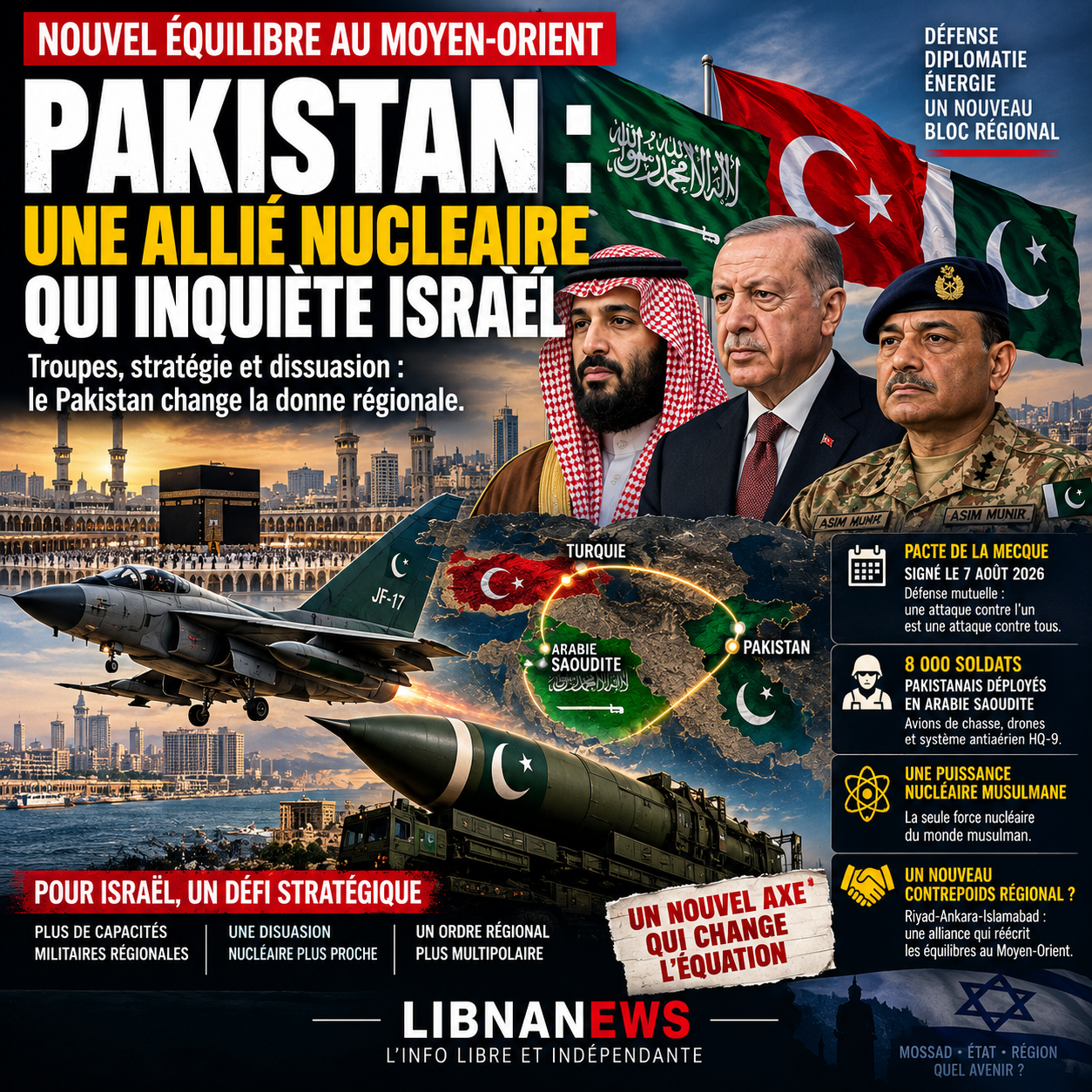
Pakistan established itself in 2026 as an increasingly visible player in the Middle East, both military, diplomatic and strategic. Islamabad strengthened its defence pact with Saudi Arabia, deployed approximately 8,000 soldiers as well as combat aircraft, drones and an anti-aircraft system in the kingdom during the regional war, participated in the mediation between Washington and Tehran and joined the defence alliance formed with Riyadh and Ankara on 7 August. This rise in power comes as Pakistan remains the only nuclear power in the Muslim world and still refuses to recognize Israel. For Jerusalem, concern does not come from a direct Pakistani threat or from a known preparation for a conflict with Israel, but from a deeper transformation: Islamabad now brings military and nuclear depth to States in the Middle East seeking to reduce their strategic dependence on the United States and to limit Israel’s ability to impose the regional balance of forces alone.
The movement accelerated in less than a year. In September 2025, Saudi Arabia and Pakistan signed a mutual defence agreement according to which aggression against one of the two countries must be considered as aggression against the other. In April and then May 2026, this text began to produce concrete effects with the strengthening of Pakistan’s military presence in the kingdom. On 7 August, Turkey joined this architecture through the Mecca Pact, which extends the principle of collective defence to three countries.
Islamabad is no longer content with the traditional role of Saudi military partner. Pakistan hosted negotiations between the United States and Iran, contributed to a truce during the war, participated in mediation efforts in Libya and engaged in defence discussions with other Gulf monarchies. Kuwait was considering, inter alia, strengthening its cooperation with Islamabad, while Bahrain and Jordan had also expressed interest in further arrangements.
Taken separately, each of these files may seem limited. Together, they are shaping an evolution: Pakistan is gradually transforming its position as a South Asian powerhouse into a guarantor, mediator and security provider in the Middle East.
Saudi pact changed the nature of Pakistani engagement
Relations between Saudi Arabia and Pakistan are old. They are based on religion, financial transfers, Riyadh’s economic support to Islamabad and decades of military cooperation. Pakistani officers trained Saudi soldiers and Pakistani troops were stationed in the kingdom at different times.
For a long time, however, this relationship remained deliberately ambiguous. Pakistan helped Riyadh strengthen its forces but avoided automatically engaging in Saudi wars. Yemen ‘ s precedent clearly shows this. In April 2015, the Pakistani Parliament refused direct participation in the Saudi-led coalition against the Houthis. Islamabad wanted to maintain its balance with Iran and prevent regional war from fuelling its own religious tensions.
The agreement of 17 September 2025 therefore marks a significant break. Both countries have formalized a mutual defence clause. An attack on one must be considered an attack on the other. The signing had taken place a few days after an Israeli attack on Qatar, which had caused great concern in the Arab monarchies about the real scope of American safeguards.
The text immediately raised a question: how far was Pakistan prepared to go to defend the kingdom? Pakistan’s defence minister, Khawaja Muhammad Asif, had said that his country’s capabilities could be made available to Saudi Arabia if necessary. His remarks were understood to include the nuclear dimension, although Islamabad had not provided any details on the conditions for such a guarantee.
This ambiguity remains at the heart of Israeli questioning.
In 2026, Islamabad moved from statements to military deployment
The war with Iran gave this alliance a first operational translation. By May 2026, Pakistan had deployed approximately 8,000 troops, a JF-17 fighter squadron, drones and a Chinese air defence system HQ-9 in Saudi Arabia. That deployment was far more than just a training mission.
Pakistan’s forces in the kingdom were tasked with contributing to the defence of Saudi territory while missiles, drones and attacks related to the regional conflict threatened the Gulf’s energy facilities and civilian infrastructure. Islamabad had thus agreed that Pakistani personnel and equipment should participate directly in the protection of an Arab State in a war of which Pakistan was not initially a party.
The number of military personnel is significant. It obviously does not transform Saudi Arabia into a Pakistani base, but it demonstrates the ability of Islamabad to quickly project several thousand men with air and anti-aircraft means. For the Gulf monarchies, this capacity is interesting at a time when the perception of American protection has changed.
In particular, JF-17 provides air capacity that adds to Saudi capabilities. Developed jointly by Pakistan and China, it is also one of the pillars of Pakistan’s arms export strategy. Its use and operational performance have fuelled the interest of several foreign buyers.
The HQ-9 system adds another dimension. Saudi Arabia already uses different Western systems, but the presence of Chinese-based equipment operated by Pakistanis shows that Gulf security is no longer structured solely around American or European technologies.
Pakistan becomes a Gulf security supplier
The dynamics do not stop at Riyadh. In July, Pakistan and Kuwait opened discussions on an expanded defence agreement. Sources close to the negotiations indicated that the objective could include the provision of security in exchange for energy cooperation and investment.
Bahrain has also shown interest in a comparable mechanism, while Jordan has shown interest in arms and training agreements. None of these cases has yet reached the level of the Saudi Pact, but they show growing regional demand for Pakistani capabilities.
For Islamabad, this request comes at a favorable time. The country needs investment, energy and foreign exchange. The defence sector is one area where Pakistan can offer a real comparative advantage. It has experienced personnel, military industry, structured aviation and historical ties with the Arab armies.
The formula can therefore be mutually beneficial. The monarchies obtain a second source of security and training. Pakistan obtained contracts, investments and strengthened international stature.
This evolution transforms Islamabad’s place in the region. Pakistan is no longer only the Muslim country with the bomb and a special relationship with Riyadh. It gradually becomes an institutional security provider.
The pact with Ankara gives a new scale to the scheme
The agreement of 7 August with Turkey and Saudi Arabia further expands this function. The Mecca Joint Defence Agreement provides that any attack against any of the three states will be treated as an attack against all. The Turkish Foreign Minister, Hakan Fidan, compared the principle with that of Article 5 of NATO, while specifying that operational details still needed to be defined.
The Pact includes the establishment of a ministerial committee and a secretariat based in Saudi Arabia. The three countries must deepen military coordination, intelligence exchange, defence programmes and the fight against certain common threats.
Pakistan occupies a special place in this triangle. Riyadh brings the financial capacity and political weight of the Gulf. Ankara brings a large conventional army, a dynamic military industry and NATO membership. Islamabad brings significant military depth, ancient relations with Saudi forces and, above all, the nuclear dimension.
This architecture is still too recent to qualify as an integrated military bloc. No joint command exists and no permanent trilateral force has been announced. But it now links three defence systems that already had bilateral relations.
Turkey and Pakistan cooperate in particular in shipbuilding and training. Ankara delivered or built MILGEM class corvettes for Islamabad. Industrialists from both countries are also working on different aeronautical programs. Riyadh buys Turkish drones and seeks to develop some of their production locally.
For Israel, concern comes precisely from this complementarity.
Pakistan’s nuclear power is the most sensitive factor for Israel
Israel has long monitored Pakistan’s nuclear capacity. There is no concern about the existence of a direct conflict between the two countries. Pakistan has never used its arsenal to officially threaten Israel and its nuclear doctrine remains initially structured around India.
But Islamabad is the only Muslim capital with operational nuclear weapons. In a regional environment where Israel itself is widely regarded as a nuclear power, Pakistan’s growing integration into the security structures of the Middle East necessarily alters strategic calculations.
The pact with Saudi Arabia made this question much less theoretical. In September 2025 Khawaja Asif had publicly indicated that Pakistani capabilities would be available under the agreement if Riyadh needed it. The Pakistani government has never published any doctrine detailing the conditions under which nuclear could be involved.
It should therefore not be concluded that Pakistani nuclear weapons are stationed in Saudi Arabia. There is no public evidence of this. There is also no evidence of a transfer of military nuclear control or technology to Riyadh.
The problem for Israel lies in ambiguity. Deterrence also works by obliging the adversary to calculate a risk that he cannot accurately measure. A major operation against Saudi Arabia would no longer involve only Saudi conventional capabilities. Jerusalem should also ask how far Islamabad would be prepared to implement its commitment.
The issue becomes even more sensitive if Saudi Arabia continues its ambitions in civilian nuclear power.
Saudi nuclear issue amplifies concerns
Riyadh is negotiating with Washington a civil nuclear cooperation agreement that could, under the conditions set out, enable it to develop sensitive fuel cycle activities. In July, the issue raised concerns in Israel and in the US Congress.
Mohammed bin Salmane has already stated in the past that Saudi Arabia would seek military nuclear capability if Iran obtained the bomb. This does not mean that a military programme currently exists, but it explains why any Saudi enrichment capability is being carefully examined.
The alliance with Islamabad adds an extra layer. Israeli officials must now simultaneously consider three elements: a potentially more autonomous Saudi civilian nuclear programme, a defence alliance with the Muslim nuclear power alone and growing strategic cooperation with Turkey.
None of these elements, taken in isolation, constitute proliferation. Together, however, they reduce Saudi dependence on Israeli-American protection against a regional nuclear threat.
For Israel, which has always sought to preserve a qualitative military advantage in the Middle East, this development deserves special attention.
Islamabad still refuses to recognize Israel
The other key factor is political. Pakistan does not recognize the State of Israel and continues to link any change in its position with a solution satisfactory to the Palestinians.
This line was tested in May 2026 when Donald Trump asked several Muslim states, including Pakistan, Saudi Arabia, Qatar, Turkey, Egypt and Jordan, to join or strengthen Abraham’s agreements. Islamabad rejected this request.
A Pakistani official explained that the Israeli-Palestinian issue and negotiations with Iran could not be artificially merged. Pakistan’s government remains particularly attentive to domestic public opinion, where the Palestinian question enjoys very broad support.
A recognition of Israel would therefore represent an extremely heavy political change. It would require not only a government decision, but also the ability of the army and civilian authorities to defend this choice before a population where the subject is highly sensitive.
This fact distinguishes Pakistan from certain Arab partners in Washington. Israel cannot easily hope to integrate Islamabad into a regional arrangement structured around the Abraham agreements.
On the contrary, Pakistan is now approaching Riyadh and Ankara without normalizing with Jerusalem.
Gaza strengthens political convergence with Riyadh and Ankara
The war in Gaza helps bring positions closer together. On 6 August, Pakistan joined Turkey, Egypt, Qatar, Jordan, Indonesia and Saudi Arabia in a joint condemnation of new Israeli operations.
Islamabad regularly presents strikes against civilians and infrastructure in Gaza as contrary to international law. This position does not mean that Pakistan is preparing a confrontation with Israel, but it is part of a group of States that want to increase diplomatic pressure on Jerusalem.
The Mecca Pact was signed the day after this regional declaration. The signatories ensure that the agreement is not directed against any particular country. The context nevertheless gives it wider political significance.
In this way, Israel is approaching three States that have very different profiles but share several reservations about its regional behaviour. Ankara is in a deep political confrontation with the Netanyahu government. Riyadh refuses normalization under current conditions. Islamabad does not recognize Israel.
The establishment of a common military mechanism between them cannot therefore be treated in Jerusalem as a mere technical agreement.
Pakistan maintains a close relationship with Washington
One of the most important paradoxes is the relationship between Islamabad and the United States. The rapprochement with the powers of the Middle East is not directed against Washington. Pakistan has developed particularly active relations with the Trump administration since 2025.
Pakistan’s army leader, Asim Munir, met Donald Trump and occupied a growing position in Pakistani diplomacy. Islamabad even announced in 2025 its intention to propose Trump for the Nobel Peace Prize after the Indian-Pakistan crisis.
This proximity gives Pakistan special value as a mediator. Islamabad has simultaneous relations with Washington, Riyadh, Ankara, Tehran and Beijing. Few states can speak crediblely with all these capitals.
Pakistan also represents Iranian interests in the United States in the absence of diplomatic relations between Washington and Tehran. This institutional role gives it an additional channel to both sides.
During the 2026 war, Islamabad used this position to try to get a de-escalation.
The role in negotiations with Iran reveals a new ambition
Pakistan has played an important role in the ceasefire attempts between Washington and Tehran. Discussions in Islamabad in April sought to transform a temporary truce into a more lasting agreement.
The files were considerable: uranium enrichment, missiles, sanctions, Ormuz Strait and the future of regional confrontation. Israel was, of course, following these discussions carefully because any American-Iranian agreement directly affected its own strategy.
Pakistan’s role is remarkable for another reason. Islamabad protected Saudi Arabia militarily from the consequences of the war while trying to preserve a sufficiently functional relationship with Tehran as a mediator.
This position is difficult to maintain. In July, the new Houthis attacks on Saudi Arabia also led to tensions in Islamabad. Pakistani officials warned that an attack on the kingdom could force their country to honour its defence pact.
Pakistan could thus eventually have to choose between its role as mediator and its military commitments.
For the moment, he is precisely trying to avoid this choice.
Islamabad even gets involved in Libya
The rise in diplomatic power is not limited to the Gulf and Iran. In July, information revealed that Pakistan was also involved in mediation between rival Libyan camps.
Islamabad maintains contacts with the authorities in western Libya and with Marshal Khalifa Haftar’s camp. The leader of the Pakistani army met Saddam Haftar in Rawalpindi.
The project is aimed at gradual institutional reunification, with a period of transition and power-sharing between the two sides. The United States and Saudi Arabia were informed of that approach, while Turkey and Qatar had also encouraged the Pakistani role.
This mediation confirms that Pakistan no longer wants to be called only when a crisis concerns South Asia. He seeks to become an interlocutor in the Arab conflicts themselves.
This change can produce economic benefits. Mediation often opens up political relations which can then lead to defence, training or infrastructure contracts.
Pakistan’s military industry is precisely looking for new markets.
The armaments industry becomes a lever of foreign policy
The JF-17 is the best example. Pakistan wants to turn the aircraft’s operational performance into a commercial advantage. Several countries are interested in a less expensive fighter than last-generation Western aircraft with modern capabilities.
Islamabad also develops drones, ammunition, vehicles, small arms and light weapons and various defence systems. This industry remains much smaller than those of the United States, China or Turkey, but can meet the needs of states with more limited budgets.
In January 2026, Pakistan was negotiating a contract of approximately $1.5 billion for armaments destined for the Sudan. At the same time, discussions with Riyadh on defence equipment could amount to several billion dollars.
Military cooperation thus becomes directly linked to Pakistan’s financial needs. Saudi Arabia and other monarchies have capital. Islamabad has an industry and military personnel.
This complementarity facilitates a sustainable settlement in the Middle East.
What really worries Israel is not a Pakistani attack
However, we must avoid turning this evolution into an immediate military threat. There is no serious evidence that Pakistan is planning an attack on Israel. Both countries do not share borders and Islamabad does not have a regional offensive mechanism specifically aimed at Jerusalem.
Israeli concern is structural in nature. For decades, Israel has benefited from an environment where no Arab power had both the economy, the army and the deterrent necessary to counterbalance it.
Pakistan alone does not become this counterweight. But its integration into an alliance with Riyadh and Ankara brings together several elements that were previously separated.
Saudi Arabia has financial resources and a major influence in the Arab world. Turkey has a large army, advanced defence industry and a geographical position directly linked to the Levant. Pakistan brings an experienced military power and nuclear deterrence.
The Israeli strategic problem arises from the combination.
Israel must also integrate the possibility of extending the Pact
The pact of 7 August is open to other partners. Hakan Fidan said it could expand, and Egypt is one of the countries regularly mentioned in regional discussions.
Possible Egyptian participation would further alter the balance. Cairo has the largest Arab army, controls the Suez Canal and shares a border with Israel. Egypt remains bound to Israel by the peace treaty, but its political relations have deteriorated sharply around Gaza.
It is too early to talk about a great Islamic military alliance. The differences between these countries are considerable and their alliances with Washington are not identical.
But for Israel, the hypothesis of greater coordination between Saudi Arabia, Turkey, Pakistan and possibly Egypt can no longer be overlooked.
It would mean that post-Iran does not necessarily lead to Israeli strategic domination. Instead, it could produce a more multipolar system in which several Sunni powers sought to limit Tehran and Jerusalem simultaneously.
Iran also understands the interest not to push Islamabad into a hostile camp
The Iranian reaction to the pact is revealing. On 10 August, Foreign Ministry spokesman Esmaeil Baghaei said that Tehran saw no reason to fear the agreement if it contributed to inclusive regional security.
This caution contrasts with what could have been expected from a pact of three great Sunni powers. It shows that Iran wants to avoid the alliance becoming explicitly anti-Iranian.
Tehran also knows the value of its relationship with Pakistan. Both countries share a long and complex border. They have experienced tensions linked to armed groups, but neither of them has any interest in turning these incidents into a lasting confrontation.
Iran finally knows that a Pakistan open to mediation is preferable to a Pakistan definitively integrated into a hostile coalition.
For Israel, this situation is less favourable than a return to a simple opposition between Riyadh and Tehran. While Saudi Arabia, Turkey and Pakistan build a defence architecture while maintaining channels with Iran, the region becomes much less compatible with a logic of blocks structured around Israel.
Pakistan becomes a piece of the new Middle Eastern order
The most important evolution is perhaps geographical. For a long time Islamabad looked mainly at New Delhi, Beijing, Kabul and Washington. The Middle East was essential for energy, expatriate workers and financial aid, but it was not the focus of Pakistan’s military strategy.
In 2026, this strategic border moved. Pakistani soldiers defend Saudi Arabia. Pakistani diplomats are hosting negotiations on Iran. Military officials are negotiating with the Gulf States. Islamabad tries to mediate in Libya and joins an alliance with Ankara and Riyadh.
This involves risks. The more Pakistan guarantees the security of Arab States, the more it can be trained in their confrontations. A further major Houthis attack against Saudi Arabia could force Islamabad to respond. An escalation between Riyadh and Tehran would put its diplomatic balance under pressure.
A confrontation between Turkey and Israel would create an even more delicate issue if Ankara invoked the defence pact.
It is precisely this still theoretical possibility that Israeli strategists must now integrate.
The central question will be the interpretation of the « attack against »
The real test of the pact has not yet taken place. The three signatories claim that an attack on one is an attack on the three, but they have not publicly detailed all the situations covered.
Is a drone attack on a Saudi facility enough? Could an accidental Israeli strike against Turkish soldiers in Syria trigger consultations? Would an attack on a Pakistani ship in the Gulf be covered? The response will depend on mechanisms that remain to be clarified.
The difference between a diplomatic guarantee and a real military alliance will appear in the first crisis where a member will ask for concrete assistance.
For Pakistan, this definition is particularly important. Too broad an interpretation could lead to several conflicts at the same time. An overly restrictive interpretation would reduce the credibility of the guarantee he has just signed.
For Israel, it will determine the real level of constraint created by the alliance.
As of August 10, 2026, Israeli concern must therefore be understood as a strategic anticipation rather than a response to an imminent threat. Pakistan is not preparing a war against Israel. However, it is providing the Middle East with what it has so far lacked: a Muslim nuclear power willing to hire soldiers, aircraft, defence systems and its diplomatic weight in the service of a regional architecture that Israel does not control rules or enlargement.