

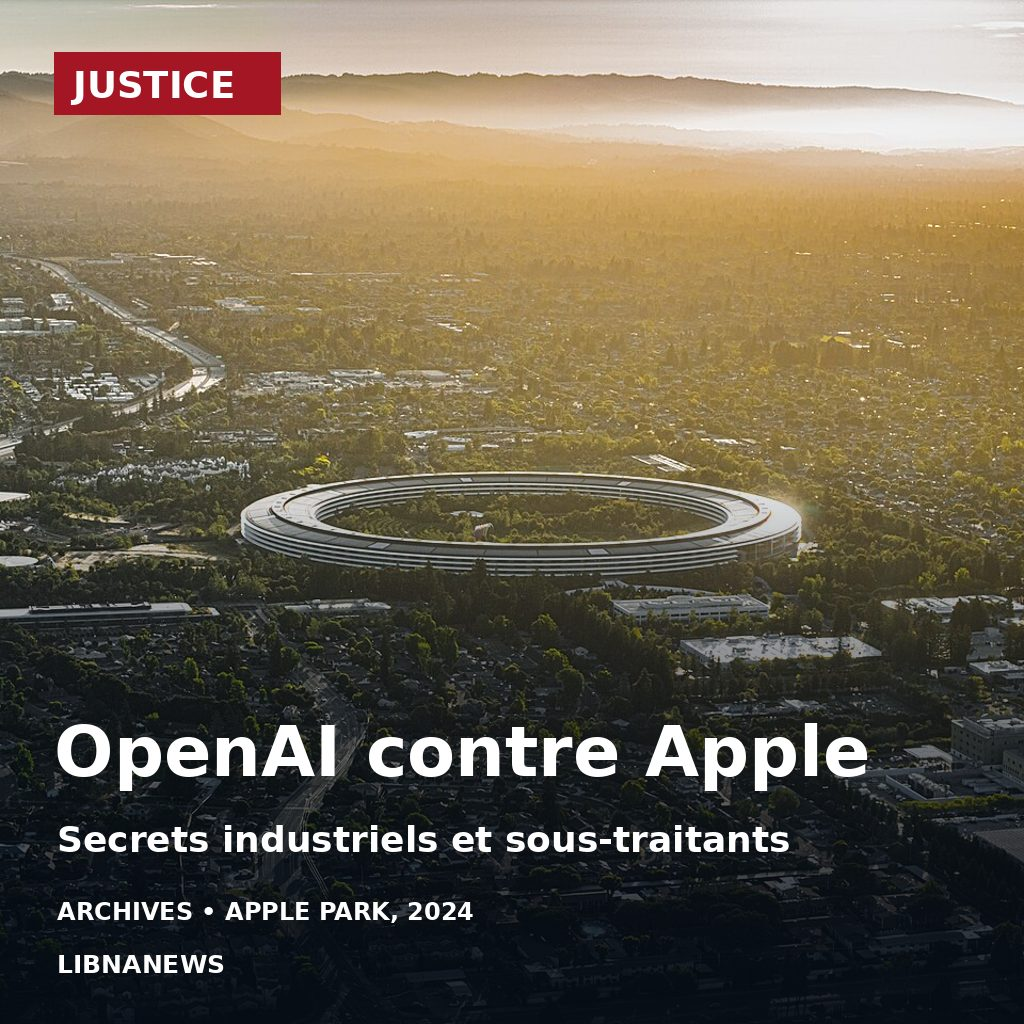
OpenAI and its io Products hardware subsidiary filed counterclaims against Apple in the Federal Court of San José, California on Friday, November 27. They accuse the iPhone manufacturer of having obtained information about a device in preparation and of having pressured common suppliers. Apple contests these claims. It was Apple who started the proceedings in July, accusing OpenAI of recovering its own industrial secrets.
The document filed Friday in the fileApple Inc. v. Liucontains the respondents’ response and 12 applications against Apple. Four come from the OpenAI Group and from the Products. The other eight are presented by Chang Liu and Tang Yew Tan, two former Apple employees who are already parties to the trial. It is therefore not a matter of opening a second trial: these applications are added to the original complaint and will have to be considered in the same case.
An employee past Apple to OpenAI, then back to Apple
To support her accusation, OpenAI describes the path of an engineer she does not name. He started working at OpenAI on December 2, 2025 and left on June 2, 2026, according to the memoir. The company claims that it sent documents concerning its equipment projects to accounts or personal numbers. Among them, she cited a 76-page document on the measurement and control of a component that had not been marketed.
OpenAI states that the engineer then returned to Apple. On the basis of the information she claims to have had, she submits that in July, he presented information to Apple officials in Asia-Pacific about his device activities and projects. Apple denies having used this employee to obtain confidential information from OpenAI. The filing does not constitute a finding by the court on the transmission or use of documents.
The dispute extends to subcontractors
OpenAI applications also concern manufacturing. The company claims that a joint subcontractor specializing in surface processing of metal parts moved its work to a night shift after Apple objected. According to OpenAI, another manufacturer told him that he was giving up planned work because of Apple’s pressure. The names of these suppliers are not given in the public narrative of these two episodes.
OpenAI distinguishes in its memory the protection of drawings, tools and instructions reserved for a customer from the use of common means of production. It considers that the restrictions it denounces have exceeded Apple’s own information protection and increased its costs. Apple rejects any attempt to impede competition in the manufacture of devices incorporating artificial intelligence. In particular, the judge will have to determine what constitutes a commitment of confidentiality or production capacity and what, if any, has prevented a supplier from performing a contract.
What Apple has been blaming since July
In its complaint of 10 July, Apple accuses in particular Chang Liu and Tang Yew Tan of having taken away or used confidential information from the company for the benefit of OpenAI’s device projects. It also aims at OpenAI and io Products and asks the court to prevent the use of the documents it claims and to order their return. OpenAI denies being appropriate to Apple’s secrets. Apple, for its part, presents the November 27 applications as an attempt to divert attention from its complaint.
OpenAI and its subsidiary, in turn, apply for prohibitions and damages the amount of which is not stated in the memorandum. The file now contrasts two stories on the circulation of documents and a third on relations with suppliers. No substantive judgement established that one company had stolen or exploited the other’s secrets.





Comments