

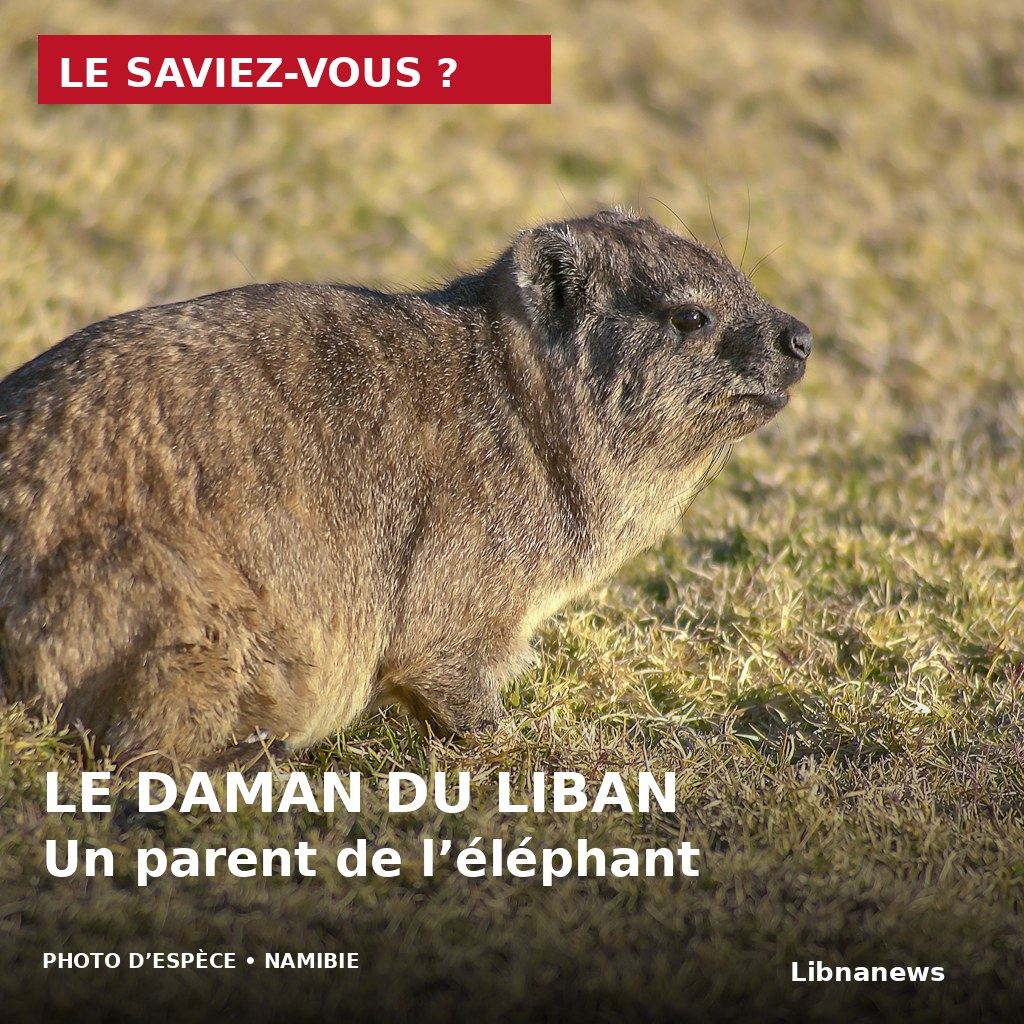
Did you know that? The daman who lives in the rocks of Lebanon is neither a rabbit nor a big rodent. This small mammal belongs to a group related to elephants and lamantines. His presence was documented by photographic traps in Jabal Moussa.
A trapu body, rounded ears, short legs: at first glance, the daman evokes a guinea pig more than an elephant. The resemblance is misleading. The daman of Cape Town, Procavia capensis, is in the order of hyracoids. He shares an evolutionary history with the elephants and the Sirenes, the group of the lamantines and the dugongs.
This relationship does not mean that the daman descends from the elephant, nor that he would be a miniature elephant. The lines differentiated from common ancestors. The present size and appearance of an animal is not sufficient to establish its place in the tree of the living.
The daman of Lebanon, photographed in Jabal Moussa
In Lebanon, its presence is not based solely on observation by walkers. A study by Mounir Abi-Said and Zuhair Amr, published in 2012, documented in the Jabal Moussa Biosphere Reserve in the Kesrouan-Jbeil region. The aircraft had been installed between March 2008 and May 2009. These dates count: the study establishes a presence at this time, not a current count.
Researchers obtained 22 photographs of damans in open rocky areas. Some images showed groups of three to nine individuals. On a July shot, four adults appeared with four youths. Photographs should not be added as if they were different animals.
The device documented thirteen mammal species in the reserve. For the Damans, he mainly confirmed the occupation of steep lands where direct observation is difficult. A camera allows you to see a passage without permanently keeping an observer nearby.
Feet adapted to rock
The daman did not have the silhouette of a climber. Yet his feet give him good grip. Their lower side has soft pads, held moist by glands. This combination helps to progress on rocky surfaces and quickly take refuge in a crack.
His fingers are mainly rounded nails. A particular claw, located on an inner finger of the back foot, serves for grooming. Long sensory hairs complement this equipment: they help to perceive what surrounds the narrow passages.
Crevices are an essential part of its habitat. They provide shelter against predators and bad weather conditions. The daman uses the available fractures rather than digging himself a network of burrows. It is also looking for accessible vegetation around its refuges.
Small defenses, but no tricks
The mouth brings another surprising detail: its superior incisors develop like small defenses. His molars crush the plants he feeds on. In adults, the weight is usually within a range of a few kilograms, far from the size of an elephant.
Daman mainly consumes plants. Herbs, leaves and other available resources make up its diet. Its digestive system is home to microorganisms that help treat this food. The menu varies according to background and season: observations made in Africa do not necessarily describe the regime of each Lebanese colony alone.
Sun before activity
The daman is mostly active during the day. Groups can gather in the sun before going to feed. This collective life is accompanied by alarm calls: when a danger is detected, animals return to their rocky shelters.
The young are born already covered with hair, with open eyes. They become mobile quickly, unlike the poor newborns of many small mammals. Their birth occurs after a particularly long gestation for an animal of this size, several months in length.
Globally, the species is classified as a minor concern. This status does not make it possible to conclude that every local population is sheltered. Land transformation can reduce access to shelters and food. In Jabal Moussa as elsewhere, conserving boulders, their cracks and surrounding vegetation protects habitat that sometimes seems empty, but is not empty.
Cover photograph: © Hans Hillewaert, Hardap, Namibia, June 12, 2007, Wikimedia Commons. Photo of the species, not taken in Lebanon. Boxing and dressing Libnanews under cC BY-SA 3.0 license.





Comments