

Since the financial collapse of 2019, some Lebanese households have devoted their energy to making ordinary gestures possible: enlightening, caring for, keeping children in school. Available surveys describe unequally distributed social wear and tear, aggravated by displacement and war. They invite us to look at what families need to organize themselves when services no longer guarantee the continuity of daily life.
An electricity bill does not measure everything a cut-off requires. There is also a need to reorganize schedules, preserve food, find a solution to work or run a pump. The lack of income and the lack of predictability eventually joins one another: even an expenditure already settled does not always guarantee that the day will take place as planned.
Talking about exhaustion in Lebanon, however, means not locking a whole population in the same story. Situations vary according to housing, income, dependent relatives, region and exposure to violence. A household receiving foreign dollars has opportunities that are beyond the value of its resources. A displaced family still has to solve another uncertainty: where can it live the following month?
Must choose what will stay connected
Human Rights Watch Report « Cut Off From Life Itsself », published in March 2023, gives a specific example. When questioned in Aley on 8 June 2022, Ihab Abu Fakhr explained that he had deleted the generator subscription from his own home to preserve his mother’s. This is a testimony gathered by the organization, with consent according to its methodology, and not an interview conducted by Libnanews.
The quantitative survey, conducted from November 2021 to January 2022, estimated that generator bills absorbed an average of 44% of the monthly income of the households concerned. For the poorest fifth, the share was 88 per cent, compared with 21 per cent in the easiest fifth. These figures describe this period, not the November 2026 rates and revenues.
They illuminate a sustainable mechanism: when access to an essential service depends on a private solution, not all families have the same replacement capacity. Arbitration can be done within the same relationship, between two housing units, rather than between comfort and superfluous.
Very uneven protections from the crisis
The World Bank estimated in May 2024 income poverty affected 44 per cent of the population in the areas studied in 2022, and 33 per cent of Lebanese nationals in those areas. The survey covered Akkar, Beirut, Bekaa, Northern Lebanon and most of Mount Lebanon. It excluded Palestinians living in camps and groups. It is therefore neither an exhaustive photograph of the territory nor a national rate measured in 2026.
The report highlights the protective role of dollar incomes and foreign transfers for part of households. It also notes a particularly high poverty among Syrians interviewed, close to nine in ten. Nationality, access to employment and family resources thus profoundly alter the exposure to the crisis.
These differences prevent signs of visible consumption in some neighbourhoods from being confused with general improvement. They also prevent every inhabitant from being deprived of the same resources. Social exhaustion is understood from these differences, not by erasing them.
A interrupted recovery, horizons to rebuild
The context has changed further since these investigations. In its summer review 2026The World Bank estimated real growth from 2025 to 4.2 per cent, before a projected contraction of 6.4 per cent in 2026. The new escalation of March had interrupted this fragile improvement, damaged housing and infrastructure, displaced communities and weighed on consumption and tourism.
The forecast for decline is still shown in the Macro Poverty Outlook October 2026. It remains a projection, subject to security developments. A rebound in gross domestic product is not sufficient to establish that each family has recovered its income or services.
The succession of shocks complicates the possibility of projecting. An economic improvement can open up a perspective, then a displacement or a new expenditure forced to recalculate. In order to appreciate the recovery of an ordinary life, we must therefore also look at the continuity of housing, school and care.
Protecting children also calls for support for adults
The report UNICEF An Enduring Nightmarepublished in September 2026, is based on a telephone survey conducted in July among 3,016 people. She indicated that 82 per cent of households found it more difficult to finance basic needs than three months earlier. In 31 per cent of the households surveyed, children had not received the necessary care, mainly for financial reasons.
The press release of 30 september 63% of households reported anxiety or nervousness in their children. These reported observations do not constitute psychiatric diagnoses. Nor is it possible to calculate a mental disorder rate for all adults in the country.
Parents themselves have to deal with their concerns. In a communication of october 2026The International Rescue Committee describes interviews with ten mothers of children under the age of nine, displaced in collective shelters, rented apartments or relatives. Some described their isolation and their efforts to hide their fear in front of their children. This small set of interviews illuminates experiences; It is not a representative survey.
Benoit Delsarte, director of the IRC in Lebanon, stressed in this communication the need to support adults who care for children, including after their return home. The departure of a shelter does not mean that any concern disappears. A policy of support must be able to accompany families beyond the displacement itself.
The departure remains an aspiration, not a measure of exodus
Uncertainty is found in migration projects. Arab Barometer interviewed 2,400 Lebanese citizens between February and April 2024 38% expressed desire to emigrate. The proportion was 58 per cent for the 18-29 age group, compared with 29 per cent for the older age group. Economic reasons dominated the candidates’ initial answers.
The result measures an intention, not a number of actual departures. It also precedes the escalation of 2026. The level of 38% was the same as in 2022 and 2012, which precludes describing this only survey as evidence of a continuous increase.
Wanting to leave and be able to leave remain two different questions. The data do not give each interviewee a visa, a job or the means of moving. They point out, above all, how the future is envisaged for some young people outside the country where it should be able to build itself.
Making daily energy less expensive
Mental health responses exist. LWHO presented in June 2026 Step-by-Stepfree digital support developed with the National Mental Health Programme of Lebanon. It combines five modules with short weekly contacts with a trained stakeholder. The organization reports positive results in tests conducted in Lebanon and indicates that the programme is being deployed nationwide.
This type of support can increase access to aid. It does not exempt the burden of spending, security and essential services. Making a consultation accessible, allowing for continued schooling and ensuring reliable supply meet different needs, which can be combined in the same household.
The social question is then very concrete: what part of the day can the inhabitants devote to something other than repairing interruptions? Finding predictability makes it possible to prepare an examination, organize a job, take care of a loved one or simply rest. It is also to this possibility to loosen the ordinary constraints that the exit from crisis will be measured.
This file is a literature review based on identified investigations and communications. No new interviews were conducted for this article. Collection dates are distinguished from publication dates; indicators of poverty, declared distress and migration intent are not interchangeable.
To extend: our file on child deprivation and our analysis of obstacles to returning to school.
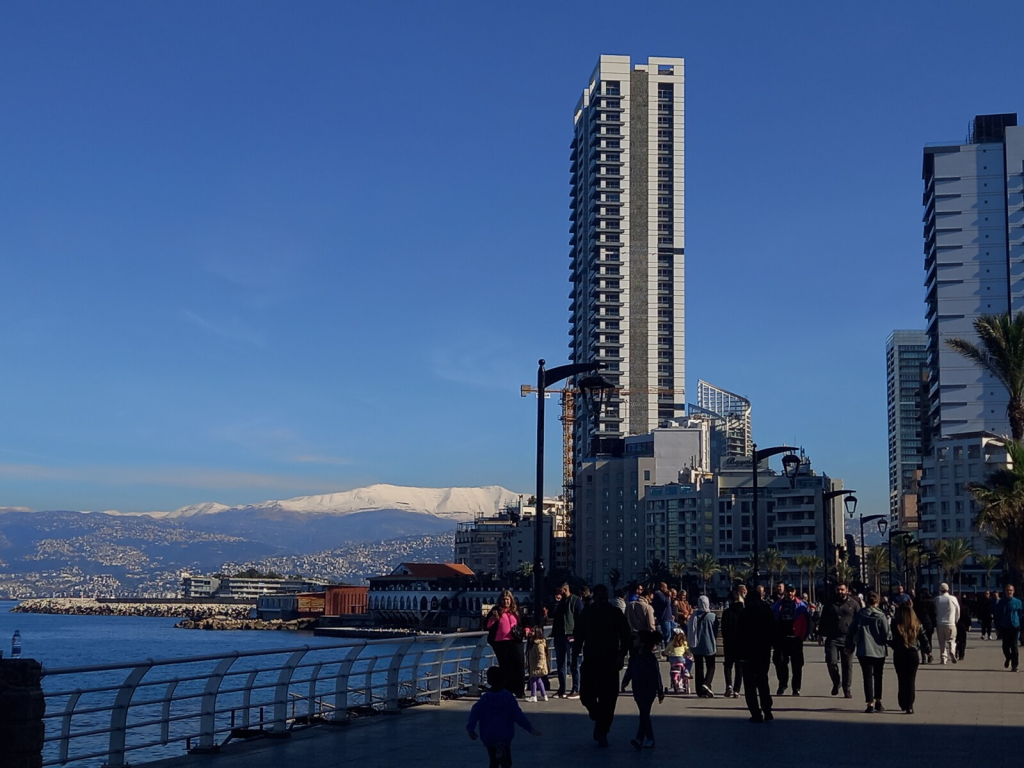
Illustration: Beirut seafront, 4 January 2026. TorbeyCharbel / Wikimedia Commons, CC BY 4.0. Proportional resizing, without cropping or changing the scene. The persons photographed are not witnesses called.






Comments