

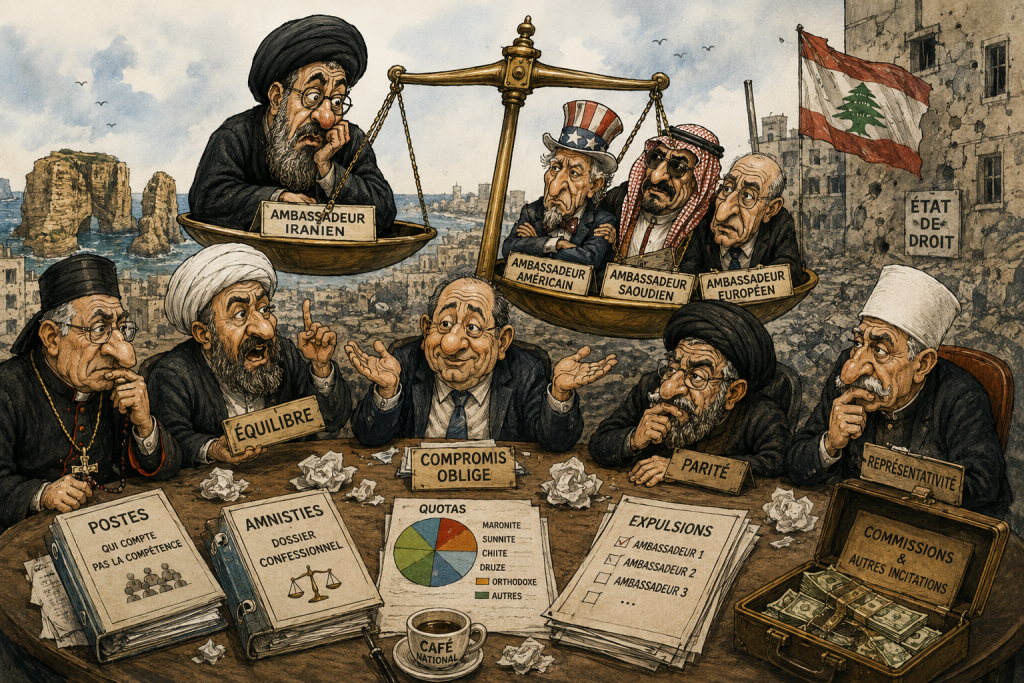
In Lebanon, nothing is done alone. Even problems must respect the community balance.
You want to appoint a senior official or a minister? First question: is he competent? No. The first question is which community belongs to the position.
If he has to return to a maronite, he will need a maronite. If he comes back to a Sunni, he’ll need a Sunni. If he comes back to a Shiite, he’ll need a Shiite. And if an appointment benefits one community, one will probably have to find another position to satisfy others.
Competence? She’ll come later.
It does not matter whether the state is already drowning in incompetence, whether the administration is working badly and whether some public bodies would need technicians who can do their job. The essential thing remains to preserve religious balances. Sometimes it is better to be incompetent in the right faith than to be competent in the wrong: at least the community balance is safe. The state, much less.
For the amnesty law, same principle. Almost impossible, or almost impossible, to amnesties criminals claimed by a community without seeking those whom another community wishes to bring out of prison. In Lebanon, even forgiveness must respect a certain parity: each one has his criminal, and especially that no one can claim that the neighbour has obtained more.
Therefore, the problem posed by the Iranian ambassador could perhaps find a genuine Lebanese solution to the great damn of the AE minister, a little isolated in recent days and thus thinking of returning to the stage.
Expulsion? Why not? But expelling only the ambassador of Iran would immediately create a dangerous imbalance. It would therefore be necessary, as a compromise, to determine which ambassador of the opposite camp should pack with him.
The United States? This would restore some geopolitical symmetry, but some communities would protest. The one from Saudi Arabia? Same problem with the reverse protests. Deport both? Attention: the representativeness coefficients should be checked and no regional axis should be underrepresented in the large national division of evictions.
Of course, there remains a slight problem: if the principle is now to expel any ambassador whose country is ingesting in Lebanese affairs, then it is necessary to start immediately organizing the boxes in the embassy district.
At this rate, the chancelleries would run the risk of emptying themselves quite quickly.
And maybe not just chanceries.
If we were also to cut off all the channels of influence, political financing, favours, intermediaries, contracts negotiated between friends and commissions that have been accompanying Lebanon’s great international friendships for decades, the pockets of some political leaders would also risk experiencing a spectacular air flow.
It would even be an institutional revolution: for the first time, Lebanese politics might have to be made with Lebanese money.
It is therefore understandable why the issue deserves reflection and even if it is not beneficial in the end.
The most prudent for our politicians in short panties would be to establish a national commission for diplomatic expulsions. Its members would naturally be chosen according to their confession, the decisions taken by consensus and each expulsion compensated by another in order to preserve the national balance.
After six months of negotiations, no one would be expelled.
Ambassadors would remain in Beirut, political leaders would continue to solemnly denounce foreign interference while attending their respective embassies, and everyone would announce that they had defended national sovereignty.
Perhaps that is the genius of the Lebanese system: in a state that is already drowning under the weight of its dysfunctions, succeeding in considering that the problem is never really to know who is competent, who is ingesting, who is paying or who decides.
The key issue remains much simpler:
What confession is he, who supports him… And who touches the commission?




