

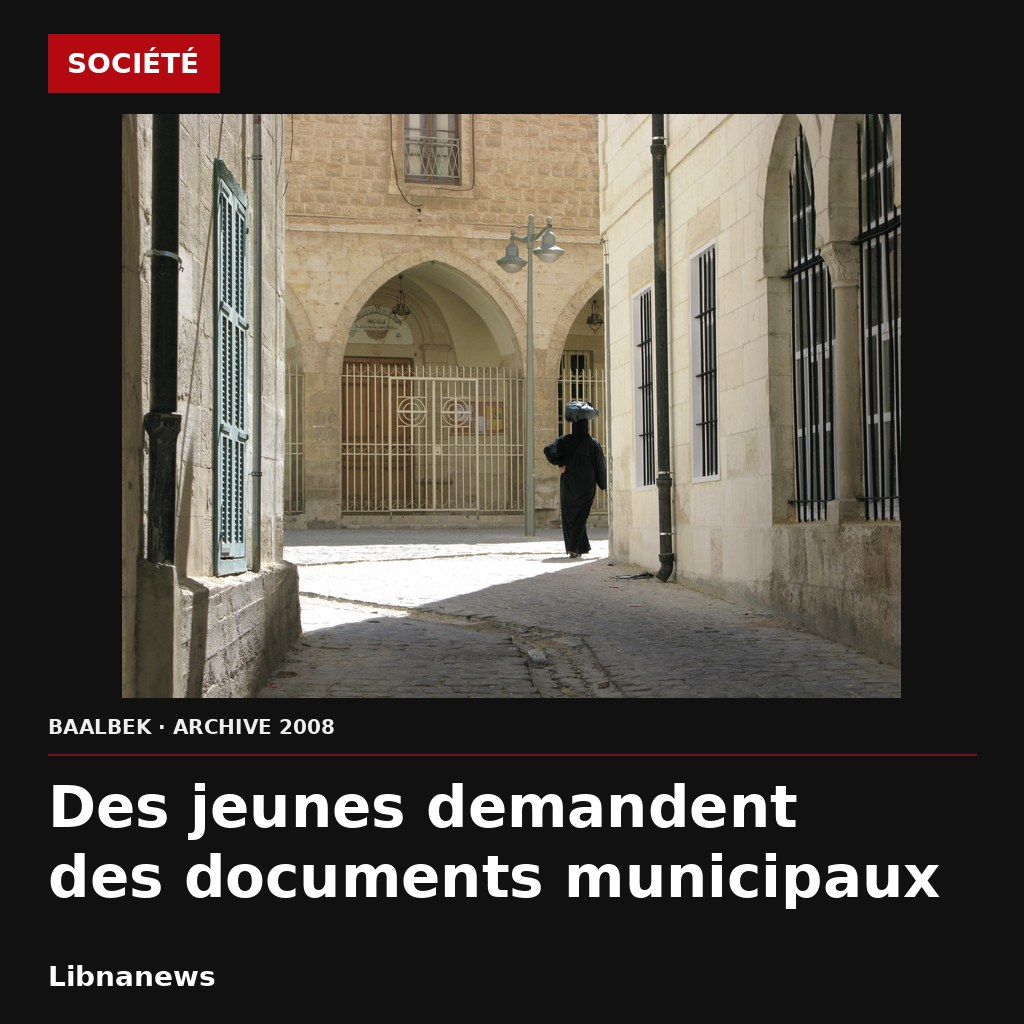
In Baalbek, young participants in a Maharat Foundation campaign sent information requests to local municipalities. The experiment, presented at the end of October, shows how to make a little known approach. The responses of the administrations were not published in the Beirut Forum Review.
In Baalbek, the campaign continues at the window
For the young people who set up the campaign « It According to the Maharat Foundation report published on 5 November, the group interviewed residents and public officials on the right of access to information. It drew an awareness campaign and training sessions before filing applications with local municipalities.
It is this last gesture that distinguishes the initiative of a campaign limited to social networks. The group was not content to explain that a right exists: it has initiated the process with the administrations concerned. Maharat reports about 70,000 views of its content in three weeks. This figure measures their circulation, not the number of individuals who have learned to apply, nor the number of documents obtained. The balance sheet does not indicate how many applications have been submitted or whether the municipalities have responded.
Request a document, not a justification
Lebanese Law No. 28 of 2017, as amended in 2021, allows a person or organization to request information held by an administration. Municipalities and municipal unions are among the bodies concerned. The applicant does not have to explain what he intends to do with the document. This does not mean that all documents are communicable: privacy information, for example, is one of the exceptions.
A request may relate to a copy of a specific document rather than a general question. For example, a resident who wishes to know what his municipality has planned for the maintenance of a public garden may indicate the decision or contract he is seeking, the period involved and the means by which he wishes to access it. This example illustrates the approach; Maharat’s assessment does not specify the subject of the Baalbek Group’s requests.
The National Anti-Corruption Commission proposes a form to specify the documents sought and the desired method of consultation. The application is submitted first to the administration holding the document. Keeping a dated copy helps keep track of the process. The Commission also proposes a complaint form in case of refusal of access: it does not replace the original application.
Five experiments, results to follow
The Baalbek group presented its work at a forum held on 24 October in Beirut. Maharat brought together five teams from Beirut and Mount Lebanon, Baalbek, Akkar, Saida and Tripoli. In Akkar, another group worked on the verification of rumours circulating on WhatsApp. The Beirut and Mount Lebanon teams examined public procurement. Each group started from a problem encountered in its region, rather than reproducing the same campaign.
In Baalbek, the result will be more concrete than the audience figures: whether the administrations responded and, when they did, what documents they made available. For now, what the initiative has made visible is the first step: young people have requested documents on their behalf from municipalities in their region.





Comments