

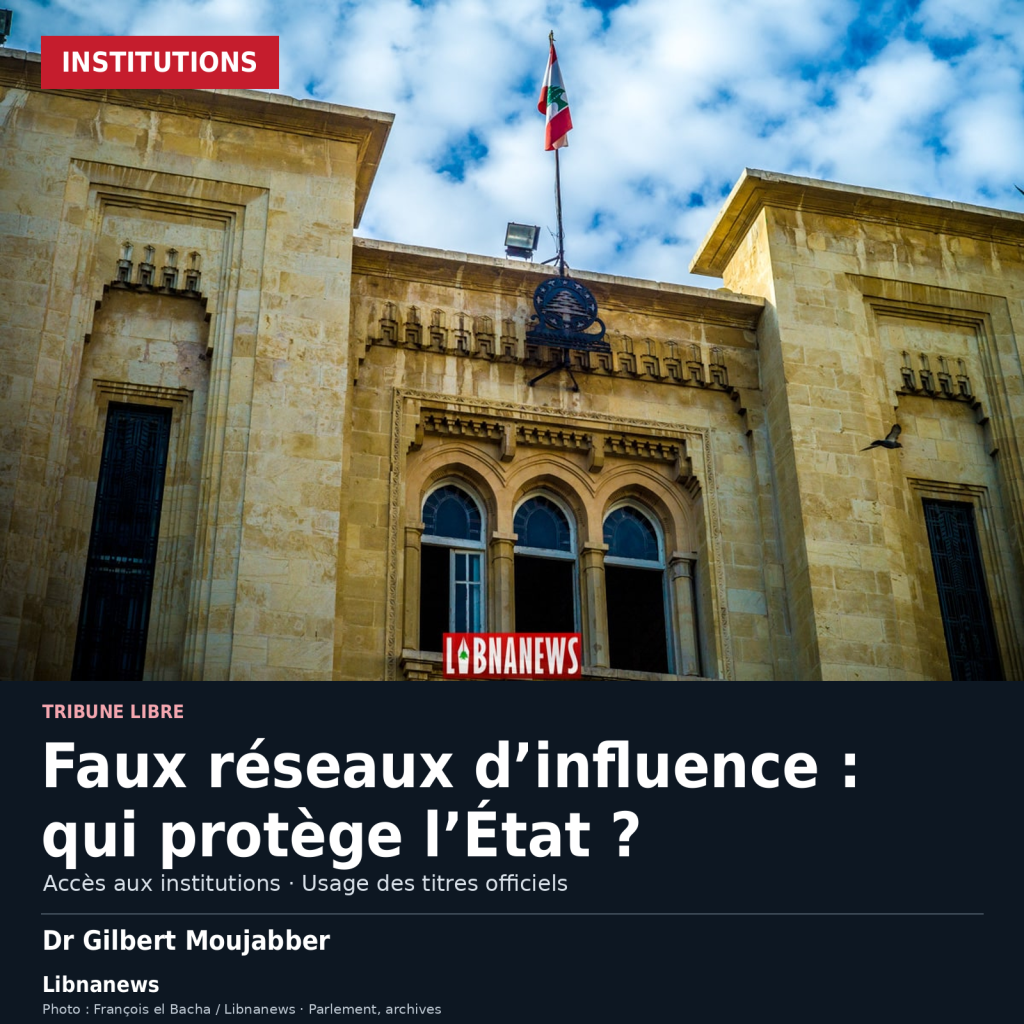
By Dr. Gilbert Moujabber
Not all serious cases involve the arrest of a person or the opening of a judicial inquiry. Some reveal much deeper questions and put the entire state in the face of its responsibilities. The suspicions of abuse of quality, judicial brokering and exploitation of alleged relationships raise a fundamental question: how can a person construct an image of influence through photographs, honours, titles and meetings with officials, and then use this image to convince others that he or she has a power that he or she does not possess?
The danger arises when the image replaces reality, when the title replaces competence, and when the photographic proximity with an official becomes an alleged certificate of influence. A photograph with a minister does not confer any authority. An honour does not give any judicial power. An official meeting does not transform anyone into an intermediary authorized to intervene in a procedure.
The State is neither a reception hall nor a space for the multiplication of protocol photographs. Each meeting must have a specific objective, each visit must be supervised and each institution must protect its authority and reputation.
WHERE THE CONTROL OF COMMITMENTS AND OUTSIDES IN THE INSTITUTIONS OF THE STATE IS FINDED?
Who checks the identity of the visitors before their admission? Who controls the reality of the functions and associations they claim to represent? Who examines the reason for their visit and the purpose of their meeting with public officials? Are the checks limited to entering a name, or do they include a true verification of the identity, quality and purpose of the visit?
Institutional security does not start after the discovery of fraud. It starts before the door opens. Verification of the identity and quality of a visitor is not a secondary formality: it is an essential obligation to protect institutions, their representatives and citizens.
But responsibility does not stop when the visitor leaves the place. Who ensures the subsequent use of photographs taken in official offices? Who prevents these images from being turned into misleading advertising tools or so-called evidence of privileged relationships? Who intervenes when the name or image of an institution is used to mislead the public?
An official building is not an ordinary place. Any person who is received there is, in the public mind, associated with an institution representing the State. The responsibility to protect this institution cannot therefore be reduced to the presence of security officers at the entrance.
PHOTOGRAPHY PRETENDED INFLUENCE: HOW DO THE MENSONG TAKE FROM THE AMPLEUR?
The mechanism can be progressive: a first encounter, a photograph, a ceremony of award, and then this image is presented to another person as proof of a privileged relationship. A new encounter then reinforces this appearance, until an artificial construction resembles an established reality.
The protocol services, the appointment offices and the administrations concerned must therefore have professional procedures capable of preventing the abuse of official meetings. It is not a question of considering every visitor as a suspect or of closing the State’s doors to civil society. The aim is to build trust on verification and apply the same rules to all.
ASSOCIATIONS MUST NOT BE COVERED FOR THE PERSONAL POWER.
Associative, civil and humanitarian work is an essential task. Serious associations deserve respect and protection. However, the administrative authorization of an association does not confer on its president any judicial or political authority or right to intervene in proceedings.
It would be unfair to discredit all associations because of the possible actions of some people. A distinction must be made between genuine humanitarian commitment and misuse of titles and associations for personal purposes.
THE LAST LAST RESTRAINT OF FAMILY SUFFRANCE.
Let’s imagine a mother waiting to hear from her detained son, a father exhausted by legal proceedings and a family that has exhausted its savings in defence. Then appears a person who exhibits photographs with officials, evokes privileged contacts and suggests that she can open doors or influence the course of a case.
What exploitation can be more cruel than turning a mother’s anxiety into a profit opportunity? What moral deprivation can be more serious than taking advantage of a family’s tears by making it believe that justice can buy through a photograph, title or telephone number?
If payments were actually required in exchange for promises of judicial intervention, the facts must be thoroughly investigated and prosecuted in accordance with the law. Justice is not a market. A detainee is not a commercial opportunity. The suffering of a family cannot become a capital for those who seek to enrich themselves in its despair.
Families should not let anyone make them believe that justice buys or that the fate of their loved ones depends on an allegedly influential intermediary. Competent lawyers, due process and independent justice must remain the only legitimate references.
RESPONSIBILITY CANN’T ALWAYS CALL OUT: « WE DON’T KNOW. ».
A person in charge may have received someone in good faith without knowing what use would be made of that meeting at a later date. A photograph alone does not constitute evidence of complicity or involvement in an offence. However, this does not exempt institutions from reviewing their procedures and strengthening their oversight mechanisms.
The public service is not personal property. The image of a person responsible must never become an instrument of deception. Clear rules must govern receptions, ceremonies and visits, and any misuse must be subject to review in accordance with the law.
WHAT MUST THE STATE DO NOW?
This case must lead to a serious review of the procedures for access and reception in presidencies, ministries and public administrations. It is necessary to strengthen the verification of professional or associative identities and qualities, organize the registers of visits and appointments, supervise the use of official photographs and symbols and investigate any attempt to exploit the name of a person responsible for obtaining money or promising illegitimate intervention.
Investigations must establish the truth: how did these practices begin? How could they last? Had any alerts been ignored? Have any families suffered any harm? Have photographs, relationships or official titles been used to obtain illicit benefits? These questions require answers based on evidence, not on rumours or premature judgements.
OUR POSITION: THE AUTHORITY OF THE STATE IS NOT A PHOTOGRAPHY ACCROCHED IN THE MUR.
Lebanon does not lack titles, distinctions or protocol photographs. What is lacking is respect for the public service, effective control, transparency, accountability and the restoration of citizens’ confidence in their institutions.
We do not want officials who welcome visitors only for a photograph, but officials who know who they receive and why. We do not want institutions that simply monitor their doors, but institutions that protect their mission, name and reputation. We want justice before which all are equal and whose decisions are neither for sale nor for negotiation.
No one should be convicted until the court decides. No person responsible shall be charged with an offence that has not been established. But respect for the presumption of innocence cannot become a pretext for silence in the face of administrative and institutional failures.
A State whose doors open without control may one day discover that citizens have been deceived in its name, that families have been stripped in the name of justice and that public confidence has been sacrificed to the detriment of human dignity.
A photograph with an official can offer a moment of prestige, but it does not confer any power. A distinction can be hung on a wall, but it does not create integrity. A title may be entered on a card, but it does not give anyone the right to play with the fate of others.
The authority of the State is not measured by the number of people crossing the doors of its institutions, but by its ability to know who deserves to be received and to prevent its name being used to deceive its own citizens.
Dr. Gilbert Moujabber





Comments