

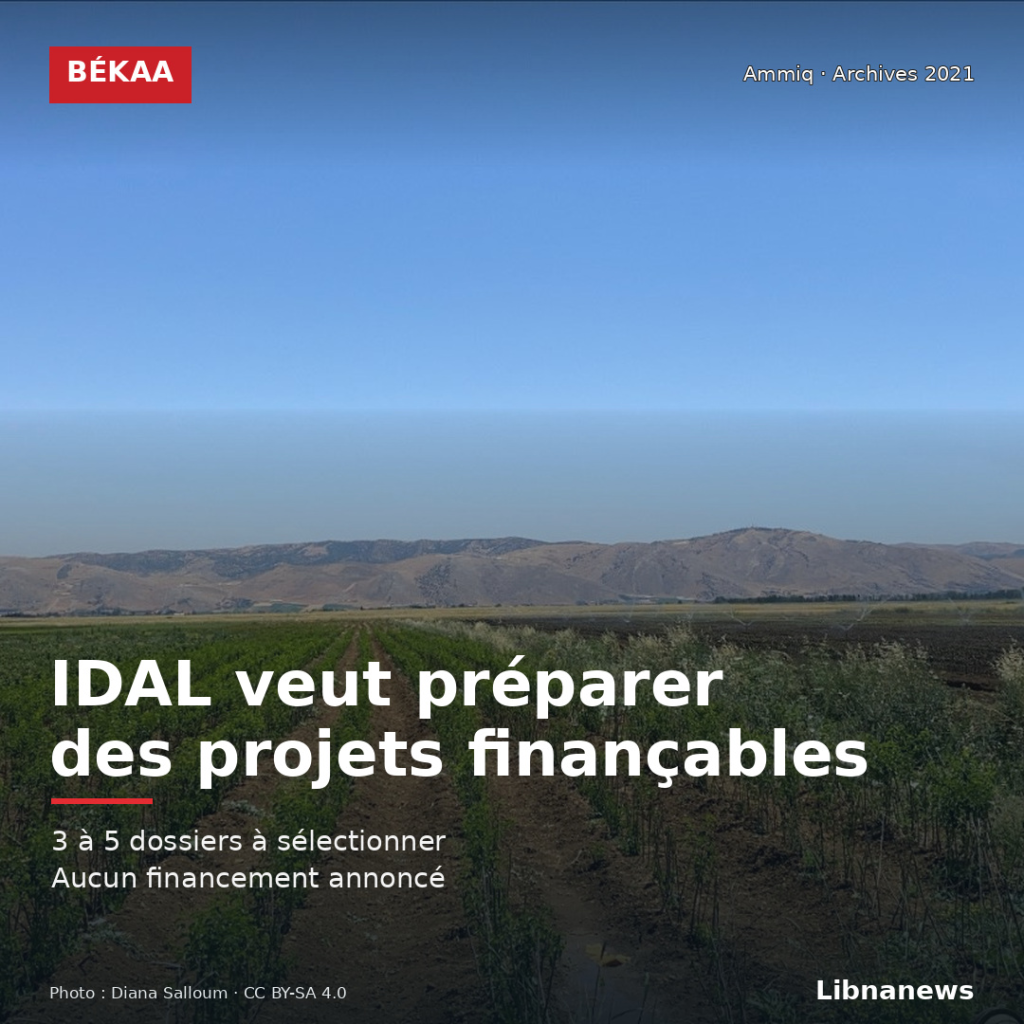
IDAL wants to prepare three to five investment files in Bekaa with the Chamber of Commerce, Industry and Agriculture of Zahlé. At the meeting on 4 November, the President of D’IDAL, Majed Mneimneh, proposed a coordination team to select these projects in the coming weeks. No funding was announced. Labour must first specify capital needs, target markets and expected jobs.
Agri-food, modern agriculture, renewable energy, tourism and logistics are among the sectors envisaged. The files would then be presented to investors. For companies in the region, this shift from idea to costed project occurs in an economy where credit remains scarce and production costs are high.
Investment in Bekaa from an old base
The region has a long documented agricultural and industrial fabric. The 2015-2016 industrial register used by IDAL included 323 companies with more than eight employees in the Bekaa governorate. About 43% were from the agri-food sector. Zahlé concentrated 278 establishments.
These data do not describe the state of the sector in 2026. However, they show why agricultural transformation plays an important role in the discussions. A plant close to producers may limit its collection costs, provided that it has regular harvests, sufficient quality and storage capacity.
The regional data sheet of the D-IDAL also draws on the 2010 agricultural census. It mentions 16,566 hectares of permanent crops, of which 31% are vines, 28.4% are stone fruits and 20.9% are olive trees. These historical areas do not provide information on farms still active after successive crises.
A precedent illustrates the role of the agency. In 2018, IDAL accounted for $15.34 million in sustained investments and 117 jobs in Bekaa. At the national level, its balance sheet was $78.55 million and 812 jobs. These were only projects supported by the organization, not all investments made in Lebanon.
Water, crops and stock costs
Drought has already reduced the available volumes for processors. In its bulletin of 25 August 2025, FAO estimated that rains from December 2024 to February 2025 were more than 50 per cent below average in Bekaa and Baalbek-Hermel. It estimated the cereal harvest for the whole of Lebanon at around 90,000 tonnes by 2025, almost 50% below average.
These figures relate to the past year, not 2026. However, they provide a measure of the risk to which a new production unit may be exposed. When the harvest drops, the plant uses less of its equipment. Its fixed costs remain, while the purchase of raw materials elsewhere may increase its costs.
Irrigation and electricity are therefore important in the choice of projects. Cheaper energy can reduce the bill for pumping or cold rooms. It does not guarantee water availability. Records will also need to include inventory financing and the time between payment to suppliers and collection of sales.
Rebuild before expanding
The war damaged farms and equipment. The agricultural valuation published in April 2025 estimated damages of $118 million and losses of $586 million throughout Lebanon. It covered the period from October 2023 to November 2024. The South and the Bekaa Valley were among the most affected areas.
Recovery and reconstruction needs reached $263 million, of which $95 million were identified as priorities for 2025-2026. This amount is neither a fund available nor an envelope reserved for Bekaa. The assessment does not cover destruction that occurred after November 2024.
For an investor, replacing a destroyed cold room and opening a new processing line meet two different needs. The first investment can simply restore lost sales. The second assumes that neighbouring farms can supply additional volumes. The rehabilitation of suppliers is as important as that of the factory.
IDAL supports projects, but does not finance them
The Agency facilitates the process and proposes incentives for eligible projects. She doesn’t bring them the money directly. Its participation in preparing a dossier does not therefore constitute a loan or investment commitment.
In its documentation on agri-food, IDAL presents, among other things, Area C: a $1 million investment threshold and corporate and dividend tax exemptions for 10 years. The global incentive contract provides for a minimum of $3 million and 60 jobs. A framed reduction in the employment threshold is possible in return for training.
These schemes remain subject to eligibility criteria. None of the projects mentioned on 4 November was announced as a beneficiary. Above all, a tax exemption relates to future profits. It does not regulate the initial purchase of the machines, the work and the cash needed to start.
National forecasts highlight the difficulty of the context. In October, the World Bank projected a 6.4% contraction in Lebanese GDP in 2026 and an inflation rate of 17.5%. It noted supply disruptions and rising energy and transport costs. Its summer economic report also stressed the continuing weakness of the banking sector.
Rayak, Masnaa and the rail remain proposals
The Speaker of the House, Mounir Tini, defended a broader vision: the Arab highway, Rayak airport, rail and economic area connected to Masnaa. He spoke of a logistics platform, a dry port and a financing mechanism involving the Bank of Lebanon. These proposals were not the subject of investment decisions announced at the meeting.
Their schedule is not confused with the preparation of the three to five files. A company capable of using existing networks can move forward without delay all these equipment. On the other hand, a project whose revenue depends on an infrastructure that is still missing must incorporate this time and cost.
The next step announced by IDAL is the selection of files in the coming weeks. Project promoters, sites, budgets and target markets still need to be specified before they are presented to investors.





Comments