

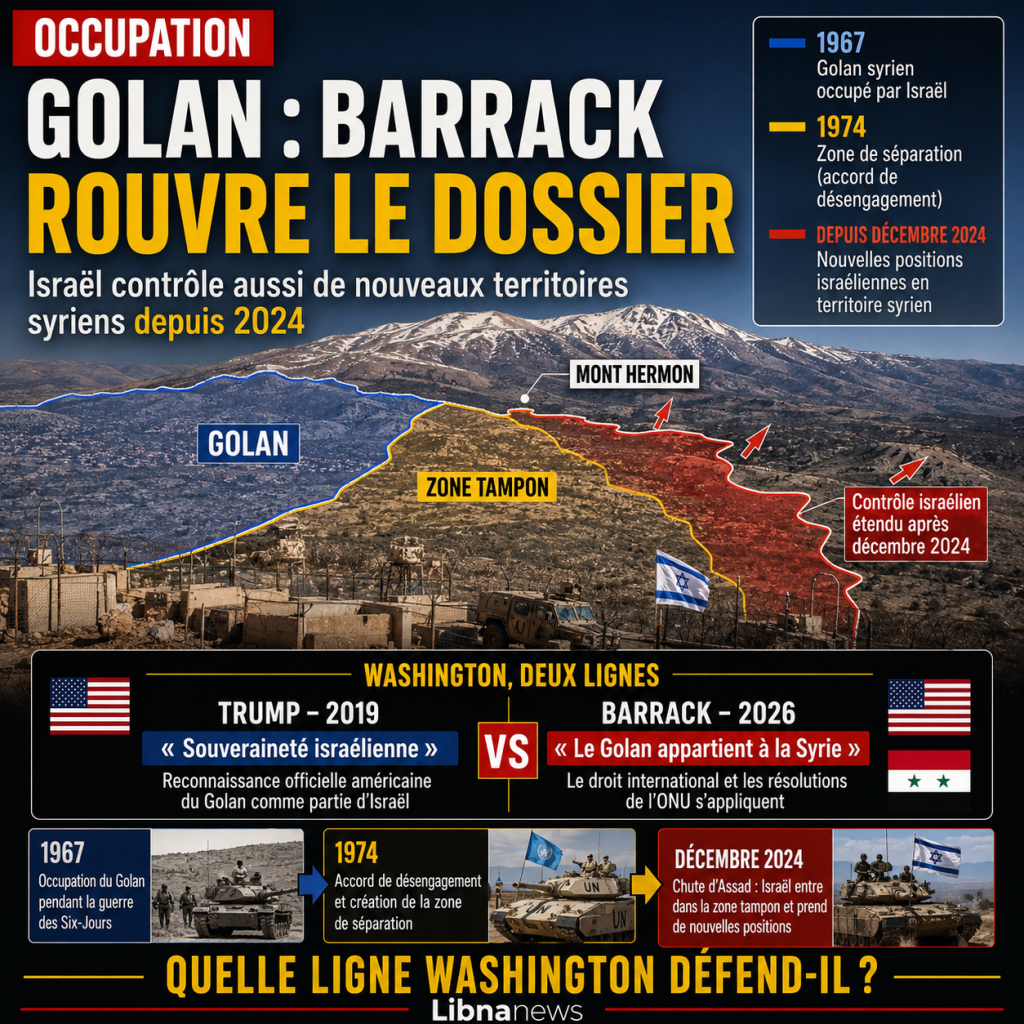
Tom Barrack’s statements on the Golan place the Trump administration in the face of a contradiction that far exceeds the US decision of 2019. The US Special Envoy for Syria and Iraq claimed that the plateau belongs to Syria according to UN resolutions and international law, while Donald Trump officially recognized Israeli sovereignty over that territory seven years earlier. But this divergence occurs mainly in a deeply transformed territorial situation: since the fall of Bashar Al-Assad in December 2024, the Israeli army has taken a position beyond the Golan it already controlled, particularly in the buffer zone and other parts of Syrian territory.
Barrack’s statement therefore does not refer only to an occupation of nearly sixty years old. It comes at a time when the issue of Syrian sovereignty has become an immediate subject between Washington, Damascus and Israel. The new Syrian authorities demand respect for their territorial integrity, while Israel maintains forces beyond its pre-December 2024 positions and continues to conduct military operations in Syria. The question put to the United States is now twofold: do they still regard the Golan as Israeli despite international law, and how far do they accept the recent extension of Israeli military control over the rest of Syrian territory?
Barrack: Golan belongs to Syria
In an interview aired on Saturday 22 August by the Clash Report platform, Tom Barrack used a particularly clear formulation. The US envoy said the Israelis still occupy the Syrian Golan in contradiction with United Nations resolutions and the international order, which considers the plateau to belong to Syria.
The scope of these comments lies first of all with the author. Barrack is not an outside observer of American politics. He directly represents the Trump administration on Syrian and Iraqi issues and plays a central role in US efforts to stabilize the new Syria and to frame its difficult relations with Israel.
In terms of international law, his assertion is in line with the United Nations position. Israel conquered most of the Syrian Golan during the war of June 1967. After more than fourteen years of military occupation, the Knesset passed the so-called Golan Law in December 1981, which extended Israeli « law, jurisdiction and administration » to the territory.
The Security Council reacted a few days later by resolution 497. Adopted unanimously, including with the vote of the United States, it considers the Israeli decision to be « no and no avenue and no international legal effect ». This framework remains that of the United Nations in 2026: the plateau is designated as the occupied Syrian Golan.
The Golan remains at the heart of an occupation begun in 1967
The territory concerned is strategic. The plateau dominates Galilee and the lake of Tiberias on the Israeli side, while it opens towards the area of Damascus on the Syrian side. Its topography gives it considerable military importance, plus water resources and height control issues.
Prior to 1967, the Golan was under Syrian sovereignty. Israel took control of it during the Six Days War, during which it also occupied the West Bank, East Jerusalem, the Gaza Strip and the Egyptian Sinai. Syria tried to take over the plateau during the war of October 1973, but failed to restore control over most of the territory.
A disengagement agreement between Israel and Syria in 1974 then organized the separation of forces. A demilitarized buffer zone has been established under the supervision of UNDOF, the United Nations Disengagement Observer Force.
This architecture survived for decades the regional wars, the absence of an Israeli-Syrian peace treaty and even a large part of the Syrian civil war.
At the same time, Israel consolidated its settlement on the plateau. Israeli settlements developed there while a Syrian Druze population remained present, notably in Majdal Shams. However, the 1981 annexation in fact never obtained general international recognition.
For nearly four decades, no US government had broken with this consensus.
Trump recognized Israeli sovereignty in 2019
Donald Trump changed this policy on March 25, 2019. During a ceremony at the White House in the presence of Benjamin Netanyahu, he signed a proclamation officially recognizing the Golan as part of the State of Israel.
The decision was spectacular. The United States became the first great power to recognize the Israeli annexation of a territory conquered during the 1967 war.
Trump then justified this change by Israel’s security imperatives. The Syrian civil war had enabled Iran and Hezbollah to strengthen their military presence in Syria, and Washington considered that returning the plateau to Damascus would pose a major risk to Israel.
However, the American proclamation did not change the status of the Golan for the United Nations. American bilateral recognition commits Washington’s foreign policy; It alone cannot overturn a Security Council resolution or transform the international legal consensus.
That’s why Barrack’s statement is so remarkable. It does not use the vocabulary of the 2019 proclamation. It goes back to the vocabulary of international law: Syrian territory and Israeli occupation.
However, no formal decision by Donald Trump overturning his recognition of 2019 was announced on August 22. There is now a clear tension between two levels of American discourse.
Since December 2024, the occupation no longer concerns only the Golan
However, it is the situation created after the fall of Bashar Al-Assad that gives Barrack’s comments their most current dimension.
When the Syrian regime collapsed in December 2024, Israel estimated that the 1974 disengagement agreement had ceased to function under previous conditions. The Israeli army then entered the buffer zone between Israeli and Syrian forces.
In particular, it took control of the Syrian side of Mount Hermon, or Jabal al-Sheikh, a dominant position of exceptional military importance. This height offers observation capabilities on a large part of Syrian territory and on the axes leading to Damascus.
Israeli forces also occupied several positions in the area of separation and beyond the lines they previously held.
The geography of litigation has therefore changed.
Prior to December 2024, the main territorial issue concerned the Golan occupied since 1967 and de facto annexed by Israel in 1981. Since the fall of Assad, a second territorial layer has been added: additional Syrian positions taken by the Israeli army in the name of protecting its border and preventing new threats.
This distinction is indispensable. The legal status and history of these territories are not identical, but they are now joining in the debate on Syria’s territorial integrity.
Israel presents new positions as a security necessity
Benjamin Netanyahu justified the entry of the army into the buffer zone by the collapse of the former Syrian order. For Israel, the departure of the Assad regime had created a military and political vacuum that could be exploited by hostile groups.
The Israeli government also insisted on the protection of Druze communities in southern Syria and on the need to prevent the establishment of forces considered hostile near its border.
Israel thus seeks to maintain a safe depth beyond the line it controlled before December 2024.
This logic was not limited to the occupation of land positions. Israeli aviation has carried out numerous strikes in Syria since the fall of Assad, targeting infrastructure, military installations, weapons systems and various sites considered to constitute a threat.
For the Israeli government, the disappearance of the previous regime does not mean that the new Syria can immediately have all the military capabilities on its territory without restriction. Israel considers that the security of its border requires guarantees before withdrawal or normalization takes place.
For Damascus, the reasoning is the opposite: the fall of Assad does not give Israel the right to expand its occupation.
Southern Syria becomes a disputed security zone
The dispute now concerns the very nature of the space between the Golan and the Syrian interior.
Israel wishes to prevent forces which it considers threatening from approaching its border. The new Syrian authorities seek to restore their sovereignty over the whole territory after more than a decade of fragmentation.
Both objectives collided directly when Israeli security was defined as requiring a military presence inside Syrian territory.
The problem is becoming even more sensitive with Turkey. Ankara plays an important role in the new Syrian configuration and maintains close ties with Damascus. Israel is concerned about any possibility of Turkish military deployment to certain Syrian facilities.
This week, this rivalry again produced an indirect confrontation. On 18 August, Israel struck the Abu Douhour air base in north-western Syria, citing concerns related to a possible Turkish presence.
Tom Barrack publicly challenged the Israeli justification. The US envoy considered that concerns about Turkey did not justify the attack and argued for de-conflict mechanisms.
His remarks on the Golan were therefore part of a series of statements in which Washington seemed to want to impose more limits on Israeli operations in Syria.
Damascus wants to return to the 1974 framework
For the new Syrian authorities, the reference to international law meets a concrete objective: to secure Israeli withdrawal from the additional territories occupied since December 2024 and to restore the framework resulting from the 1974 disengagement agreement.
This framework would make it possible to distinguish the Syrian and Israeli forces around an internationally monitored area.
But simply returning to the previous situation would not resolve the question of the Golan. The 1974 agreement organises a military separation; it does not sever sovereignty over the plateau occupied since 1967.
This is where Barrack’s statement becomes particularly important.
Had he only asked Israel to leave the conquered positions since December 2024, Washington could have defended a return to the status quo without touching American recognition of the Golan.
By recalling that the Golan itself belongs to Syria according to international resolutions, Barrack goes back much further in the litigation.
It implicitly puts on the table the boundary between the immediate security issue and that of final territorial sovereignty.
Recent occupation complicates the 2019 argument
The new situation also creates a difficulty for Trump’s security argument when he recognized the Golan as Israeli.
In 2019, Washington presented Israeli control of the plateau as protection against Iran, Hezbollah and the Assad regime. But the Syria of 2026 is no longer that of 2019. The Assad regime has fallen, the Iranian architecture in Syria has been deeply shaken and Washington now maintains relations with the new power.
This does not mean that Israeli security concerns have disappeared. The Syrian territory remains unstable, several armed groups operate there and the state has not yet found uniform control everywhere.
But the political justification of 2019 can no longer be reproduced without taking into account this transformation.
More importantly, if any Syrian instability warrants a preventive extension of Israeli control, no clear territorial boundaries appear. A position can be occupied because it dominates the border; another because it could accommodate foreign forces; a base can be struck because it could serve Turkey.
It is precisely this extension logic that Damascus seeks to challenge by reintroducing the principle of territorial sovereignty.
United States vs. two incompatible doctrines
Washington must now clarify its own line.
The first doctrine is that of 2019: the Golan belongs to Israel, because historical and security considerations justify the recognition of its sovereignty.
The second is that formulated by Barrack on Saturday: the Golan remains Syrian according to United Nations resolutions and the international order, while Israel continues to occupy it.
The two formulations cannot be fully true simultaneously as official positions of the United States.
Barrack may describe only international law without announcing diplomatic change. But in the context of the current negotiations between Israel and Syria, this distinction is becoming increasingly difficult to maintain.
A U.S. mediation must necessarily determine which card it uses as a starting point.
If Washington considers the Golan as Israeli, it implicitly asks Damascus to accept the permanent loss of a territory that the United Nations recognizes as Syrian. If, on the contrary, it considers that Syrian sovereignty remains legally intact, the 2019 Trump proclamation becomes contradictory with its own mediation.
To this is now added the question of the territories occupied after December 2024, on which the US recognition of 2019 cannot be invoked anyway.
Next test concerns positions taken after Assad
It is probably in these recently occupied territories that the new American position can first be assessed.
Immediately asking Israel to return to the recognition of the Golan would be politically extremely costly for Donald Trump, since he should overthrow one of his own most symbolic decisions in favour of Netanyahu.
Getting Israeli withdrawal from certain positions taken since December 2024 would be different. Washington could present this approach as a return to the 1974 disengagement agreement and as a necessary step towards the stabilization of the new Syria, without immediately deciding the final status of the Golan.
This would also test the American ability to obtain Netanyahu concessions.
The problem is that Barrack has now expanded the issue publicly. He referred not only to recent Israeli developments: he recalled that the Golan itself remained Syrian in the international legal order.
His statement thus links three superimposed maps: that of Syria before 1967, that of the military separation organized in 1974 and that appeared after the fall of Assad in December 2024.
It is this superposition that makes the dossier much more than a historical debate. Israel has controlled the Golan for nearly sixty years, Washington has recognized Israeli sovereignty over this territory since 2019, and the Israeli army has held additional Syrian positions since December 2024 that this American recognition does not cover. By affirming today that international law considers the Golan as Syrian, Tom Barrack does not resolve any of these contradictions. On the other hand, it obliges the Trump administration to clarify how far it still recognizes the principle of territorial integrity of Syria and, above all, from what line it now intends to ask Israel to withdraw.




