





Lebanon accuses Israel of having sprayed glyphosate with high concentration on border villages in the South, before seizing the UN. Analyses cited by Beirut suggest levels up to 20-30 times higher than usual concentrations, with a reported peak of 22,750 micrograms per gram of soil. Beyond the diplomatic complaint, the case raises a concrete question: how can we measure, contain and depollute agricultural land already weakened by the war?
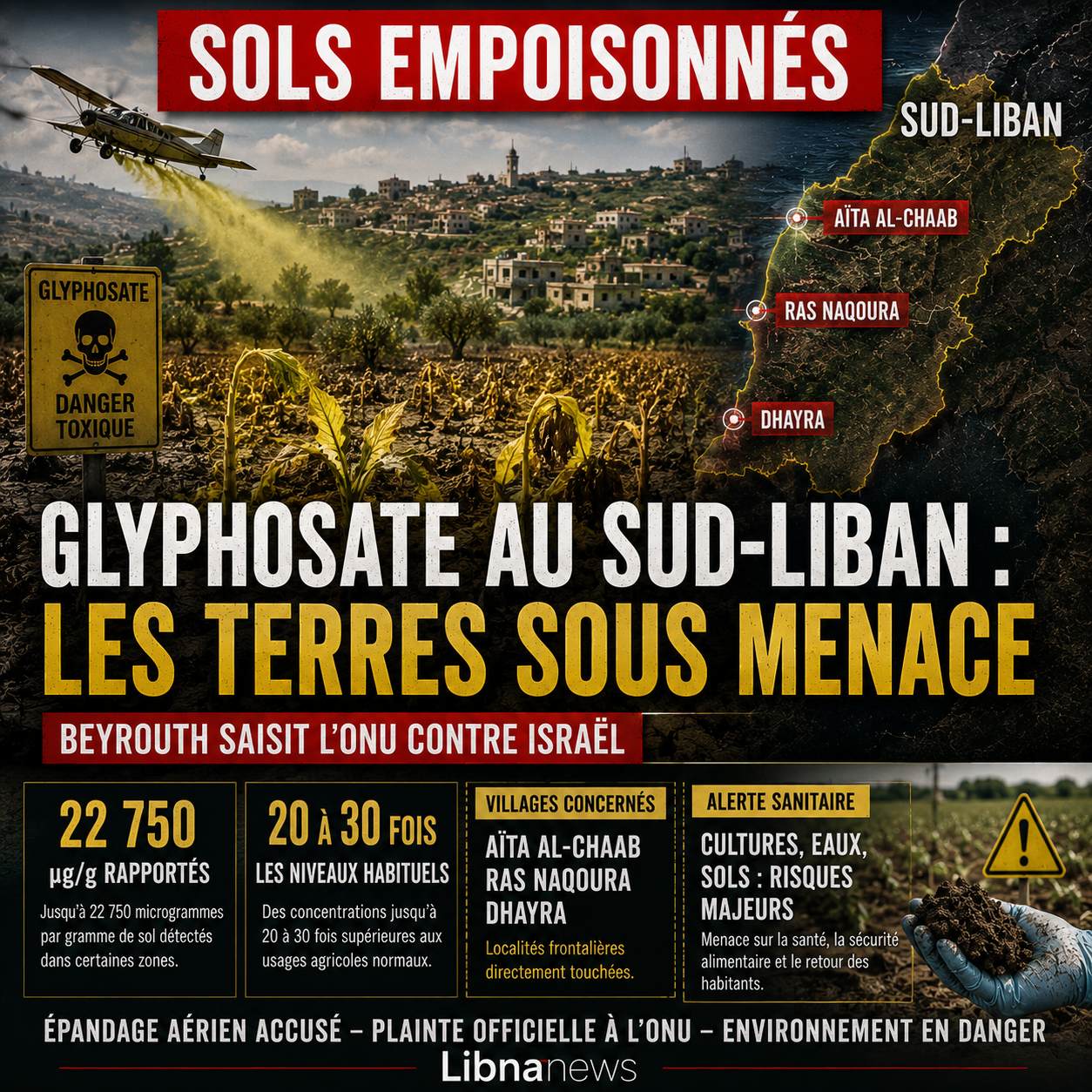
Lebanon has officially brought before the United Nations a serious accusation against Israel: the aerial application of glyphosate on border villages in southern Lebanon. According to the Lebanese Ministry of Foreign Affairs, a complaint was made to the Security Council and the Secretary-General of the United Nations, based on a report from the Lebanese National Council for Scientific Research. Soil analyses suggest high concentrations in several border localities, including Aïta al-Shaab, Ras Naqurah and Dhayra.
The case goes beyond the only environmental framework. It affects Lebanese sovereignty, the return of displaced persons, food security and the use of chemicals in an area already ravaged by bombing. According to the Lebanese authorities, the incident dates back to 1 February 2026, before the expansion of the war between Israel and Hezbollah in early March. Israeli aircraft reportedly then sprayed a substance presented to UNIFIL as non-toxic before Lebanese analyses identified glyphosate at levels deemed abnormally high.
The figures reported are of particular concern. According to Xinhua, citing the Lebanese Ministry, laboratory tests were reported to have detected up to22 750 micrograms glyphosate per gram of soilin some samples. Converted, this level corresponds to22 750 milligrams per kilogrameither22.75 grams per kilogram of soil. If this unit and result are confirmed by the full technical report, it would be a massive level of point contamination, much higher than the residues generally observed after ordinary agricultural use.
Agricultural villages directly targeted
The localities mentioned by the Lebanese authorities are all located in the southern Lebanese border band. Aïta al-Sha`b, Ras Naqurah and Dhayra are villages linked to agriculture, livestock, olive groves, tobacco and food crops. These areas have already been affected by military destruction, fires, bombardments, displacement and restrictions of access. The alleged application of glyphosate adds a layer of pressure on already weakened soils.
As early as February, Lebanese ministries of agriculture and the environment had spoken of concentrations20 to 30 times higher than usualin agricultural uses. The Guardian reports that these ministries had warned of direct effects on vegetation, agricultural production, soil fertility and ecological balance.
The World also reported that the first high levels concerned at least Ras Naqurah and Aïta al-Sha`b, some 20 kilometres away. The Lebanese authorities then referred to a first phase of analysis, before complete mapping of the affected surface. The Lebanese Minister of the Environment, Tamara El-Zein, indicated that the vegetation cover had already been yellowed in the exposed areas, according to the testimonies of the inhabitants.
UNIFIL had been informed by the Israeli army of an air operation to disperse a so-called non-toxic substance near the Blue Line. The peacekeepers had to take shelter and suspend operations for more than nine hours in part of their area. UNIFIL subsequently found this activity « unacceptable » and contrary to Security Council resolution 1701.
What the rate of 22 750 micrograms per gram means
The figure of 22,750 micrograms per gram should be explained with caution. In soil chemistry,1 microgram per gram is equivalent to 1 milligram per kilogram. The reported level therefore corresponds to22 750 mg/kg. In mass proportion, this represents about2.275 % of soil analysed, if the sample is expressed on dry basis. This level is extremely high for herbicide residue in agricultural soil.
However, three things must be distinguished. First, a peak concentration in a sample does not mean that the entire contaminated area has the same level. The results shall then be interpreted according to the sampling method, soil depth, humidity, particle size and distance from the deposit area. Finally, complete results will be required: number of samples, location, unexposed controls, presence of AMPA, margin of error and analytical protocol.
The reference to « 20 to 30 times higher » concentrations at normal levels indicates a net anomaly. But it does not alone give the total mass of glyphosate deposited. To estimate this, it is necessary to know the area affected, the depth of contamination and the apparent density of the soil. Without this mapping, it is impossible to precisely quantify the total amount of product to be processed.
This is crucial for clean-up. Surface contamination, over a few centimetres, can be managed by containment, targeted sampling or biological treatment. More widespread contamination, infiltrated into agricultural soils and driven by rain, requires a much longer response, with monitoring of runoff, wells, crops and sediments.
Glyphosate: a controversial herbicide
Glyphosate is one of the most widely used herbicides in the world. It acts by blocking an enzyme pathway essential to plant growth. It is not selective: when applied to non-resistant vegetation, it causes decay of affected plants. It is precisely this efficiency that makes it a common agricultural tool, but also a formidable product when it is sprayed at high doses on cultivated land or natural areas.
His health risk has been debated for years. The World Health Organization International Cancer Research Centre classified glyphosate in 2015 as« probably carcinogenic to humans »Group 2A. This classification is based on limited human evidence, sufficient animal evidence and strong genotoxicity.
Other agencies have adopted a different reading. The European Food Safety Authority concluded in 2023 that its assessment had not identified a « critical area of concern » for human, animal or environmental health, while reporting data gaps and unresolved issues.
This discrepancy does not make the file insignificant. It means that the level of risk depends heavily on the type of exposure. Low-dose food exposure is not compared to village-based aerial spraying, exposure of agricultural workers, inhalation of contaminated dust or direct contact with newly treated soils. In the case of South Lebanon, the main problem is not a regulated agricultural use. This is the accusation of a cross-border, massive, unconscionable application and potentially used as an environmental warfare tool.
Health risks
Health risks should be addressed without exaggeration but without minimisation. Glyphosate can expose populations through several routes: skin contact with contaminated plants or soils, inhalation of droplets or dust, indirect ingestion via crops, contamination of water by runoff or transfer to shallow wells. The most exposed people are farmers, children playing in the soil, first aid workers, residents returning quickly to villages and herders.
In the short term, glyphosate-based commercial formulations can cause skin, eye or respiratory irritation, especially in direct contact with high doses. The risk also depends on the adjuvant present in the sprayed product. However, the Lebanese authorities must not only seek pure glyphosate. They must identify the complete formulation: solvents, surfactants, additives and degradation products.
In the medium to long term, the most sensitive issue concerns cancer, including non-Hodgkin’s lymphoma, at the heart of the scientific and judicial controversies related to glyphosate. The classification of IARC as Group 2A does not mean that any exposure causes cancer. It means that a probable carcinogenic hazard has been identified under certain exposure conditions. In the Lebanese case, therefore, it is the levels, the duration of exposure and the possible repetition of application that must be documented.
Health authorities should also monitor water. Glyphosate attaches strongly to certain soil particles, but can be transported via runoff, especially on bare, burned or eroded soils. Its main metabolite, L Scientific research reports of half-lives in soils ranging from 60 to 240 days for AMPA.
Risks to soil and agriculture
For the lands of South Lebanon, the first risk is visible: the destruction of vegetation cover. When plants yellow and die, soils become more vulnerable to erosion, runoff and loss of organic matter. In border villages already affected by fires and bombardments, this loss of vegetation worsens land degradation.
The second risk concerns fertility. Glyphosate can affect microbial activity in soils, depending on dose, soil type, moisture, pH, and organic matter. Agricultural soils are not just physical supports. They contain bacteria, fungi, worms, insects and micro-organisms that contribute to the nitrogen, phosphorus and carbon cycle. High contamination can disrupt these balances, especially when soils are already stressed by ammunition, heavy metals or fires.
The third risk concerns crops. The Lebanese authorities will have to decide whether crops in the affected areas can be consumed, sold or exported. This decision cannot be based on the appearance of plants. Residue analyses are required in leaves, fruits, seeds, tubers, irrigation water and soil. In the meantime, caution requires the suspension of the food harvest in the most exposed plots.
The fourth risk affects pollinators. Useful bees and insects depend on a diverse plant cover. If an entire strip of vegetation is destroyed, the hives lose resources. The Guardian cites Lebanese environmental officials alerting the cumulative effects of these attacks on insects, pollinators and an already devastated agricultural sector.
A possible « sterile zone » strategy
In Lebanon, the accusation is read in a military context. Environmental authorities and NGOs see this as less an isolated incident than an element of a border control strategy. The destruction of vegetation reduces natural caches, improves military visibility, prevents certain crops and makes the return of civilians more difficult. This reading echoes UNIFIL’s concerns about the long-term impact of this type of operation on the return of the people and their livelihoods.
Resolution 1701 has been in place since 2006 to support the cessation of hostilities and the role of UNIFIL in southern Lebanon. The mission’s mandate includes support for the safe and voluntary return of internally displaced persons, monitoring the cessation of hostilities and supporting the deployment of the Lebanese army.
In this context, cross-border chemical application poses a political as well as environmental question. If a foreign army renders agricultural land unusable, even temporarily, it affects the right of return, the subsistence of the inhabitants and the sovereignty of the State. That is why Beirut speaks of « environmental and health crime » and a flagrant violation of its sovereignty.
Can we clean up the soil?
Yes, but the response depends on the actual level of contamination, its depth, the area affected and the agricultural schedule. There is no single clean-up method. We must first map the contaminated areas precisely. This phase should involve the Lebanese CNRS, the Ministry of the Environment, the Lebanese Army, UNIFIL, independent laboratories and, if possible, international experts.
The first step is to temporarily prohibit agricultural access to the most affected parcels. Immediate tillage should be avoided, which could mix contamination in deeper layers. The grazing, harvesting and use of contaminated plants as fodder must also be prevented. Soils should be sampled by grid, with samples 0-5 cm, 5-15 cm and 15-30 cm. Analyses should measure glyphosate, AMPA, potential adjuvants, heavy metals and explosive residues.
The second step can be based on natural degradation monitored. Glyphosate is often degraded by soil microorganisms. Its persistence varies greatly. Scientific synthesis points out that it can be relatively rapidly inactivated by adsorption and degradation, but that local conditions determine the actual duration.
The third option is bioremediation. It consists of stimulating micro-organisms that can degrade glyphosate by adding organic matter, controlled compost, moisture, aeration and sometimes microbial inoculation. This method is adapted if the contamination is diffuse and especially superficial. It is less brutal than excavation, but it requires time, pilot testing and regular monitoring.
The fourth option is phytoremediation. It involves using plants and their rhizospheres to stimulate degradation or stabilize pollutants. The U.S. Environmental Protection Agency describes this technique as suitable for shallow contamination on large surfaces when conventional methods are too expensive or not feasible. However, it highlights its limitations: long duration, regulatory acceptance, risks of transfer to the food chain and need for follow-up.
The fifth option is excavation of the most contaminated soils. It must remain targeted because it is costly, destructive and difficult in the border area. It may be necessary around extreme concentration points, especially if the peak of 22 750 μg/g is confirmed. The excavated land must then be treated or contained. Sending them to landfill without treatment would move the problem instead of solving it.
How much can it cost?
It is impossible to give a final cost without knowing the contaminated surface and depth. But orders of magnitude exist. According to a EPA technical report on phytoremediation, plant and rhizosphere treatment costs may be around$10-35 per tonnefor certain contaminated soils$50 to $150 per tonnefor in situ bioremediation,$120-300 per tonnefor soil washing, and360-440 dollars per tonnefor incineration.
These costs must be translated into agricultural areas. For one hectare contaminated over the first 10 centimetres, with an average apparent density of 1.3 tonnes per cubic metre, the soil volume concerned is about 1 000 m3, or 1 300 tonnes. At this level, phytoremediation would cost about$13,000 to $45,500 per hectareexcluding mapping, security, surveillance, analysis, agricultural compensation and loss of income. In situ bioremediation would rather cost$65,000 to $195,000 per hectare. A washing of the soil would rise between$156,000 and $390,000 per hectare. Incineration would exceed$468,000 per hectare.
If the contamination reaches 30 cm deep, these amounts can be multiplied by three. If it remains limited to a surface band, costs can be reduced by targeted treatment. If soils are also contaminated with heavy metals, white phosphorus, explosives or hydrocarbons, the costs increase significantly, as mixed pollution must be treated.
The cost of emergency must also be added. A serious analysis campaign can cost several hundred thousand dollars if it covers several villages. Water, crop and soil monitoring for two years may cost more. Agricultural compensation, crop losses, destroyed fodder, affected hives and interrupted income may exceed the technical cost of remediation.
A Lebanese response in five steps
The most realistic response should follow five steps. First, secure and document. The affected areas must be marked. Residents should receive simple instructions: not to harvest, not to feed, not to burn contaminated plants, not to move land, not to use runoff water before analysis.
Then map. A public map must be produced per village, with contamination levels, depth, agricultural areas, water points, dwellings, roads and priority plots. This map should distinguish between highly contaminated areas, suspect areas and unaffected areas. Without mapping, fear extends to all lands and even strikes farmers whose plots are not contaminated.
Third, choose treatment by level. Low-contamination areas can be monitored by natural degradation and cover non-food crops. Medium areas may receive bioremediation and phytoremediation. Very concentrated points may require surface stripping, containment or ex situ treatment.
Fourthly, to protect food chains. Productions in exposed areas should be analysed prior to marketing. It is important to avoid the long-term damage to the reputation of products in South Lebanon caused by actual or supposed contamination. This requires certificates of analysis, public controls and transparent communication.
Finally, seek redress. If Israeli liability is confirmed by independent analyses and recognized by international bodies, Lebanon can document damage, assess agricultural losses and seek compensation. This request should include the costs of clean-up, health monitoring, compensation for farmers and ecological restoration.
South Lebanon facing war pollution
The Glyphosate file adds to an already heavy list: white phosphorus, unexploded ordnance, fires, heavy metals from the bombings, burned soils, destroyed olive groves, cut roads and empty villages. The Guardian quotes Lebanese NGOs describing cumulative impacts on ecosystems already degraded by war months.
This accumulation makes clean-up more difficult. Healthy soil can absorb, degrade or immobilize some pollutants better than soil burned, compacted or saturated with military residues. In southern Lebanon, the affected land is not an ordinary agricultural laboratory. They’re soil of war. The answer must therefore be both scientific, health, agricultural, legal and diplomatic.
It is now urgent to obtain the full report of the Lebanese CNRS, to have it evaluated by independent laboratories, to publish contamination maps and to put in place a plan to protect the inhabitants. The figure of 22,750 micrograms per gram, if confirmed, requires an immediate response on the most affected points. Lebanon seized the UN. The villages concerned now expect less general condemnation than a specific protocol to know where to grow, what to consume, what to avoid and how long it will take to make the soil alive again.