





Hat —The draft Islamabad memorandum between the United States and Iran is not limited to nuclear, sanctions and Ormuz Strait. Its first clause explicitly mentions Lebanon, the permanent cessation of military operations on all fronts and the guarantee of Lebanese sovereignty. This formulation can become a major lever for Beirut, but only if it results in a verifiable Israeli withdrawal from southern Lebanon.
The text presented as « Islamabad Memorandum of Understanding » between the United States and the Islamic Republic of Iran places Lebanon at the heart of a much broader compromise. It is not just a document on Iranian nuclear, sanctions or the Strait of Ormuz. From its first paragraph, it mentions the permanent cessation of military operations « on all fronts, including in Lebanon », and adds an important formula on the guarantee of Lebanese territorial integrity and sovereignty. This statement changes the political scope of the text.
The document remains, at this stage, a draft attributed to the discussions between Washington and Tehran. It should therefore be read with caution. It does not have the value of a treaty until it is signed, officially published and confirmed by a legal mechanism. But its structure already sheds light on the priorities of both parties. Iran obtains the registration of sovereignty, the lifting of sanctions, the release of its funds and the reopening of the sea. The United States obtains a nuclear commitment, a status quo during negotiations and a monitoring framework. Lebanon obtains a decisive but still insufficient mention if it is not accompanied by a verifiable Israeli withdrawal.
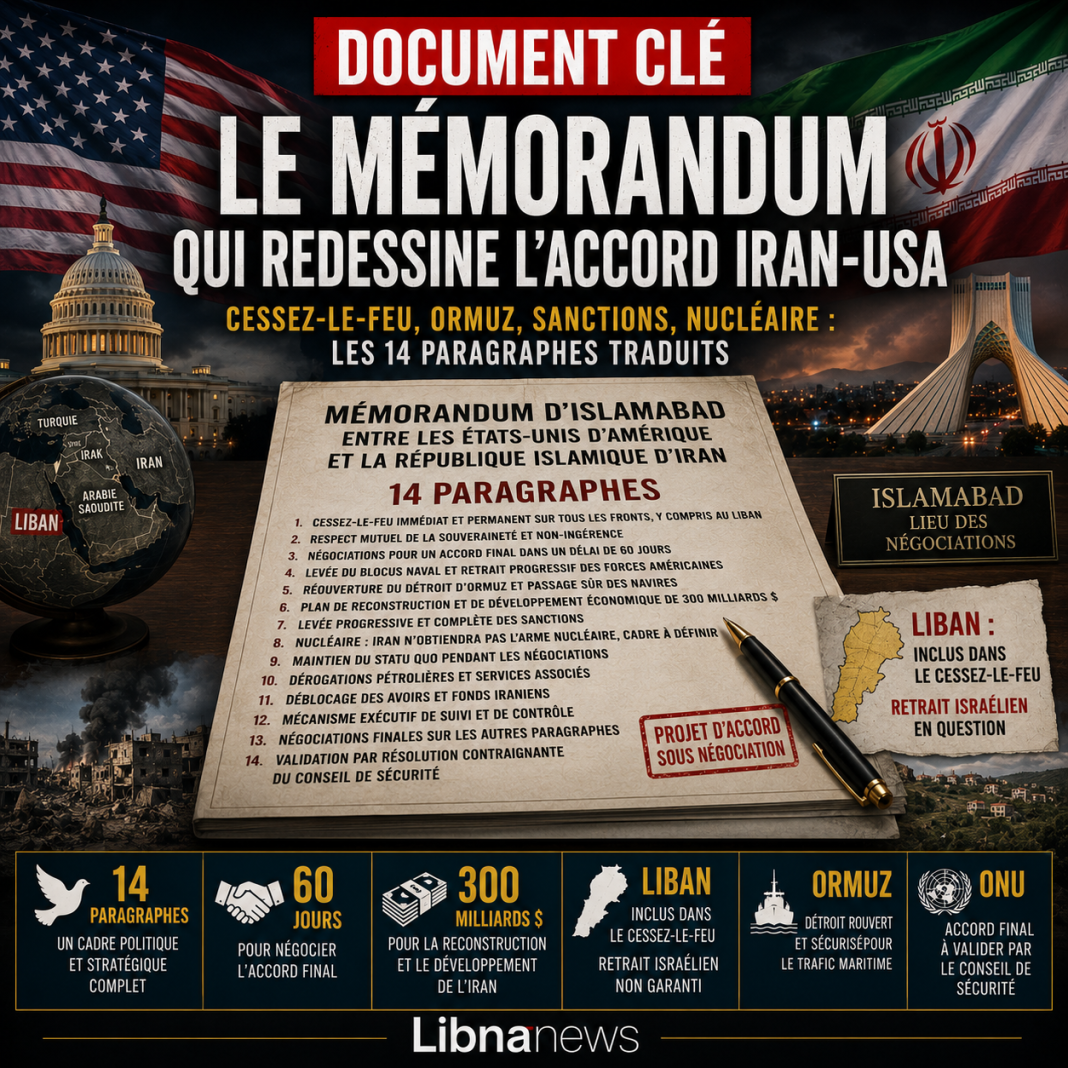
Full translation of the Islamabad memorandum
Memorandum of Understanding between Islamabad and the Islamic Republic of Iran.
The United States of America and the Islamic Republic of Iran have jointly agreed, in good faith, on the following date.
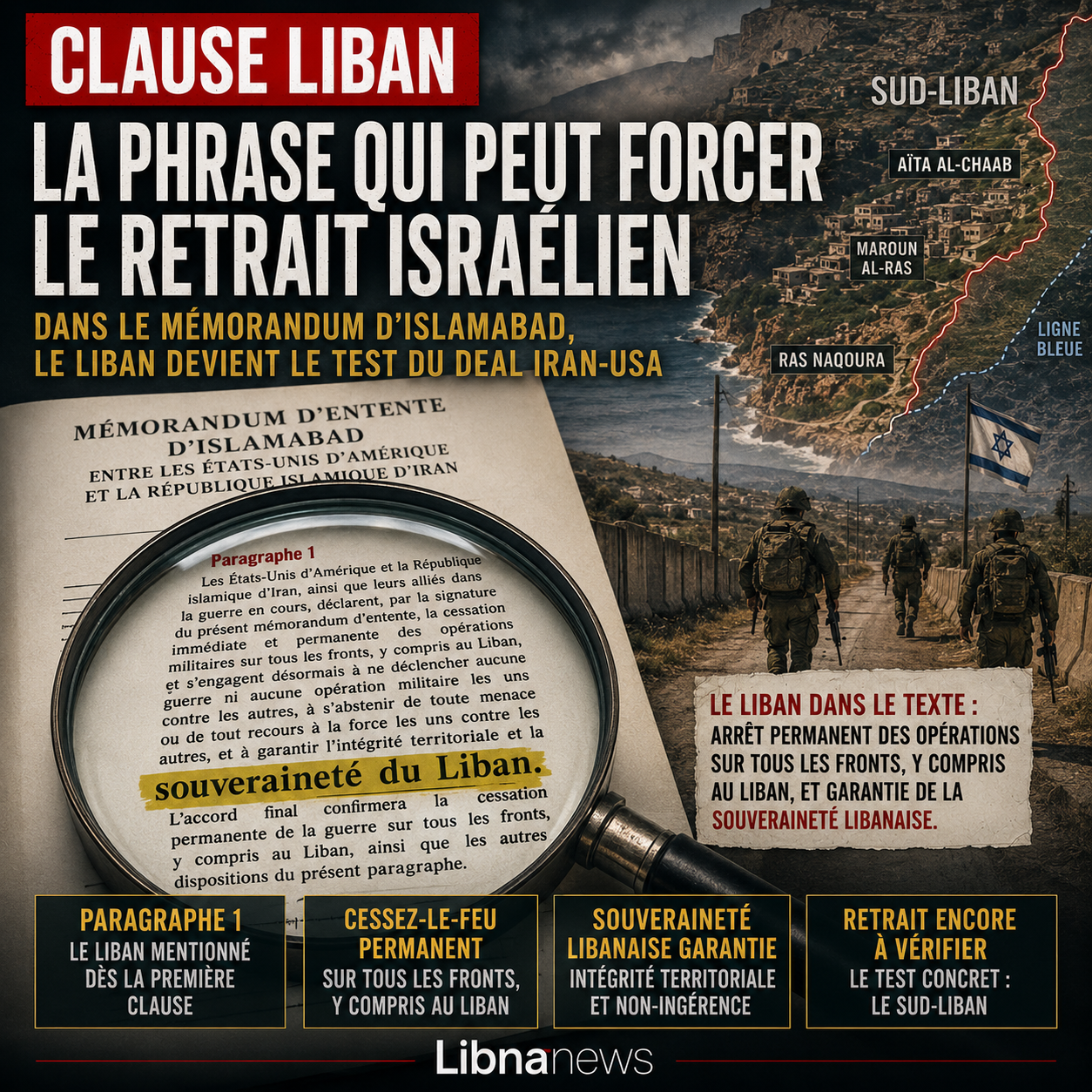
Paragraph 1
The United States of America and the Islamic Republic of Iran, together with their allies in the ongoing war, declare, through the signing of this Memorandum of Understanding, the immediate and permanent cessation of military operations on all fronts, including in Lebanon, and now commit themselves not to trigger any war or military operation against each other, to refrain from any threat or use of force against each other, and to guarantee the territorial integrity and sovereignty of Lebanon. The Final Agreement will confirm the permanent cessation of the war on all fronts, including in Lebanon, as well as the other provisions of this paragraph.
Paragraph 2
The United States of America and the Islamic Republic of Iran undertake to respect each other’s sovereignty and territorial integrity and to refrain from interference in their respective internal affairs.
Paragraph 3
The United States of America and the Islamic Republic of Iran undertake to negotiate and reach the final agreement within a maximum of 60 days, which may be extended by mutual consent.
Paragraph 4
Immediately after the signing of this Memorandum of Understanding, the United States of America will begin to lift its naval blockade and any disturbance or obstruction against the Islamic Republic of Iran, and will fully end the naval blockade within 30 days. During this period, vessel traffic will be restored by the Islamic Republic of Iran in proportion to pre-war traffic levels. The United States of America further undertakes to withdraw its forces from the proximity of the Islamic Republic of Iran within 30 days of the final agreement.
Paragraph 5
Upon signature of this Memorandum of Understanding, the Islamic Republic of Iran will make the best efforts to ensure the safe passage of commercial vessels, free of charge for a period of not more than sixty days, from the Persian Gulf to the Oman Sea, and vice versa. Traffic in commercial vessels will begin immediately and, taking into account the need for the Islamic Republic of Iran to remove technical and military obstacles and carry out demining, will be restored within 30 days. The Islamic Republic of Iran will engage in a dialogue with the Sultanate of Oman to define future administration and maritime services in the Strait of Ormuz, in consultation with other States bordering the Persian Gulf, in accordance with applicable international law and the sovereign rights of coastal States in the Strait of Ormuz.
Paragraph 6
The United States of America is committed, together with regional partners, to a final, mutually agreed plan of at least US$300 billion for the reconstruction and economic development of the Islamic Republic of Iran. The mechanism for implementing this plan will be finalized within the framework of the final agreement within 60 days. All necessary licences, exemptions and authorizations for the relevant financial transactions will be granted by the United States of America.
Paragraph 7
The United States of America undertakes to put an end to all types of sanctions against the Islamic Republic of Iran, including United Nations Security Council resolutions, International Atomic Energy Agency Governing Council resolutions, as well as all unilateral US, primary and secondary sanctions, in accordance with a timetable agreed in the Final Agreement. The Islamic Republic of Iran and the United States of America recognize the critical importance of the issue of ending the sanctions mentioned above, and express their intention to address these issues immediately in the negotiations in order to reach mutual agreement on them.
Paragraph 8
The Islamic Republic of Iran reaffirms that it will neither acquire nor develop nuclear weapons. The United States of America and the Islamic Republic of Iran agreed to resolve the issue of the fate of enriched materials stored in a mutually agreed mechanism, in accordance with the timetable referred to in paragraph 7, the minimum method of on-site dilution under the supervision of the International Atomic Energy Agency. Both sides also agreed to discuss enrichment and other mutually agreed topics related to the nuclear needs of the Islamic Republic of Iran, on the basis of the statutory framework to be agreed in the Final Agreement. The Final Agreement shall confirm the provisions of this paragraph. The United States of America and the Islamic Republic of Iran recognize the critical importance of the above-mentioned nuclear issues and express their intention to address these issues immediately in the negotiations in order to reach mutual agreement on them.
Paragraph 9
Pending the final agreement, the United States of America and the Islamic Republic of Iran agree to maintain the status quo. The Islamic Republic of Iran will maintain the current status quo of its nuclear programme, and the United States of America will not impose any new sanctions or deploy additional forces in the region.
Paragraph 10
The United States of America undertakes that, immediately after the signing of this Memorandum of Understanding, and until the end of the sanctions, the United States Treasury Department shall issue exemptions for the export of Iranian crude oil, petroleum products and derivatives, as well as for all associated services, including banking, insurance, transportation, etc.
Paragraph 11
The United States of America undertakes to make fully available for use the frozen or restricted funds and assets of the Islamic Republic of Iran upon the implementation of this Memorandum of Understanding. The United States of America and the Islamic Republic of Iran will mutually agree on procedures for the release of these funds during the negotiations. These funds, whether kept in the original account or transferred, will be made fully usable for any payment to any final beneficiary designated by the Central Bank of the Islamic Republic of Iran. The United States of America undertakes to issue all necessary licences and authorizations accordingly.
Paragraph 12
The United States of America and the Islamic Republic of Iran agree that an executive mechanism will be established to monitor the proper implementation of this Memorandum of Understanding and future compliance with the Final Agreement.
Paragraph 13
Following the signing of this Memorandum of Understanding, subject to the commencement of the implementation of paragraphs 1, 4, 5, 10 and 11 of this Memorandum, and the further implementation of these measures, the United States of America and the Islamic Republic of Iran shall commence negotiations on the Final Agreement exclusively on the other paragraphs.
Paragraph 14
The final agreement will be approved by a binding UN Security Council resolution.
Lebanon, first potential beneficiary and first blind spot
The Lebanese part of the text is almost entirely in the first paragraph. It’s little in volume, but very important politically. The memorandum is not just about a ceasefire. He mentioned the permanent cessation of the war « on all fronts, including in Lebanon », and added the commitment to guarantee Lebanese territorial integrity and sovereignty. This formula is stronger than the vague versions that were confined to a cessation of hostilities. It gives Lebanon an explicit status in the agreement.
For Beirut, this sentence can become a diplomatic lever. If the United States and Iran sign a text that guarantees Lebanese sovereignty, maintaining Israeli forces in southern Lebanon becomes difficult to justify politically. This is no longer just a Lebanese claim. This is an undertaking contained in a memorandum between Washington and Tehran, which is intended to be confirmed in a final agreement and validated by a binding Security Council resolution. The legal scope will depend on the final text, but the political scope is already considerable.
The problem is that the paragraph does not detail the modalities. It does not set an Israeli withdrawal schedule. He does not mention the return of the displaced. It does not specify the role of the Lebanese army or UNIFIL. He does not say how destroyed villages will be secured. Nor does it define what will happen if Israel claims to remain in southern Lebanon until Hezbollah is disarmed. The main risk for Lebanon is the gap between the general formula and the reality of the ground.
Lebanon can therefore read the text in two ways. The first is in favour: the agreement finally enshrines its sovereignty in the regional sequence, which can force Washington to exert greater pressure on Israel. The second is prudent: without a timetable, without a map and without a verification mechanism, Lebanon can remain a political clause without immediate effect. The test won’t be the signature. It will be the effective withdrawal, the silence of drones, the end of destruction and the real return of the inhabitants of the South.
New pressure on Israel
For Israel, the memorandum is binding even if it is not signed directly by its Government. The first paragraph refers to the United States, Iran and « their allies in the ongoing war ». This formula implicitly includes regional actors engaged in conflict-related fronts. She puts Israel before a difficulty. If Washington signs the permanent cessation of operations on all fronts and the guarantee of Lebanese sovereignty, it becomes more difficult for Israel to pursue its operations in southern Lebanon freely without appearing as the actor defying the American line.
The text directly affects the Israeli doctrine of freedom of action. Israel claims to want to stay in southern Lebanon until Hezbollah is disarmed. Israeli officials refer to a lasting presence and control of certain border areas. The memorandum speaks of permanent cessation of the war and Lebanese sovereignty. These two logics oppose each other. One builds a safe area under Israeli control. The other seeks to close all fronts in a regional context.
Israel can try to circumvent this pressure. He may say that he is not a party to the memorandum. It can argue that its operations are self-defence. It may condition any withdrawal to the disarmament of Hezbollah. It may also ask the United States for additional guarantees on northern Israel. But the political margin is narrowing. If Trump wants to make an agreement with Iran a success, he will have to prevent Israel from sabotaging the first paragraph.
This tension can cause a political crisis between Washington and Tel Aviv. The alliance remains strong, but interests diverge. The United States wants to stabilize the region, reopen Ormuz and avoid a wider war. Israel wants to prevent Hezbollah and Iran from presenting the deal as a victory. South Lebanon thus becomes one of the places where American ability to impose discipline on its ally will be measured.
The United States gets an exit, but at the price of heavy concessions
For the United States, the memorandum offers an exit from the crisis. It halts hostilities, freezes Iran’s nuclear programme, avoids further military deployments and opens a 60-day negotiation. It also provides Washington with a monitoring framework: Iran reaffirms that it will not develop nuclear weapons, accepts a discussion on enriched materials and accepts the principle of IAEA supervision for minimum dilution on site.
But the political price is high. The United States is committed to lifting its naval blockade, issuing oil exemptions, making frozen Iranian funds usable, ending sanctions according to an agreed timetable and participating with regional partners in a plan of at least $300 billion for the reconstruction and development of Iran. Even if these measures are conditional on the final agreement, their inclusion in the memorandum gives Tehran an immediate narrative advantage.
Washington may present these concessions as the price of stabilization. The reopening of Ormuz is essential for the global economy. The nuclear program freeze avoids a race to climb. The ceasefire on all fronts reduces the risk of regional war. The monitoring mechanism is used to monitor implementation. But the US opposition can read the text differently: like a series of major concessions granted to Iran after a war that failed to achieve its objectives.
Paragraph 13 was particularly important. It provides that the final negotiations shall begin after the start of the implementation of paragraphs 1, 4, 5, 10 and 11. In other words, the cessation of operations, the lifting of the naval blockade, the reopening of the sea, oil derogations and the release of funds must begin before the other issues are negotiated. Iran therefore gets concrete actions upstream. The United States bets that these actions will create the conditions for a final agreement, but they risk reducing their leverage too soon.
Iran Gets Strategic Recognition
For Iran, the text is a diplomatic victory if confirmed. It recognizes its sovereignty, provides for the gradual lifting of sanctions, paves the way for the reactivation of its oil exports, unlocks its funds and organizes a massive economic plan. It also allows Tehran to portray the war as a failure of American pressure. Iran is not forced to surrender. He negotiated with Washington on a higher political footing than before the conflict.
The nuclear issue is Iran’s main compromise. Tehran reaffirms that it will not seek nuclear weapons. He agreed to discuss the fate of stored enriched materials and referred to on-site dilution under IAEA supervision as a minimum method. This formula preserves a share of technical sovereignty. It avoids the image of a humiliating transfer of all materials outside the country. It also leaves open the discussion on enrichment, civilian nuclear needs and the final framework.
Paragraph 5 also gives Iran a central role in Ormuz. Tehran undertakes to allow safe passage of commercial vessels, but does so by recalling the sovereign rights of coastal States and opening a dialogue with Oman and other riparian States. Iran has thus gained recognition of its role in the future administration of maritime services in the Strait. It’s not a detail. The Strait of Ormuz becomes a subject of regional negotiations where Iran is no longer only accused of disrupting traffic. He is presented as a necessary actor in his security.
Finally, the text protects the regional image of Iran by mentioning Lebanon. Tehran can tell its allies that it has not signed an agreement solely for its sanctions and oil. He can claim that the Lebanese front, Hezbollah and Lebanese sovereignty are included in the compromise. This dimension is important to avoid the accusation of abandonment. However, it will only be enough if the Israeli withdrawal becomes real.
Nuclear: a skilful but incomplete formulation
Paragraph 8 is one of the most technical. It contains three elements. Iran reaffirms that it will not develop nuclear weapons. Both parties agree to settle the fate of enriched materials stored by a mutually agreed mechanism. The minimum method would be on-site dilution under IAEA supervision. Finally, Iranian nuclear enrichment and needs will be discussed within the statutory framework of the final agreement.
This formulation avoids immediate confrontation. The United States is getting a public commitment against nuclear weapons and a discussion on enriched stocks. Iran avoids accepting full dismantling or complete withdrawal from enrichment from the memorandum. The language refers the details to the final text. This makes it possible to sign quickly, but it delays the difficulties.
The risk is obvious. If the two parties do not agree on enrichment levels, stocks, centrifuges, inspections, sensitive sites and deadlines, the agreement may be blocked within 60 days. The status quo provided for in paragraph 9 limits immediate risks. It does not prevent substantive differences. Nuclear energy therefore remains contained, but unresolved.
For Washington, the question will be whether on-site dilution is enough to reduce the risk. For Tehran, a solution that is perceived as humiliation must be avoided. For the IAEA, real access will be needed, not just a symbolic role. The memorandum provides an architecture, not yet a complete verification regime.
Ormuz and sanctions, the economic heart of the compromise
Paragraphs 4, 5, 7, 10 and 11 form the economic core of the memorandum. They organized a sequence: lifting the US naval blockade, reopening commercial traffic in Ormuz, oil derogations, releasing Iranian funds and negotiating the end of sanctions. It is this combination that gives the text its immediate value for Tehran and for markets.
Paragraph 4 requires the United States to begin lifting the embargo upon signature. Paragraph 5 calls on Iran to ensure safe passage of commercial vessels for 60 days at no cost. Paragraph 10 requires the United States Treasury to issue exemptions for crude oil, petroleum products and associated services. Paragraph 11 makes Iranian funds usable according to beneficiaries designated by the Iranian Central Bank.
This logic shows that the agreement is based on verifiable actions. Ships pass or do not pass. Exemptions are issued or not. The funds are usable or not. Sanctions shall be lifted or maintained. Contrary to a general political statement, these elements can be measured quickly. This is also what makes the agreement fragile. Any bank blockage, maritime incident or regional strike may be described as a violation.
The $300 billion plan adds a reconstruction dimension. It is not just about freeing up trade. It is about giving Iran a development perspective. The mechanism remains to be defined. Regional partners will have to agree to contribute. U.S. licences will have to allow transactions. This point can become one of the most disputed, as it will give Iran a new economic margin.
An agreement that will depend on the UN resolution
Paragraph 14 provides for a binding resolution of the Security Council. This choice is intended to give the final text an international strength. It would allow the compromise to emerge from the only bilateral relationship between Washington and Tehran. It would also engage other permanent members of the Council, including Russia and China. For Iran, this validation would provide a guarantee against a subsequent US withdrawal. For the United States, it could provide a legal framework for lifting certain multilateral sanctions.
But this stage is complex. A binding resolution requires a specific text. It will have to deal with nuclear power, sanctions, maritime safety, monitoring mechanisms and the consequences of a violation. It will also have to deal with the Lebanese question if the first paragraph is confirmed. A vague formulation on Lebanon would be insufficient. A precise wording on the Israeli withdrawal would be politically explosive.
The Security Council will therefore become a diplomatic battlefield. Russia and China could support a text in favour of an early lifting of sanctions. The United States would like to preserve automatic return mechanisms in case of violations. Europeans will seek to maintain the role of the IAEA. Israel will press for the resolution not to limit its freedom of action. Lebanon will have to try to establish its sovereignty in an operational manner.
The decisive point: turning sentences into mechanisms
The Islamabad memorandum is ambitious because it seeks to cover all fronts. It’s not just nuclear. It affects sanctions, maritime trade, frozen funds, United States forces, economic reconstruction, Ormuz, IAEA and Lebanon. That’s his strength. It’s also his weakness. The more topics the text covers, the more the risk of blocking increases.
For Lebanon, the stake is clear. Paragraph 1 should become a mechanism. There is a need for an Israeli withdrawal schedule, a verifiable halt to strikes, a return of internally displaced persons, a specific role for the Lebanese army and UNIFIL, and a ban on any buffer zone imposed. Without this, Lebanese sovereignty will remain a useful but fragile formula.
For Israel, the agreement requires a choice. Either he accepts American discipline and limits his operations to southern Lebanon. Either he defies the spirit of the text and risks deteriorating his relationship with Trump. For the United States, the deal offers an exit, but demands to control their Israeli ally as much as their Iranian opponent. For Iran, it represents a strategic recognition, but obliges it to deliver concrete nuclear and maritime safeguards.
The text therefore opens a real window. It can stop a war, reopen Ormuz, ease sanctions and place Lebanon in an international setting. But it can also fail if each signs its own interpretation. In the next few hours, the most sensitive point will be not only the amount of funds, nor the nuclear formulation. It will be a question of whether the sentence on Lebanon’s sovereignty finally produces an Israeli withdrawal visible in the South.