

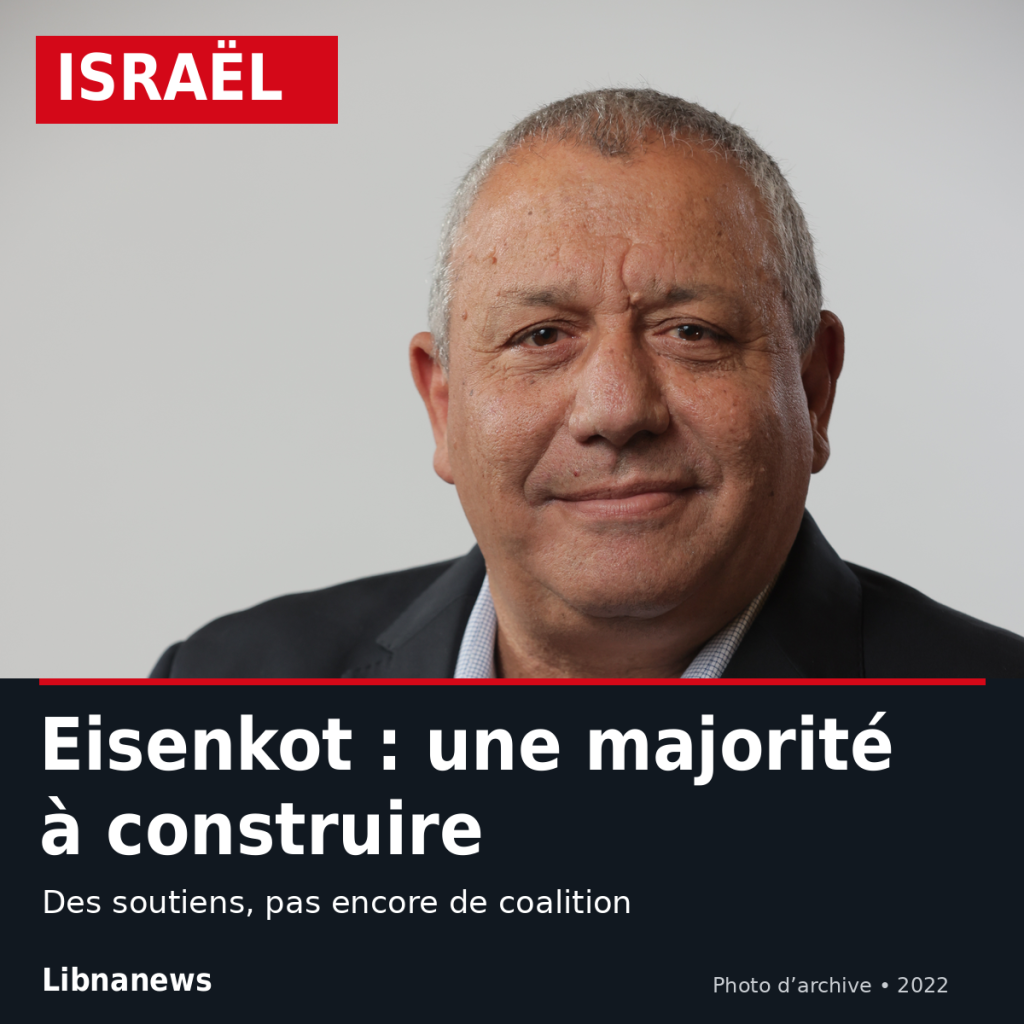
Israeli President Isaac Herzog announced on Saturday 7 November his intention to entrust Gadi Eisenkot with the formation of the next government. The formal surrender of the mandate is scheduled for Sunday, 8 November, at 5 p.m. in Jerusalem. For Benjamin Netanyahu, this is an important setback, but not yet the end of his power. Eisenkot must transform 67 parliamentary recommendations into an agreement between deeply divided partners. His eventual arrival would also open a new sequence on the responsibilities of 7 October 2023, without deciding the judicial fate of his opponent.
The distinction is essential: Israel has not yet changed its Prime Minister. The Presidency announced its choice on Saturday night, after further consultations during the weekend. The official act must take place the next day in the presidential residence. Netanyahu remains at the head of the outgoing government pending the formation of a new executive.
The election on 27 October deprived his camp of majority, without giving a decisive victory to the opposition. The Likud remained the first party, with 27 seats. Yashar, the formation of Eisenkot, gets 21. The president must, however, appreciate the ability to form a government, rather than mechanically designate the leader of the party that came first.
Gadi Eisenkot facing a majority still not found
The consultations drew up a favourable balance of power for the former Chief of Staff. Herzog’s statement of 5 November identified 67 recommendations for Eisenkot, compared with 46 for Netanyahu. Seven deputies, those of Unified Judaism of the Torah, had not recommended any candidate. This refusal weakened Netanyahu without automatically bringing an additional ally to Eisenkot.
These figures are not a government agreement. The political core of Eisenkot consists of four lists and only 48 MPs: Yashar counts 21, Naffali Bennett Yachad and Yair Lapid 12, Yair Golan Eight Democrats, and Yisrael Beytenu d’Avigdor Liberman Sept. The absolute majority of the Knesset is 61 out of 120 seats.
The 19 additional recommendations come from the two Arab lists: eleven elected members of the Joint List and eight from Rasam. They want to prevent the renewal of Netanyahu and its far right partners. But recommending Eisenkot to the president, supporting his nomination and participating in his government are three different commitments.
The traditional camp in Netanyahu totals 53 seats. In addition to the 27 elected members of the Likud, it includes seven deputies of Otzma Yehudit, seven d The seven abstentions of UTJ explain the change from 53 seats in this camp to 46 presidential recommendations.
The Arab way, possible on paper and politically blocked
The first possibility would be to rely on the Arab elected representatives. All recommendations to Eisenkot represent 67 seats. Some of the supporters could remain outside the firm, guaranteeing nomination and some essential votes. The Common List expressed its availability for external support.
This scenario is affected by the rejection of Eisenkot’s partners, especially Liberman. It excludes a government that is dependent on Rasam or the Common List. The government is also opposed to a coalition with Ra的am. Eisenkot must therefore obtain a political evolution, and not only add up elected officials already willing to recommend it.
Detailed calculations show the difficulty. The 48 members of the bloc would reach 56 seats with Rasam alone. With the only Common List, they would be 59. To obtain an absolute majority without further rallying, the two groups would have to be brought together. A minority government could also seek abstentions at the time of its nomination, but that assumption required additional arrangements.
Arab parties would retain their agenda and demands. Their opposition to Netanyahu is not worth joining the secure line of Eisenkot. External support would require concrete commitments and a mechanism to maintain agreements beyond the first vote.
Ultraorthodox can provide exactly 61 seats
The other path passes through the religious formations. The addition is precise: 48 members of the Eisenkot bloc, seven of the UTJ and six of the Shas give 61 seats. This formula would have an absolute majority without depending on Arab lists. However, it would have no safety margin in the event of defection.
On Friday, 6 November, Liberman opened this road. Long hostile to an alliance with the ultra-Orthodox parties, he declared himself ready to compromise on their military recruitment. He maintained his goal of replacing Netanyahu and his refusal to depend on Arab parties. This makes it possible to discuss a coalition that was previously difficult to envisage.
It does not resolve the main disagreement. Eisenkot continues to defend compulsory service for all, which could be military, national or civilian. The ultra-Orthodox parties demand guarantees for students in religious institutions. The timetable, exemptions, recruitment targets and sanctions remain issues to be negotiated.
UTJ welcomed the opening of Liberman, while indicating waiting for a formal proposal. Shas retains a different position: he recommended Netanyahu and remains engaged with him. The six seats in Shas would be indispensable for this combination. Forbearance is therefore not sufficient to make alternation possible.
A mixed formula could also involve religious partners and Arab supporters. However, it would multiply the difficulties already present in each scenario. At this stage, there is no public agreement to present one of these buildings as acquired.
Former military leader becomes an opponent of Netanyahu
The 66-year-old Gadi Eisenkot belongs to the generation of Israeli leaders from military command to politics. Son of Moroccan immigrants, he grew up in Tiberias and Eilat. His military career began in 1978 in the Golani Brigade, where he held several command functions.
He then led important units and commands, including the North Command. Appointed Chief of Staff on 16 February 2015, he left office in January 2019, after more than four decades of service. This experience is the core of his political credibility and his speech on security.
Eisenkot entered politics with Benny Gantz in 2022. After the attack of 7 October 2023, he joined the emergency government of Netanyahu. He left him in June 2024 with the Gantz camp, against the background of disagreements over the conduct of the war and its objectives.
The war also struck personally. His 25-year-old son Gal was killed fighting in the Gaza Strip in December 2023. This event is part of his public journey, without summarizing his positions or dispensing with examining the decisions in which he participated.
An institutional breakdown more than a pacifist turning point
Eisenkot wants to form a national emergency government around its four partners. He asked other trainings who wished to join him to accept several principles. These include Israel’s Jewish and democratic character, the values of its declaration of independence and a mandatory service for all.
It also requires the recognition of Hamas as a terrorist organization and the dismantling of its military and government capabilities. These conditions shed light on the limits of openness to Arab parties. They are not yet a signed coalition program, with a division of ministerial responsibilities.
His qualification as a centrist should not imply a conversion to a pacifist policy. During the campaign, Eisenkot rejected the creation of a Palestinian state. He also defended settlements which, according to him, were in accordance with conditions of legality and national interest.
On the other hand, he denounced settler violence and criticized the E1 extension project. His opposition to Netanyahu’s extreme right-wing partners therefore involves real differences, without equivalent to a commitment to dismantle the settlements or immediately relaunch a peace process.
For Lebanon, its military past remains an important element. Eisenkot is associated with the so-called Dahiyeh doctrine, based on the use of massive and disproportionate force against the adversary. Its possible accession to power alone does not allow for an Israeli withdrawal, a border settlement or an automatic change to Hezbollah.
Concrete decisions would depend on the negotiated program, the composition of the firm and the security power relations. The gap between the Golan Democrats, Bennett’s right and Liberman’s right would already impose compromises. Any promise of regional change must therefore be distinguished from the positions actually expressed.
Netanyahu would remain confronted with his trial
The immediate consequence for Netanyahu is political: a rival gets the first opportunity to build a government. If he succeeds, the leader of the Likud would lose the executive leadership. But the presidential announcement is neither an immediate removal nor a judicial decision.
His criminal trial is still ongoing. As at 5 November, hearings continued before the Jerusalem District Court. Netanyahu faces charges of fraud and abuse of trust in 1000, 2000 and 4000 files. The 4000 case also includes a corruption charge. He denies the charges against him.
These cases concern, respectively, gifts received from wealthy businessmen, discussions on favourable media coverage and alleged regulatory benefits to Bezeq. In the latter case, the prosecution argues that a favourable coverage on the Walla site would have been the counterpart. These elements remain charges to be tried.
The judges suggested that the prosecution should consider withdrawing the charge of corruption in the 4000 case. The prosecution continued. To present this discussion as a abandonment of prosecution or acquittal would therefore be inaccurate.
An alternation would not remove the trial and would not guarantee a conviction. The courts value the evidence and arguments of the defence. The Prime Minister called upon to form a government does not have the power to decide the guilt of his predecessor.
The question of a pardon is also a separate procedure. Netanyahu submitted an application at the end of November 2025. Herzog indicated that he wanted to focus on seeking a judicial agreement before a possible decision. There is no verified evidence to present a pardon against a political departure as a contract.
7 October could come back to a state commission
The most direct change could concern the review of responsibilities in the disaster of 7 October 2023. Eisenkot announced on 29 October a text on a state commission of inquiry. He placed this initiative among the priorities he wants to put before the new Knesset.
A coalition supportive of this investigation could lift the political deadlock surrounding its creation. It could open an in-depth review of government, intelligence and military decisions before the attack. But the agreement of the partners, the scope chosen and the necessary decisions remain to be obtained.
In the traditional mechanism of a State commission, the government decides on its establishment and the President of the Supreme Court appoints its members. This procedure is intended to ensure independence from officials whose actions would be examined. The commission may hear witnesses and make personal recommendations.
His work is not a criminal trial. Political or administrative responsibility, personal recommendation and criminal conviction are subject to different procedures. It would be premature to state which responsibilities would be held against Netanyahu, other leaders or military officials.
The investigation dispute remains open. On 23 September, the High Court gave the government until 15 January 2027 to clarify how it intends to examine the events. A new majority could act before this deadline, but the announcement of the term of office in Eisenkot is not worth setting up the commission.
A limited mandate, then other possibilities in case of failure
After the formal surrender of the mandate, Eisenkot will have 28 days to form a government. The President may grant a total extension of up to 14 days. The aim is to present a team and orientations capable of gaining the confidence of the Knesset.
In the event of failure, Herzog will be able to entrust the mission to another Member of Parliament or see the lack of a solution. Another phase allows 61 MPs to propose a candidate within 21 days. The latter then has 14 days to form a government. The exhaustion of institutional possibilities can lead to new elections.
Netanyahu therefore maintains a strategy of waiting and negotiation. He can hope his opponent’s failure or defend a formula of unity. But Yashar refuses a government under his leadership, and the disagreements between the blocs remain considerable.
The first deadline is now the ceremony announced Sunday, 8 November, at 5 p.m. in Jerusalem. Then the new Knesset will be installed on November 10. Parliamentary votes and party commitments will show whether the 67 Eisenkot recommendations can become a majority able to govern.





Comments