

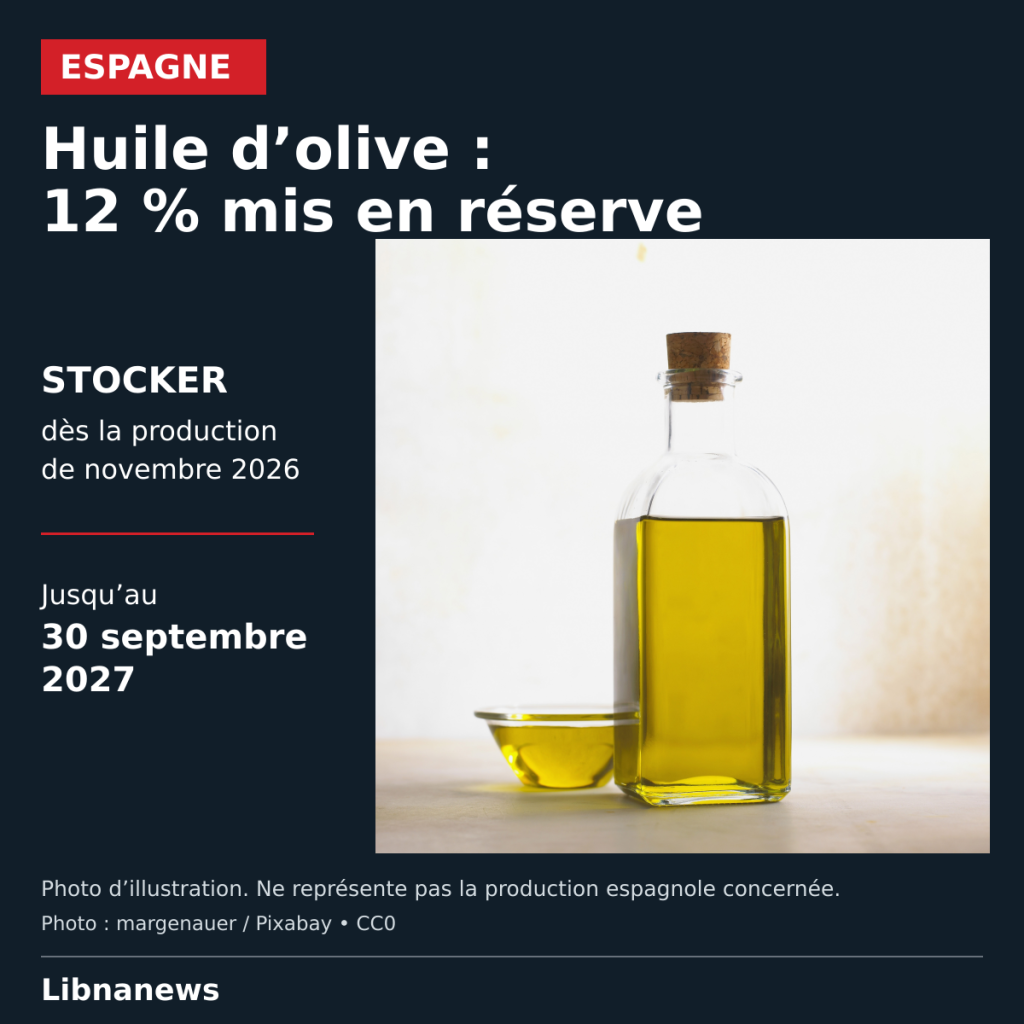
For olive oil in Spain, a new rule requires mills to reserve 12% of their declared production from November 2026. This olive oil must remain out of the market until 30 September 2027. The measure, which entered into force on 6 November, aims to stabilize supply in the face of an abundant announced harvest. It concerns storage in producers, without fixing the price of bottles sold to consumers.
The decision concerns the marketing year 2026-2027, which began on 1 October. However, it distinguishes volumes according to their month of production. The oil declared for October escapes this obligation, as previously produced. From November each mill must retain a quantity corresponding to 12 % of its cumulative production concerned.
Olive oil in Spain: storage begins with November
The mechanism is not to remove bottles from the shelves. It intervenes upstream, in the mills that produce oil, called almazaras in Spain. They may store volumes in their own facilities or in those of a third party. They must be able to justify the quantities kept and identify the storage places.
The resolution of 4 November, published on 6 November, specifies the calculation. The rate applies to the production reported each month and then to the cumulation of that production during the marketing year. A mill must therefore adapt the fixed volume when its production increases. The obligation is not limited to a fixed quantity at the time of entry into force.
For example, a mill reporting 100 tonnes of production must keep 12. If its cumulation then reaches 300 tonnes, the corresponding quantity increases to 36 tonnes. This example illustrates the regulatory rate: it does not describe the situation of a particular company.
The mill owner chooses the category of oil he puts in reserve. Therefore, the device does not automatically store extra virgin oil. Its target is the volume available at first marketing.
An estimated harvest of over 1.6 million tonnes
The trigger is based on two separate data. The stocks at the beginning of the marketing year reached 357,040 tonnes. Estimates from the Spanish regions bring the expected production to 1,602,596 tonnes. This second figure remains a forecast: it does not correspond to a volume already produced.
| Benchmark | Value |
|---|---|
| Initial stocks | 357 040 tonnes |
| Estimated production 2026-2027 | 1 602 596 tonnes |
| Mandatory storage rate | 12 % |
| First production concerned | November 2026 |
| Storage maturity | 30 september 2027 |
These figures explain the activation of the measurement. They do not allow to calculate the volume finally stored with the only increase of the annual harvest by 12%. October production is excluded and actual quantities will depend on successive mill declarations.
The preparatory decree describes favourable spring conditions in the main olive regions. Moderate temperatures and heavy rains favored flowering and fruit formation. The administration thus anticipates a harvest significantly higher than the average levels in the last few years.
Two calculations to trigger and calibrate the measurement
The device includes a activation threshold and a rate calculation rule. To activate, the sum of initial stocks and estimated production must be at least 120% of its average over the previous six marketing years. The resolution notes that this condition is met.
The withdrawal rate then responds to another calculation. The administration takes the estimated resources of the marketing year, which also includes the average imports of the last six marketing years. It compares them to 120% of the average of the two highest marketing volumes of this period.
Therefore, the 120% threshold used in the regulatory calculations should not be confused with the 12% rate imposed on mills. The first is used to assess market conditions. The second determines the share of production that must remain in storage.
The decree also sets a ceiling: withdrawal may not exceed 20% of the estimated production. The rate decided for this marketing year remains below this limit. The regulations apply in the Autonomous Communities which have the mills concerned.
A deferred offer, without price imposed in store
The economic choice is to postpone the sale of part of the oil. A large harvest can rapidly increase the quantities proposed by producers. Mandatory storage reduces the immediately marketable share, while keeping the product for a later marketing year.
For mills, this means having storage capacity and tracking fixed volumes. The monthly declarations must show the oil concerned. The use of external facilities remains possible, but does not remove the requirement to provide the authorities with evidence.
The decision does not set any sales rates. The European framework referred to in the decree specifically prohibits these marketing standards from imposing prices, even indicative ones. It also limits their scope to operations prior to transactions subsequent to the first marketing.
A definite increase in the price of bottles cannot therefore be announced on this basis alone. The text organises the offer of producers. It does not provide a new scale for stores or an estimate of the final effect for households.
A possible review by the end of December
The Autonomous Communities shall ensure official controls. A technical group coordinated by headquarters must approve the control plan. Operators must be able to submit, at any time, the documents necessary to verify the quantities withdrawn and the installations used.
The rate may change. From 31 December 2026, the administration will review production estimates and the effects on demand, prices and market stability. The decree then authorizes a reduction in the quantity to be immobilized, by a new officially published resolution.
Pending this assessment, mills must apply the rate of 12 % to their production concerned. The next verifiable step will be the resumption of the November declarations, followed by the revision of the harvest forecasts to be used for year-end monitoring.
Cover photo: olive oil bottle, archive illustration of 21 June 2005 according to metadata. Does not represent the Spanish production concerned. Photo: marginnauer / Pixabay, CC0 1.0. Layout: Libnanews.





Comments