

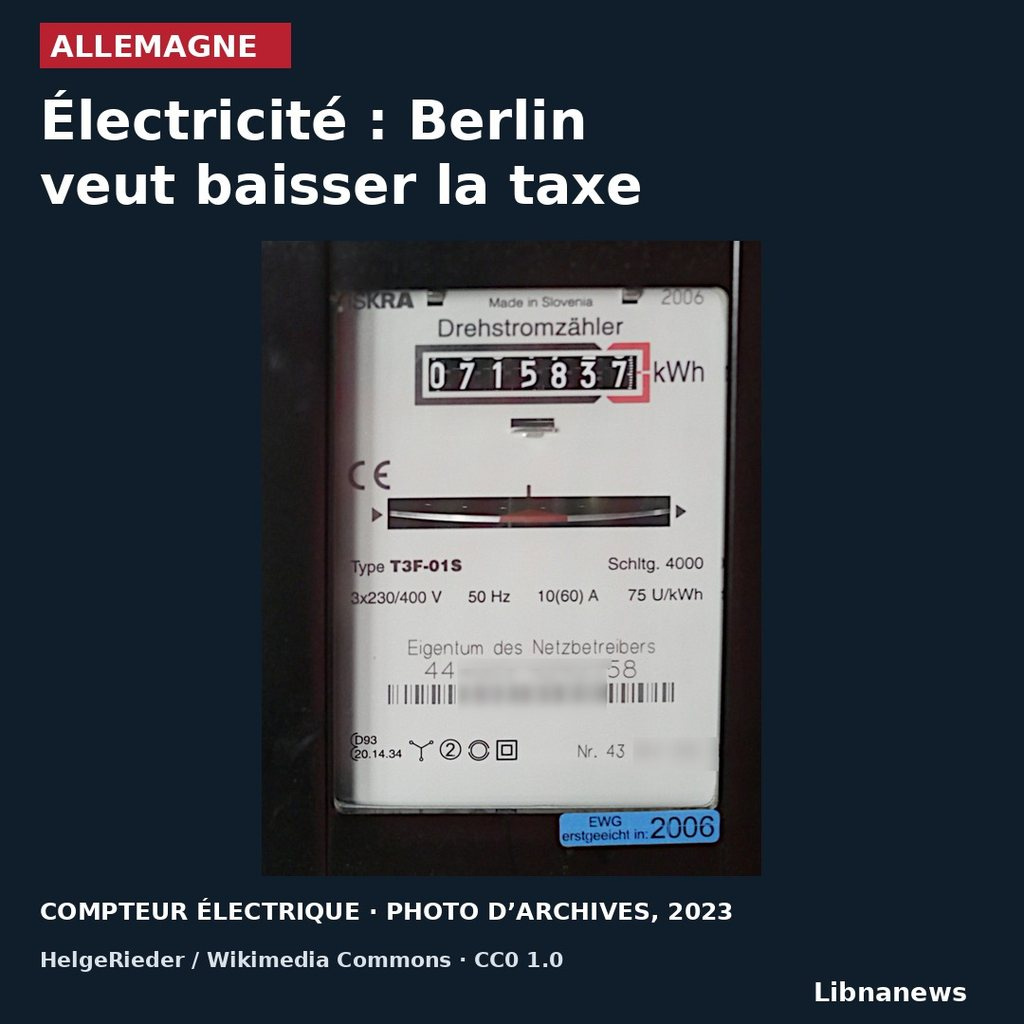
The German coalition wants to reduce the household electricity tax from 2.05 to 0.10 cents per kilowatt hour in 2027. The Budget Committee of the Bundestag has yet to incorporate the measure into the texts. The Government is separately preparing a temporary cap on fuel prices, the amounts of which are not announced.
The compromise reached at the Chancery on 18 November has yet to go through the parliamentary stage. The following day, the Acting Chair of the Budget Committee, Lisa Paus, announced a special session to include the tax reduction in the draft budget. The Bundestag plans to examine the Federal Budget 2027 from 24 to 27 November. The political announcement therefore does not yet change the tariffs applied to consumers.
Savings on tax, not on the whole bill
The project plans to apply the new rate from 1 January to 31 December 2027 to households, as well as to many businesses that have not previously benefited from a reduced rate. For households, 0.10 cents per kilowatt hour is equivalent to 1 euro per megawatt hour, the European minimum for non-professional use. The difference with the current rate of 1.95 cents per kilowatt hour relates only to this tax. For an annual consumption of 3 000 kWh, it represents 58.50 euros on this component, all other things being equal. This calculation does not predict the evolution of the total invoice, which also depends on the contract and other components of the price.
Chancellor Friedrich Merz estimates the additional relief for electricity consumers in Germany at EUR 5 billion. This overall estimate is not for households and does not correspond to one payment per household. To finance the measure in 2027, the coalition intends to mobilise funds that would not be used to support renewable energies. These appropriations are part of the federal budget, not the account used for renewable energy aid payments, the Ministry of the Economy said. An extension would require funding from Budget 2028.
Fuels: a variable ceiling for three months
The agreement also envisages limiting pump prices to prevent excessive increases. The government is announcing a formula based on international prices, possible regional exemptions and an obligation to preserve supply. It is therefore not a uniform and fixed price at all stations.
The Ministry of Economy specified that the law should create the legal basis for the scheme and that a regulation should activate it for three months. Berlin aims to activate on 1 January 2027, but no amount per litre appears in the announcement. This measure is distinct from the reduction in the electricity tax: it has neither the same timetable nor the same duration.





Comments