

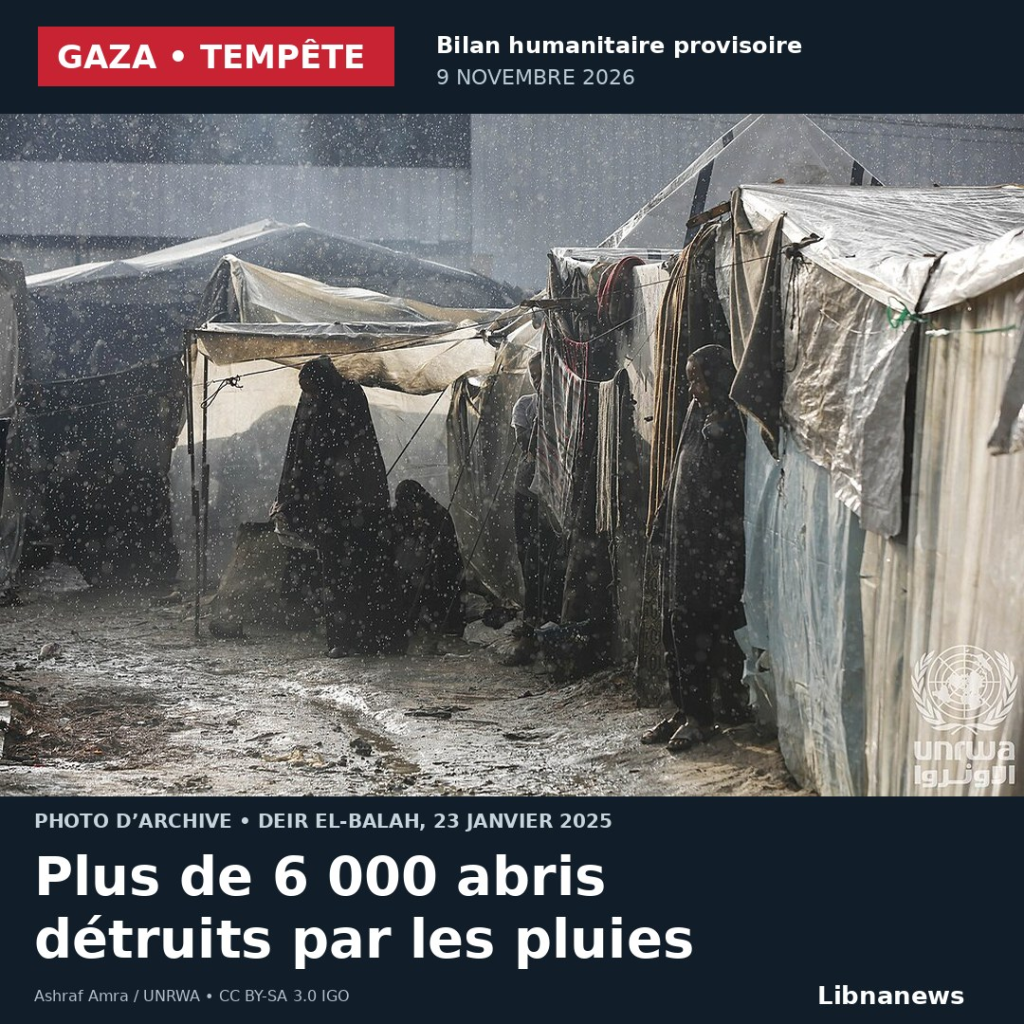
The rains in Gaza destroyed more than 6,000 family shelters and damaged about 17,400 others, according to a first United Nations humanitarian assessment on Monday, 9 November. More than 26,000 households asked for help after the weekend storm. Stocks available in the enclave are depleted, while supplies are still waiting outside.
This assessment details the extent of the damage after the first floods reported on Saturday and the fatal collapse in Deir el-Balah on Sunday. The special report of the United Nations Office for the Coordination of Humanitarian Affairs, OCHA, covers the situation as at 8 November. The teams continue their assessments: the figures remain provisional and do not cover all affected sites.
Rains in Gaza cause further displacement
About 600 homes should have left their homes again. Reports also include more than 3,900 households without housing. The emergency concerns the replacement of tents, but also bedding, clothing and materials to make the facilities habitable.
The heavy rains began on Friday evening, November 6. They affected the five governorates of a territory where about 1.4 million people live in tents or makeshift shelters. For these families, wet or taken goods often represent what remains after several trips.
The site tracking system gives an indication of the limits of the count. Its first survey covers 268 alerts, of which 264 related to rain and floods. They come from 261 displacement sites. Only the incidents transmitted by the partners present on site feed this base.
The site management group states that its partners are present at only 40 per cent of the approximately 1,700 active sites. It therefore considers that the actual needs probably exceed the available reports. This survey cannot be regarded as a comprehensive census of families affected throughout Gaza.
Five dead in the collapse of a slope
The storm also had deadly consequences. Sunday, 8 November, three children and two women died when a mass of sand collapsed in tents in Dayr al-Balah. The Palestinian Civil Defence confirmed this assessment, which was included in the humanitarian report.
These victims were buried. The available information does not make it possible to present them as dead of hypothermia. Rain, land instability and exposure to cold are distinct hazards, even if they threaten the same families without safe housing.
Helpers asked residents to keep their tents away from the slopes and sandy slopes. However, this requires finding an accessible and less dangerous location. Humanitarian organizations point out that restrictions on access to large parts of the Territory reduce the possibilities for rehousing.
Limited relief despite 2,166 calls
Civil Defence reported receiving 2,166 distress calls during this episode. Together with municipalities and other stakeholders, its teams were able to respond to 218 requests in the field. Most of the other appellants were instructed because of a lack of resources to deploy relief.
The lack of pumps and equipment adds to the damage to the evacuation systems. The teams need engine oil, spare parts and hoses to keep their vehicles and equipment running. A shortage of consumables can thus immobilise equipment already present.
Before the weather, the humanitarian report of 5 November signalled failures in storm and wastewater pumping systems. It also described the impossibility of establishing sufficient stocks. As at 1 November, the partners had approximately 2,800 tents for needs estimated at 121,000 units.
These pre-storm data do not measure weekend destruction. However, they show the weakness of the reserves as new families lost shelter. Emergency distributions must respond simultaneously to old needs and recent damage.
Tents and blankets waiting outside Gaza
More than 150,000 tents, 300,000 tarpaulins and 500,000 blankets are located outside the territory, ready for delivery. OCHA reported that preparations were hampered by Israeli restrictions on supplies and equipment, as well as funding shortfalls.
These obstacles are not interchangeable. The purchase of an article, the authorization of its entry and its transport to families are different stages. The presence of goods outside Gaza therefore does not mean that each lot is subject to the same administrative refusal.
The Israeli authorities are also reporting on their actions. In a communication of 6 November, the army and COGAT, responsible for coordinating civil affairs in the Palestinian territories, claim to have facilitated the entry of more than 85,000 tents since the start of their winter programme.
They also announce over 820 approved applications for winter supplies. According to their version, about half of these requests have not yet resulted in delivery, particularly for logistical and budgetary reasons. These Israeli figures relate to permits and cumulated entries, not reserves still available after distribution.
The report of 5 November already described a shortfall of $186.5 million for the winter needs then estimated at $267.9 million. He warned that some orders could only arrive in the second half of the winter due to delayed purchases, financing and authorizations.
Cold increases risks for children
In a November 8 call, Save the Children estimates that more than 560,000 children live in critical or catastrophic housing conditions. This figure results from a demographic estimate applied to the assessment of shelters. It does not correspond to the number of children directly affected by the last storm.
The organization reports that 84% of the families surveyed in the evaluation cited have no effective means of heating their shelter. Almost half burn plastic, tires, waste or cardboard for cooking. These practices expose occupants to smoke, burns and fires.
The NGO calls for the entry of protective materials and equipment, as well as increased funding. On the ground, the teams continue drainage, soil strengthening and camp protection. The site survey remains open to identify families still homeless and to organize future distributions.





Comments