

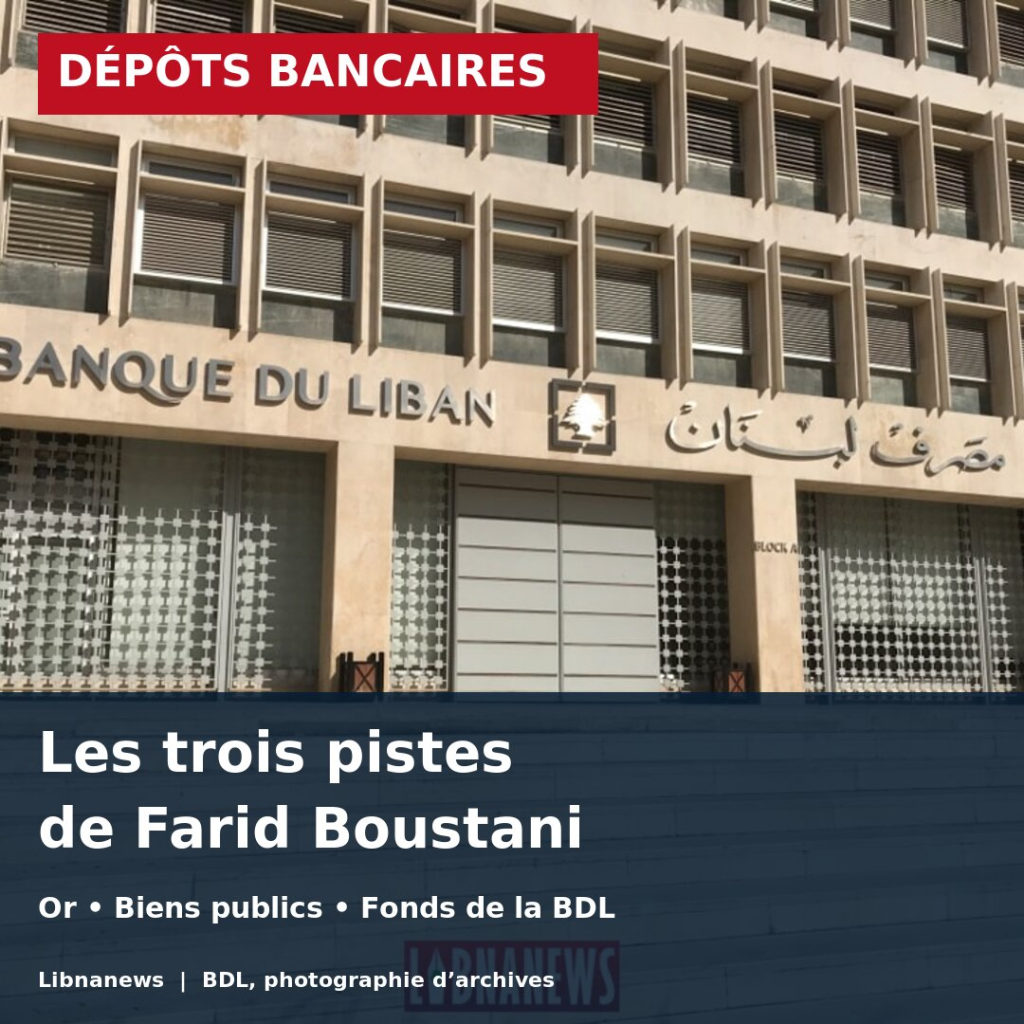
Farid Boustani proposes to mobilize some of the gold, public real estate and Bank of Lebanon funds to return deposits. Presented at a meeting in Deir el-Qamar, its tracks revive the debate on the repayment of bank deposits in Lebanon. However, they do not constitute an authorisation to sell gold or an adopted payment scheme.
The Member of Parliament for the Chouf, member of the strong Lebanon bloc and chairman of the Parliamentary Committee on the Economy, defends the participation of depositors in the discussions. In the report published on 9 November, he refused to regard them as mere recipients of a solution negotiated elsewhere. He wants to involve them in dealing with the crisis and protecting their rights.
His intervention advances three possible resources. But each one responds to a different logic. Gold has a particular market value and legal protection. Real estate requires identification and evaluation. The funds present at the central bank must be reconciled with its liabilities. Therefore, their addition is not sufficient to establish an available envelope.
A quarter of gold, with a buy-back planned later
The first track is to sell a limited fraction of the gold reserve. The report places this fraction around one quarter of the stock. Boustani plans to use the product to return some of the deposits, and then to buy metal if its price drops.
This proposal contains two separate decisions. A sale provides currency immediately, subject to its authorization and conditions. Further acquisition requires new resources. If the sales dollars have been distributed, they are no longer available to replenish the reserve.
The future decline in the price is also a hypothesis. If the metal becomes more expensive, buying the same amount requires more dollars. No repurchase financing mechanism, target prices and binding schedules are included in the reported presentation. The idea of later rebuilding the stock therefore does not guarantee its realization.
Gold was valued at approximately $36.80 billion at the end of October. A quarter represents arithmetically $9.20 billion, before fees and price changes. This calculation gives an order of magnitude. It does not mention the proceeds of a decided sale or an amount already allocated to savers.
The 1986 Act requires passage to Parliament
Act No. 42 of 24 September 1986 prohibits the disposal of BDL’s gold holdings without legislation. It covers both direct and indirect transactions. Therefore, the government or the governor cannot turn this proposal into a sale through a simple management decision.
Parliament could consider a text authorizing an operation. The scope, conditions and beneficiaries should be defined. The minutes of the meeting do not contain any adopted text on this protection. Nor is it possible to announce a date of assignment.
This legal step precedes the question of economic opportunity. Allowing a sale alone would not demonstrate that its product is sufficient to finance the advertised refunds. A scheme should specify which debt it settles, on which balance sheet, and which obligations remain after payment.
118 properties still to be identified
The second leads to public real estate assets. Boustani refers to approximately 118 State-owned property, some of which could be transferred or exploited economically. The reported number refers to real property. It does not provide an overall area and no estimate of its value.
Boustani does not present a piecemeal inventory, location or occupancy of the proposed property. A building used by an administration, vacant land and property in dispute do not have the same constraints.
Sales and exploitation also generate different revenues. An assignment brings a one-time resource in exchange for an asset. A lease or other form of valuation can generate spread income. To finance a quick refund, you should know the cashable amount and its date, not just the heritage potential.
Without a checklist or expertise, 118 assets cannot be converted into billions of dollars. The public nature of an asset does not mean that its sale is free, immediate or compatible with its current use.
Eight billion reported to the BDL, an unspecified perimeter
The third track is based on funds that Boustani places around $8 billion at the Bank of Lebanon. He proposed examining partial employment to start or accelerate refunds. However, the report does not specify the date of this amount or the accounting line concerned.
At the end of October, foreign currency reserve assets reached approximately $11.47 billion, separately from gold. This figure does not directly validate or invalidate the eight billions mentioned. The perimeters may differ. Boustani does not detail the commitments deducted from its estimate.
A central bank asset may have a counterparty to the liability. A liquid sum may also meet an existing obligation. In order to establish a repayment capacity, it is therefore necessary to identify the free resources, the payments already foreseen and the consequences of a levy on reserves.
Bank deposits in Lebanon: financing still to be established
The proposed contribution does not exempt from determining the share of banks and their shareholders. In September, IMF requested that losses reach shareholders and subordinated creditors before depositors. It also linked refunds to bank viability and public debt sustainability.
Boustani’s presentation does not yet provide this distribution. It does not specify the types of deposits concerned, the individual amounts or the deadlines. It opens a discussion on resources, without allowing a client to calculate what he would receive.
No repayment date shall accompany these proposals. Their implementation would depend on a gold law, the valuation of public goods and resources compatible with BDL’s commitments. For applicants, they do not open any new rights to withdrawal.





Comments