

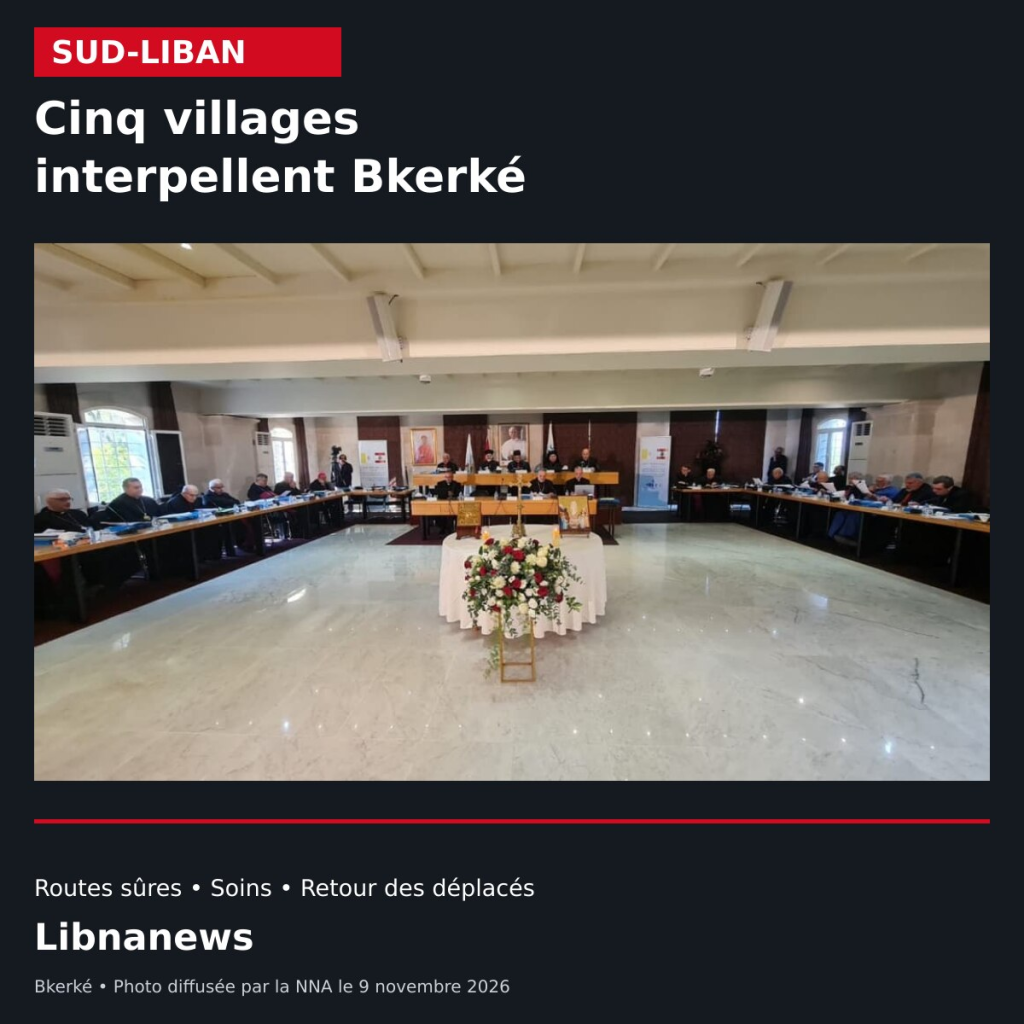
The mayors of five Christian villages in the South, located near the border, ask the Council of Catholic Patriarchs and Bishops of Lebanon to bring ten claims to the State, the Holy See and international partners. On Monday, 9 November, their appeal specifies the conditions they consider essential to stay in the settlements still inhabited and to allow the return of displaced families. Safe roads, accessible care and income maintenance occupy a central place in this document addressed to Catholic leaders gathered in Bkerké.
The signatories are Hanna al-Amil, Mayor of Rmeich, Akl Naddaf, Mayor of Debel, Ayoub Khreish, Mayor of Ain Ebel, Shadi Sabbah, Mayor of Alma al-Sha`b, and Charbel Rizk, Mayor of Qauzah. Their approach extends the letter mentioned on Sunday by Patriarch Béchara Rai, who had announced the consideration of ten urgent requests at the annual session of the Council.
At the opening of the session on Monday, the Apostolic Nuncio Paolo Borgia asked that this call not remain unanswered. He invited Catholic leaders to listen to the needs of the bishops of Tyre and to take a concrete initiative of solidarity before the closure of their work, scheduled for 13 November. This intervention supports village demand for action, without announcing at this stage the adoption of their programme or specific funding.
Safe roads for Christian villages in the South
Freedom of movement is the first priority. The mayors ask for safe roads and passages, allowing the inhabitants of Rmeich, Ain Ebel and Debel to join hospitals, schools and markets, and then return home. They present access to care and livelihoods as a daily condition for maintaining the population.
For Alma al-Sha’b, the text calls for the restoration of weekly visits with the relevant authorities, international actors and Caritas Lebanon. Where security permits, residents should be able to return for two or three hours to inspect their homes and lands, recover business and maintain a concrete link with their village.
Such visits would not replace permanent return. The appeal calls for a safe, voluntary and life-worthy resumption in the evacuated localities. Special attention is paid to the internally displaced persons from Yarun, Qauzah and Alma al-Sha`b, scattered throughout the country or accommodated in Rumaysh, Ain Ebel and Debel. In the meantime, mayors demand adequate housing, rent subsidies and support for current expenditure.
At Ain Ebel, a health agreement to be implemented
The medical component distinguishes an already signed measure from the resources still sought. On 30 October, the Ministry of Health, the Lebanese Armed Forces and Caritas Lebanon concluded an agreement integrating the primary care centre in Ain Ebel Hospital into the national primary health care network.
The Ministry confirms this agreement, signed by Rakan Nassereddine, Father Samir Ghaoui, President of Caritas Lebanon, and General Robert Chakhtoura, representing the head of military medicine. It includes provision of essential medicines, vaccines and medical supplies, as well as urgent health needs.
Mayors welcome this step, but call for a progressive programme to strengthen the hospital. They cite the opening of the 24-hour emergencies, the completion of equipment for the operating rooms, resuscitation and laboratory, and the availability of medical, nursing and technical personnel. These services are still among the strengthening objectives formulated by the mayors.
He also called for hospital coverage and increased medical evacuations. In Rmeich, the signatories wish to support the François Hajj medical-military and civilian centre and to provide the Civil Defence Centre with the vehicles and equipment necessary for rescue, fire and operations.
Preserving schools, work and homes
The document links the maintenance of residents to the continuity of water, electricity, communications and supplies of fuel, food and medicine. It calls for support for schools and participation in school and university fees for families in difficulty.
Mayors also insist on income. They demand programmes for farmers, artisans and small businesses, as well as for people who have lost their jobs. According to them, emergency aid must be accompanied by means enabling families to resume activity and prepare their children for the future.
For losses incurred, they require a comprehensive and documented inventory of damages and a transparent compensation mechanism. Housing, shops, tobacco crops, agricultural land and olive groves are among the goods concerned. The text also calls for accompanying the families of those killed or injured and for the rehabilitation of infrastructure.
Guarantees for post-FINUL
The signatories devote a specific component to the consequences of the departure of UNIFIL. They fear a vacuum affecting security, travel and humanitarian assistance, as well as jobs, businesses and services linked to the international presence.
They call on Catholic leaders to step up their efforts with the Lebanese State, the Holy See, the United Nations and the international community to obtain concrete guarantees. However, their appeal does not describe any replacement arrangements already adopted.
A commission to monitor commitments
The five mayors finally propose a commission from the Council, involving dioceses, congregations, ecclesial institutions and Caritas, in coordination with the apostolic nuncio. Its mission would be to set priorities, coordinate aid and monitor projects with authorities and donors.
The protection of churches and heritage is also included in requests, with particular attention to the church of Qauzah. On the occasion of the fifty-ninth regular session of the Council, the mayors hoped that the final communiqué would affirm the right of the inhabitants to remain safe on their lands and that of the displaced to return with dignity. Above all, they expect a follow-up mechanism capable of translating these principles into concrete measures.





Comments