

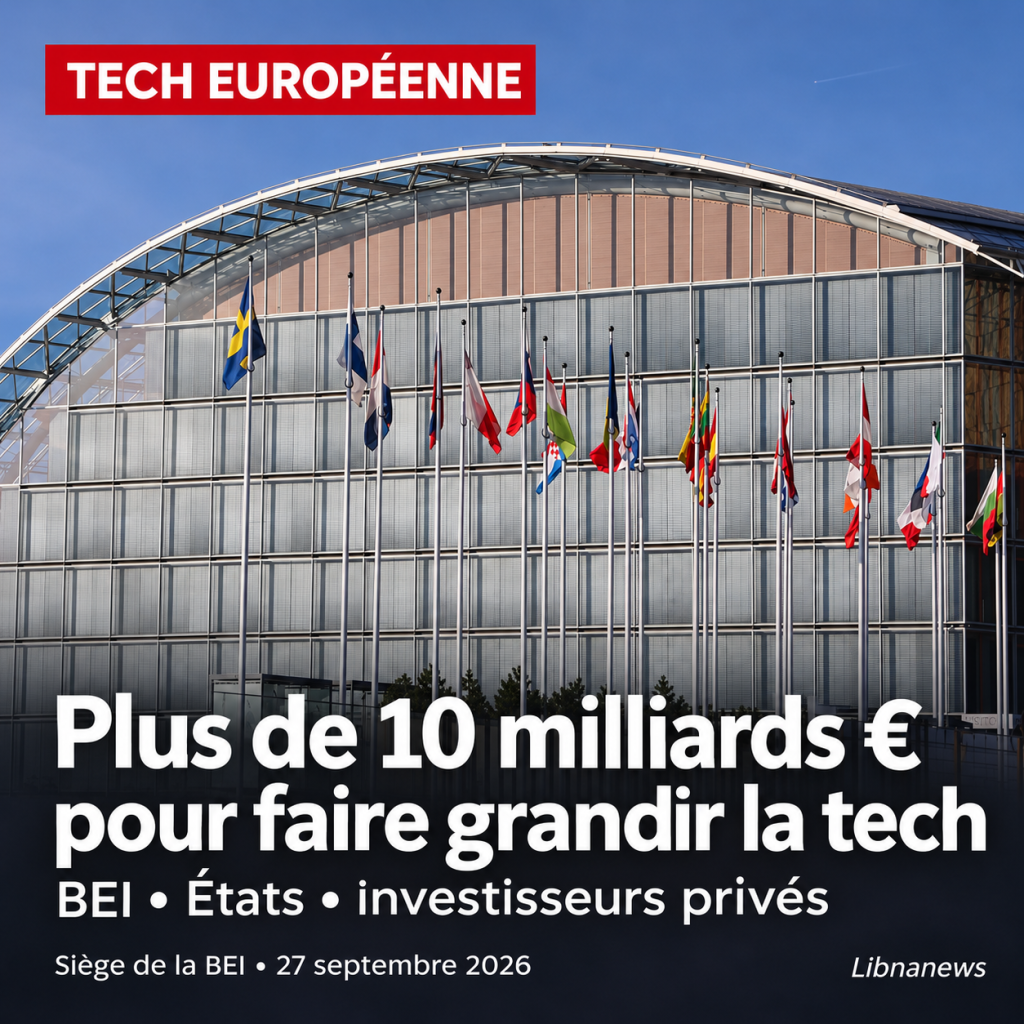
On Monday 9 November, the European Investment Bank (EIB) announced a public and private alliance of over EUR 10 billion. It must finance the growth of European technology enterprises. Presented in Brussels on the sidelines of the Finance Ministers’ meetings, the transaction involves fourteen institutional investors and seven Member States.
EIB: public commitments and private intentions
The announced envelope brings together contributions of a different nature. Private investors and the French initiative Tibi say they want to channel more than €8 billion towards innovation. The EIB Group and the participating States provide approximately EUR 2 billion in commitments in the first round of financing of ETCI 2.0.
Bulgaria, Germany, Greece, Italy, Luxembourg, the Netherlands and Spain are participating in this first stage, according to the EIB. The first investment decisions are expected in the coming weeks. The announcement therefore does not mean that 10 billion euros have already been paid to businesses.
The difficult course of international expansion
ABN AMRO confirms its participation in this first lifting. The Dutch bank describes a particularly marked lack of capital when technological enterprises enter their growth phase. They must then finance their investments, expand their activities and deploy to foreign markets.
This need exceeds the financing of a start-up company at its inception. A company may have an innovation and business activity, without finding the means to change scale. ABN AMRO presents its commitment as support for energy, digital, mobility and security transitions.
In the long term, the scheme aims at up to EUR 80 billion in investment, with operations of around 200 million on average. This amount is an overall target, not the capital available at launch. The ability to attract other investors will determine the extent of financing that is actually available.
Specialized funds rather than a grant window
The European Investment Fund, a subsidiary of the EIB Group, describes ETCI 2.0 as an extension of a fund model. The scheme invests in vehicles that finance companies themselves. It opens this strategy to medium-sized funds, starting at EUR 300 million, alongside large funds exceeding one billion.
This openness must diversify the territories and enterprises accessible to investors. Targeted sectors include artificial intelligence, break-up technologies, life sciences, cybersecurity, space and clean technologies. The announced terms also provide opportunities for co-investment.
Capital financing involves equity participation and exposure to corporate risk. It is neither an automatic subsidy nor a traditional bank credit. The platform offers several paths, adapted to the experience, financial capacity and appetite for the risk of institutional investors.
Bringing long savings into technology
The alliance announced on Monday extends the pact launched on 22 September by the European Commission and the EIB Group. This voluntary framework seeks to bring growing businesses closer to banks, insurers and pension funds. The challenge is to give them access to long-term capital while maintaining their development in Europe.
Two tools accompany this approach. A platform led by the EIB Group shares investment opportunities and market information. A Commission-led forum organises exchanges on regulation and investment policies. Their role is to facilitate investor participation, without removing individual allocation decisions.
ETCI 2.0 also links with the Scaleup Europe Fund, a separate fund for €5 billion in commitments. Presented in September as a direct investment vehicle, it targets semiconductors, robotics and biotechnology. For the new round of financing announced on Monday, the first approvals expected in the coming weeks will specify the transition from commitments to investments.





Comments