

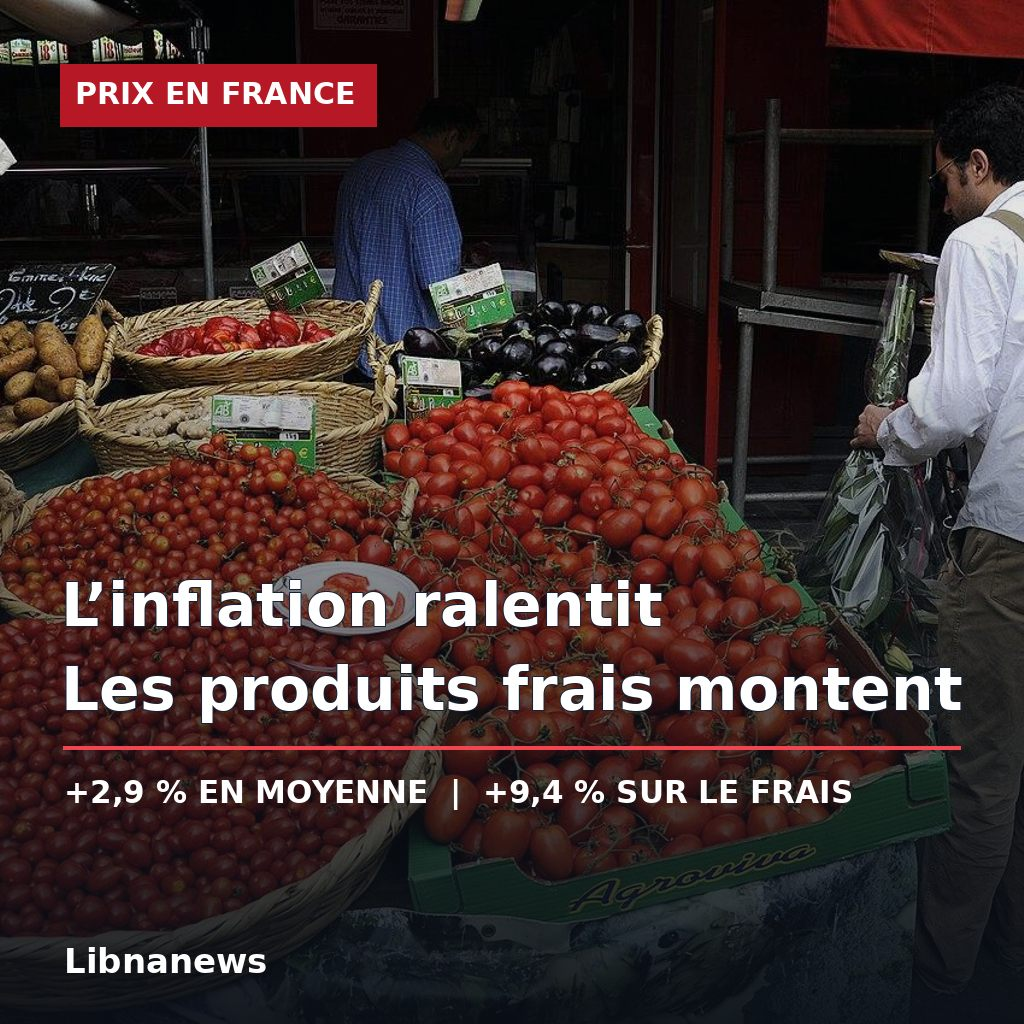
Inflation in France would slow from 3.4% in October to 2.9% in November, according to the INSEE estimate published on 27 November. However, fresh products would cost 9.4% more than a year ago and energy 19.2% more. The national average declines over a month, but not all households spend the same share of their budget on these expenditures.
Price of fresh produce: +9.4% year-on-year
The November estimate distinguishes two movements. Feed prices would rise by 1.3% year-on-year, after 1.2% in October. In this total, fresh products would increase from +8.0 % to +9.4%. The rest of the feed would slow from +0.3% to +0.2%. A purchase focused on fresh products does not therefore evolve as the food item as a whole.
The difference is primarily due to the composition of the index. Food accounts for 14.85 % of INSEE’s reference basket in 2026, but fresh products account for 1.70 % of the total basket. The rest of the diet weighs 13.15%. A large price change on a relatively small item can be very visible for consumers who buy regularly and move only a few tenths of the overall index.
| Post | November 2025 | October 2026 | November 2026 |
|---|---|---|---|
| All prices | +0.9 | +3.4 | +2.9 |
| Food | +1.4 | +1,2 | +1.3 |
| Fresh produce | -2.8 | +8.0 | +9.4 |
| Other food | +1.9 | +0.3 | +0.2 |
| Energy | -4.6 | +24.1 | +19.2 |
| Services | +2.2 | +2.6 | +2.3 |
The starting point also counts. By November 2025, prices of fresh produce had fallen by 2.8% over a year. Following this decline and the estimated increase of 9.4% a year later, there was an estimated 6.3% increase between November 2024 and November 2026. This calculation does not reduce the year-on-year increase. It does not confuse it with higher prices for two years and does not indicate the price of a particular product.
Oil products slow down the index, gas is the exception
Energy remains the highest annual increase among the major index groups: 19.2% in November. But the increase was 24.1% in October. INSEE attributes the slowdown to the sharp slowdown in oil prices. Conversely, gas prices would accelerate. The overall energy figure therefore does not apply to all contracts or to all heating modes.
Compared to October, the overall index would fall by 0.7%, after an increase of 0.4% the previous month. The decline in oil products and the seasonal decline in transport prices contributed to this decline. In parallel, INSEE notes that food prices are almost stable over the month. The comparison with October and November 2025 answer two different questions. They may even have opposite signs: prices may fall over a month and remain higher than a year earlier.
The budget of a household is not the reference basket. A household that spends more than the average on fuel or heating can experience a higher price increase than the CPI. A household whose expenditure is concentrated on manufactured goods does not experience the same trend: their prices would fall by 0.2% over one year. This is not enough to calculate either inflation. This would require their quantities, the selected items and the actual rates charged to them.
Prices and quantities: two household budget measures
In a separate publication on the same day, INSEE reported that household goods consumption remained stable in volume in October, after -0.9% in September. Energy purchases fell by 2.9 per cent in volume, with the Institute falling sharply for fuels in a context of high prices. Food purchases were almost stable, down 0.1 per cent. Conversely, manufactured goods grew by 1.3% after their fall in September.
The publication on consumption takes the effect of prices to estimate variations in purchases. It does not say whether the expenditure in euros of a given household has declined. A reduction in the quantities consumed may coexist with a stable or higher bill. These figures cover October, while the provisional prices are for November: neither of the two surveys is yet able to establish the response of households to the November price change.
To compare two tickets, the useful measure is the price at constant quantity: kilo, liter or coin of the same format. For energy, the fixed share of a subscription and the price of consumption must be distinguished. This reading does not replace the national index; it indicates what part of the difference in an invoice comes from the unit price and what part comes from the volume consumed or the composition of the basket.
The harmonised index, used to compare European countries, would increase by 3.2% over one year. This is not a second estimate of the same basket: the treatment of health expenditure, in particular, differs. By November, INSEE is due to publish the final figures on Friday 11 December. The provisional estimate should not be used for contractual valuation.





Comments