

US aid to Israel could change shape long before the weapons already ordered were delivered. This is the main obstacle to a rapid breakdown of Donald Trump’s announced funding. Military procurement follows much longer industrial, contractual and budgetary schedules than a presidential statement. Reducing subsidies remains a policy option. However, it requires a decision on who will settle the deadlines, what programmes will be maintained and at what cost others could be slowed down.
On November 3, the U.S. President announced his intention to end the annual aid from 2027. However, he wished to continue selling arms to Israel. The modalities of this transition need to be clarified. Beyond this ad, already processed by Libnanews, the order file reveals a relationship that is more difficult to untie than just an annual payment.
According to a Wall Street Journal survey published on 5 November, approximately $10 billion would remain to be financed after 2028. The newspaper quotes a letter from the State Department to the representative Joaquin Castro, describing Israeli orders on 1 April. These deadlines could mobilize US aid, Israeli resources or both. They therefore do not constitute an automatic new US debt.
What is really covered by US aid to Israel
The current framework dates back to the Memorandum of Understanding signed in September 2016. It covers the 2019 US fiscal years at 2028 and provides $38 billion. Grants from the Foreign Military Financing program, or FMF, amount to 33 billion. The remaining $5 billion relates to missile defence. The annual benchmark rate is $3.3 billion for military procurement and $500 million for missile programmes. A total of 3.8 billion.
The 38 billion represent the entire decade. They are not yet an intact reserve from which Israel could draw today. The protocol is also a political commitment, not a treaty guaranteeing automatically every payment. The amounts remain subject to appropriations voted by parliamentarians. The Congressional Research Service, the CRS, recalls this in a note dated 4 June 2026.
The US exercises end on September 30th. A withdrawal announced for calendar year 2027 is therefore not exactly superimposed in fiscal years 2027 and 2028 of the Protocol. To measure a reduction, it will be necessary to know its effective date, the appropriations concerned and the treatment of funds already allocated. The decision on new grants and the settlement of previous commitments are two separate transactions.
This architecture adds exceptional funding. The additional Act of 24 April 2024, inter alia, opened up $3.5 billion in FMF. It also provides 5.2 billion for missile and laser defences, including 1.2 billion for Iron Beam. Other lines of the text refer to US stocks or operations. Adding the whole package by presenting it as money paid directly to Israel would therefore distort the analysis.
Order today with revenue expected tomorrow
The origin of the gap is in the multi-year funding of procurement. Thanks to the mechanism calledcash flow financing, Israel can schedule payments for an acquisition over several years. It anticipates future FMF allocations, instead of paying the full amount immediately. This flexibility makes it possible to reserve production capacity and engage programmes that will take a long time to deliver.
The SRC also describes, for certain purchases of F-35, a deferred payment scheme involving a banking consortium led by Citibank. The manufacturer receives his payment while the deadlines are spread according to an agreed schedule. This organization brings the pace of funding closer to that of expected resources. It does not remove the bill if future subsidies are reduced.
There is even a specific arrangement for sales that exceed the current protocol or its 33 billion FMF envelope. ThisSpecial Billing Arrangementmakes it possible to mobilise Israeli national reserves, in particular to cover financial responsibilities related to possible termination. Thus, the system already provides for certain obligations to be based on Israel rather than on new American donations.
The distinction is decisive. An order doesn’t prove that Washington has promised to pay every due date. Nor does it prove that Congress has already voted for the corresponding appropriations. It shows, however, that an anticipation of funding has been incorporated into military planning. To change this expectation requires a new financial schedule, with possible consequences for other defence expenditures.
The F-15 illustrates the addition trap
The F-15IA program understands why arms sales figures should be handled with caution. In August 2024, the United States notified Congress of a possible sale estimated at $18.82 billion. Its perimeter included up to 50 new aircraft, upgrading of existing 25 F-15I, equipment and support. Such notification opens the way for a transaction. It does not certify a firm order of the announced totality.
In November 2024, the Israeli Ministry of Defence announced an agreement of $5.2 billion for 25 F-15. It includes one option for another 25. Shipments were scheduled from 2031 onwards, with four to six aircraft per year. The timetable was therefore already several years after the expiry of the current aid protocol.
Another stage appeared on December 29, 2025. Boeing received an American contract capped at $8.5777 billion. It covers 25 F-15IA and an option of 25 additional devices. The contract covers in particular design, integration, testing, production and delivery, with a planned completion at the end of 2035. At the time of allocation, $840 million in FMS funds were committed. This figure does not necessarily mean an amount already disbursed.
These three amounts should not be added together: they refer to different stages and boundaries of the same programme. Public documents do not allow the last two figures to be fully reconciled. On the other hand, they establish a solid reality: part of the disarmament relationship is organised until the middle of the next decade.
Signed agreements, options and deliveries
The other programs confirm this spread. In June 2024, Israel signed a letter of offer and acceptance for an additional 25 F-35, with maintenance and support. The amount is about $3 billion, financed by US aid. Deliveries of this instalment are scheduled to begin in 2028, at the announced rate of three to five aircraft per year.
The case of the Apache helicopters shows why an authorisation should not be confused with the finally signed purchase. The US notification of January 30, 2026 involved a possible sale of 30 AH-64E and their support for $3.8 billion. On 14 October, the Israeli ministry announced an agreement for 12 aircraft, expected in the early 2030s. Its statement does not give any price: to allocate the 3.8 billion to the only twelve helicopters would be unjustified.
| Programme | Documented step | Schedule or amount to be deducted |
|---|---|---|
| F-15IA | Israeli agreement announced in November 2024 for 25 aircraft, with option | $5.2 billion; first deliveries announced in 2031 |
| F-35 | Agreement signed in June 2024 for 25 additional aircraft | Approximately $3 billion; deliveries from 2028 |
| AH-64E Apache | Agreement announced in October 2026 for 12 helicopters | Unpublished amount; deliveries in the early 2030s |
| KC-46 | Six supplies under contract according to Boeing in May 2026 | First delivery announced on May 27, 2026 |
These elements describe different programs and steps. They do not constitute a calculation of the remaining balance to be financed.
On 3 May 2026, Israel also approved the acquisition of a fourth F-35 squadron and a second F-15IA squadron. The communiqué still called for finalizing the agreements. This single ministerial green light is therefore not enough to establish a firm new order. Similarly, the decisions of May and October cannot be automatically incorporated into a statement of commitments adopted on 1 April.
Stopping subsidies does not mean stopping deliveries
U.S. military sales follow several steps: notification to Congress, sales agreement, industrial contracts, fund-raising, production and delivery. These steps can overlap and their amounts evolve. An invoice may precede the arrival of the equipment; A delivery may also occur after the end of the fiscal year that financed its purchase.
The US defence cooperation agency, the DSCA, specifies the rules in its financial manual. FMF funds transferred to the FMS trust fund may remain available for future payments consistent with their purpose. A removal of the new appropriations would therefore not mechanically remove the existing accounts and would not cancel the corresponding orders alone.
Conversely, maintaining sales does not guarantee their financing by Washington. Israel could continue to purchase the same aircraft with more domestic resources. For each programme, the payments already covered should be distinguished from those based on future appropriations. It should also be determined which obligations would survive a contract amendment.
Industrial dependence remains
Financial dependence does not summarize the relationship. The SIPRI research institute estimates the American share at 68% of the volume of Israeli imports of major weapons in 2021-2025. The German share is 31%. This indicator measures major arms transfers, not the US share of the entire Israeli military budget or of all equipment in service.
A largely American fleet requires parts, upgrades, maintenance services and continuity of supplies. Replace an American grant with Israeli funds is a budgetary decision. The replacement of another aircraft with an already integrated aircraft is a longer military transformation. The SRC notes that Israel could remain dependent on US supply chains even after a reduction in aid.
Nor does payment from domestic resources remove all US rules governing exports and the use of equipment. The exact scope of the restrictions varies according to legal arrangements and funding. It would therefore be misleading to present self-financing as a total freedom of purchase or employment.
Three exit routes, with different costs
A first option would be to organize a phase-out, distinguishing existing programmes from new ones. Both countries could negotiate a transition schedule that would allow time to absorb deadlines. This would reduce the immediate shock, but delay the savings sought by Washington. Above all, it would require a precise definition of the commitments that future appropriations would continue to support.
A second way would be to replace subsidies with Israeli resources. The government could raise revenues, reallocate expenditures or seek funding. The cost would not disappear: it would move to the national budget and, if necessary, to additional interest. Without a full schedule of contracts, it is impossible to estimate seriously the annual effort required or the trade-offs between military procurement, civilian expenditure and debt.
The third option would be carried forward, reduced quantities or terminated. It could alleviate some future payments, but would expose it to contractual costs and capacity delays. The FMS rules provide for financial liability for termination. Since the detailed provisions of the agreements concerned are not all public, no overall amount of compensation can be advanced with certainty.
Co-production does not pay all invoices
Enhanced industrial cooperation is another avenue for the US debate. It would replace some of the donations with joint programs, research and cross-purchasing. Provisions under discussion in the Defence Authorization Bill for 2027 (NDAA) aim to develop this cooperation. They should not be presented as a scheme already adopted or as financing for previous orders.
Joint projects already exist. The SRC notes that Congress voted $202 million for 2026 for defence cooperation outside the current protocol. This shows that an industrial relationship can take several budgetary channels. This does not make these credits interchangeable with the billions of subsidies to acquire equipment.
Moving funding to research or co-production would change their destination, control and beneficiaries. It should be clarified which projects receive money, which technological rights are shared and whether the credits serve American, Israeli or common needs. A new industrial envelope would only pay for the old deadlines if the texts and the agreements expressly permitted it.
The next step will be the appropriations actually voted by Congress and the conditions for a possible new bilateral agreement. The payment schedules for current contracts will be equally decisive. Orders make a quick exit expensive and complex. They do not make the continuation of subsidies legally inevitable. Between the two, an invoice is still to be distributed, part of which runs well beyond 2028.
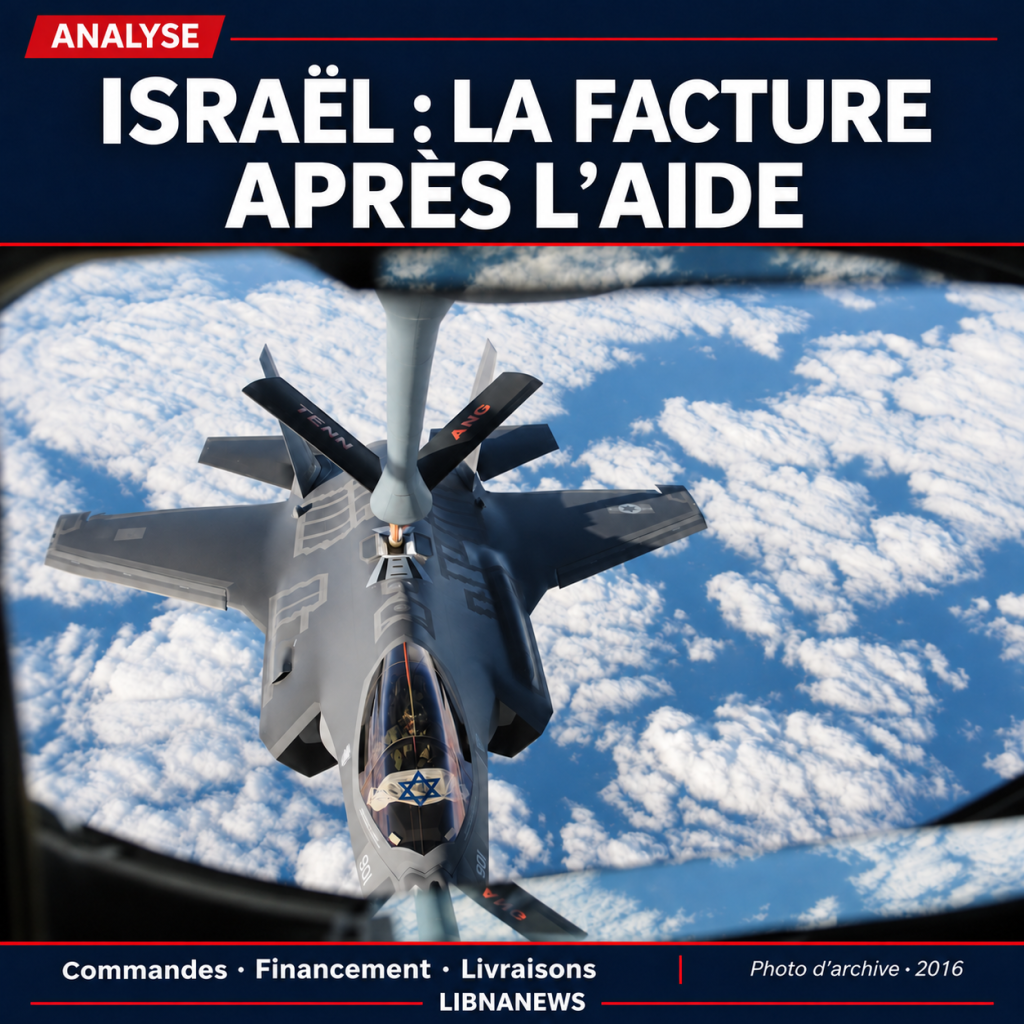
Photo archive: refuelling an Israeli F-35 during its transfer to Israel, December 6, 2016. 1st Lt. Erik D. Anthony / U.S. Air Force, via DVIDS. Public domain. Editorial layout Libnanews assisted by IA from this real photograph.Original photography and rights. The appearance of U.S. Department of War (DoW) visual information does not imply or constitute DoW sleep.





Comments