

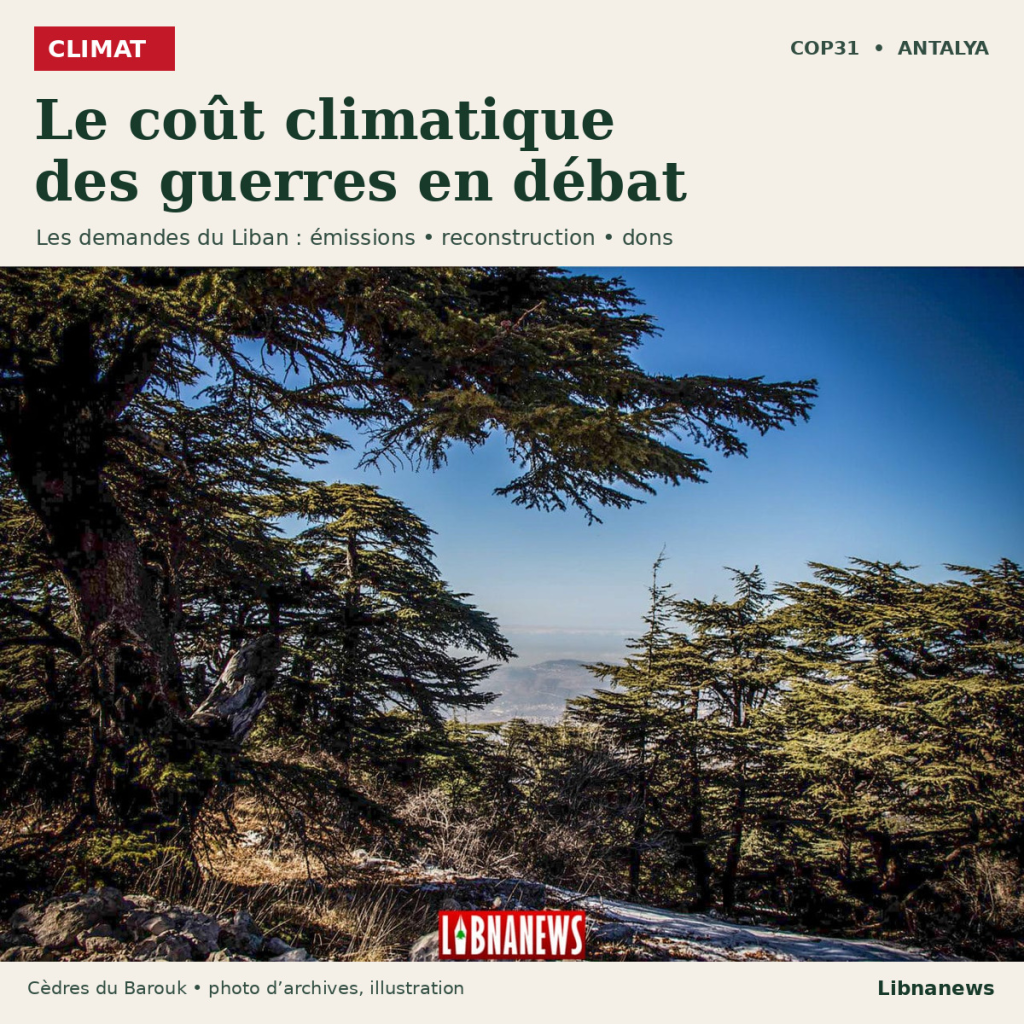
Lebanon wants to include the climate cost of wars in COP31 decisions. In a report released on 4 November, Tamara El-Zein presents this priority to the national negotiating delegation. The Minister of the Environment asks that the destroyed countries do not bear alone the emissions associated with their reconstruction. She also claims donations rather than new debts. These positions will be defended in Antalya, Turkey, where the conference will be held from 9 to 20 November 2026.
The climate cost of wars beyond fighting
Lebanese demand covers the entire cycle of war. Tamara El-Zein wishes to integrate the manufacture, development and transport of weapons. Their use, destruction and environmental damage also fall within the proposed scope. Lastly, she asked to take into account reconstruction needs. The approach therefore exceeds the only emissions produced during military operations.
The Minister advocates consideration of the causes of these additional expenditures and issues. In its view, reconstruction of destroyed infrastructure cannot be treated without examining the circumstances that imposed this work. Affected countries must restore their services while meeting their climate commitments. Beirut wants international rules to recognize this constraint in aid and funding mechanisms.
The position also includes a request for responsibility. Tamara El-Zein wants support and compensation mechanisms that take into account the actors responsible for the damage. She called for explicit provisions in the decisions and recommendations of the conference. This is a negotiating objective. No international agreement on this proposal was announced in the minutes of the meeting.
Donations to avoid a new debt burden
The nature of funding is the second central component of the process. The Minister calls for an increase in resources for developing countries. It defends a priority for grants against loans. For States weakened by war and financial crises, access to funds should not create new debt.
This request also concerns access conditions. Tamara El-Zein wants simpler and faster procedures. It calls for urgent and flexible mechanisms for fragile countries. The conditions imposed must, in its view, take into account recovery capacities and development needs. The aim is to allow for actual projects beyond the announcement of a strategy.
However, the meeting was not accompanied by any new funding for Lebanon. Nor does it provide a list of projects now funded. The Minister provides guidance to negotiators prior to the conference. Funding, amounts and conditions will depend on separate decisions, which are not established at this stage.
Measuring commitments by national capacity
The delegation should also advocate changes in the indicators used to monitor climate commitments. Tamara El-Zein asked not to limit the assessment to absolute measures. It proposes to combine relative indicators. They should take into account the economic resources, the level of development and the specific circumstances of each country.
This position concerns contributions determined at national level. These commitments constitute one of the frameworks for state participation in the climate effort. The Minister contests the application of uniform criteria to countries whose means differ greatly. His intervention calls for a link between obligations and available responsibilities and capabilities.
No new calculation formula is detailed in the published elements. The Lebanese position cannot therefore be presented as an already operational indicator. Nor is it a general exemption from effort. The application seeks a more equitable assessment and appropriate means to meet the commitments.
The digital subject to a complete review
Tamara El-Zein also wants to make a proposal on the environmental impact of technologies. In particular, it cites artificial intelligence and digital tools. Their interest should not, in her view, lead to their systematic classification as environmentally friendly solutions. It calls for an evaluation of their entire life span.
This approach includes the use of natural resources, energy consumption, emissions and other environmental burdens. The Minister proposes to compare these costs with the opportunities offered by the tools. It does not call for a general ban on artificial intelligence in the published statements. His intervention focused on the criteria for assessing their use.
There is no estimate of the footprint of Lebanese digital technology accompanying this proposal. No company classification or balance sheet of specific equipment is presented. The subject remains a negotiating direction, linked to the broader demand for comprehensive assessments. It does not replace the main issue of funding and the consequences of wars.
Need-based access to funds
Finally, the Minister insists on the independence of climate finance. It calls for the exclusion of political considerations, biases and discrimination when reviewing projects. In her view, transparent criteria should be based on national needs and priorities. The same requirement applies to access to technical support.
This position therefore combines two questions: the volume of available resources and their distribution. Increasing funding is not enough if countries cannot access it. The Minister also wants procedures to accompany the constraints of fragile administrations. However, the record does not identify any individual lessor as having breached these principles.
A delegation to defend these positions in Antalya
The meeting involved the Lebanese technical group and young delegates trained in international negotiations. It aimed to set priorities and guide their work. Tamara El-Zein asks them to coordinate their positions with friendly countries. It wants common proposals, while preserving Lebanon’s own interests.
The delegation arrived in an early calendar. The United Nations conference opens on 9 November in Antalya and must continue until 20 November. The Lebanese announcements therefore precede the discussions. They do not prejudge the final place of Beirut’s requests in the negotiated texts.
The next concrete point will be their translation into the work of the conference. The Minister asked to go beyond the presentation of national difficulties. It seeks rules that take into account responsibilities, reconstruction needs and the right to development. Funding arrangements, criteria and war provisions remain to be negotiated.
Sources
Al Sharq, 5 November 2026 edition, p. 11.
Lebanon Debate, NNA report, November 4, 2026;Icon News, transcript, 4 November 2026.





Comments