

A quarter of a second, or almost: two black crows indicated the direction of movement in 235 milliseconds on average. The study of the University of Tübingen, published on 22 October 2026, sheds light on the speed of a visual decision. It does not measure an intelligence superior to that of humans.
Two crows facing a simple choice
The device features moving points on a touch screen. Birds of the species Corvus corone must recognize their dominant direction: left or right. A beak on the corresponding target indicates their response.
When the movement is clear, their success approaches 100%. Even with signals that are difficult to distinguish, the answers exceed the level of chance.
Signals before the beak
Neuronal records reveal signals associated with the chosen direction from about 70 milliseconds after the stimulus appears. They therefore precede the observable answer.
Researchers observe these mechanisms in the caudolateral nestopallium, an associative region of the bird brain. Activity increases during decision-making. It reflects both the available visual information and the chosen direction.
Birds do not possess the organized cortex in mammalian layers. However, the recorded dynamics are compatible with decision models established in primates.
Why « twice faster » requires a shade
The observed delay represents about half of that previously reported in humans or monkeys for comparable tasks. This rapprochement should not be read as a cash tournament organized under identical conditions.
Two individuals, one species and one specific task: the scope of the result remains narrow. Experience does not allow for an overall classification of the reasoning abilities of birds and humans.
The requirements of flight and movement control may have facilitated this visual speed during evolution. This explanation remains a hypothesis. The mechanisms responsible for the temporal advantage remain to be specified.
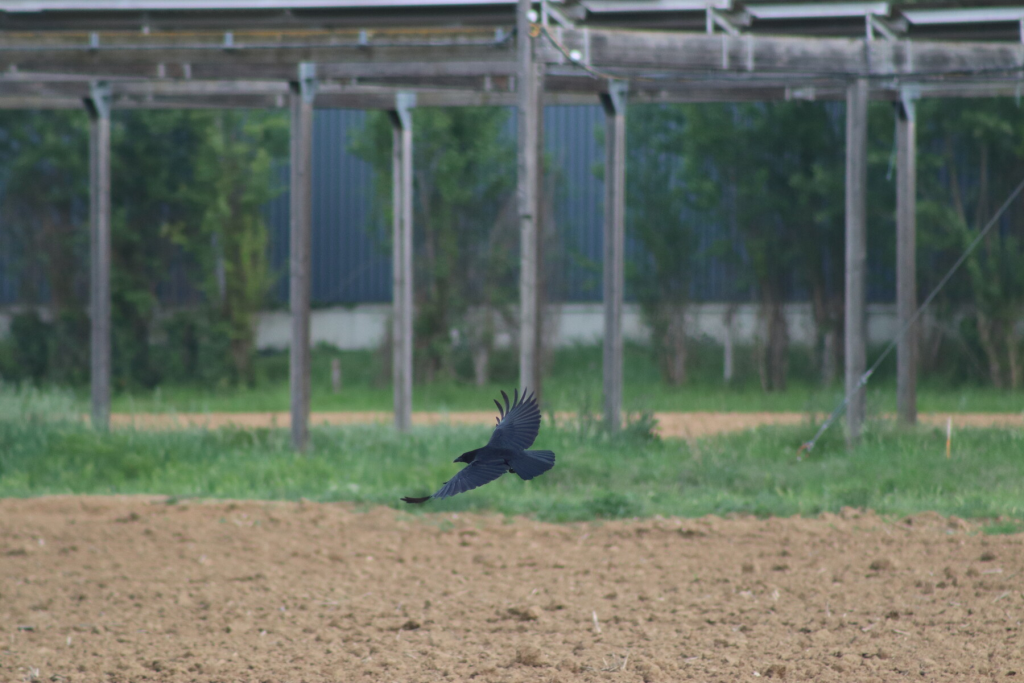
Illustration: Black crow flying in Montpellier, April 24, 2019. Photograph of archives unrelated to the two birds studied. Rorolinus,CC BY-SA 4.0viaWikimedia Commons. Resized image without cropping.






Comments