

Lebanon is considering a new formula for calculating the electricity tariff of Lebanon. The Ministry of Energy has requested that the calculation not be limited to diesel and thermal power plants already in operation. The company submitted a revised draft for consideration. On 13 November the Council of Ministers approved a general plan for electricity, but its published decisions do not set a new price per kilowatt hour.
Lebanon’s electricity letter to the Ministry distinguishes the formula for calculating the tariff decision. She reported on the Minister’s comments and then requested that the revised draft be forwarded to the Council of State for advice. She mentions attached tables. The tables are not included in the available copy of the letter. Therefore, an amount applicable to an invoice cannot be deducted, nor can an increase limit or an application date be confirmed.
A calculation to cover more plants
The Ministry asks to consider all plants that produce during the period. It refers to hydraulic installations and thermal units which may enter into service. The observation aims at a first method which relied mainly on the price of diesel and the thermal power plants then active. The cost of one litre of fuel is not sufficient to measure the average cost of the grid if part of the electricity is produced otherwise.
The purchase price of fuel can rise while a greater share of production comes from hydraulics. Conversely, cheaper fuel does not necessarily lead to an equivalent reduction in the average cost if the company has to produce more with its least efficient units. The place of each source in the calculation therefore counts as much as the reference price used for oil.
The Department also requests that the calculation be compared to the most recent version of the cost recovery plan. In its addendum published in December 2025, Electricity of Lebanon says that the end of the exchange arrangement with Iraq requires it to finance the cost of fuel itself. The addendum also updates assumptions on power plants, invoices actually paid and the recovery of arrears. It is a financial plan of the company, not the final tariff formula submitted to the government.
Who would pay more depends on the modified tranche
In a press release published in 2026, Electricity of Lebanon recalled the reference scale: 10 cents of dollars per kilowatt hour for the first 100 kilowatt hours, then 27 cents beyond. At 100 kilowatt hours, the energy share is $10. At 200 kilowatt hours, it represents $37. These examples exclude fixed shares and levies. They don’t describe a full bill.
This price difference allows you to situate the issue without assigning a percentage to the project. If only the upper band were raised, a subscriber remaining below the 100 kilowatt hours threshold would not see its share of energy increase for this reason. If, on the contrary, the first instalment was raised, the effect would also affect small consumers. And if one hundred dollars were added to both prices, it would represent 10 per cent increase on the first price and about 3.7 per cent on the second. This calculation is an illustration, not a scenario chosen by Electricity of Lebanon.
It is also necessary to distinguish the public bill from what a household spends to illuminate. A household that buys power from a private generator can see a growing position while the other one remains unchanged. An improvement in the public service could reduce the need for private power, but neither the letter nor the published decisions quantify this effect for subscribers. The proposed tariff alone does not guarantee a number of hours of power.
Public unpaid payments follow another procedure
On 12 November Parliament approved an appropriation of £8,950 billion to pay part of the accumulated invoices of public administrations and bodies. This credit is for an already constituted debt. It is not an increase in the price of households and does not prove that the money has already been cashed. Lebanon’s electricity recovery plan itself distinguishes between the amounts invoiced and the revenue received: a revised price does not address the problem of uncollected invoices.
The document which would measure the effect on households is the formula finally approved, with the basis and treatment of each tranche, the rules for upward and downward revision, and the periods of consumption to which it will apply. These elements are not derived from the approval of the general plan or from the request for an opinion addressed to the Council of State.
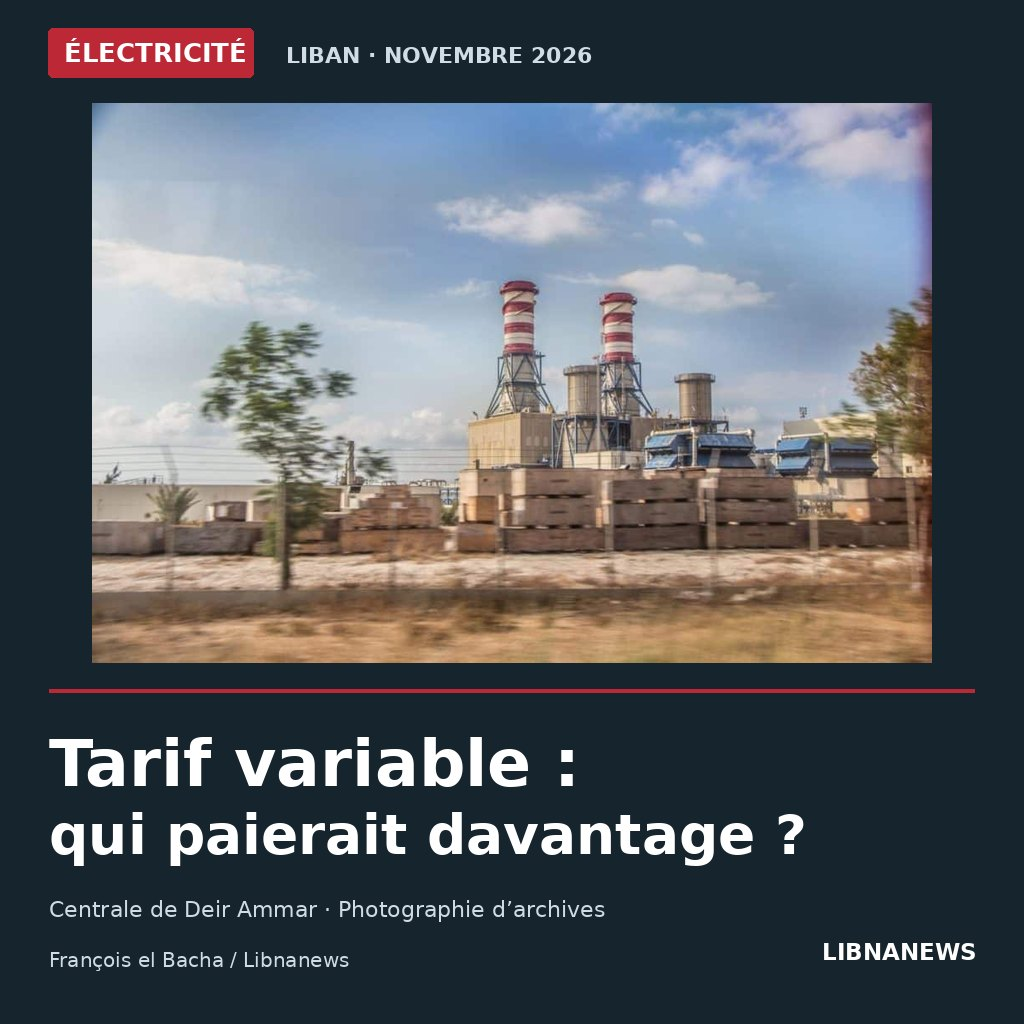
Deir Ammar Central in northern Lebanon. Archive photograph published in the media library in February 2019, exact date of unestablished shooting. It does not show the current state of the installation. Photo François el Bacha / Libnanews.





Comments