

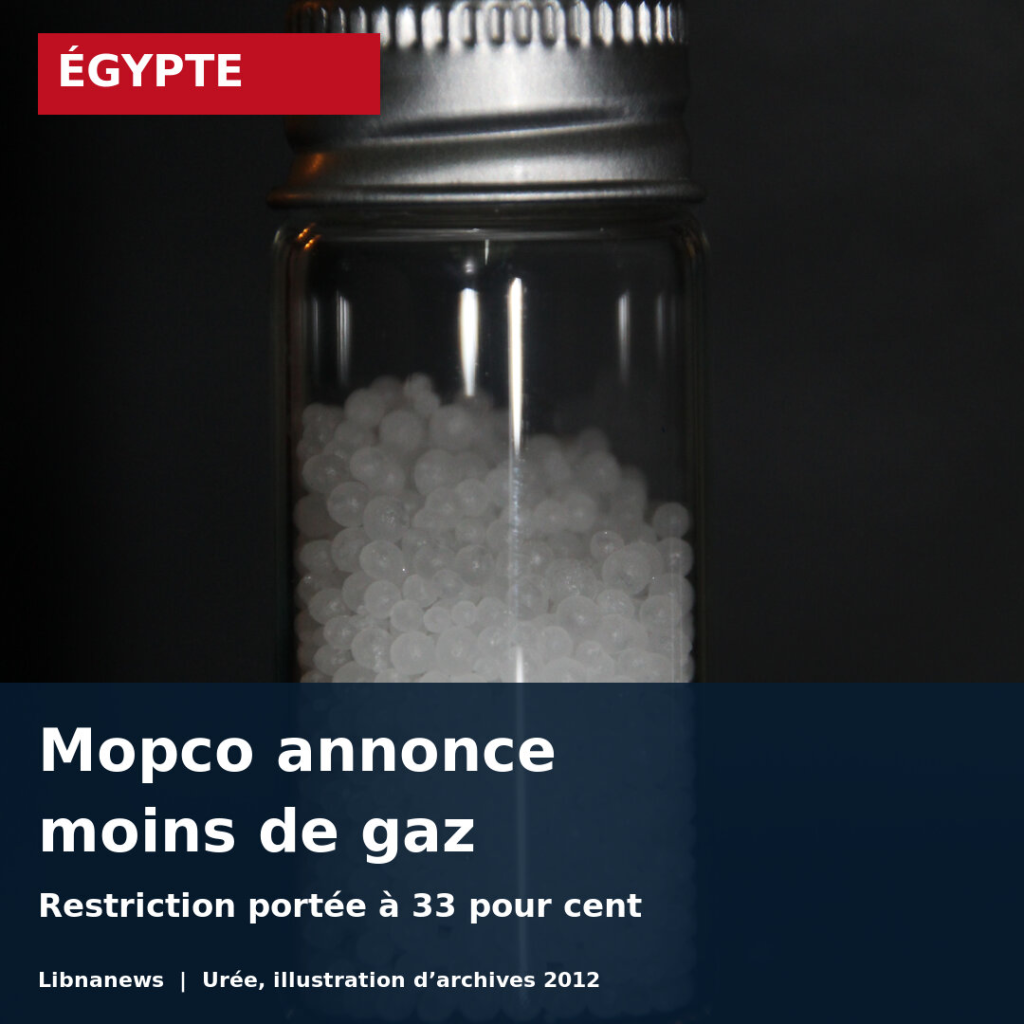
Mopco announced on November 8, 2026 a 33% reduction in its natural gas supplies. The Egyptian fertilizer manufacturer ensures that its operations are maintained with available volumes. This new restriction, after that of 20% mentioned at the beginning of November, puts its plants under pressure while Egypt seeks to contain its energy bill.
Misr Fertilizers Production Company, known as Mopco, confirmed the notification to the Egyptian Stock Exchange. It states that its teams adjust operations and production to the quantities of gas received. However, it does not publish any daily supply volume or estimate of the tons of fertilizer that will be missing. There is no date of return to normal in the letter.
The figure of 33 % therefore concerns gas, not a measured decrease in production or profit. Nor does the company report a general shutdown of its facilities. For its customers, uncertainty now concerns the duration of rationing and its effects on deliveries.
Mopco confirms stronger restriction
On 3 November, Mopco had already informed the market that it was continuing its business despite a 20% reduction in supplies to fertilizer plants. His letter referred to the increase in the cost of imports. Five days later, she confirmed that she had received a notification raising the announced restriction rate to 33%.
Mopco did not detail the flows delivered to each of its units.
The distribution of gas between units, stocks and technical constraints determines the possibilities of maintaining production. Mopco undertakes to inform the Stock Exchange of any significant developments.
Gas enters into fertilizer production
Mopco is located in the Damiette Free Zone and produces mainly urea and ammonia. In this industry, gas is not only used to power equipment. It also supplies the hydrogen needed for the manufacture of ammonia, which then enters into the production of nitrogen fertilizers.
This dual function explains the sector’s sensitivity to restrictions. Reducing auxiliary electricity consumption does not replace the missing chemical raw material. A plant can adapt its pace, but its capacity to manufacture remains tied to the quantities actually received.
Gas also weighs on costs. In conventional ammonia and urea production, it often accounts for a major share of operating expenditure. Its increase in price compresses margins when sales prices do not follow. A physical limitation of deliveries adds another constraint: even a profitable order can become more difficult to produce.
Agricultural opportunities and export earnings
The data published by Mopco for 2024 give the scale of its activity. The company reported having produced 1,718 million tonnes of urea. It reported 947 000 tonnes exported and 795,000 tonnes destined for the internal market. The same facilities supply Egyptian agriculture and foreign markets.
For Egyptian agriculture, the question concerns the availability of fertilizers at the time of need. For foreign buyers, it concerns compliance with deadlines and exportable volumes. An extended restriction may require producers to review their business schedules. However, no national fertilizer deficit can be deducted from Mopco’s statement alone.
Another producer, Abu Qir, had explained in the first episode of the reduction that he would adapt his activity to the gas available. According to one news agency, its measures included inventory management and maintenance reorganization. These adjustments may limit immediate disturbances. Their effectiveness depends on how long the restrictions remain in effect.
Imported gas bill weighs on arbitrations
Egypt uses gas to generate electricity as well as to power its industries. Inadequate local supply to demand increases its reliance on imports. The rise in international prices of liquefied natural gas, in the context of regional war, makes this supply more expensive.
An analyst estimate relayed by an agency places the LNG import budget for fiscal year 2026-2027 at approximately $10.1 billion. According to the same estimate, 5.8 billion had already been spent by 6 October.
The government is also looking for alternative fuels. Commercial sources reported the purchase of six shipments of high sulphur fuel oil for November and December. The use of fuel oil can meet certain energy needs. It does not directly replace the gas used as a raw material in the manufacture of ammonia.
The arbitration thus exceeds the only fuel purchase invoice. Limiting imported volumes can reduce immediate spending, while also affecting an industry that supplies farmers and sells abroad. The industrial cost will depend on the length of rationing and deliveries that producers can maintain.
An offshore discovery still awaits its development
On November 6, the Ministry of Oil announced positive results at the Nassim-1X exploratory well. It is located in the Tiba concession in the Mediterranean. The initial estimate is about 200 billion cubic feet of gas in place. Eni operates the concession with Woodside; Petrobel conducted the drilling operations.
This volume does not correspond to recoverable reserves already certified, let alone immediately available gas for plants. The Ministry indicated that it would continue the study of the reservoir. It provides for a connection to the existing installations by a pipeline of approximately 22 kilometres, without announcing in this communiqué a date of first production.
In Damiette, factories must now adapt their production to the gas available. The offshore development announced does not provide an immediate response to the November restrictions.





Comments