

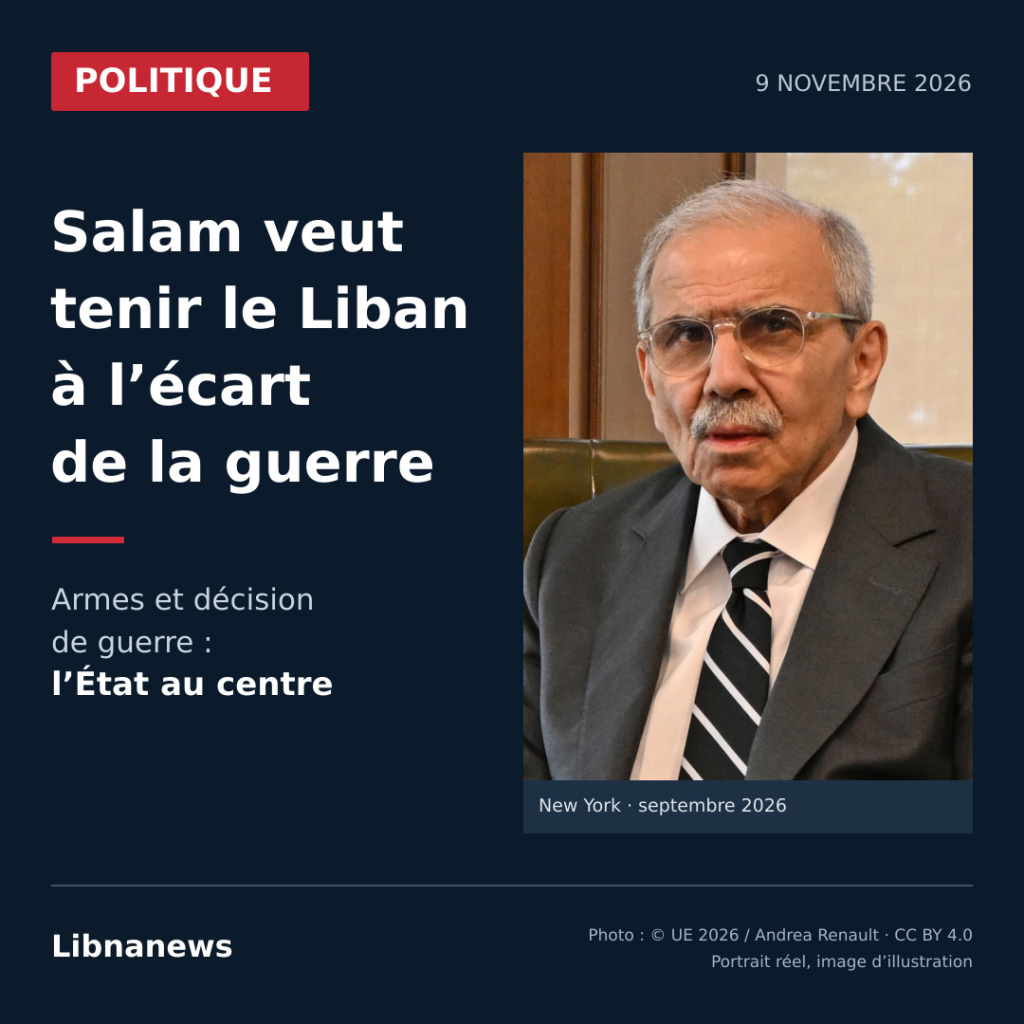
Nawaf Salam wants to avoid a new war in Lebanon. The Prime Minister reaffirmed this priority on Monday, November 9, 2026, at a ministerial meeting in the Greater Serail in Beirut. This declaration extended an interview made public the day before, in which he defended the state monopoly on arms and decisions of war and peace.
The protection of the country, its security and stability must guide government action, Nawaf Salam said at the opening of the meeting. Ministers reviewed developments in Lebanon and the region, as well as several security and daily issues. The official record does not mention any decision involving the country in a military confrontation.
Both interventions specify the same position at one day apart. On Sunday, the head of government responded to criticisms of a hesitant power in the face of regional change. On Monday, it placed war prevention at the top of ministerial priorities. It links this protection to the authority of Lebanese institutions, rather than after external power relations.
Nawaf Salam wants to avoid a new war
In his interview published on Sunday, November 8, the Prime Minister challenged the accusations of confusion against his government. He regretted that the Lebanese were misled by speeches presenting the executive as dependent on « external bets » or « illusory calculations ».
He opposed this reading as the institutional basis for his action. His Government, he said, acts under the Constitution, the law and parliamentary trust. He recalled having obtained that confidence twice. He also referred to his ministerial declaration as a framework for work, regardless of the scenarios envisaged abroad.
This response comes as the consequences of the American and Israeli elections fuel questions in Lebanon. However, Salam refuses to present these changes as the guiding principle of government action. He claims to maintain his line, regardless of the nature of external developments.
The Prime Minister thus distinguishes the diplomatic means which he intends to mobilise from the political dependencies which he denounces. It ensures that Lebanon’s own resources and relations with friendly countries are used to maintain a safety net. It does not present these steps as a guarantee already acquired against any escalation.
Arms and the decision to war in the hands of the State
The heart of his intervention is the power to engage Lebanon in conflict. According to Nawaf Salam, the protection of the country requires that all respect two principles: to reserve to the State the decision of peace and war, and to guarantee to it the exclusivity of arms. He assures himself that he will pursue this policy relentlessly.
He also denounced the external ties which, according to him, regularly lead the country into « absurd wars ». He warned that those commitments might offer Israel new pretexts for expanding its occupation of the South. He referred to the continuation of destruction, death and displacement.
These statements express his political warning of the consequences of a new confrontation. They do not constitute the announcement of a specific Israeli operation. Salam did not give a military calendar or description of an offensive plan. He requested that Lebanon’s reason and best interests prevail over regional calculations.
The head of government opposed his approach to that of actors whom he accuses of linking their interests abroad. He did not name them in the words quoted. The issue, however, joins the Lebanese debate on Hezbollah’s weapons and on the State’s ability to impose its military choices alone.
His intervention does not detail a new operational phase of disarmament. It reaffirms a political and institutional objective. Similarly, the Monday ministerial meeting does not include in its minutes any additional deadline or new arrangements on this matter.
A warning already given to Baabda
In the interview, Nawaf Salam himself referred to his statement of November 4, after his meeting with President Joseph Aoun. In Baabda, he warned against any new military adventure that was being carried out in the service of outside interests. He stressed that Lebanon could not bear the consequences of such a confrontation.
He then insisted on the situation of the people of the South. Human losses, destroyed housing and lost livelihoods were at the centre of his warning. He defended their right to live in safety and refused to impose a new war on them.
The comments of 8 and 9 November therefore continue this position. Their novelty is mainly due to the direct response to the accusations of detentism. Salam asserts that his Government pursues its own policy, while seeking Lebanese diplomatic relations to reduce the dangers.
Between negotiations with Iran and Israeli threats
The regional context remains uncertain. Donald Trump estimated Sunday, November 8, that new American strikes against Iran were very unlikely. This assessment was conditional: the US President related to the progress of the negotiations and the conclusion of an agreement which he considered sufficiently solid.
His remarks therefore do not constitute a definitive waiver of the military option. A meeting with Qatari Prime Minister Mohammed bin Abdelrahmane Al-Thani was announced Monday in Washington. Qatar acts as a mediator between the United States and Iran.
Israel’s Defense Minister, Israel Katz, delivered a more threatening speech on Sunday. He claimed that Israel’s mission concerning Iran was not completed. He also threatened Hezbollah with very severe strikes if the movement participated in an Iranian attack on Israel.
This threat remains conditional. It does not demonstrate that Hezbollah has decided to participate in a possible resumption of the war. Nor does Trump and Katz’s statements make it possible to conclude that a new confrontation is stopped. It is in this uncertainty that Salam reaffirms the priority of preserving Lebanon.
In Beirut, follow-up on security measures
Monday’s meeting also focused on security measures in Beirut and Greater Beirut. Ministers reviewed the strengthening of patrols and security deployment. Salam called for continued efforts to protect the inhabitants and their property.
On food security, discussions focused on intensifying inspections of restaurants, warehouses and distribution centres. The relevant ministries and departments must coordinate with the Lebanese Food Security Authority. Finally, participants discussed measures taken around the airport to preserve aviation safety. The report does not detail the content.
Illustration photo: Nawaf Salam in New York in September 2026. This image does not represent the November 9 meeting. © European Union, 2026 / Andrea Renault. Box portrait available under CC BY 4.0 license; Libnanews editorial dress, without changing the face.
Credit Line
Photography and provenance·Creative Commons Attribution 4.0 License.






Comments