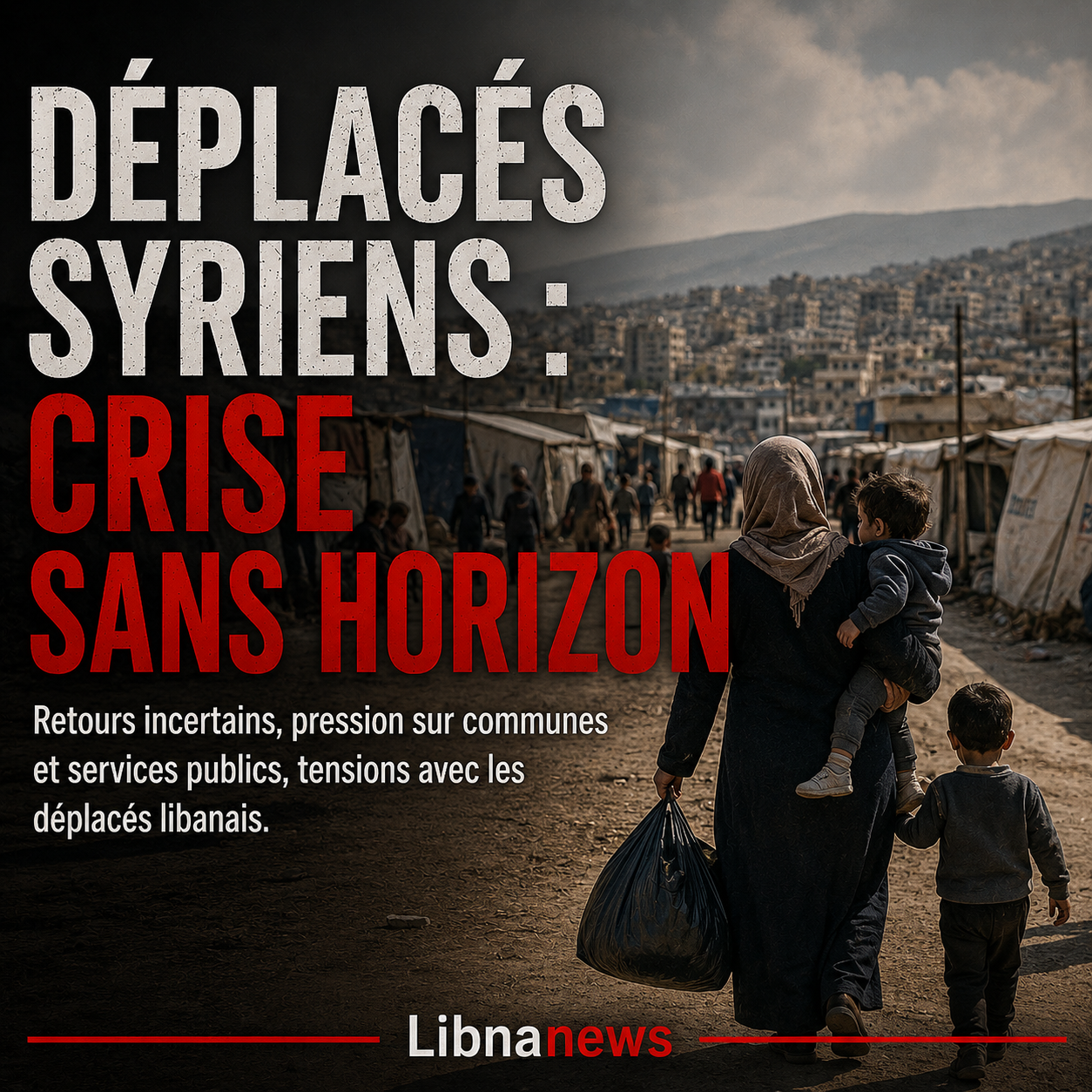
The issue of Syrian internally displaced persons in Lebanon returns to the forefront as the country faces its own internal displacement crisis. The war in the South, the strikes on the southern suburbs of Beirut, the evacuation orders and the uncertainty over the ceasefire have displaced more than one million Lebanese. In this already saturated landscape, the Syrian presence remains an explosive subject. It affects municipalities, schools, clinics, informal employment and rents. It also feeds on political tensions, as each Lebanese camp projects its fears, calculations and priorities on this issue. However, Lebanon can no longer be content with a debate of slogans. It needs a clear framework, with Syria, the United Nations and donors, to organise possible returns without causing a new humanitarian crisis.
The figures themselves summarize the complexity. The Lebanese Government still estimates that there are between 1.3 and 1.5 million Syrians, while UNHCR registers have a much smaller number of registered refugees. The UNHCR operational portal indicated, as at 31 March 2026, approximately 490,000 registered refugees, distributed mainly between the Bekaa, the North, Beirut-Mont-Lebanon and the South. This difference is due to the suspension of new registrations since 2015, due to returns, undeclared departures, unregistered persons and constant mobility between Lebanon and Syria. It also feeds distrust. The Lebanese authorities speak of a massive demographic and economic burden. International agencies respond with verifiable but incomplete figures.
Syrian IDPs caught in an expanded Lebanese crisis
The current crisis has changed the nature of the problem. For years, the Syrian question has been presented as a separate crisis: a host country exhausted in the face of a refugee population that has been living since 2011. Since the escalation of 2026, Syrian internally displaced persons have been caught in a wider Lebanese crisis. Lebanese families in the South are looking for shelter in the same schools, the same public buildings, the same host villages and sometimes the same rental markets as Syrians who have been living for years. Resources have not increased. The needs have overtaken each other.
This overlay creates silent competition. A municipality already housing Syrian families must accommodate displaced Lebanese. A school that received Lebanese and Syrian students can become a reception centre. A dispensary that cared for a poor population must treat more wounded, chronically ill and displaced families. Rent increases in areas deemed safer. Owners sometimes prefer to rent to families able to pay in dollars. The most vulnerable, Syrian or Lebanese, find themselves being pushed back to more precarious housing.
The political danger comes from this proximity of misery. When resources are lacking, the temptation of the scapegoat increases. Syrians are accused of weighing wages, services, security or aid. Displaced Lebanese sometimes denounce the impression of more structured international assistance for Syrian refugees than for themselves. Syrians respond that they have lived in precarious conditions for years, with restrictions, controls, point expulsions and constant fear of forced return. These resentments may coexist. They are no less dangerous for social cohesion.
The municipalities on the front line
Municipalities are bearing part of the shock. They must manage waste, water, lighting, shelter, neighbourhood tensions, informal work permits, rents, markets, roads and complaints. Many do not have budgets, staff or up-to-date data. Mayors often know better than the ministries where families are located, which houses are overcrowded, which neighbourhoods lack water or which schools are under pressure. But they don’t always have the means to act. This weakness turns the Syrian presence into a permanent local problem.
In the Bekaa, North and parts of Beirut-Mont-Lebanon, the pressure is old. Informal settlements, unfinished housing, farms, neighbourhoods and small towns have been hosting Syrian populations for more than a decade. The war in the South has added a new layer of vulnerability. The municipalities must arbitrate between poor inhabitants, Syrians, displaced Lebanese and host families. They often do so without a clear national framework. Decisions then become local, sometimes arbitrary: restrictions on movement, dismantling of camps, administrative pressure, informal curfews or refusal of installation.
These measures can respond to real concern. They can also exacerbate insecurity. A Syrian family displaced from one camp to another municipality does not disappear. It becomes more invisible. A worker prevented from moving loses income. A child whose documents are not in order risks leaving school. A woman who avoids controls sometimes gives up care. Municipal management cannot replace a national policy.
Schools, care and work under stress
School remains one of the most sensitive points. The Lebanese education system has long operated with dual arrangements to accommodate Syrian students. The financial crisis had already weakened this model. The war then turned schools into shelters, moved teachers, cut off roads and disrupted calendars. In this context, Syrian children are particularly vulnerable to dropping out. They sometimes combine poverty, early work, lack of documentation, linguistic difficulties, distance from institutions and family pressure. Displaced Lebanese children now suffer part of the same breakdown.
Another challenge is health. Syrians often depend on subsidized services, NGOs, health clinics or humanitarian networks. International budget cuts have reduced some programs. Lebanese hospitals, already weakened, demand payment guarantees. Poor families delay consultations. Chronic diseases, pregnancy, mental health and paediatric care become more difficult to follow. When displaced Lebanese arrive in the same structures, waiting times increase and tensions increase. The system does not lack only money. It lacks predictability.
Employment finally crystallizes accusations. Syrians often work in agriculture, building, services, delivery, cleaning, catering or daily activities. These are sectors already marked by informality, low wages and weak social protection. The poor Lebanese see this labour force as a competition. Employers see flexibility. Syrians sometimes see it as the only way to survive. The solution cannot only be repressive. Prohibiting without alternative pushes work further into lawlessness. Formalizing without regulation feeds social anger. There is a need for a limited, controlled and transparent employment framework linked to the real needs of the economy.
The return to Syria, between hope and constraint
The fall of the former Syrian regime and the political recomposition in Damascus have revived the question of return. Tens and then hundreds of thousands of Syrians have left Lebanon since the great waves of violence and political change in Syria. Programmes facilitated by UNHCR and IOM were launched to support voluntary returns, with limited financial assistance, advice, official passages and closure of cases in Lebanon. According to UNHCR, the movements of Syrians to Syria stabilized in the spring to several thousand people per day at certain passages. This movement is real. It is not enough to close the crisis.
The word voluntary is decisive here. A person who returns because his or her shelter in Lebanon is threatened, because he or she has no income, because he or she fears expulsion or because a war strikes the host country is not in the same situation as a family who chooses serenely to rebuild its life in Syria. UNHCR points out that returns during the conflict in Lebanon are not always considered to be voluntary in the full sense, even when they are facilitated to mitigate risks. This distinction protects an essential humanitarian principle. It avoids turning Lebanese pressure into a forced return.
Barriers to return remain numerous. Syria remains devastated by more than a decade of war. Neighborhoods are destroyed. Public services work badly. The economy remains fragile. Food aid has been reduced in several areas due to lack of international funding. Many families do not know if their home still exists, whether their land is accessible, whether their papers are recognized or whether their safety is guaranteed. Returns can be successful in some areas. They can fail in others. A failed return sometimes creates a secondary shift to another Syrian city or, again, to Lebanon.
New beginnings do not solve old blockages
Since the start of the war in Lebanon, passages to Syria have also served as a flight route. Syrians left Lebanon to escape the strikes. Lebanese crossed the border to take shelter. Mixed families hesitated between staying, leaving for Syria or joining another Lebanese region. This mobility blurs categories. A Syrian who comes under the bombs is not necessarily a lasting returnee. A Lebanese who spends a few weeks in Syria is not a refugee in the classical sense. The conflict is the result of urgent movements that national statistics fail to capture.
These departures may even complicate planning. The Lebanese authorities may be tempted to see a solution. But if conditions in Syria do not allow sustainable settlement, people will return or remain trapped in a cross-border precarious situation. International agencies will then have to follow families between two countries, with closed files in Lebanon and insufficient services in Syria. Return should not be thought of as an administrative exit. It must be thought of as real reintegration.
International financing is another block. Programmes for refugees in Lebanon, host communities and returns to Syria suffer from donor fatigue. Global priorities have multiplied: Ukraine, Sudan, Gaza, Iran, climate, migration, food crises. Lebanon may see aid decline as needs increase. This creates a perverse effect. Less aid to Lebanon increases the pressure on return. Less aid in Syria makes it more difficult to return. Families find themselves caught between two shortcomings.
A Lebanese debate often trapped
The Lebanese debate on the Syrian internally displaced often remains trapped between two excesses. The first is to deny the burden of this presence for a country in crisis. No State of Lebanon’s size, with weakened institutions and a collapsed economy, can permanently absorb such a population without tension. Municipalities, schools, hospitals, the labour market and infrastructure are under real pressure. It is not necessarily a question of racism. It is to recognize a constraint of sovereignty and public capacity.
The second excess is dehumanizing Syrians. Presenting them only as a burden, a threat or a political tool erases individual stories: families fleeing war, children born in Lebanon, poor workers, single women, elderly, sick, young people without a horizon. This feeds abuse, arbitrary expulsion, violence and discrimination. A serious policy must hold both realities together: Lebanon cannot carry this crisis alone, but the Syrians cannot be treated as a displacing mass at will.
The political discourse must therefore change its register. It is no longer enough to demand a massive return. It must be said who goes back, where, with what documents, what security, what help, what follow-up and what possibility of recourse. It is no longer enough to demand international financing. It is necessary to explain how they support municipalities, schools, hospitals, poor Lebanese and refugees at the same time. The Syrian crisis in Lebanon cannot be resolved either through incantation or humanitarian abandonment.
Towards a clear bilateral framework
The only credible outcome is through a clear bilateral framework between Beirut and Damascus, backed by the United Nations and donors. This framework should start with a common database that respects rights and protects against abuse. It should identify persons wishing to return, their areas of origin, documents, needs, housing conditions and security obstacles. It should provide for official passages, limited but predictable assistance, follow-up after return and coordination with local Syrian authorities.
This framework should also protect those who cannot return immediately. Medical cases, undocumented families, threatened persons, school children, single women, stateless or homeless persons in Syria require specific procedures. Sustainable return must not create new rightsless ones. Lebanon has an interest in an orderly process. Forced or chaotic return would result in abuse, return and a bad international reputation. It would not reduce the long-term pressure.
The Lebanese communes must be integrated into this system. They know who lives on their territory. They must also receive direct support for public services, waste management, water, schools, clinics and temporary accommodation. Host communities cannot be sacrificed in the name of refugee protection. This is one of the conditions for social peace. Helping Syrians without helping the poor Lebanese feeds anger. Helping Lebanese by excluding Syrians feeds marginalization. Funding must be territorial, not just categoryl.
A crisis without a horizon if nothing changes
Syrian internally displaced persons in Lebanon face a crisis without a horizon because the three conventional solutions remain incomplete. Sustainable integration remains politically rejected by a large part of Lebanese officials. The massive return remains limited by Syrian conditions, security, documents and economy. Resettlement to third countries involves too few people to change the balance. The result is a prolonged in-between: neither assumed facility nor large-scale organized return nor sufficient international protection.
This in-between uses everyone. He uses Syrians, who live in wait, poverty and fear of an administrative decision. He used the Lebanese, who saw public services deteriorate and aid spread. It uses the municipalities, which manage a national crisis with local resources. It uses donors, who finance programmes without a clear political perspective. It also uses relations between Beirut and Damascus, because the return file remains full of contradictory history, security, mistrust and interests.
The war of 2026 made this impasse more urgent. Lebanon cannot rebuild the South, welcome its own internally displaced persons, revive its economy and stabilize its institutions while leaving the Syrian question unclear. Syria cannot request returns without providing guarantees of housing, security, services and documents. Donors cannot reduce aid by hoping that families will find a solution alone. The next useful agreement will not only be a repatriation mechanism. It will have to be a shared responsibility contract, where every return will be followed, every supported municipality and every family protected against a new leak.