





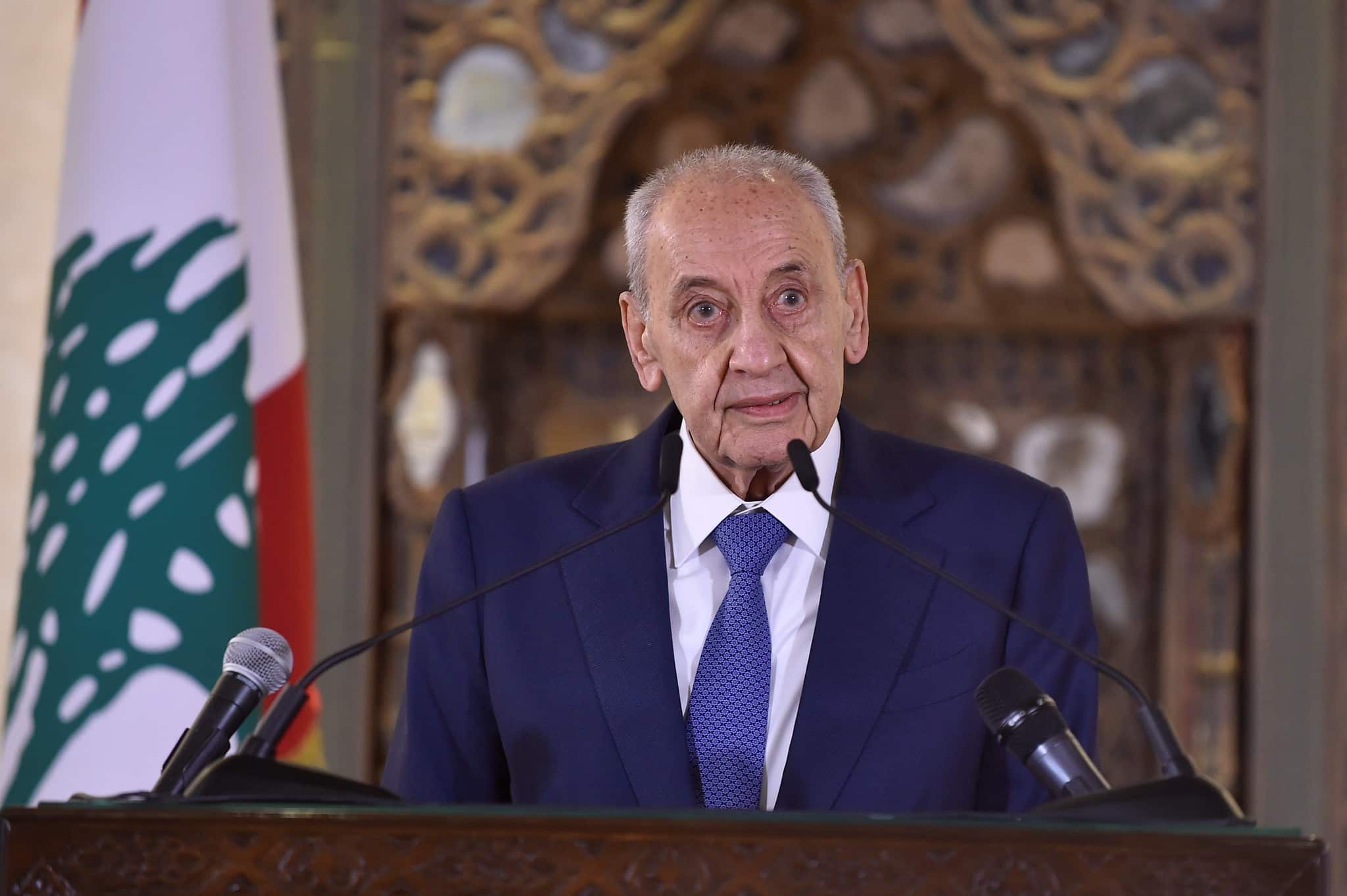
On the occasion of the Army Day, the President of the Lebanese Parliament, Nabih Berry, paid tribute to the armed forces while rejecting the principle of the « pilot zones » negotiated between Lebanon and Israel under American mediation. He believes that the Lebanese army should not be « tested » in a way in which Israel continues to conduct military operations and delay its withdrawal. This position comes at a time when the first experiments of the mechanism reveal the difficulties in implementing the framework agreement concluded at the end of June.
The President of the Chamber of Deputies, Nabih Berry, chose the Army Day to send a double message. The first is intended for the Lebanese military, hailed as the symbol of national unity and state sovereignty. The second relates to the « pilot zones » set up as part of the negotiations between Lebanon and Israel. Berry believes that the army should not be used as an instrument of verification or pressure as Israel continues its military operations in southern Lebanon.
This declaration goes far beyond the commemorative framework. It comes at a time when the first pilot zones, negotiated under American mediation, are supposed to prepare for the gradual withdrawal of Israeli forces, the deployment of the Lebanese army and the implementation of the security commitments provided for in the framework agreement of 26 June 2026.
This mechanism has been under discussion in Lebanon for several weeks. Its supporters see it as a pragmatic method of avoiding a new war. On the contrary, its critics denounce a process that imposes immediate obligations on Beirut while Israeli withdrawal remains incomplete and international safeguards remain limited.
Nabih Berry’s comments reinforce this second reading. They reflect the reservations of a large part of the Lebanese political class towards a system which, in its view, could transform the army into a guarantor of an agreement whose conditions have not yet been met.
Berry defends the army, but criticizes the mechanism of the pilot zones
In his message, the President of Parliament presented the army as « the model of unity, identity, belonging, sacrifice and fidelity ». He recalled that, in his view, the institution remained the main guarantor of national sovereignty, internal stability and the preservation of civil peace.
This part of the speech is part of a Lebanese political tradition. Despite denominational and partisan divisions, the army remains one of the few institutions with relatively broad legitimacy among the population and different political forces.
Berry, however, quickly expanded his speech by attacking the current experiment in southern Lebanon.
According to him, Israel « designs pilot areas by fire, destruction and death. » This approach reflects the main criticism of the mechanism: discussions continue as Israeli military operations and destruction continue in several sectors.
For the President of Parliament, these conditions make any logic of testing the capabilities of the Lebanese army before a complete Israeli withdrawal unacceptable.
This criticism does not directly target the armed forces. It addresses the political framework in which they are called upon to intervene.
What are « pilot zones »?
The pilot zone mechanism is the heart of the framework agreement negotiated under American mediation after the Israeli-Hizbullah clashes.
Rather than organising simultaneous withdrawal across the entire border, negotiators have chosen a gradual approach.
Israel evacuates a limited area.
The Lebanese army is deploying.
Lebanese authorities are gradually taking control of the ground.
Non-State military infrastructure must be dismantled.
An international group then checks compliance before a new phase is opened.
This method aims to limit the risk of collapse of the agreement in the event of a localized incident.
It should also test the mechanisms for coordination between the different parties.
But this logic presupposes that each one respects its own timetable.
However, several difficulties quickly emerged.
Israel believes that some sectors do not yet have the necessary security guarantees.
On the contrary, Lebanon considers that withdrawals are too slow and that certain positions continue to be occupied without justification.
The destruction in several localities further reinforces the criticism of this mechanism.
According to several international observers, the first pilot areas highlighted the difficulties of coordination between military commitments, the return of inhabitants and demining operations. They also showed that differences of interpretation between the parties remain significant.
Why Berry refuses the army to be « tested »
The formula used by Nabih Berry has an important political significance.
It means that the army must not become the criterion for measuring the success or failure of the agreement.
Under the current arrangement, each Israeli withdrawal is supposed to be followed by an army deployment.
If an area is not considered sufficiently secure, Israel can slow down its withdrawal.
This logic places a strong responsibility on the armed forces.
Berry believes that this approach reverses priorities.
In his view, Israeli withdrawal constitutes an obligation under international law and resolution 1701.
It should therefore not depend on a unilateral assessment of the capabilities of the Lebanese army.
This position is consistent with that expressed in recent weeks by several Lebanese officials.
They consider that the safeguards should apply to both parties.
Lebanon accepts the deployment of its army.
Israel, for its part, must adhere to a precise timetable for withdrawal and stop the strikes and destruction.
An indirect critique of American mediation
Not to mention Washington, Nabih Berry also questions the method preferred by the United States.
American diplomacy supports progressive implementation.
Each step must be validated before the next step.
This approach is inspired by other security agreements concluded in contexts of high mistrust between the parties.
It helps to prevent an overall failure from removing the whole process.
But it also gives the parties the opportunity to slow down or suspend the next steps.
Lebanon is concerned that Israel may use this flexibility to maintain a longer military presence than expected.
On the contrary, Berry defends a more direct logic.
The Israeli withdrawal should be synchronized with the deployment of the army and not subject to a series of successive validations.
This divergence explains some of the tensions that have arisen since the Framework Agreement was signed.
Army, central institution but limited resources
Despite its strong support for the armed forces, Nabih Berry knows that they will face a considerable challenge.
Deployment to the South requires additional personnel, modern equipment, monitoring capabilities and significant logistics.
Since the beginning of the economic crisis, the military’s financial capacity has been severely affected.
The United States, France, several European countries and Arab States provide material and financial support.
President Joseph Aoun is also seeking to diversify these partnerships, particularly with Turkey, in order to strengthen the operational capacity of the institution.
But no foreign partner can replace a clear political strategy.
The army will have to control destroyed areas, secure the return of the inhabitants, prevent the reconstruction of military infrastructure and maintain civil peace.
These missions require a political consensus that Lebanon does not yet fully possess.
Hezbollah remains at the heart of the debate
Berry’s statement does not mention Hezbollah directly. However, the entire pilot zone system is linked to the organisation’s presence in southern Lebanon. The agreement provides that the State shall progressively exercise a monopoly on arms in the sectors concerned.
Israel considers this condition indispensable for its withdrawal. Hezbollah, for its part, refuses any disarmament under Israeli occupation. Berry takes an intermediate position. He supports the army. and demands Israeli withdrawal.
It emphasizes the implementation of resolution 1701.
But it avoids the issue of Hezbollah disarmament publicly.
This caution reflects his political role.
Head of the Amal movement and ally of Hezbollah, he remains one of the main interlocutors of foreign mediators.
It seeks to preserve the possibilities for negotiation without opening up a new front of internal confrontation.
A statement before further negotiations
Nabih Berry’s comments precede a new round of discussions on the implementation of the Framework Agreement.
In particular, negotiations should specify the extension of the pilot areas, the modalities of the Israeli withdrawal and the functioning of the international monitoring mechanism.
The President of Parliament is obviously trying to influence this sequence.
His message sets several red lines.
The army must not be transformed into an adjustment variable.
Israeli withdrawal must remain an obligation.
International safeguards must concern both parties.
And the pilot zones cannot become a pretext to extend the Israeli military presence in southern Lebanon.
These statements come at a time when several villages remain largely destroyed and the inhabitants are still waiting to be able to return to their homes. Future rounds of negotiations will have to determine whether the pilot areas are a step towards full withdrawal or whether they are likely to settle in a sustainable way as a transitional arrangement without a clearly defined deadline.