






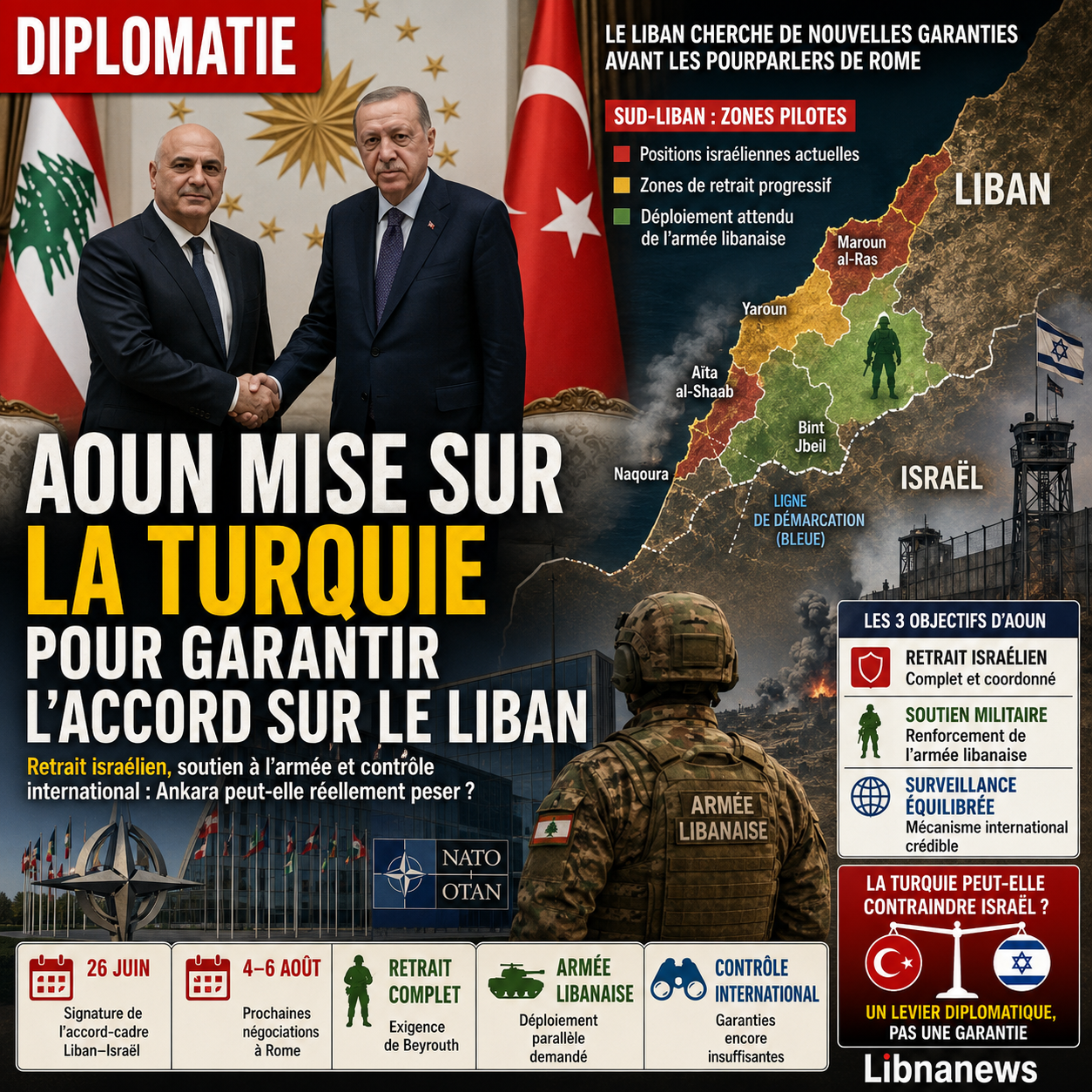
On a visit to Ankara on Thursday 30 July, Lebanese President Joseph Aoun called on Turkey to support the international framework agreement with Israel. Beirut hopes that Ankara’s regional weight, NATO membership and relations with several actors in the conflict will lead to stronger guarantees. The Head of State calls for a complete Israeli withdrawal, coordinated with the deployment of the Lebanese army, a lasting cessation of hostilities and an international monitoring mechanism. But Turkey’s real ability to compel Israel remains uncertain.
Joseph Aoun seeks to broaden the circle of States involved in the implementation of the framework agreement between Lebanon and Israel. After Washington and the European capitals, the Lebanese president turned to Ankara. Its objective is to transform a still fragile text into an international commitment that is more difficult to circumvent.
During his visit to Turkey, the Head of State considered that Ankara could defend the agreement with its partners and call on all parties to respect their obligations. He cited Turkey’s membership in the North Atlantic Treaty Organization and its political, economic and military relations in the region.
This reflects growing concern in Beirut. The agreement signed on 26 June does not yet guarantee a rapid Israeli withdrawal. Its application is based on successive steps. Israel must evacuate certain areas while the Lebanese army deploys its units there and weapons beyond State control are withdrawn.
The system already encounters obstacles. Withdrawals remain limited. Destruction complicates the return of the inhabitants. Hezbollah refuses to abandon its arsenal as part of an agreement to which it did not directly subscribe. Israel maintains an extensive reading of its security requirements.
In this context, Joseph Aoun wants to avoid Washington being the sole arbiter of the process. Turkish support would not replace American mediation. It could, however, give Lebanon an additional partner in discussions on withdrawal, international surveillance and support to the army.
Ankara, new stage in Joseph Aoun’s diplomacy
The move to Turkey is part of a diplomacy aimed at consolidating Lebanon’s official position. Joseph Aoun seeks to convince his interlocutors that the Lebanese State remains committed to the framework agreement, but that it cannot apply it alone.
The President confirmed Beirut’s commitment to the text. However, he stressed several safeguards. The Israeli withdrawal must be complete. It must take place in parallel with the deployment of the Lebanese army. Hostilities must cease throughout the country. An international mechanism must finally verify the obligations of both parties.
This latter request is intended to correct an asymmetry of the current system. Lebanon is concerned that the main focus of the surveillance is on Hezbollah weapons and on the action of the Lebanese army. It calls for comparable control of Israeli operations, incursions, destruction and possible delays in withdrawals.
For Beirut, the agreement cannot work if Israel retains the right to decide alone that a threat remains. Such an interpretation would allow him to extend his presence or resume his strikes on the basis of information that the Lebanese authorities cannot verify.
Joseph Aoun therefore tries to internationalize the guarantees. While the United States would remain at the centre of the mechanism, other countries could participate in the monitoring, financing or training of Lebanese forces. Turkey is one of the actors involved.
This openness also responds to an internal political need. An implementation perceived as exclusively American would expose the presidency to criticism by Hezbollah and its allies. The involvement of regional states can help Joseph Aoun present the agreement as a multilateral arrangement, not as a set of conditions imposed by Washington and Israel.
What the Framework Agreement with Israel provides for
The framework agreement concluded on 26 June constitutes a road map and not a final settlement. It is organizing a series of negotiations aimed at ending hostilities and addressing security issues between Lebanon and Israel.
The text is based on a central exchange. Israel must gradually withdraw from the Lebanese sectors it occupies. The Lebanese army must take control of the areas evacuated. It must prevent the presence of non-State weapons and military infrastructure.
This obligation mainly concerns Hezbollah. For decades, the movement has had an autonomous military apparatus, missiles, combat units and infrastructure in several regions. The agreement provides that the State becomes the only armed authority in its territory.
The first steps are based on pilot areas. Israeli forces are withdrawing from a defined perimeter. The Lebanese army then enters the area, inspects the ground and takes care of security. Residents can start returning when mine clearance and security operations are completed.
This model is intended to test commitments before extending to larger sectors. However, it faces several difficulties. Some localities remain almost uninhabitable. Buildings were destroyed. Critical infrastructure is no longer functioning. Israeli forces also maintain positions nearby.
The agreement has a broader ambition. He referred to developments towards the end of the conflict and to the normalization of relations between two States, which remained officially in a state of war. However, the Lebanese Government insists on the progressive nature of the process. He did not present the text as a peace treaty already concluded.
This distinction is important. Part of the Lebanese population rejects normalization before the complete resolution of territorial and security issues. Hezbollah also accuses the agreement of seeking to disarm the movement without guaranteeing an end to the Israeli threat.
Why Turkey Interests Beirut
Turkey has several strengths in the eyes of the Lebanese presidency. It belongs to NATO, maintains an institutional relationship with the United States and has a large army. It also maintains political influence in several Middle East issues.
Ankara can engage with Washington without systematically aligning itself with all its positions. This autonomy is an advantage for Beirut. Lebanon is seeking a partner capable of speaking to American officials while publicly criticizing Israeli operations.
Turkey also maintains relations with the new Syrian leaders and seeks to strengthen its role in the Levant. The Lebanese-Syrian border, arms movements and regional stability directly affect the implementation of the agreement. Coordination with Damascus may therefore become necessary.
Ankara also has experience in international operations, military training and ceasefire monitoring. It could provide experts, equipment or units under a mechanism agreed by the parties.
Turkey would not, however, be a neutral actor in the strict sense. His relations with Israel have experienced strong tensions. President Recep Tayyip Erdoğan regularly criticizes Israeli policies and supports the Palestinian cause. This position may strengthen its credibility with some Lebanese opinion, but it limits its ability to be accepted by Israel as an impartial auditor.
Joseph Aoun did not necessarily ask Ankara to replace the United States. He wanted to use several dimensions of Turkish power: his access to NATO, his regional influence, his military capabilities and his diplomatic weight.
A lever in NATO, but not a power of decision
The argument of Turkish membership in NATO deserves to be balanced. The Atlantic Alliance has no direct mandate in the conflict between Lebanon and Israel. It cannot decide on an Israeli withdrawal or deploy a mission without a specific political agreement.
However, Turkey can bring the matter to its allies. It can call for Lebanon’s stability to be integrated into the strategic discussions on the Eastern Mediterranean and the Middle East. It can also plead for coordinated assistance to the Lebanese army.
Its influence within NATO is based in particular on its military capabilities, its geographical position and its role in several regional crises. Ankara can use this weight in its exchanges with Washington and European capitals.
But Israel is not a member of the Alliance. NATO decisions do not impose any direct obligations on NATO. The main interest of the Atlantic Canal therefore lies in the mobilisation of the Member States, especially the United States, France, Italy and the United Kingdom.
Turkish diplomacy can also help prevent the agreement from being treated only as a bilateral matter between Washington and the parties. It can call for multilateral guarantees and support a more balanced control of violations.
However, this influence will remain political. Without American commitment, Turkish pressure will probably not be enough to change the Israeli military calendar. Ankara can strengthen Lebanon’s position, but it alone does not have the means to impose a withdrawal.
The Lebanese Army at the heart of cooperation
Joseph Aoun announced that he would discuss an expansion of Turkish military aid and training programmes. Former commander-in-chief of the army, he considers the strengthening of this institution as a prerequisite for the implementation of the framework agreement.
The army must deploy in areas evacuated by Israel. It must secure villages, remove explosives, monitor roads and prevent the rebuilding of armed installations. These missions require personnel, vehicles, communication systems and intelligence.
The economic crisis has weakened the institution’s capacity. Wages have lost much of their value. Maintenance of equipment remains expensive. Part of the logistics still depends on international aid.
Turkey can offer training, equipment and technical cooperation. Its defence industry produces drones, armoured vehicles, surveillance systems and communications. All these tools could be used to control the border and rural areas.
Joseph Aoun said, however, that Turkish aid should not replace American or international support. This statement is intended to reassure Washington, the main military partner of the Lebanese Armed Forces for many years.
The President is looking for diversification, not alliance change. An exclusive dependence on the United States exposes Lebanon to American political priorities. Additional Turkish aid can expand the resources available without calling into question existing programmes.
This diversification also entails risks. Equipment from several countries may complicate maintenance, training and interoperability. The army must therefore integrate any new assistance into a coherent strategy.
Israeli withdrawal, first guarantee requested by Aoun
Joseph Aoun insists on a complete Israeli withdrawal. This condition meets a legal and political requirement. Lebanon considers that the Israeli presence undermines its sovereignty and prevents the normal return of the inhabitants.
The president calls for a synchronization between the withdrawal and the deployment of the army. This formula seeks to avoid two opposing scenarios. The first would be an evacuation without Lebanese force capable of taking immediate control. The second would be an obligation for the army to act against Hezbollah while Israel retains its positions.
Beirut believes that each step must include reciprocal commitments. Israel is evacuating an area. The Lebanese army is entering. Autonomous weapons are removed. An international mechanism verifies all measures.
Israel defends a more conditional sequence. He wants to see the disarmament or neutralization of Hezbollah’s infrastructure before abandoning certain strategic positions. This difference accounts for much of the delays.
The first pilot zones revealed this tension. The Israeli withdrawal allowed for a Lebanese deployment, but neighbouring areas remain under military control. Residents returning to their villages continue to live under threat of operations or fire.
Turkey can support Lebanese demand for a parallel calendar. She may also plead for specific maps, verifiable dates and a procedure for resolving disagreements. But it will have to convince the United States to include these guarantees in the next round of negotiations.
Monitoring mechanism, weak point of agreement
The demand for an effective international mechanism is one of the most important elements of the presidential position. It reflects Beirut’s mistrust of a system where Israel would remain free to assess violations itself.
Credible control must have access to the ground, technical means and a clear procedure. It must be able to see military movements, destruction, firing and the presence of weapons. It shall also publish or transmit its findings to the parties.
UNIFIL already has some of this experience. It patrolled the South, maintained contacts with the armies and reported to the Security Council. Yet his future remains uncertain, while his gradual withdrawal has been scheduled.
The Framework Agreement also provides for a coordination group supported by the United States. This mechanism should oversee pilot areas and assess compliance with commitments. However, its composition and powers remain open to discussion.
Turkey’s participation could take several forms. Ankara could provide observers, surveillance equipment or political support. It could also join an expanded group with European and Arab countries.
Israel could oppose a direct Turkish presence. The tense relations between the two governments make this option difficult. An indirect contribution, through army training or technical support, seems more realistic.
Turkish diplomacy also guided by its interests
Ankara’s support for Lebanon is not just about solidarity. Turkey is seeking to increase its influence in a region where the balances have been profoundly altered.
The decline in Iranian influence and the Syrian political recomposition have opened new diplomatic spaces. Ankara wants to weigh in Lebanon, Syria, Iraq and the eastern Mediterranean.
The Lebanese case allows him to present himself as a power capable of supporting an Arab state without taking over the entire American agenda. It also offers a way to compete with the influence of Israel and some Gulf countries.
Turkey maintains relations with several Lebanese communities. It funds educational, cultural and humanitarian projects. However, its commitment may raise concerns in a country with regional rivalries.
Beirut must avoid Turkish support becoming a new element of internal polarization. Cooperation must remain institutional, go through the state and meet needs defined by the army and the government.
Joseph Aoun insists on this dimension. It presents Turkey as a support to Lebanese institutions, not as the protector of a community or party.
Hezbollah remains absent from the official equation
The visit to Turkey cannot circumvent the question of Hezbollah. The framework agreement requires the State to exercise exclusive control over arms. The Shiite movement, however, refuses an Israeli occupation or threat of disarmament.
Joseph Aoun defends a progressive approach. He wants to avoid a confrontation between the army and Hezbollah. It links the treatment of weapons with Israeli withdrawal, reconstruction and state-building.
This strategy seeks to create political conditions in which the arsenal of the movement would lose some of its justification. It assumes, however, that Hezbollah finally agrees to transfer its capabilities to the state or dismantle them.
Turkey maintains complex relations with Iran, the main regional support of Hezbollah. Ankara cooperates with Tehran in some cases and opposes it in others. It may transmit messages, but it does not have sufficient direct influence to decide the future of the movement.
Its main role could be to support a solution avoiding civil war. Turkey can defend the strengthening of the army while rejecting an internal military operation under external pressure.
This position would be consistent with that of Joseph Aoun. However, it does not solve the problem of timing. Israel is demanding verifiable results. Hezbollah first calls for an end to the occupation. Between the two, the Lebanese State is seeking guarantees that it does not yet control.
Useful support, but no automatic guarantee
Joseph Aoun’s visit to Ankara expands Lebanese diplomacy. It shows that the Presidency does not want to allow the implementation of the framework agreement to depend exclusively on Washington.
Turkey can strengthen Beirut’s position in international forums. It can support the army, participate in reconstruction and advocate for a balanced monitoring mechanism. It can also use its regional relations to facilitate some exchanges.
However, its influence is limited. Ankara cannot compel Israel alone. It cannot guarantee the disarmament of Hezbollah. Nor can it replace the US, European and Arab financing needed to stabilize the South.
The main issue therefore remains the translation of Lebanese applications into future application documents. The withdrawal must have a timetable. International control must cover Israeli acts as well as Lebanese obligations. The army must be provided with the necessary resources before undertaking new missions.
The next round of negotiations, to be held in Rome from 4 to 6 August, should specify the extension of the pilot zones and the verification procedures. The support announced in Ankara will only be of real value if Turkey succeeds in weighing on these guarantees which are still absent from the ground.