

Paolo Bulgari, who presided over the Roman jewellery house from 1984, died at 89. His disappearance was announced Saturday, November 21. A grandson of a Greek goldsmith based in Italy, he first learned the trade with his father, before accompanying Bulgari’s international expansion and then his rapprochement with LVMH in 2011.
Paolo Bulgari, third generation jeweller
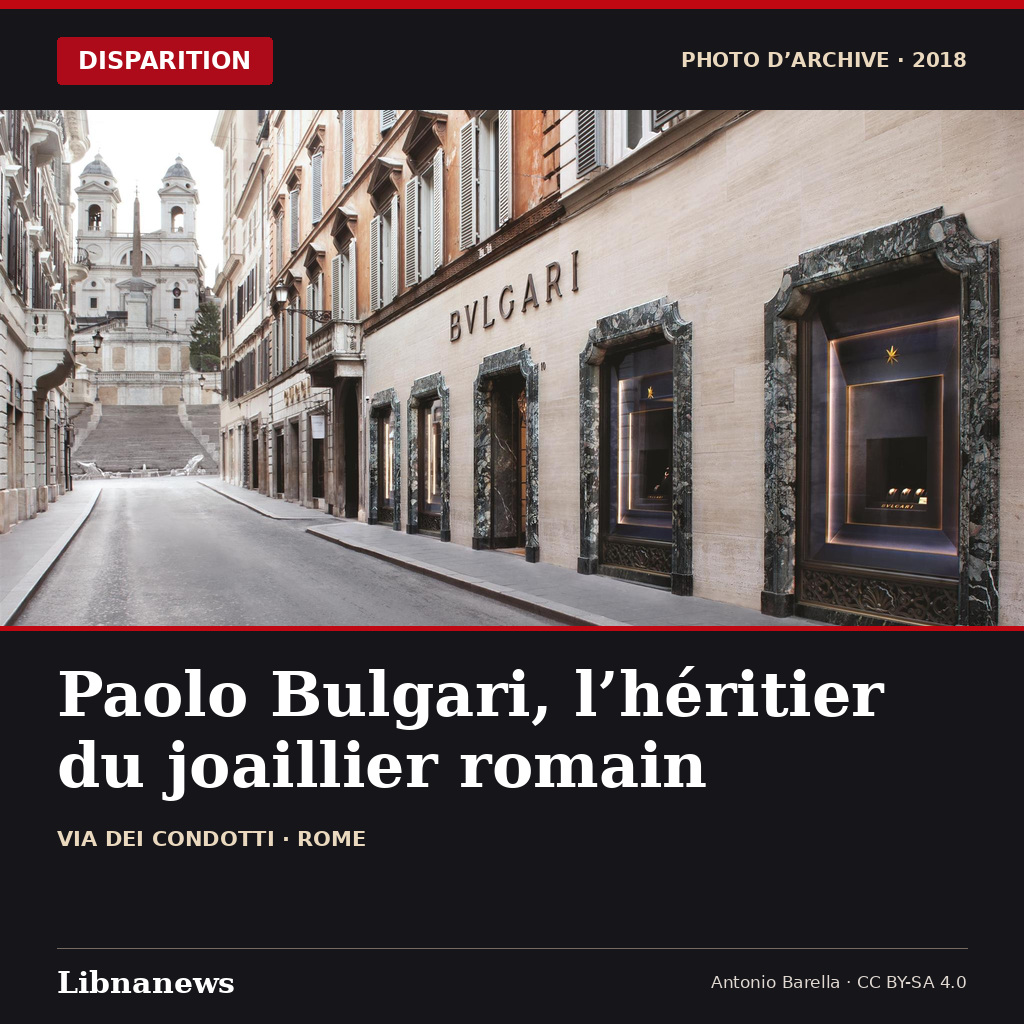
When he joined the company in 1960, Paolo Bulgari worked alongside his father Giorgio and specialized in precious stones. The house doesn’t leave anything. Founded in Rome in 1884 by her grandfather Sotirio, she moved from silver to platinum and diamond jewelry, then to yellow gold and coloured stones. The Via Condotti boutique, frequented during the Dolce Vita era by actors and actresses, has already given the house an international clientele.
Colour becomes one of its distinctive signs. The workshop combines stones that the jewellery of the era brings together less willingly, and sizes certain cabochon gems, with a curved surface rather than a succession of facets. A 1969 necklace kept in the archives of the house brings together an emerald of 44.60 carats, rubies and diamonds. Its octagonal pendant detachs to wear in a brooch. This piece illustrates the work of the workshops of this generation; It cannot be attributed to Paolo Bulgari alone.
The house opened shops elsewhere in Europe and the United States in the early 1970s. Paolo took the chair in 1984. Together with his brother Nicola and his nephew Francesco Trapani, he was involved in the development of a company that no longer sold only jewellery. When LVMH launched the rapprochement in 2011, Bulgari is already present in watchmaking, perfumes and accessories. The place of the watches in the company owes in particular to models where the design of the bracelet or case counts as much as the dial.
In 2011, the family gave control but remained in the presidency
The rapprochement with LVMH takes place in two stages. The family brings to the French group its controlling interest in the Italian company, then listed in Milan. It receives LVMH shares in exchange. The group then launches an offer at EUR 12.25 per share to acquire the securities still held by the minorities. At the closing of the offer in September 2011, LVMH announced that it would hold 98.09 per cent of the capital once the acquisitions were completed.
The shareholder change does not result in the immediate departure of family leaders. The agreement provides for Paolo Bulgari to remain Chairman of the Board of Directors of Bulgari and for Nicola to remain Vice-Chairman. Francesco Trapani is the head of LVMH’s watch and jewellery activities. This distribution makes it possible to distinguish what the family transmits in 2011, the control of capital, and the functions it continues to perform in the house.
In East Rome, support for schools
In a text dedicated to his foundation, Paolo Bulgari went back to a detail that the italianized name of the house can make forget. His grandfather had left a village in Epirus where he worked money. He had first established himself in Naples, before opening in Rome a shop of Via Sistina. The jeweler retached to this family history his interest in the access of young people to education.
Founded in 2019, its foundation has worked with schools and associations in Tor Bella Monaca, east of Rome. It supported the renovation of public spaces and projects against early school leaving. Among them, the Tornasole programme brought together 14 schools in three districts of the capital. The family fixed the funeral on Monday, November 23, at 11 a.m., at the Basilica of St. Croix de Jerusalem, in Rome.





Comments