

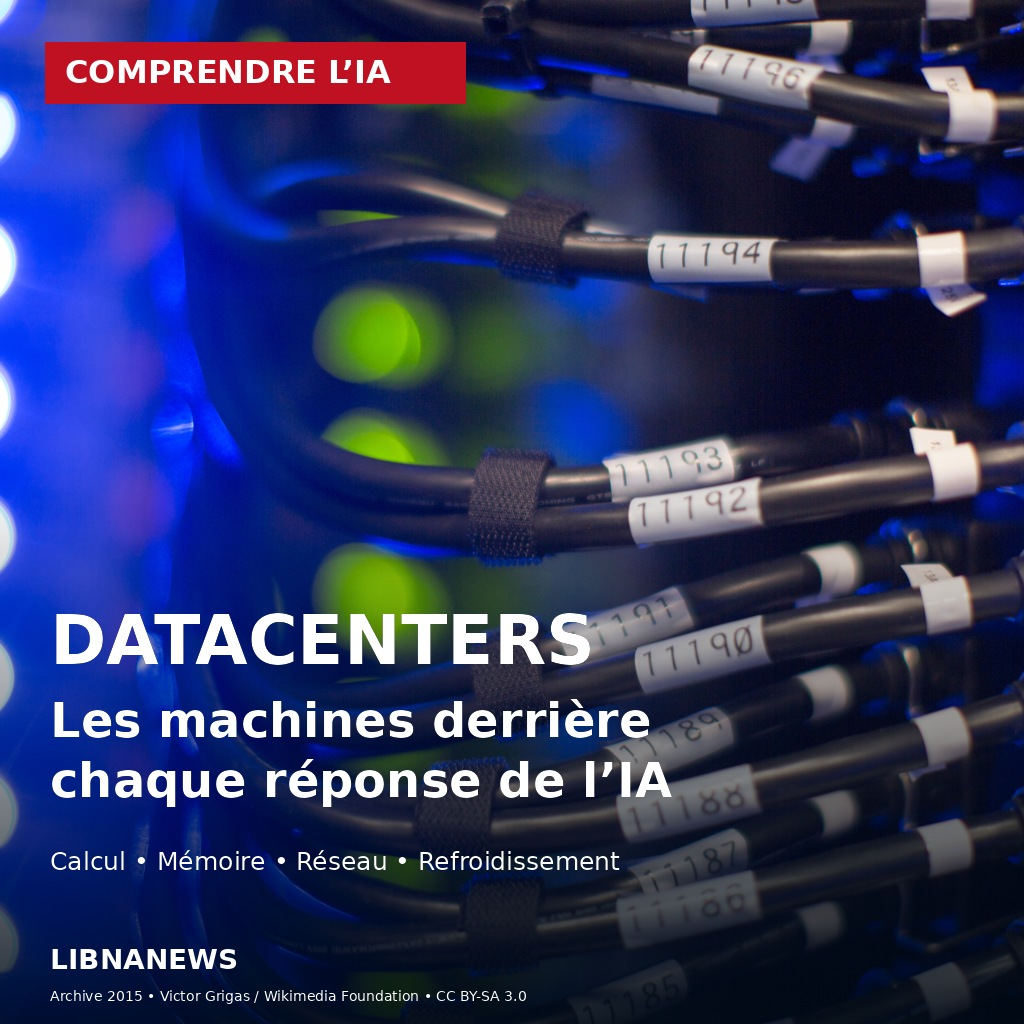
A data centre is a building equipped to operate computers permanently. Artificial intelligence mobilizes processors, memory and fast networks, both to learn and to respond to users. Behind a conversation on a phone, we need to power these machines, move data and evacuate heat. This is what really happens between a question and its answer.
When a user asks an AI to summarize a document, his/her phone can primarily serve as a screen and access point. In a remote hosted service, the request joins servers. They execute the model, then return the result. These servers are located in one or more data centres, generally referred to as « datacenter ».
The building counts as much as the computers it houses. A powerful chip becomes unusable if it lacks power, overheats or waits for information on a saturated network. The actual capacity of a datacenter therefore depends on the whole chain. Accumulating expensive accelerators is not enough to produce fast and reliable service.
A data center brings together calculation, storage and network
Inside, servers often take the form of enclosures stacked in cabinets called bays, or racks. Each machine combines processors, memory and network interfaces. Some run applications, others manage databases or keep files. Storage equipment keeps documents, images, software and backups.
Switches and routers circulate information between these machines and outwards. Optical fibers connect the centre to operator networks. In an online commerce application, several servers can intervene to display a catalogue, identify the client and register an order. The data center existed long before the conversational assistants.
A centre may belong to a company that uses it for its own needs. In co-location, a provider provides space, power, cooling and connectivity; the customer installs his equipment there. With the cloud, user rents computer resources or a service, without choosing each machine. The « cloud » is therefore based on physical facilities, operated and maintained somewhere.
Why IIA uses GPUs
The central processor, or CPU, remains necessary to drive programs and many general operations. But the neural networks make massive calculations on number tables. GPUs, originally developed for graphics, can perform a large number of operations in parallel. They are particularly suitable for these repetitive treatments. Other specialized accelerators, such as Google’s TPUs, also perform this function.
This specialisation changes the layout of the rooms. Nvidia describes, for example, its GB200 NVL72 system as a bay of 72 GPU Blackwell and 36 CPU Grace. The components communicate through a rapid interconnection, and the assembly uses liquid cooling. This product illustrates the level of integration achieved by some of the AI equipment. It does not represent all data centers, many of which still host traditional servers.
Memory is another constraint. The parameters of the model, these numbers adjusted during learning, must be available for calculation. Intermediate results must also be maintained. A model can exceed the memory capacity of a single accelerator: the work is then distributed over several chips. The flow of trade becomes as important as the power of each.
Training a model: working machines together
Training builds model capabilities from data. For a language model, a classic task is to predict the continuation of a text. The system produces an estimate, measures its error, and then adjusts its parameters. He repeats this process on many examples. Learning therefore involves calculations, but also reading and preparing data.
To speed up the work, several machines can process different portions of a dataset. They must then share the information needed to update the model. Another method directly distributes a too large model between several accelerators. These approaches can be combined. Distributed computing tools, including PyTorch, organize this cooperation and synchronization of results.
The internal network is therefore not only used to receive questions from the public. It allows machines to build the model together. If they spend too much time waiting for their neighbors, some of the equipment remains underutilized. Storage must also keep pace: GPUs without data do no more work because they are more recent.
The operator regularly maintains intermediate states of training. These backups allow you to resume after a breakdown without repeating the entire calculation. It must also check the quality of the model: a larger infrastructure increases the means available, but does not guarantee good data or fair answers.
Inference, the work done at each use
Once trained, the model can be used: this phase is called inference. Recognizing an object on an image, transcribing a sentence or writing a response are examples of inference. The ordinary use of a model does not automatically change its parameters. A possible future exploitation of exchanges for a new training is a separate process and rules of service.
For a text assistant, the request is converted into units called tokens. A token can correspond to a word, a word fragment or a sign. The model processes the context and gradually calculates the response. In self-regressive language models, the tokens already produced are used to determine the following. A long answer therefore requires more steps than a short answer, all other things being equal.
Software keeps some intermediate representations in a cache to avoid repeating the same calculations. This speed gain uses memory. As the context and number of simultaneous conversations increase, this resource counts. Operators also pool requests to better occupy accelerators, while limiting the expectations of each user.
Training is an operation focused on building a model. Inference is then repeated for each use. An individual request mobilizes much less calculation than full training, but millions of requests are a permanent activity. A widely used service must have capacity for peaks, not just for a daily average.
An answer is not necessarily an Internet search
A template can generate text from its parameters and the context provided, without consulting the Web. When an assistant searches for recent information, other components are used: search engine, documentary databases, recovery tools and verification programs. The documents obtained are forwarded to the model in its context. This mechanism does not mean that the whole system is immediately re-trained.
The path of an application can thus combine several steps: check access rights, find a document, run the model and save the result. These operations do not necessarily take place on the same machine or in the same building. A failure can affect one of these steps without all servers being stopped.
There is also a local AI, executed on a computer, telephone or industrial equipment. It can work without sending each data to a remote centre, depending on the application. The size of the model, the memory available and the response time sought determine the choice. Large data centers are therefore not indispensable for all uses of AI, but they allow for the sharing of considerable power.
Electricity becomes an operating condition
The equipment receives power through transformers, electrical panels and distribution systems. Inverters ensure continuity during certain disturbances. Emergency devices take over according to the architecture of the site. Cooling must also remain operational: keeping servers powered without removing their heat is not enough.
In its 2026 report, the International Energy Agency estimates the global electricity consumption of data centres in 2025 at 485 terawatt hours. It projects about 950 terawatt hours in 2030, around 3% of global electricity demand. The second figure is a projection, not an already observed consumption. The first covers all data centres, not only AI.
It is also necessary to distinguish power and energy. A project announced at 100 megawatts describes a power capacity or need, the perimeter of which must be specified. For calculation purposes, a constant load of 100 megawatts for 24 hours would consume 2,400 megawatt hours. This does not prove that an advertised site at this size already works, nor does it use all its capacity permanently.
Cool chips without confusing circuit and water consumption
Most of the electricity consumed by computer equipment ends in heat. Facilities must transfer it to the outside. In an air system, fans circulate air around the servers. The layout separates cold and hot flows to avoid unnecessary cooling of a mixture of the two.
With very dense chips, a liquid can capture heat near components through cooling plates. This heat then joins exchangers and the building system. « liquid cooling » does not mean that water is systematically released after each passage. The internal circuit can operate in a closed loop, while the external device uses evaporation or not.
Evaporative towers consume water to dissipate heat. Other systems focus on external air, climate and equipment constraints. To compare two projects, it is therefore necessary to examine their actual water consumption, their source of supply and the season. The only number of GPUs does not calculate this impact.
What the EU measures, and what it leaves behind
A common indicator, the EUP, reports the total energy consumed by the centre to that of its IT equipment. A PUE of 1.2 means that, for every 100 energy units used by these equipment, the site consumes a total of 120. The 20 additional units include cooling and electrical losses. This is an example of calculation, not a universal average.
The EUP measures the effectiveness of the support infrastructure. It does not say whether servers perform useful work, whether the model is efficient or whether electricity is low carbon. An effective centre can consume more in total if it significantly increases its activity. To judge an AI service, you must also look at the work produced, the material used and the source of the current.
Cost depends on use, not just the building
The owner finances land, building, connections, electrical equipment and machinery. To the operation add energy, network, maintenance and teams. Specialized equipment represents capital capital and must be used sufficiently to make the service economically viable. The speed of execution does not solve this problem alone.
For the customer, the invoice may cover a rental period of machines, a storage volume or the use of an API. In the latter case, a supplier may charge processed tokens and products. This commercial tariff does not directly give the electricity consumption of the demand. The chosen model, the length of the context, the tools requested and the additional calculations vary the actual work.
This increases the need for calculation, but mainly requires operators to coordinate several resources. A new room does not enter service simply because its servers have been delivered. The electrical connection, network, cooling and operating tests must be ready at the same time.





Comments