

The value of the Bank of Lebanon’s gold reserves may decline without the sale of metal. It depends on the price at which the gold is valued, not just the amount held. This distinction is essential for reading movements in the central bank balance sheet, while valuation estimates vary with markets.
By mid-October 2026, the available data were about $38.36 billion, compared to about $40.37 billion at the end of 2025. This difference describes a value variation between two dates. It does not show that ingots have left the reserves.
Gold reserves: quantity and valuation are distinct
The quantity held is expressed in physical units, in particular tonnes or ounces. The valuation translates this quantity into currency at the rate taken on the date of calculation. Both information answer different questions.
When the price drops, the monetary value of the same stock decreases. When the price rises, it increases. In order to determine whether the quantity has changed, physical data and transactions must be consulted, not just a balance sheet line expressed in dollars or books.
The Bank of Lebanon has already described this mechanism in its 2025 economic report. The increase in the value of its gold reserves was linked to the appreciation of international prices. The reasoning also works in the other direction: a fall in prices can reduce value without involving a sale.
A loss of value is not a cash outflow
An accounting revaluation and money movement are not interchangeable. A decrease in valuation reduces the displayed value of assets. It does not alone mean that the central bank paid this difference to a third party.
This nuance does not make the variation insignificant. The amount of assets changes and may change the reading of the balance sheet. It simply prevents the transformation of a market change into a financial transaction that the data do not prove.
Conversely, an increase in gold does not automatically constitute a recipe available to reimburse depositors or finance an expense. A distinction must be made between a valued asset, its possible mobilisation and usable liquidity.
Do not mix gold with foreign exchange reserves
Gold reserves and foreign reserve assets are separate items. Adding them can provide a total of assets, but does not give a homogeneous amount of cash immediately available. Their nature and variations differ.
Similarly, comparing a gold valuation with an amount of bank deposits is not sufficient to establish a repayment capacity. Such an analysis would require consideration of other assets, liabilities, applicable constraints and actual decisions.
The evolution of the metal price does not therefore replace detailed information on the financial situation of the central bank. It explains part of the change in value without resolving liquidity or loss allocation issues.
Date and method must remain visible
An estimate calculated from a market price and a balance sheet at a given date are not necessarily the same. Comparing them requires knowing the price chosen, the unit of measure and the conversion rate.
The $38.36 billion benchmark is mid-October 2026. It should not be presented as a value at the end of October. Any subsequent comparison should retain the same distinction between balance sheet date and market prices used.
A possible sale would require information on the quantity held or on an identified transaction. A decrease expressed in dollars, even large, does not constitute this evidence.
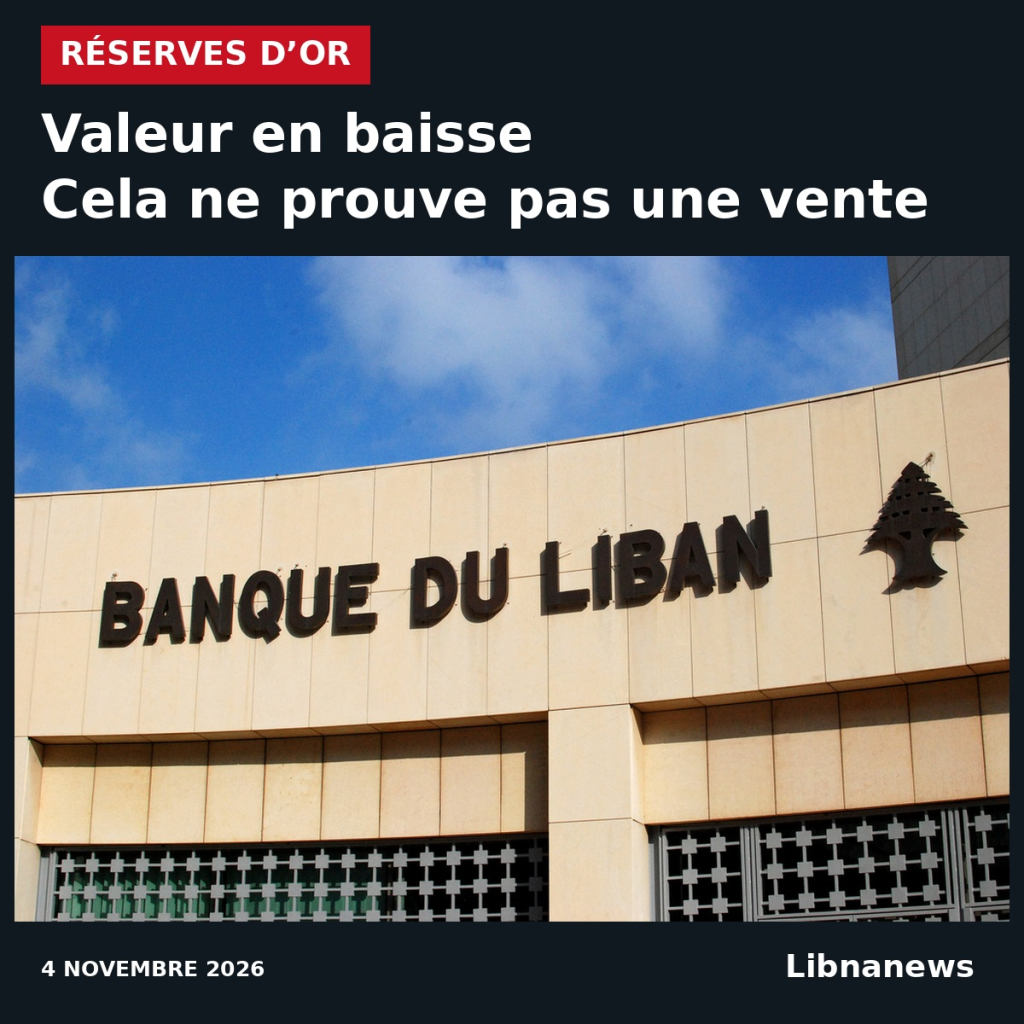
Ensign of the Bank of Lebanon, photographed on 5 June 2011. Institutional archive: it does not show gold reserves or a metal operation. Whole photo preserved; classic editorial dressing. © Karan Jain / Wikimedia Commons, CC BY-SA 2.0.





Comments