






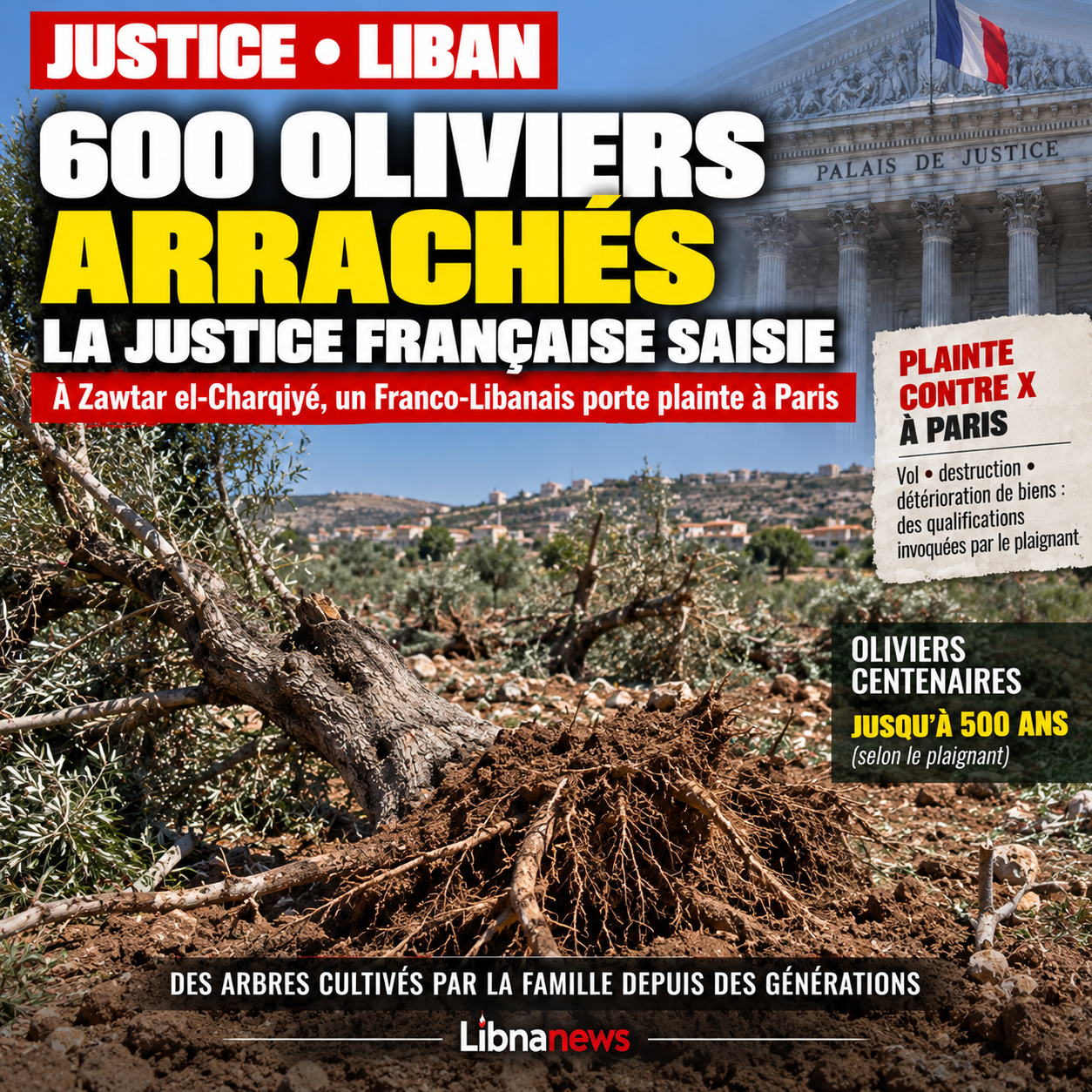
A French entrepreneur born in Lebanon filed a complaint in Paris against X for acts which, according to him, could constitute war crimes or crimes. He accuses the Israeli army of tearing up about600 centenary olive treesbelonging to his family in Zawtar al-Sharqiyah, in southern Lebanon. Some trees would have reached 500 years. The complaint concerns theft, destruction and damage of property. It intervenes at a time when several legal proceedings have been initiated in France by Franco-Lebanese regarding Israeli military operations in Lebanon.
A complaint in Paris after the grubbing up of 600 olive trees
The complainant, 37 years old and an entrepreneur in the digital sector, is French and born in Lebanon. His family owns agricultural land inZawtar al-Sharqiyah, village of the south of the country.
According to the civil suit filed in Paris and consulted by a press agency, approximately 600 olive trees belonging to his family were torn off. The trees were reportedly removed with their roots.
The complainant states that some were about five centuries old. He also explained that the land had been cultivated by his family for some 250 years.
The proceedings were initiated against X. It deals with facts qualified in the complaint of theft, destruction and damage of property that could constitute war crimes or offences.
At this stage, these qualifications constitute the legal arguments put forward by the complainant and his lawyers. It is for the French courts to examine their admissibility, establish the facts and, if necessary, identify any responsible persons.
Complainant suspects tree transfer to Israel
The contractor claims that the olive trees were uprooted in their entirety and suspected that they could have been transported to Israel.
However, there was no independent evidence made public on Wednesday 23 September to establish their destination after their grubbing-up. This is therefore one of the allegations that will need to be verified in the context of possible investigations.
The complaint also states that its author is neither a member nor a sympathizer of Hezbollah.
His lawyers argue that there is no evidence to establish that the family home or agricultural fields concerned were being used by Hezbollah for military purposes.
This issue could be central to the legal review of the case. International humanitarian law protects civilian property, while providing special rules when a property becomes a military objective or when its destruction meets a imperative military necessity.
The characterization of war crimes thus depends on the precise circumstances in which the destruction was carried out, its purpose and the information available to the forces involved.
A family home also destroyed
The complaint does not only concern olive trees.
The Frenchman claims that his family home was completely destroyed during an Israeli air strike a few hours before the announcement of a ceasefire in southern Lebanon in April 2026.
According to his account, the Israeli army then took control of the area a few weeks later. The grubbing-up of olive trees was said to have taken place after the signing at the end of June of a framework agreement between Lebanon and Israel.
The exact chronology of these events is therefore another element that the procedure will have to establish.
For the complainant, the loss of trees represents destruction that exceeds the immediate value of the harvest. According to him, the olive trees concerned had been part of the family’s agricultural heritage for several generations.
His lawyers, Vincent Brengarth, William Bourdon and Nicolas Busin, put the case in the wider context of the destruction in southern Lebanon.
They ask the French courts to identify those who may be responsible for the alleged acts and, if the evidence so permits, to prosecute.
Agricultural destruction already documented in Lebanon
Charges concerning Zawtar al-Sharqiyah land have been brought after several investigations into the destruction of buildings and agricultural surfaces in southern Lebanon since the outbreak of clashes between Israel and Hizbullah in October 2023.
In an investigation published in August 2025, Amnesty International analysed the destruction in 26 municipalities in southern Lebanon between October 2024 and January 2025.
The organization had identifiedmore than 10,000 structures heavily damaged or destroyedduring this period. His investigation included satellite images, videos, photographs and local accounts.
Documented destruction involved housing but also roads, public spaces, religious buildings and agricultural land.
Amnesty had considered that certain destructions carried out while Israeli forces controlled the sectors concerned and in the apparent absence of imperative military necessity should be investigated to determine whether they constituted war crimes.
The Israeli army, for its part, supported, in connection with some documented operations in southern Lebanon, that civilian buildings had been used by Hezbollah, sheltered weapons or were above underground infrastructure.
These general elements do not in themselves make it possible to determine the particular circumstances of the grubbing up of the 600 olive trees denounced in the new complaint.
Olive groves hard hit since 2023
Agricultural land has been an important part of the damage in southern Lebanon since October 2023.
Fires, bombardments, earthworks and destruction have affected farms and orchards. Olive groves occupy a special place in this region, both as a source of income and as perennial crops that require many years before they reach full production.
International assessments had already found significant damage in the agricultural areas of the South and Nabatiyeh.
Amnesty International also documented the destruction of olive trees and other farmland during the Israeli land operations of 2024 and 2025. In some border villages, the organization has identified areas of razed orchards along with buildings.
Contacted in August on environmental destruction in Lebanon, the Israeli army reported that it was aware of the potential environmental consequences of its operations and that it was taking precautions to reduce damage to civilians and the environment.
She was again asked on Wednesday about the complaint concerning Zawtar al-Sharqiyah.
Several Franco-Lebanese complaints before the French courts
The proceedings concerning the 600 olive trees are not the first in France concerning Israeli military operations in Lebanon.
April 2, 2026, Franco-Lebanese artist and filmmakerAli Cherrifiled a civil suit against the crimes against humanity cluster of the Paris court.
This procedure concerns an Israeli strike against a residential building in Beirut on26 november 2024a few hours before the entry into force of the ceasefire between Israel and Hezbollah.
Seven civilians had been killed. Among them were Ali Cherri’s parents, Mahmoud Naim Cherri and Nadira Hayek.
Ali Cherri’s complaint relates to the bombing of civilian property which, according to her authors, could constitute a war crime. Another case was initiated in July by a Franco-Lebanese man who lost his mother, sister and two nephews in Israeli strikes.
These files present separate facts and must be examined separately by the French courts. However, they have one thing in common: the French nationality of the complainants allows the French courts to refer certain offences under international criminal law.
In the Zawtar al-Sharqiyah case, investigations will now have to determine the circumstances under which the olive trees were ripped out, identify any units involved and verify the allegation that the trees were then taken out of Lebanon.