





An appointment announced for October, without date or convocation
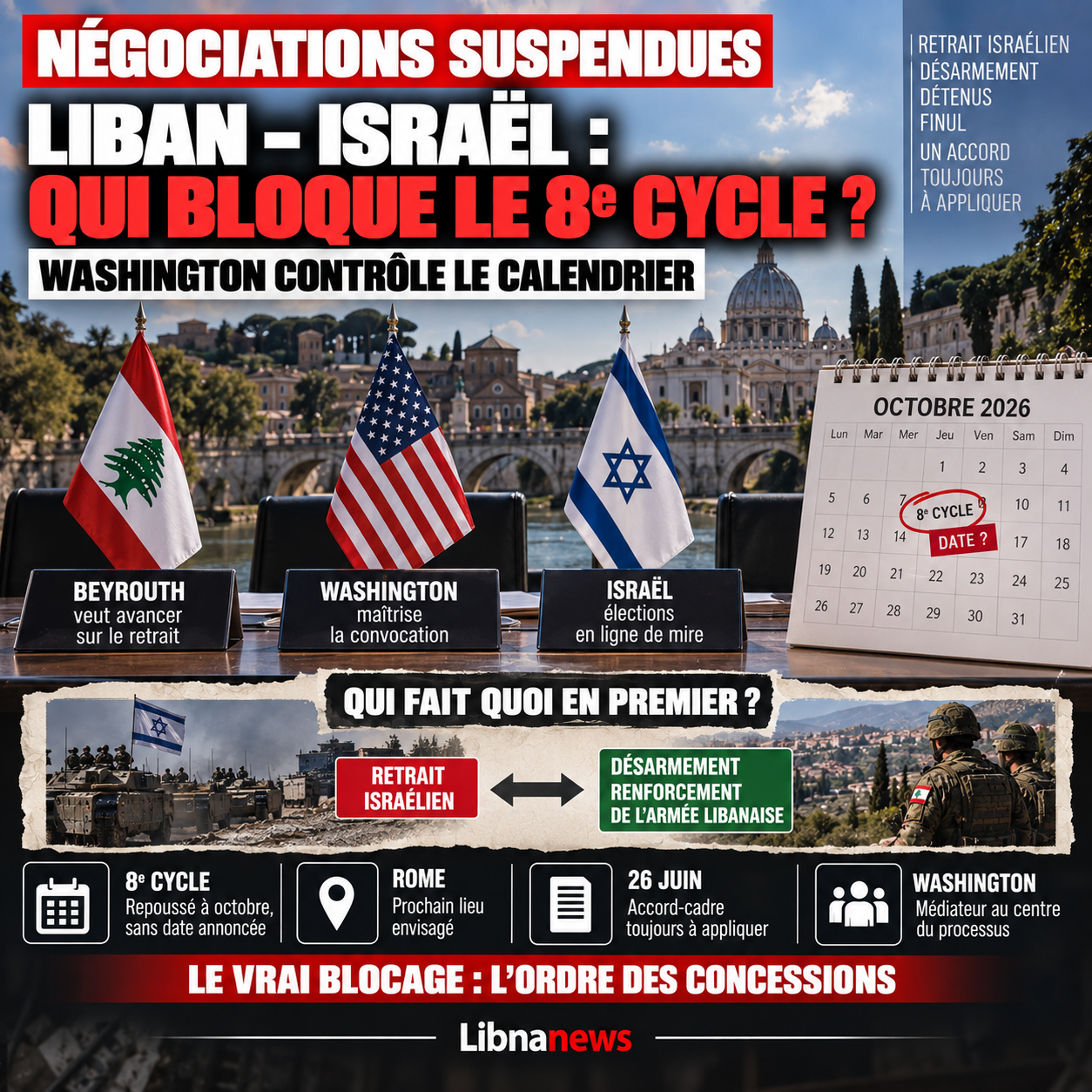
The eighth round of direct negotiations between Lebanon and Israel should be the next step in the open process under United States mediation. As of 23 September 2026, its principle appears to be acquired. His organization is not. Beirut did not receive any final date or official convocation from Washington. More significant, diplomatic information indicates that this uncertainty could be less a technical problem than the Israeli political timetable.
The next round should be held in Rome, which would host the negotiators for the third time. But the date remains in the hands of the United States. A Lebanese ministerial source hopes that the meeting will take place before the Israeli elections on 27 October. Arab and foreign diplomats accredited to Lebanon, however, put forward a different hypothesis: Israeli Prime Minister Benjamin Netanyahu would seek to postpone the substantial resumption of negotiations after the election.
This divergence changes the reading of the delay. It is no longer just a question of when the negotiators will meet. The question is whether Israel still wants to negotiate before its elections or prefers to retain the current military situation.
The distinction is major for Lebanon. Each additional week without diplomatic advance leaves open the questions of Israeli withdrawal, military positions in the South, detainees, the deployment of the army and the conditions imposed on the implementation of the framework agreement of 26 June.
The eighth cycle thus arrives at a paradoxical moment. Both sides already have a negotiated framework. Yet disagreements over its application become more important as military realities evolve.
Rome for the third time, but Washington retains control of the calendar
The choice of Rome is already identified in diplomatic information. The Italian capital would host this process for the third time. However, the final decision on the date is the responsibility of the American Ombudsman.
This detail measures the weight taken by Washington.
The United States is not merely facilitating discussions. They practically control their calendar. Lebanon can request a quick meeting. Israel can try to delay it. But it is the American mediator who must finally summon the parties.
This situation gives particular importance to the displacement of Nawaf Salam to the United States after the New York meetings. The discussions with the US administration are therefore not just about political support for Lebanon. They can determine whether the eighth cycle will take place before or after the Israeli elections.
Beirut also hopes that the exchanges between Donald Trump and Emmanuel Macron in New York will promote a revival. A high-ranking French diplomat described their meeting as positive. The Lebanese authorities want this improvement to be reflected in the negotiations.
But the problem remains: Is Washington willing to press Netanyahu for a meeting before October 27th?
In the absence of such a decision, the Israeli electoral calendar may become de facto the diplomatic calendar of the South Lebanon.
Why should Netanyahu wait for October 27
The hypothesis of a postponement must be seen in the Israeli context.
Political sources consider that the internal calculations now weigh on Netanyahu’s position regarding Lebanon’s withdrawal and the concessions that can be made in a negotiation.
An agreement involving withdrawal of military positions before the elections could be politically sensitive. Conversely, maintaining a firm military posture would allow the Israeli government not to appear as making concessions during the campaign.
The available information indicates that Israeli officials are now linking Lebanon’s withdrawal to Hezbollah disarmament throughout Lebanon. This condition far exceeds the only area south of Litani.
This is precisely where the file becomes more complicated.
The Lebanese government claims to want to place weapons under the exclusive authority of the State. Nawaf Salam said in New York that the decision on war and peace must belong to the state and that there could not exist « two armies » or « two decisions ».
But turning this political objective into a precondition for an Israeli withdrawal is to reverse the timetable.
Beirut seeks withdrawal to enable the State to regain full control of the territory. Israel can, on the contrary, demand that disarmament be largely achieved before withdrawing.
Between the two positions, the eighth cycle must precisely determine what comes first.
Article 5 of the Agreement of 26 June returns to the centre of the debate
The heart of the dispute lies in part in the framework agreement signed on 26 June 2026.
Joseph Aoun then highlighted an important achievement: recognition of the absence of Israeli territorial ambitions in Lebanon. But article 5 also contains a much more binding provision for Beirut.
According to the text reproduced in the sources, Israel justifies its military operations in Lebanon by the attacks, threat and hostile intentions of non-State armed groups, in particular Hezbollah. The same article links the end of this threat to the disarmament and dismantling of these groups throughout Lebanese territory and to additional security arrangements to be agreed between the two countries.
This formulation opens two readings.
For Lebanon, the agreement must lead to Israeli withdrawal and the restoration of State sovereignty. The strengthening of the army and the state monopoly of arms are part of this process.
However, Israel may use the same text to consider that its withdrawal remains conditional upon the prior disappearance of the threat it attributes to Hezbollah.
The disagreement therefore does not concern only the application of the Agreement. It concerns his execution order.
Who must act first?
This is probably one of the most important issues that the eighth cycle will have to address.
The risk of a new condition: disarming before recovering the territory
According to information gathered from political and military circles, a scenario of particular concern is Beirut: Israel may seek to gradually return certain areas only after a series of conditions have been executed by the Lebanese army.
Such a logic would transform withdrawal into a conditional process.
Instead of a withdrawal followed by the deployment of the army, each stage could depend on the required pre-emptive measures from Lebanon.
This question is already perceptible around several sectors of the South. Israeli positions, security zones and new military installations create a situation in which the return of territory can be negotiated position by position.
The longer this situation lasts, the more difficult it becomes to reverse.
Lebanon therefore faces a very concrete timetable problem. A delayed negotiation of one month does not mean only another thirty days before a meeting. It means 30 days during which military positions remain in place and can be consolidated.
That is why Beirut wants a stronger US diplomatic intervention.
Ali Al-Taher, a military issue parallel to political negotiations
The situation on Ali Al-Taher hill illustrates this development.
Information from September 23 indicates that a separate military component is to be discussed in the United States. A Lebanese military delegation is to visit the headquarters of the United States Central Command in Tampa to meet Israeli representatives and the United States military team.
The situation in South Lebanon should be examined, with particular attention to Ali Al-Taher.
This meeting is important because it reveals the existence of two levels of negotiation.
The first is political and diplomatic. It includes direct cycles organized under American mediation, the eighth of which is expected in Rome.
The second is military. It deals with operational realities, positions, incidents and coordination mechanisms.
The existence of these two channels can facilitate the resolution of technical problems. It can also fragment negotiations.
A territorial issue can thus be discussed militarily in Tampa while the principles of withdrawal are negotiated politically in Rome.
Washington is in the centre of both circuits.
Prisoners should come back to the table
The seventh cycle had, among other things, made it possible to address the case of Lebanese detainees in Israel.
Beirut had issued a list. However, the available information indicates that it was incomplete. Since then, new releases have revealed that some detainees have not even been identified by Lebanese structures following the case file.
The eighth cycle should therefore return to this issue with a problem now clearly identified: Lebanon does not only call for the release of persons whose identity it knows. He must first get a complete list.
The number currently advanced reaches 39 identified Lebanese detainees, plus missing persons whose fate remains unknown.
Israel has not yet provided the necessary information to resolve this uncertainty. Access by the International Committee of the Red Cross would also remain insufficient.
The record of detainees may seem secondary to territorial and military issues. Yet it is one of the few areas where concrete action can be achieved without waiting for a comprehensive agreement.
Liberations in September show that a canal exists.
The eighth cycle could determine whether these actions remain ad hoc or whether they open up a genuine mechanism for settlement.
UNIFIL now adds additional deadline
The negotiating process is also caught up in the announced end of the UNIFIL mission.
Beirut seeks to maintain an international presence after the end of 2026. A six-month extension is discussed as a transitional solution, even if it is not yet officially agreed.
This issue is directly related to negotiations with Israel.
The future international arrangement will have to operate in an environment determined by the security agreement between the two countries. If Israeli positions remain within Lebanese territory, its mission will be different from that which might follow a withdrawal.
Similarly, if negotiations were not concluded before the end of the UNIFIL mandate, Lebanon could enter the transitional period without having settled the basic parameters of security in the South.
The two calendars therefore overlap.
October: Israeli elections and eighth cycle expected.
End 2026: UNIFIL deadline.
Between the two, the withdrawal, the deployment of the army, the security arrangements and the future international mechanism remain to be negotiated.
The time available is much less than it seems.
Can Washington really unlock the negotiation?
Lebanon relies on American intervention because it alone does not have a means of forcing Israel to resume discussions quickly or evacuate its positions.
However, this dependency is a weakness.
Washington is both the mediator, Israel’s main ally and the actor who decides the meeting schedule.
While the United States believes that a meeting before the Israeli elections is not timely, Beirut has little means to speed up the process.
The situation explains the Lebanese efforts in New York to increase the number of interlocutors: Antonio Guterres, Emmanuel Macron, Recep Tayyip Erdogan, King Abdullah II, Qatari officials and other partners.
But these contacts can create diplomatic pressure. They’re not replacing the American channel.
The test will therefore be simple: will Washington convene Rome before October 27th?
A pre-election call would mean that the Trump administration wants to preserve the dynamics of the negotiations despite Israeli political calculations.
A postponement after the elections would confirm, on the contrary, that the Israeli internal calendar took precedence.
Another US deadline complicates the equation
The calculations are not limited to Israel.
The United States is also moving towards its mid-term elections on 3 November. At the same time, Washington is engaged in a major confrontation with Iran.
This accumulation of deadlines may explain some of the American caution.
A Lebanese-Israeli negotiation is not taking place in a regional vacuum. Hezbollah is directly linked to the balance with Iran. Any decision concerning disarmament, security in the South or Israeli withdrawal interacts with the confrontation between Washington and Tehran.
Lebanese official sources also envisage that certain decisions concerning the future international arrangement in the South will be taken only after the American and Israeli elections and after a clarification of the trajectory of the conflict with Iran.
This calendar could lead to a paradoxical situation: everyone says they want to negotiate, but everyone is waiting for an outside event before making a decision.
The risk of negotiation emptied of its substance
The eighth cycle will be of interest only if it deals with points that remain blocked.
A mere meeting that would allow delegations to reaffirm their positions would not change the situation on the ground.
For Lebanon, several concrete results would be needed: a timetable for withdrawal, a mechanism for Israeli positions, progress on detainees, guarantees on the return of the inhabitants and clarification of the relationship between Israeli withdrawal and the State monopoly of weapons.
For Israel, priority appears to be on the disarmament of Hezbollah and security assurances beyond the South alone.
It is precisely this shift that explains the blockage.
Beirut wants to negotiate the end of the Israeli presence and restore its authority. Israel seeks to use its military presence as a lever to achieve much broader security transformations in Lebanon.
The eighth cycle must therefore not only bring two positions closer together. It must resolve a fundamental difference on the very nature of the negotiation.
Behind the absence of invitation, a battle over the order of concessions
The fact that Lebanon has not always received any specific date or American invitation then makes sense.
Taken in isolation, this could be a mere diplomatic delay.
Placed throughout the file, it becomes the symptom of a negotiation where each actor seeks to avoid giving up his main lever too soon.
Netanyahu would have little interest, before 27 October, in abandoning positions without obtaining any visible counterpart. Lebanon cannot accept the Israeli presence as the means to impose conditions on it indefinitely. Washington must choose how far he wants to push each of the two sides.
The real issue of the eighth cycle is therefore not its date.
It is important to know whether the United States is ready to transform the framework agreement of 26 June into aprecise execution sequence, with obligations and steps for both parties, or if they will leave a formula in which each one conditions his next movement to that of the other.
Without sequencing, the mechanism can turn in circles: Israel conditions its withdrawal on disarmament; Lebanon states that it needs withdrawal and stabilization in order to fully extend State authority; and Washington continues to negotiate between the two.
In this context, the absence of a summons for Rome is no longer a calendar detail. It reveals the central problem of the whole process:six months after the opening of negotiations, the parties have a framework, but still do not seem to have been agreed on the most basic issue of a security agreement — which does what, in what order, and in exchange for what.