

In its report to Parliament, the Department of Finance estimates the cumulative material damage of the two wars at $11 billion. The draft budget for 2027 has 628 868 billion pounds of revenue and as much expenditure, of which 9.3% is spent on investment.
The Lebanese Ministry of Finance forecasts a contraction of about 7 per cent of real gross domestic product in 2026, after an increase of about 4 per cent in 2025. This estimate is contained in the explanatory report on proposed budget 2027, which was launched on 25 November. The document does not constitute a new draft law: it sets out the assumptions adopted by the government for the text adopted by the Council of Ministers on 1 October and then forwarded to Parliament.
The World Bank forecasted a decline of 6.4 per cent in October in 2026. His scenario, like that of the ministry, reported a reversal after the rebound of 2025. The difference of about 0.6 points between the two forecasts does not measure a revision of the national accounts: these are estimates made at different dates. In particular, the Ministry cites the decline in tourism activity and consumption, as well as the increase in energy imports.
Two $11 billion estimates that don’t measure the same thing
The ratio is about $11 billion, the cumulative direct material damage of the two wars, equivalent to 29 per cent of GDP expected in 2026. This is an estimate of physical destruction. The report does not present this amount as an envelope to be included in the State budget over a year.
The $11 billion released by the World Bank in March 2025 covers another measure: the rehabilitation and reconstruction needs associated with the conflict between 8 October 2023 and 20 December 2024. For this area alone, the Bank estimated that $3 to $5 billion had to come from public financing. The ministerial estimate, which covers the cumulative damage of the two wars, therefore does not allow the World Bank to double its figure or deduct the cost of the second conflict.
The project reserves 9.3% of investment expenditure
The project has 628 868 billion Lebanese pounds in revenue and expenditure. Of the expenditure, $570,299 billion is planned for current expenditure, of which $15,432 billion is for debt servicing. Investments represent £58,569 billion, or 9.3% of the total. The Ministry states that it relies mainly on external funding to support this category of expenditure. The balance of the revenue and expenditure entered in the project does not therefore establish the amount mobilised for the projects or the timing of payments.
Planned revenues increase by 16.8 per cent compared to the amount set out in the 2026 Finance Act, but by 8.6 per cent compared to what the Ministry actually estimates to be able to collect in that year. Tax levies would account for 85.9 per cent of revenues in 2027. Domestic taxes on goods and services alone would reach £329,448 billion, or 52.4% of the total. These figures describe the expected revenue structure; They do not correspond to sums already received.
The appropriations are still under review
On 25 November, the Parliamentary Committee on Finance and Budget approved operating appropriations and left several posts in agriculture, youth and sports and displaced persons in suspense pending proof. It is scheduled to meet again on Thursday 26 November at 10.30 a.m. Beirut time. These decisions in committee are not valid for adoption by Parliament.
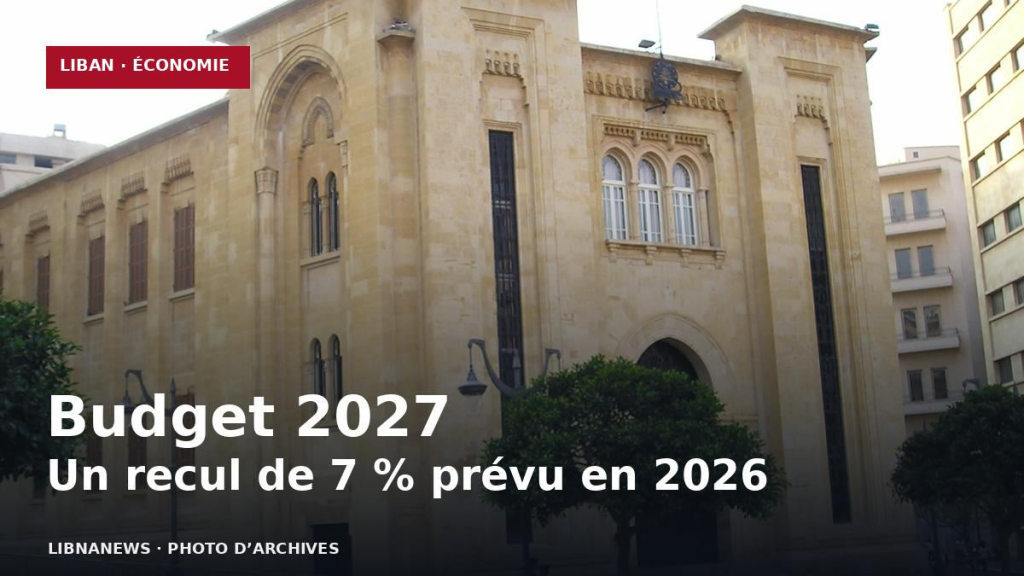
Photo archive: Lebanese Parliament, Beirut, 26 July 2005. Heretiq / Wikimedia Commons,CC BY-SA 2.5. Boxing and titration Libnanews under the same license.





Comments