

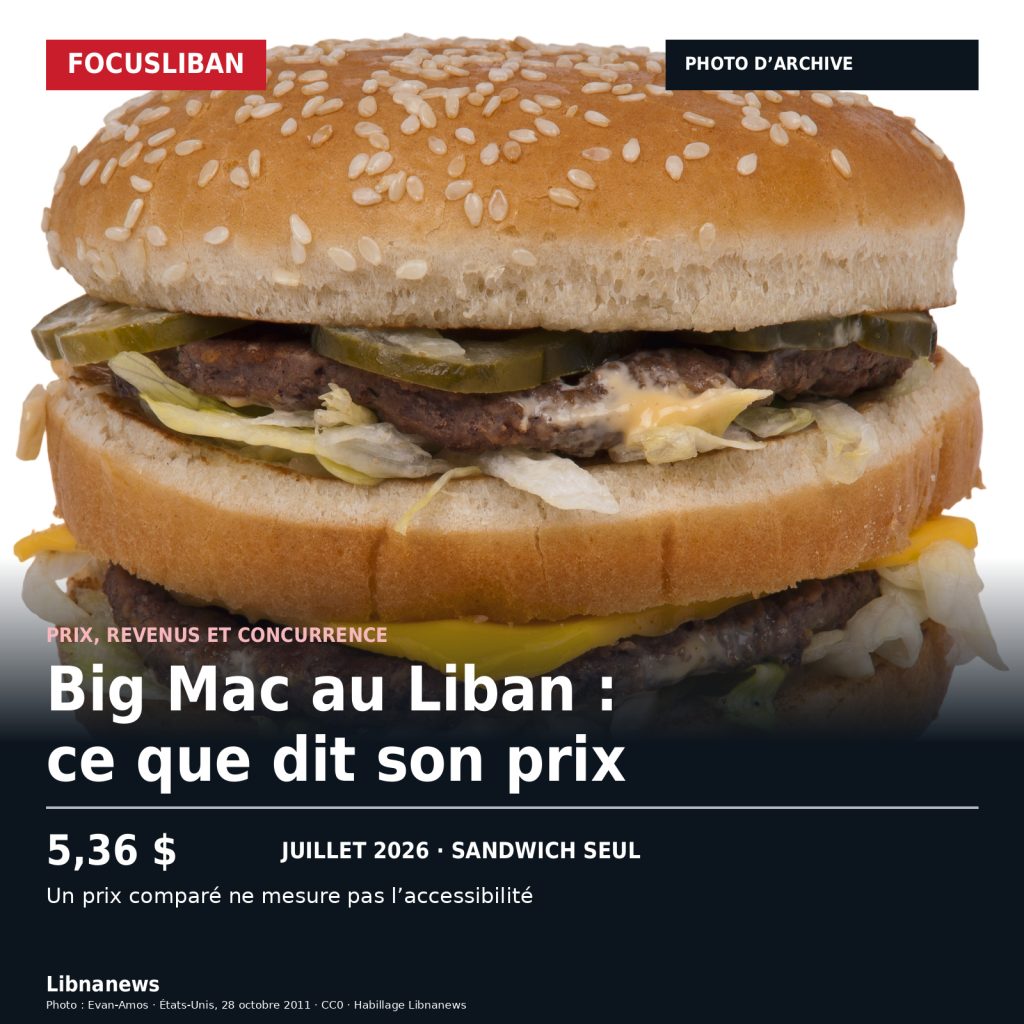
The price of the Big Mac in Lebanon exceeds that of several neighbours in the July 2026 data. It remains below the US level and the euro area average. This contrast raises a more useful question than a ranking: why can an internationally ordinary price weigh so heavily in a impoverished economy?
A burger doesn’t sum up an economy. However, it offers a concrete point of comparison, provided you compare the sandwich alone. Mixing a formula with drink and fries, a delivery rate and a counter price would produce a misleading demonstration.
Big Mac in Lebanon: a July 2026 comparison
The original series of the Big Mac Index holds 480,000 Lebanese pounds, or $5.36, as of 1 July 2026. Here are the values of the same edition, converted with its own exchange rates. These are not counter-checked rates on November 3.
| Market | Local sandwich price | United States dollar equivalent |
|---|---|---|
| Lebanon | LBP 480,000 | 5.36 |
| Jordan | 2.50 JOD | 3.53 |
| Egypt | 145 EGP | 2.87 |
| Saudi Arabia | 19 SAR | 5.06 |
| United Arab Emirates | 19 AED | 5.17 |
| United States | USD 6.22 | 6.22 |
| Euro area | EUR 6.19 | 7.08 |
Calculated before rounding, the differences place Lebanon about 52 per cent above Jordan and 87 per cent above Egypt. The supplement was 5.9% against Saudi Arabia and 3.6% against the Emirates. The Lebanese price remains 13.8% below the US price and 24.3% below the euro area average. The latter is not a French prize.
The real subject is disposable income
These figures therefore do not prove that Lebanon would be systematically more expensive than Europe. Nor do they make sandwiches affordable for Lebanese households. The price in dollars and the effort required of a consumer answer two different questions.
Accessibility depends on the income remaining after housing, energy, transport and essential expenses. Two people who pay the same amount can bear very different efforts. A serious comparison must approximate the price of comparable disposable income, not juxtapose average wages calculated using incompatible methods.
A survey by the Lebanese Center for Policy Studies of 2,400 people in January 2026 illustrates this constraint. In the July analysis, 38.2% of respondents reported reducing their essential expenditures, including food and clothing. This result does not measure the consumption of burgers. It sheds light on the social context in which a restaurant award is judged.
A fall in inflation does not reduce the addition
The confusion between inflation and price levels is fuelling false promises. If a price increases less quickly, it continues to increase. Disinflation does not automatically render households the purchasing power lost during previous increases.
Nor does the change to dollar prices address this issue. It makes comparison more readable and reduces conversion uncertainty. It does not restore revenue or competition. A stable display currency is not a reasonable price certificate.
Real costs must not become an alibi
A meal sold in a restaurant incorporates ingredients, but also work, a room, energy, equipment and services. Transportation, retention and losses may affect the invoice. Supply conditions and volumes purchased also count. Differences between countries are therefore not reduced to the price of meat.
However, there is a lack of accounts to allocate these items for the Lebanese sandwich. Without them, it is impossible to quantify the operator’s margin or the exact weight of each expenditure. To claim that all the difference with Jordan is a profit would be false. To argue that local costs necessarily explain the gap would also be so.
Economic criticism must require controllable elements: cost trends, purchase prices, operating expenses and conditions of sale. The expression « the costs of Lebanon » does not replace an accounting breakdown. Consumers cannot verify a justification that remains comprehensive.
Competition deserves better than a slogan
The diagnosis goes beyond a sign. In its October 2025 analysis, the World Bank identifies limited competition, oligopolistic structures and margin policies as one of the drivers of long-term high Lebanese inflation. This macroeconomic finding does not establish any particular infringement in the restoration.
However, it raises a central question: can new entrants really challenge the prices of installed actors? Effective competition requires more than several fronts. There is a need to be able to access suppliers, finance a stock, rent a location and offer a viable alternative.
The debate on exclusive agencies must remain specific. A catering franchise is not, by definition, an exclusive import agency. The price of a burger is not enough to demonstrate an agreement between intermediaries. On the other hand, looking at barriers to entry and supply conditions is legitimate, sector by sector.
The defaulting financing also has an invoice
The previous Libnanews survey of six food products already examined exclusivity, banking costs and limitations of retail comparisons. It distinguished bank commissions from the broader cost of degraded commercial financing.
This distinction remains indispensable. When a company has to immobilize more funds to buy its goods, its cash requirement increases. This can reduce the entry of less capitalised competitors. The economic mechanism is plausible; its contribution to the Big Mac price is not measured here.
To move from an observation to a numerical explanation, a recent survey of the sandwich alone would now be required in identified restaurants. It should specify any taxes, promotions and charges, and then compare the same conditions of sale. July data provide a solid benchmark. They do not exempt traders from explaining their prices or the authorities from checking how competition actually works.
Cover: Big Mac purchased in the United States, October 28, 2011 archive. Photo:Evan-Amos / Wikimedia Commons,CC0 1.0. Boxing and graphic dressing Libnanews. Product illustration, not a sandwich sold in Lebanon in November 2026. The Lebanese price is from the July 2026 Big Mac Index.






Comments